Montegiorgio: The Marche Town Behind the Seven Countries Study
The Seven Countries Study once used a small clinic in Montegiorgio, a hill town in the Marche. A small metal plaque on the wall is nearly all that remains today. Il Resto del Carlino, the local paper, covered the story in 2024. Yet American store shelves tell a different tale. They stamp “Mediterranean diet” on cereal, olive oil, and diet books, yet few shoppers know where that science began. This is the story of who proved it, where, and how.
Here is the short version. Montegiorgio, a hill town in the Marche, was one of the first places studied in the Seven Countries Study. That project, launched in 1958, gave the world its first real proof of the Mediterranean diet. Alongside Crevalcore and a group of Rome rail workers, Montegiorgio stood in for Italy in that work. American scientist Ancel Keys and Italian nutritionist Flaminio Fidanza led it, comparing diet to heart disease across seven nations.
An American Problem Found Its Answer in Italy
The question began in Minnesota, not in Italy. In the 1950s, a research team at the University of Minnesota noticed something odd. In fact, many middle-aged American men were dying suddenly of heart attacks. These men were rich. They looked fit. Nothing in their charts hinted at a sudden collapse.
Ancel Keys ran that lab, and he suspected diet played a part. He had already tested the idea in small trial surveys across several countries. So by 1958, he was ready for something bigger: a full study of heart risk across different diets and cultures. That study needed real towns, real families, and real dinner tables. It soon found several of them in central Italy.
The Seven Countries Study, then, grew out of an American worry, not an Italian boast. That detail matters for any traveler who assumes the Mediterranean diet simply grew, on its own, out of sunshine and olive trees. Scientists had to prove it first, and the proof needed a test group far from home.
Italy’s Three Cohorts in the Seven Countries Study
By the end of enrollment, the study had signed up 12,763 men between the ages of 40 and 59. The team split them into sixteen groups, called cohorts, across seven nations. Those nations were the United States, Finland, the Netherlands, Italy, the former Yugoslavia, Greece, and Japan.
Italy also sent three of those sixteen groups. The team tracked rail workers in Rome, farmers in Crevalcore near Bologna, and the men of Montegiorgio in the Marche. Each group ate differently, and each group’s heart-disease rate told a different story.
Officials picked Montegiorgio for a clear reason, noted on the study’s own website. The town sits roughly thirty kilometers inland from the Adriatic Sea, up in the hills of central Italy. Still, scientists believed its people ate a more Mediterranean diet than the men of Crevalcore. Crevalcore sat on flat land, where diets leaned more on animal fat.
Why a Hill Town, Not a Coastal One
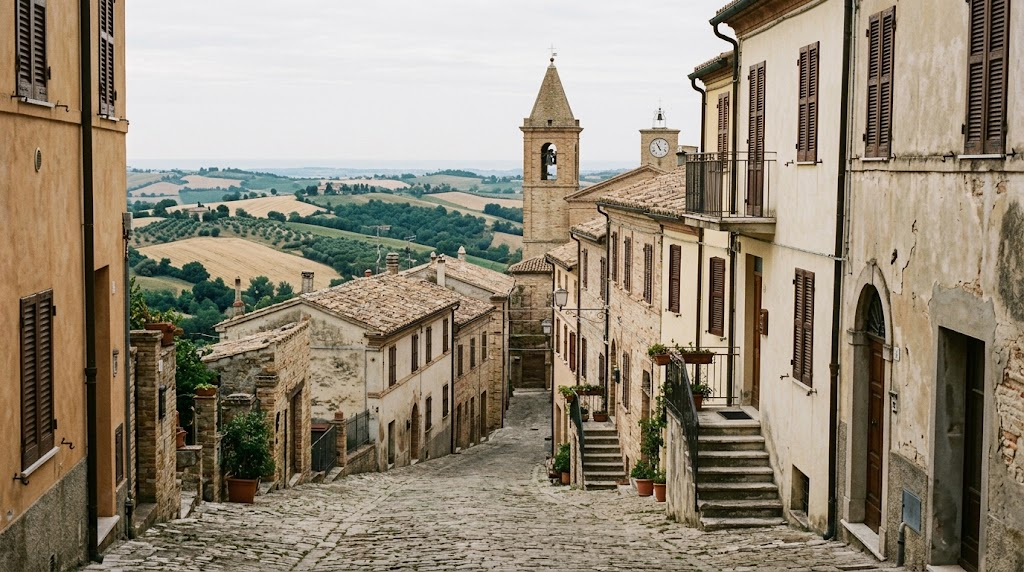
Most Americans assume the Mediterranean diet came from the coast, from fishing towns and sun-bleached beaches. I have worked on buildings across this part of the Marche for thirty years. The truth looks plainer than most travelers expect. Montegiorgio sits on a hilltop, among wheat fields and olive groves, with no view of the sea at all.
The study’s four Mediterranean groups were Crete, Corfu, a cluster of towns in Dalmatia, and Montegiorgio. None of them was a beach resort. All of them were farm towns, where families grew, raised, or caught most of what they ate. That pattern, more than any beach, was what a real Mediterranean diet looked like in the 1950s.
The Fidanza Family: A Small Cohort of Longevity in Itself
One name anchors this story more than any other: Flaminio Fidanza. First, he earned his medical degree in Naples in 1945. Later, he trained as a Rockefeller fellow in the same Minnesota lab where Keys worked. In 1965, he became a nutrition professor at the University of Perugia, and he held that post for the rest of his career.
Fidanza chose Montegiorgio as a research site. He also ran the study’s early pilot survey in Nicotera, Calabria, in the fall of 1957. He became the first Italian to lead the Seven Countries Study. That role put him at the center of Italy’s part in the project.
His family ties run to Magliano di Tenna, a village just outside Montegiorgio. According to Il Resto del Carlino and a Marche regional dossier, the Fidanza family came from Magliano. Flaminio lies buried there. Some academic sources, though, list Perugia as his birthplace instead. Both claims appear in print, and this article does not pick a winner between them.
What happened next inside that family is, to me, the real heart of the story. In the end, Flaminio died in 2012 at 93. His brother, Alberto Fidanza, also a nutrition scholar, died in December 2022, just short of turning 100. Their father, Enrico, a country doctor in Magliano, lived to 96. A family that helped define the Mediterranean diet turned out to be a small, living proof of it.
What the Study Looked Like From the Ground
Two sets of numbers describe this research, and they do not quite match. The Seven Countries Study officially enrolled men aged 40 to 59, starting in 1958. Then, in 1965, the team used the diet-history method to survey 1,139 men. Those men, aged 45 to 64, lived in the rural towns of Crevalcore and Montegiorgio.
A separate local account, from Il Resto del Carlino, tells the work a bit differently. From 1959 to 1991, that account says, a team gave heart exams to 719 men between 45 and 65. The team included Ancel Keys, heart doctor Paul Dudley White, and Flaminio Fidanza. Scientists tracked nineteen families, roughly eighty people in all, for months at a time, watching their work, their meals, and their daily routines.
These figures do not match the study’s official frame exactly. So this article treats them as two separate, honestly sourced accounts, not one blended number. Still, both versions agree on the texture of the work. Doctors checked real bodies, ate at real tables, and came back to Montegiorgio again and again across three decades. The town’s hospital, the Ospedale Diotallevi, served as a base for much of that work.
From a Local Plaque to a UNESCO Listing
The research did not stay locked away in old notebooks. In 2009, Montegiorgio hosted a conference at the Teatro Alaleona to mark the study’s fiftieth year. The next year, on November 16, 2010, the UNESCO committee met in Nairobi. There, it added the Mediterranean diet to its list of world traditions worth protecting. Italy, Greece, Morocco, and Spain shared that first honor. Cyprus, Croatia, and Portugal joined the list in 2013.
Montegiorgio kept building on that momentum. In 2012, local organizers founded the Laboratorio Piceno della Dieta Mediterranea, on Via Passari. Then, in 2018, the Marche council passed Regional Law No. 14, dated May 17. That law formally credits the local community’s role in finding and proving the Mediterranean diet. A later fix to the same law added the mayors of Magliano di Tenna and Montegiorgio to the council that oversees it.
None of this turned Montegiorgio into a major stop on the map. It simply gave a quiet farm town an official, written claim to a global idea.
What Montegiorgio and Magliano di Tenna Look Like Today
So what does a visitor actually find here? Not much built for tourists, and that is the honest answer. Both Montegiorgio and Magliano di Tenna are small Marche towns, each with just a few thousand people. Both sit among hills of wheat, sunflowers, and olive groves. Neither has a visitor center built around the Seven Countries Study. The plaque on the old clinic wall is a modest marker, not a museum.
What you will find is plain, small-town Italy, roughly thirty minutes inland from the beaches around Fermo. Expect narrow streets, a central piazza, a parish church, and shops that shut for a few hours at midday. I have driven through dozens of towns built on this same pattern for site visits over the years. Today, Montegiorgio fits that mold closely.
If you come, come for the story, not for a checklist of sights. Pair a stop here with a longer drive through the Marche’s hill towns and vineyards. Do not build a whole day around it alone. Local restaurants and rooms change often in towns this size. So this article will not name specific ones without a recent, firsthand check.
FAQ: Seven Countries Study and Montegiorgio, Answered
What is the Seven Countries Study? Ancel Keys, an American scientist, launched this research project in 1958. The study followed 12,763 men across sixteen groups in seven nations, comparing diet to heart disease risk over decades. It became the scientific base for what the world now calls the Mediterranean diet.
Why is Montegiorgio connected to the Mediterranean diet? Montegiorgio was one of three Italian groups in the Seven Countries Study, alongside Crevalcore and a group of Rome rail workers. Scientists chose the town because its people, hill farmers roughly thirty kilometers from the Adriatic, ate a notably Mediterranean diet. That diet stood apart from Crevalcore’s, further north on flat land.
When is the best time to visit Montegiorgio and Magliano di Tenna? Neither town has tourist services built for a particular season. Spring and early fall make driving through the nearby hills easier than the heat of August. Winter works too, since this is a quiet, year-round farm area, not a seasonal resort.
Is there a museum or visitor center for the Seven Countries Study? No formal museum exists yet. The Laboratorio Piceno della Dieta Mediterranea, a group founded in Montegiorgio in 2012, keeps the story alive through research and local events. Visitors mainly rely on the town itself, plus the metal plaque marking the old clinic.
How much time do you need to see Montegiorgio and Magliano di Tenna? A half day covers both towns with ease, since they sit only a few minutes apart by car. Most travelers pair the stop with a longer day trip through the Fermo countryside, rather than treating it as a stand-alone goal.
What should I pair a visit with? Pair it with the wider Le Marche hill-town circuit. Fermo, Ascoli Piceno, and the Sibillini foothills all sit within easy driving range. Food-focused travelers often pair it with our companion piece on the region’s Mediterranean diet. The two stories share the same roots.
Was Flaminio Fidanza actually born in Magliano di Tenna or in Perugia? Both claims exist in print, and this article does not settle the dispute. Il Resto del Carlino and a Marche regional dossier say his family came from Magliano di Tenna. He lies buried there. Some academic sources, though, tied to his university career, list Perugia as his birthplace instead.
The Takeaway
A small plaque and a stack of legal papers are what remain of a study that changed how the world eats. That gap, between a quiet Marche clinic and a worldwide diet trend, is worth keeping in mind. Recall it next time a cereal box promises the “Mediterranean diet.” The real one had a zip code, a hospital, and a family that lived what the science later proved.
If stories like this one interest you, explore more of Tastes & Wonders of Italy. Or, instead, sign up for the newsletter for more dispatches from central Italy’s less-told corners.