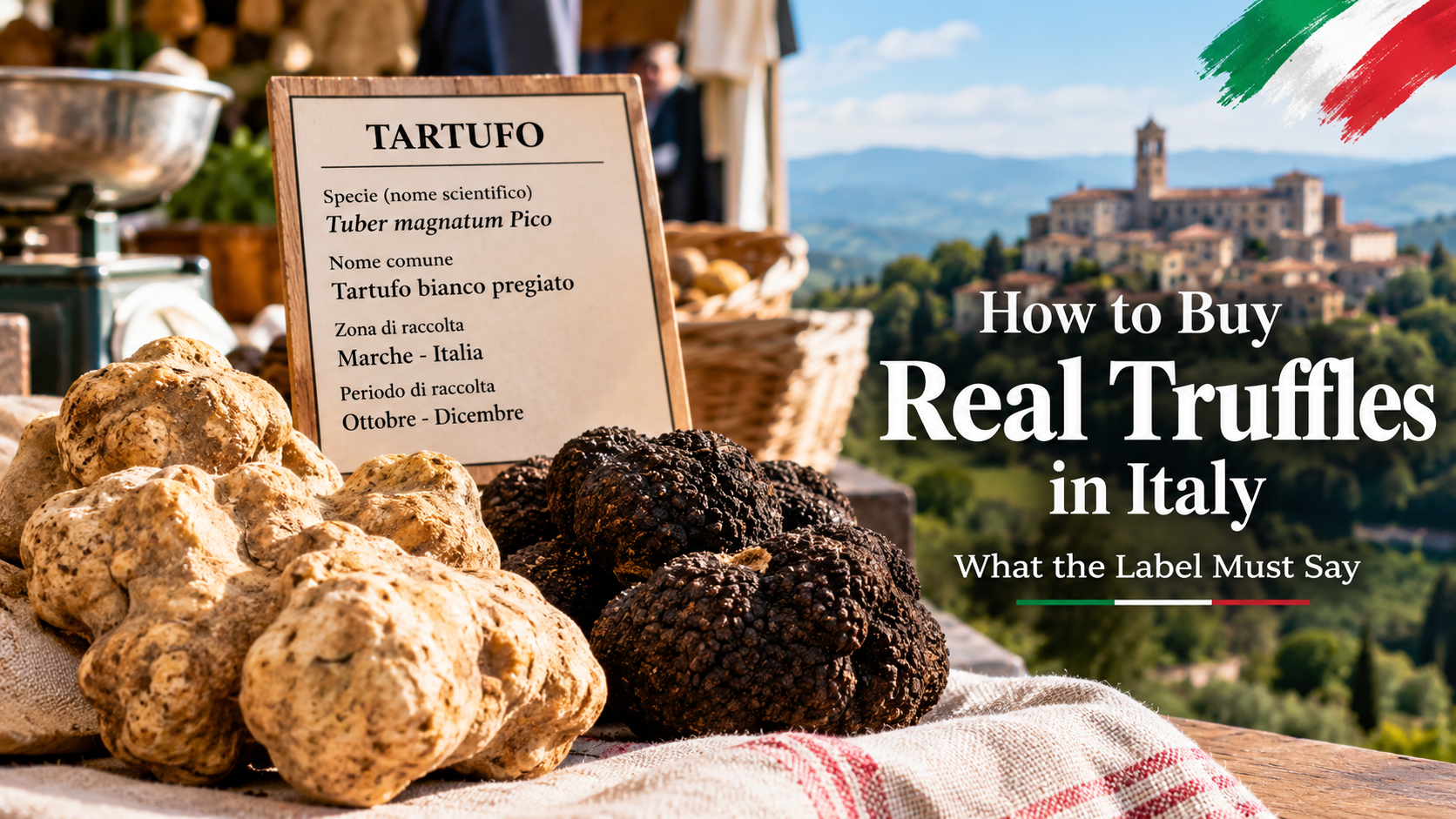
How to Buy Real Truffles in Italy: What the Label Must Say
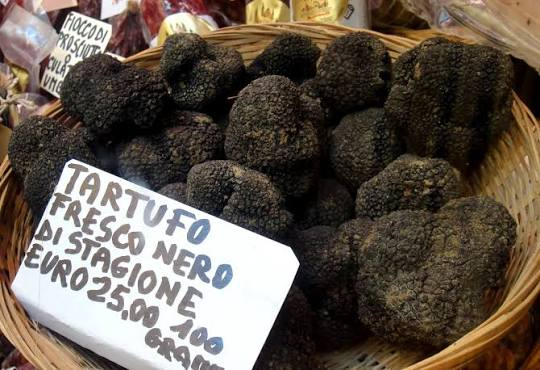
At every serious truffle stall in central Italy, next to the scale, there is a small printed card. Italian law requires it. The card lists the species in Latin, the common name in Italian, and the zone where the truffle was dug up. Nothing else at that stall matters as much as those two lines.
Most guides to buying truffles start with your nose. This one starts with the card, because the card is the only thing a vendor is legally required to get right. Everything else — the smell, the price, the seller’s enthusiasm — is secondary evidence. The card is the primary document.
A truffle is real when three conditions hold at once: the species is declared by its scientific name, the harvest zone is stated, and the selling period matches the legal season for that species. If any one of the three is missing, or doesn’t add up, treat the rest of the sales pitch as marketing, not proof.
The species the law allows you to call “truffle” — and the fraud gap this creates
Italian commerce in truffles is not a free market in naming. Law 752 of December 16, 1985, modified by Law 162 of May 17, 1991, sets out a closed list of species and varieties that can legally be sold under the name tartufo, “truffle.” Anything outside that list cannot be marketed as truffle in Italy, full stop.
The species that matter for a visitor are these:
| Species | Common name | Legal season | Typical fresh price per kilogram |
|---|---|---|---|
| Tuber magnatum Pico | white truffle, tartufo bianco pregiato | commercially sold from October through December | €1,500–€3,000 at the Acqualagna exchange; €5,000–€8,500 in Alba, with auction spikes above €12,000 |
| Tuber melanosporum Vitt. | black winter truffle, tartufo nero pregiato | November 15 to March 15 | roughly €800–€1,500 |
| Tuber aestivum Vitt. | summer truffle, scorzone | summer months | roughly €450–€600 |
| Tuber borchii | bianchetto, tartufo marzuolo | late winter through spring — a different window than the white truffle it resembles | a fraction of magnatum’s price |
Tuber indicum, the Chinese or Himalayan truffle, does not appear on that list at all. It cannot legally be sold in Italy as “truffle.” Yet it looks remarkably close to the black winter truffle on the outside, which is exactly the problem. Its skin is smoother and tends toward dark red or brown rather than the coarse, black warts of T. melanosporum, and a genetic test exists specifically to settle disputed cases. The reason that test exists is economic: National Geographic has documented wholesale prices for Chinese truffle as low as $20 to $30 a pound, against hundreds or thousands of dollars for the real thing. When two products look alike and one costs fifty times less, someone eventually tries the substitution.
Tuber borchii creates a gentler version of the same problem. It resembles the white truffle enough to fool an inexperienced buyer, but it has a sharper, more aggressively garlicky aroma, and it is in season when magnatum is not. A “fresh white truffle” offered in February, well outside the October-to-December window, is very often borchii sold under a more valuable name.
The law is a buying tool, not red tape
Article 7 of Law 752/1985 states that whole fresh truffles, as well as truffle pieces and shavings displayed for sale, must carry a printed card showing the Latin and Italian name of each species and variety, along with the geographic area of harvest. This is not a courtesy. It is an obligation, and it exists because the gap between species is too wide, and the resemblance between some of them too close, to leave to trust alone.
A vendor who skips the card is breaking the law, not being informal. In the Marche region, Regional Law 16 of July 22, 2003 sets fines between €516 and €5,170 for violations of Articles 9 through 14 of the national framework law, which include misrepresenting species, unless the conduct rises to fraud under Articles 515 and 516 of the Italian criminal code — in which case the matter leaves administrative territory entirely. Confiscation of the product applies regardless.
What this means in practice: you have a legal right to see that card before you buy. If it isn’t there, ask for it. If the seller can’t produce it, walk away. This single habit does more to protect you than any amount of sniffing.
What to ask if the card is missing or vague
Truffle sellers at serious markets expect this question, and a good one will answer it without hesitation: is this one hundred percent Tuber magnatum, or has it been mixed with another variety? Asking it signals that you know the categories exist, which is often enough to end any temptation to upsell a lesser species at a premium price.
Three checks beyond the card
Once the paperwork is in order, use your senses to confirm it, not to replace it.
Smell. A genuine white truffle has a complex, layered aroma — earthy, faintly garlicky, with notes that shift as it warms in your hand. A one-dimensional smell, or one that reads as purely chemical and garlicky with nothing underneath, is the signature of a synthetic aroma compound rather than the truffle itself.
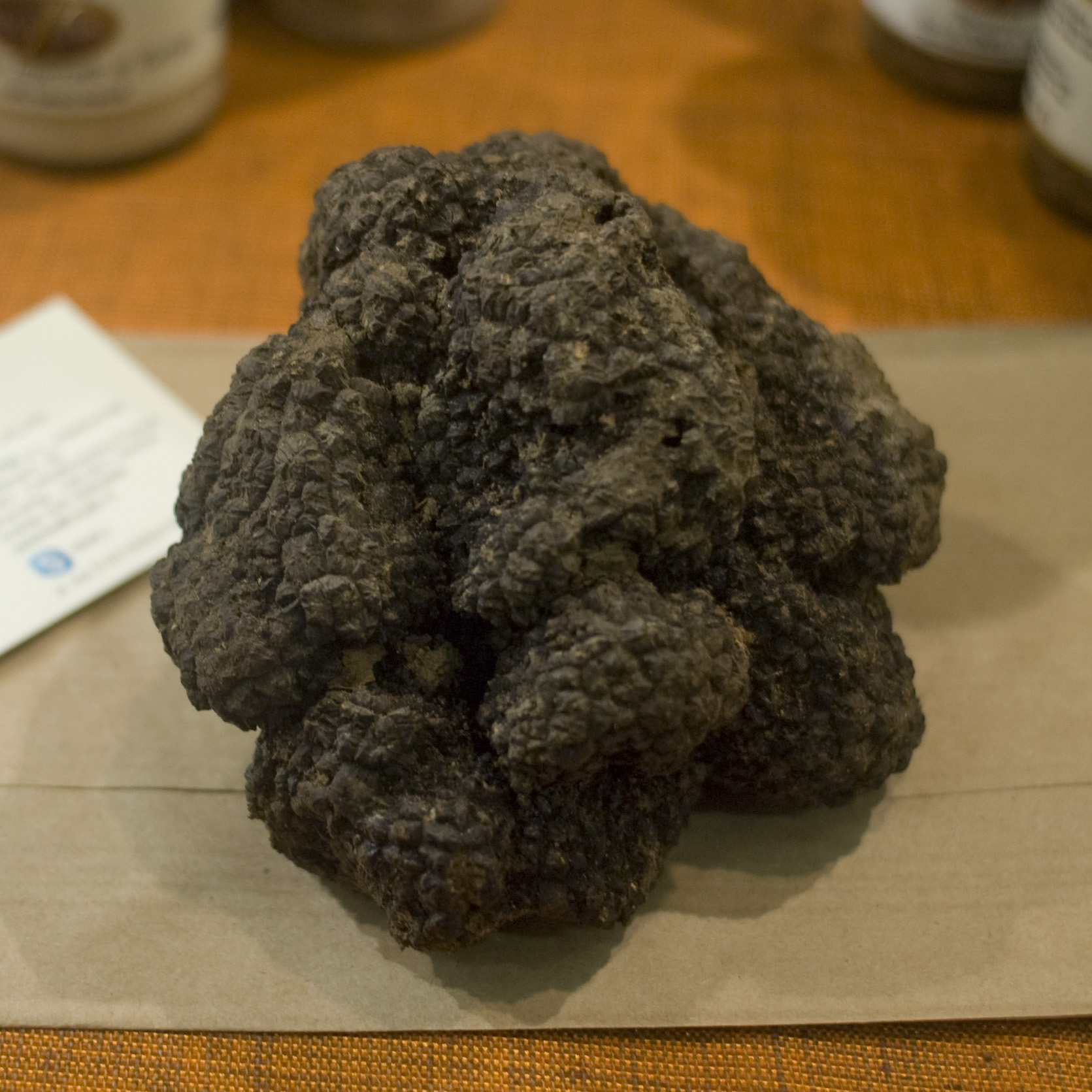
Surface and weight. Real truffles are irregular, with a rough, warty, or marbled skin depending on the species. A suspiciously smooth, uniform surface, or a specimen that feels rubbery and too light for its size, is worth questioning.
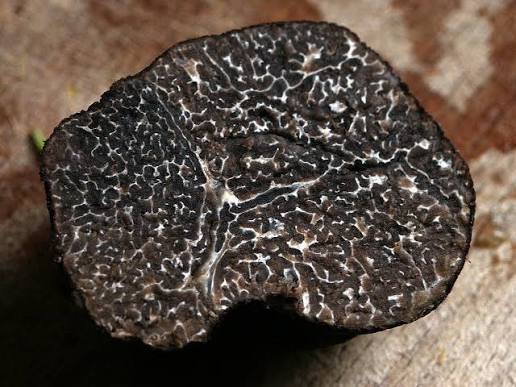
Internal marbling. If you can see a cut cross-section, the interior should show fine, branching white veins against a darker background. Thin or absent veining is a flag.
None of these three checks is conclusive on its own, which is exactly why the card matters most. Smell and texture are judgment calls; the card is a legal statement.
Truffle products: a smaller article hiding inside a bigger problem
Fresh truffle fraud is a market of specimens. Truffle oil, butter, and sauce fraud is a market of chemistry, and it is larger. Most bottled “truffle” products on supermarket shelves owe their smell to 2,4-dithiapentane, a synthetic compound that reproduces one note of truffle aroma without containing any truffle at all.
The label tells you which one you’re buying. If it lists the species by name — Tuber aestivum, for example — along with a percentage, real truffle is present in some amount. If it says only “truffle flavor” or “truffle aroma,” with no species and no percentage, the bottle is flavored chemistry. This single distinction solves most of the confusion, and it deserves its own full treatment elsewhere on this site rather than a shortcut here.
Buying in Italy, and bringing it home
The price gap between buying at the source and buying in an American gourmet shop is the strongest argument for timing a truffle purchase around a trip rather than a mail order. Fresh white truffle has sold on US retail listings for roughly $3,000 to just under $5,000 a pound this season, depending on the retailer and the week. A seven-to-ten-gram shaving — a normal single restaurant portion — costs a fraction of that bought directly at an Italian exchange in season, even accounting for the premium that large, well-formed specimens command.
The good news for American travelers is specific and not widely known: the United States Department of Agriculture classifies truffles as a generally authorized, non-propagative plant product. According to the USDA’s Animal and Plant Health Inspection Service, truffles require no import permit and no advance APHIS paperwork, and they are admissible from essentially every country of origin. This puts truffles in a different category from almost every other fresh agricultural product, most of which are barred from entry to protect American agriculture.
Two conditions still apply. First, every truffle must be declared on the customs form, along with any other agricultural item you’re carrying; declaring it means you avoid any penalty even if an officer ultimately decides not to let it through. Second, the truffle must be clean. Soil is not permitted without a separate import permit, so brush it off before you pack it, not after you land. The final decision always rests with the Customs and Border Protection officer at your first port of entry, so treat the rule as a strong likelihood, not a guarantee.
Timing matters more than most travelers expect. A fresh white truffle loses roughly five percent of its weight every day it sits after harvest, and its realistic shelf life is seven to ten days even under refrigeration, a figure confirmed by postharvest storage research on the genus. Buy one on the first day of a two-week trip, and by the time you land in the United States it is a different, lesser object than the one you paid for. Buy it in the final days of the trip instead, wrapped loosely in paper towel and kept cold, and it travels far better.
What to actually buy, and what to never buy
Buy from a stall or shop that shows the card without being asked twice, where the species on offer matches the calendar month you’re standing in. The truffle exchanges at Acqualagna and Alba are built around exactly this kind of accountability, with graders and declared provenance behind every lot. A guided hunt with a licensed tartufaio and a trained dog is also a legitimate way to buy with full traceability — you watch the animal find it and you know precisely where it came from.
One caution on that last point: if a “truffle hunting” tour runs outside the legal harvesting window for the species it advertises, the dog is very likely finding something placed there that morning rather than something that grew there. A demonstration hunt outside season can still be an enjoyable outing, but it isn’t the sourcing story the marketing implies, and it shouldn’t be the basis for a “real truffle” purchase.
Never buy a fresh truffle with no species name attached, at any price. Never buy a “fresh white truffle” outside its October-to-December season — what you’re holding is something else sold under a better name. And read any bottled truffle product by its ingredient list, not its label art: species and percentage mean truffle; “flavor” or “aroma” alone means none.
FAQ
Can you buy real truffles in a grocery store? Rarely as fresh product. A supermarket is far more likely to carry truffle-flavored oils, salts, and sauces than an actual fresh truffle, and most of those rely on synthetic aroma rather than real truffle content. Fresh truffle is sold mainly through specialty markets, truffle exchanges, and licensed dealers.
How much is a pound of truffle worth? It depends entirely on the species. Black summer truffle can run a few hundred dollars a pound, while fresh white truffle from Alba has sold for $3,000 to nearly $5,000 a pound on US retail listings this season, and considerably more at the height of a short harvest. Price swings by the week during the season.
Where can I buy authentic truffle in Italy? The truffle exchanges at Acqualagna and Alba are the most reliable starting points, since lots there are graded and sold with declared species and provenance. Licensed truffle hunters who sell directly after a guided hunt are another legitimate and traceable route.
Can I bring fresh truffles into the United States? Yes. The USDA lists truffles among non-propagative plant products that are generally admissible without an import permit. You must declare them on your customs form and make sure they’re free of soil; a Customs and Border Protection officer at your port of entry makes the final call.
Is truffle oil made from real truffles? Often not. Most bottled truffle oil gets its aroma from a synthetic compound called 2,4-dithiapentane rather than actual truffle. Check the ingredient list: a named species with a percentage means real truffle is present; “truffle flavor” or “truffle aroma” alone usually means it isn’t.
How can I tell a white truffle from a bianchetto? Season is the fastest tell. Tuber magnatum, the true white truffle, sells from October through December; Tuber borchii, the bianchetto often substituted for it, is in season from late winter into spring. A bianchetto’s aroma also tends to be sharper and more garlicky, with less of the layered complexity of the real thing.
If you’re planning a trip around the harvest itself rather than just the market stalls, a guided hunt near Acqualagna puts you alongside the dog and the handler, which is as close to full traceability as a buyer can get. Just confirm the season matches what’s advertised before you book.
For the calendar behind all of this — which species comes up when, and why the Italian harvest dates are set by law rather than habit — the truffle season calendar covers it in full. For the question of Acqualagna versus Alba as a destination, Where to Eat Truffle in Italy lays out the case for each. And if your trip lines up with the harvest itself, the guides to the Acqualagna Truffle Fair and the Alba Truffle Fair cover both fairs’ 2026 dates and logistics.
If you want more stories like this from an Italian insider’s perspective, explore more on Tastes & Wonders of Italy, or subscribe to The Engineer’s Italy newsletter for dispatches like this one straight to your inbox.
🌍 https://tasteandwondersofitaly.com/ – 📺 https://www.youtube.com/@TasteWondersofItaly