Truffle Hunting in Italy: What Really Happens in the Woods, and How to Book a Real One

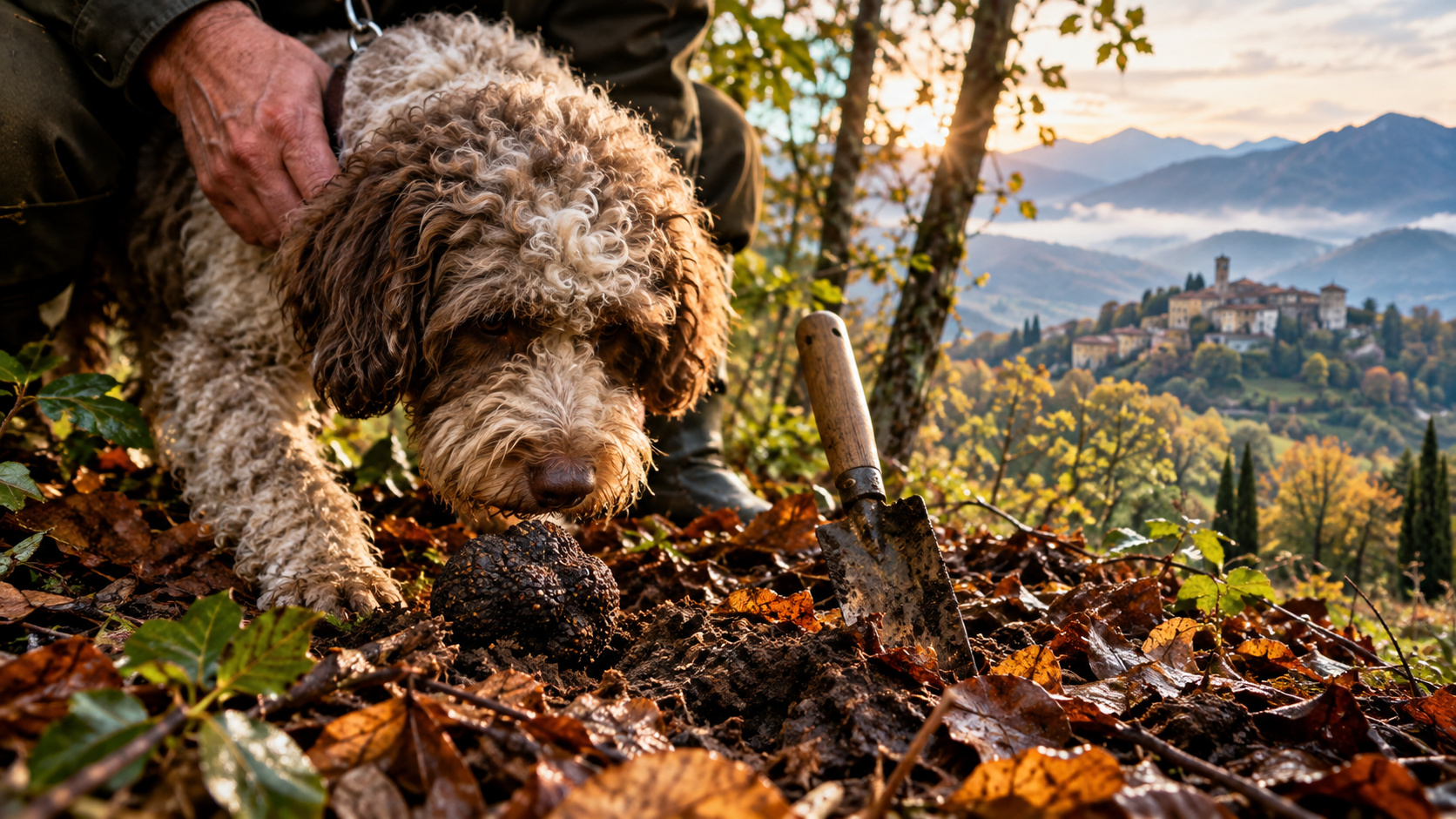
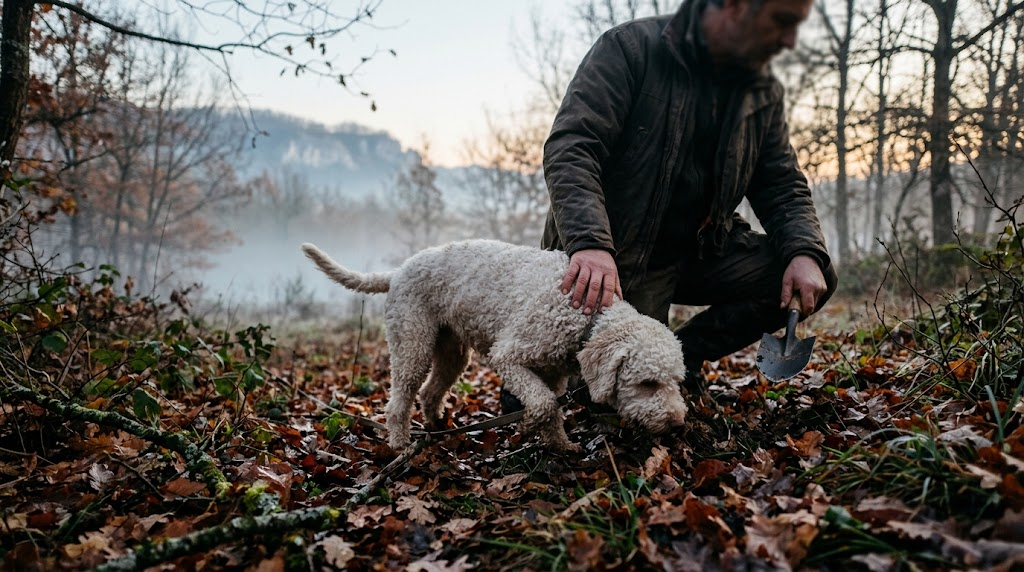
Truffle hunting in Italy starts in the dark. The air is cold enough to hold scent close to the ground, instead of carrying it off into the warming day. A Lagotto Romagnolo moves through wet leaves on a loose lead. Its nose works in short arcs. Then its tail goes still: it has found something underground. The hunter is called a cavatore in the dialect of the central Apennines. He reads the dog’s body before the dog finishes thinking, and a hand closes gently around the collar. Digging does not start yet. It starts only where the dog marks the ground, and only with a short spade called a vanghetto. That is the law. It is also common sense: a truffle pulled too soon is worth nothing to anyone, least of all the ground that grew it.
A quick note, in my own voice. Some links below are GetYourGuide affiliate links. If you book through them, I earn a small commission at no extra cost to you. I only link operators whose licensing, reviews and inventory I checked myself.
Truffle hunting in Italy is a licensed, dog-led search for wild truffles in oak, poplar, hazel and willow woods. Italian Law 752, passed on December 16, 1985, requires every hunter to work with a trained dog. It also requires hunters to dig only where the dog points, using a small spade called a vanghetto. Visitors can join a licensed hunter on guided hunts in Le Marche, Umbria, Tuscany and Piedmont. The prized white truffle, Tuber magnatum, can legally be collected from October 1 to December 31. Since 2021, the practice has held a place on UNESCO’s list of Intangible Cultural Heritage.
What Actually Happens on a Truffle Hunt
UNESCO’s 2021 listing breaks truffle hunting in Italy into two phases: cerca, the search, and cavatura, the digging. Everything else exists to protect those two moments: the licensing, the dog breeds, the tools. The hunter has different names depending on where you are. Tartufaio is the general Italian word, and cavatore is what you hear most across the central Apennines. In Piedmont, where the dialect runs differently, hunters are called trifolau.
The Dog Does the Finding
The dog does the actual finding, and Italian law requires it. Hunters may not use pigs: they were once used for truffle foraging in parts of Europe, but Italy bans them today, partly because a hungry pig tends to eat what it finds. The breed most tied to truffle hunting with dogs in Italy is the Lagotto Romagnolo. It started as a water retriever in the wetlands of Romagna. Once those wetlands were drained for farmland, the breed became a scent specialist instead. Training starts young: puppies learn to link the truffle’s smell with a reward by searching for small scented pouches buried just below the surface, with the depth increasing as the dog’s confidence grows. A well-trained dog stops and sits, or paws gently, the moment it finds the smell. It does not dig on its own. That restraint is the whole point.
One Hole, One Truffle
Once the dog marks a spot, the hunter takes over with the vanghetto, a narrow spade shaped almost like a long chisel. The law sets strict limits here: the hole can be no larger than needed to lift the truffle out, and it must be filled back in right away, to protect the mycelium that will grow next year’s truffles in that same spot. There is no sweeping the area, and no raking the soil to check what else is nearby. One dog signal makes one hole and lifts one truffle. Watch an actual hunt for an hour, and you notice how little digging really happens.
Why Hunters Go Out at Dawn
Cold air holds a truffle’s scent closer to the ground than warm midday air does. That is why most hunts start before sunrise, and why some tartufai go out through the night. There is a quieter reason too: truffle grounds are family secrets, passed down and never mapped. A hunter working alone before dawn is harder to follow back to a good patch. Guided hunts skip this part; nobody takes a paying guest out at four in the morning. But the habit still shapes how working cavatori move when no guests are along.
Why Truffles Grow Where They Grow
A truffle is not a root vegetable waiting to be dug up. It is the fruiting body of a fungus that lives in partnership with the roots of specific trees: oak, poplar, hazel, lime and willow among them. The tree and the fungus trade sugar for minerals underground, and neither survives the deal alone. That partnership needs calcium-rich, well-draining soil, enough organic matter to feed the mycelium, and the steady moisture river valleys supply without flooding the ground. It is no accident that Acqualagna, one of Italy’s most productive truffle towns, sits where the Candigliano and Burano rivers meet in Le Marche, where centuries of water built exactly that kind of soil. I am an engineer, not a mycologist, and claim no more expertise than that gives me. But the pattern holds on its own: wherever this mix of soil, moisture and trees shows up, from Le Marche and Umbria to the Langhe hills around Alba, truffle ground tends to follow.
Where to Go Truffle Hunting in Italy
Four regions account for most of the guided truffle hunting open to visitors. Each one rewards a different kind of trip. Here is how I would rank them for a first hunt, starting with the one that deserves more attention than it usually gets.
Le Marche: Acqualagna and the Furlo Gorge
Acqualagna, a small town wedged into the Apennine foothills of Le Marche, is where I would send a first-time truffle hunter in Italy, and not only because I live nearby. The town runs three truffle fairs a year. It calls itself, along with its wider district, the source of roughly two-thirds of Italy’s national truffle trade. That figure gets repeated by Italy’s own customs agency and by the national tourism board, but neither cites an audit, so treat it as a strongly held local claim, not a proven statistic. What is not in dispute is the landscape: the Furlo Gorge, a limestone canyon cut by the Candigliano river, sits minutes outside town and supplies exactly the soil truffles need. This private outing with a licensed hunter ends with lunch. The meal is built around whatever black summer truffle the dog finds that day. It is the small-scale hunt for truffle hunting in Le Marche that I would book here. Five reviews is a small sample, but a real one, and the format matches a genuine hunt. For fair dates and logistics, see my guide to the Acqualagna Truffle Fair. For where to eat the result, not how to find it, see my comparison of Acqualagna and Alba. This piece deliberately does not repeat that ground.
Umbria: From Assisi to the Valnerina
Umbria works best as a two-stop truffle hunting itinerary. Assisi is the practical entry point: well-connected by train and close enough to good ground for a half-day hunt around a morning at the Basilica. This small-group outing near Assisi includes lunch and wine, sits in the middle of the price range for truffle hunting in Umbria, and has a clean five-review record so far. The more serious truffle country lies further east and south, in the Valnerina valley around Norcia. That area is long associated with the black winter truffle, not the white one. I found no verified, bookable hunt listing there, so I am linking none; book locally once you arrive, or pair a hunt near Assisi with a day exploring the Valnerina’s food culture. Spoleto, a hill town on the edge of that same valley, and the Sagrantino wine made nearby in Montefalco are both worth adding to an Umbria itinerary, even though neither is truffle-specific.
Tuscany: San Miniato and the Day Trip from Florence
Truffle hunting in Tuscany, and specifically truffle hunting in San Miniato, centers on one name: Tartufi Nacci. This family operation works ground in the hamlet of Corazzano and has built one of the most reviewed truffle experiences in the country. Their hunt-and-tasting outing, priced in the mid-range with nearly forty five-star reviews, is the version I would book with a car and half a day free in the San Miniato hills. For truffle hunting near Florence without a car, this hunt paired with a wine tasting and lunch in San Gimignano costs more but removes the logistics problem entirely; you pay for the pickup and itinerary as much as the hunt. San Miniato’s truffle history has one well-documented high point: in 1954, a hunter named Bego Gallerini and his dog Parigi found a 2.52-kilogram white truffle nearby, still commemorated at the town’s truffle museum, MuTart. Some retellings place the find in Corazzano specifically. I could not confirm that against a primary source, so I state only what the museum documents.
Piedmont: Alba, Briefly
Alba and the Langhe hills are where most visitors already expect to find truffle hunting in Alba, and the white truffle more generally. The Alba Truffle Fair’s international profile has made sure of that, and the truffle itself is excellent. I am not covering the region’s hunts or fair logistics here, because my guide to the Alba Truffle Fair already does, in more depth than fits this piece.
When to Go
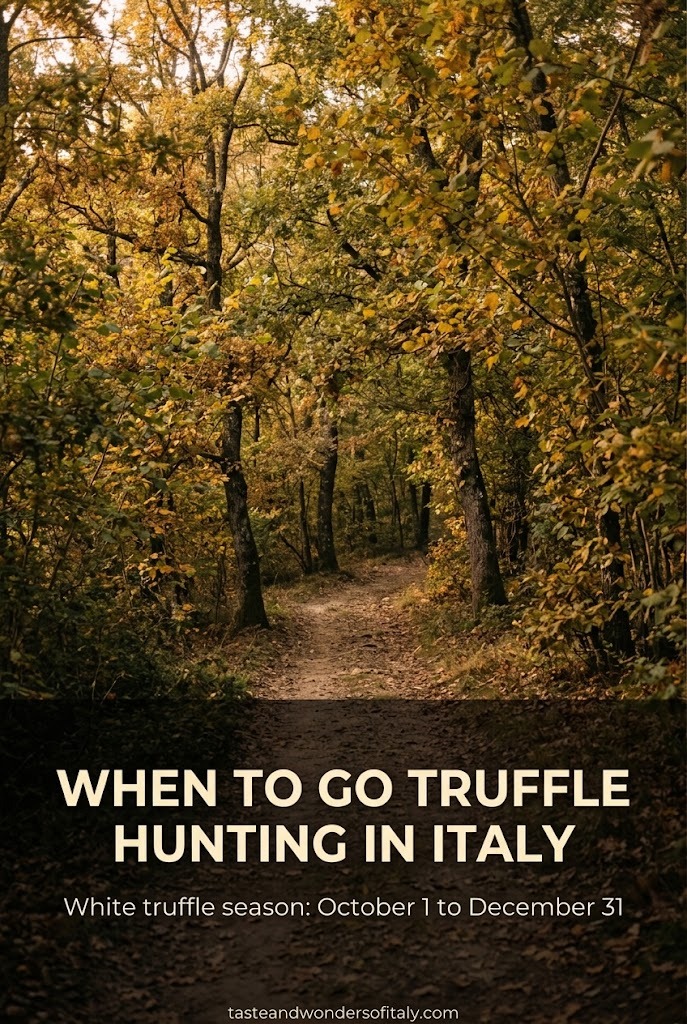
National law sets the floor: Tuber magnatum, the prized white truffle, can legally be collected only between October 1 and December 31, which is why the autumn fairs across Le Marche, Umbria, Tuscany and Piedmont cluster into that window. Regions add their own calendars for other species, including the black winter truffle and the black summer truffle, or scorzone, so something is technically in season most of the year, even if nothing matches the white truffle’s autumn peak. My region-by-region truffle season calendar breaks down which species comes up when, in more detail than one paragraph can hold.
Truffle Hunting with Dogs: The Rules Behind It
Every part of the hunt described above sits inside one legal structure. Law 752, passed on December 16, 1985, built it. Hunters must pass a regional licensing exam, the tesserino, under article 5 of that law. Only then can they legally collect and sell truffles. The law also bans collecting truffles too small or not yet mature, to protect next year’s harvest, not this year’s dinner. A visitor need not memorize any of this. In practice, it is simple: a legitimate guided hunt is led by someone who holds that license, works with a trained dog, and will show you the tesserino if asked. If a hunt cannot produce one, it is not operating inside the system this tradition depends on.
How to Tell a Real Hunt from a Demonstration
Not every bookable truffle hunt in Italy is actually a hunt, and the gap matters more than the marketing copy admits. Group size is the clearest signal: a party of more than four or five guests is not a hunt in any real sense, since a dog cannot work ground with a crowd trailing it. Operators running larger groups usually know this and budget the search for a short stretch before moving everyone to lunch. Ask whether the hunter holds a tesserino; a straight answer, or a willingness to show it, is a good sign. A listing that admits a find is not guaranteed is, oddly, more trustworthy than one that promises a result: it describes how foraging works, not how it sells. Time in the woods matters too. On the San Miniato experience recommended above, several verified reviewers describe the search lasting only twenty to thirty minutes before lunch. Ask also whether the ground is open forest or a cultivated tartufaia, a managed grove planted for truffle production. Both are legal and both can be excellent; a good operator simply tells you which one you are getting. Finally, ask whether you eat what the dog finds that day. Some kitchens serve truffle sourced separately instead, and the better operators build the whole visit around that continuity.
Booking Notes: The Hunt I Would Actually Book
If I had one morning and one region to pick, it would be Acqualagna. The Marche hunt linked above is small by design and fairly priced, inside a town whose economy still runs on the thing you came to see. For a Florence-based trip without a car, the San Gimignano pairing costs more but solves Tuscany’s biggest practical problem: getting out to the hunting ground. For a first Umbria visit, the Assisi hunt is the sensible choice; save the Valnerina for a future trip, once you have a local contact. None of these is the cheapest option, and none is the only legitimate one. They are simply the ones I could verify. Each has a license behind the hunter, and a dog doing the real work.
Frequently Asked Questions
Can tourists go truffle hunting in Italy?
Yes. Licensed hunters across Le Marche, Umbria, Tuscany and Piedmont run guided outings for visitors, usually two to four hours, ending with a meal built around whatever the dog finds. You need no license or dog of your own; the licensed cavatore handles both.
Do you need a license to go truffle hunting in Italy?
You need a license, the tesserino, only if you plan to hunt and sell truffles on your own. As a visitor on a guided hunt, you accompany a licensed hunter rather than hunting independently. No personal license or exam is required.
When is the best time to go truffle hunting in Italy?
The white truffle, Tuber magnatum, can legally be collected only from October 1 to December 31. That is when most guided hunts and the major autumn fairs happen. Other species, including the black summer truffle, extend hunting into additional months, depending on the region.
Why do Italian truffle hunters use dogs instead of pigs?
Italian law requires a trained dog, not a pig, for truffle searches. Dogs can be trained to signal a find without eating it. Pigs, once used for the same job elsewhere, tend to eat what they locate. The law exists specifically to prevent that.
How much does a truffle hunting tour cost in Italy?
Verified guided hunts run from roughly 120 to 320 US dollars per person. The price depends on group size, region, and whether lunch or wine tasting is included. Smaller, more intimate hunts with fewer reviews often sit at the lower end.
Can you keep or buy the truffles you find on a hunt?
On most guided hunts, the truffle found that day goes straight into the included lunch or dinner, rather than home with you. To buy truffles separately, confirm details with the operator or a licensed seller; Italian labeling rules govern what can be sold as fresh.
Is truffle hunting in Le Marche different from Tuscany?
The legal framework is the same everywhere in Italy, but the feel differs. Le Marche’s Acqualagna district runs on a truffle economy at a scale Tuscany’s San Miniato area does not quite match. San Miniato, in turn, offers easier logistics for visitors based in Florence.
A good truffle hunt in Italy is less about the truffle than about watching a dog and a person solve a problem neither could solve alone, inside a legal structure that has protected the practice since 1985 and a tradition UNESCO recognized in 2021. For more dispatches like this one, see The Engineer’s Italy. The newsletter covers parts of the country most guides skip. For help planning a longer Marche or Umbria itinerary built around a hunt like this, get in touch directly.