Glamping in Tuscany: Eight Curated Stays for the Slow Traveler
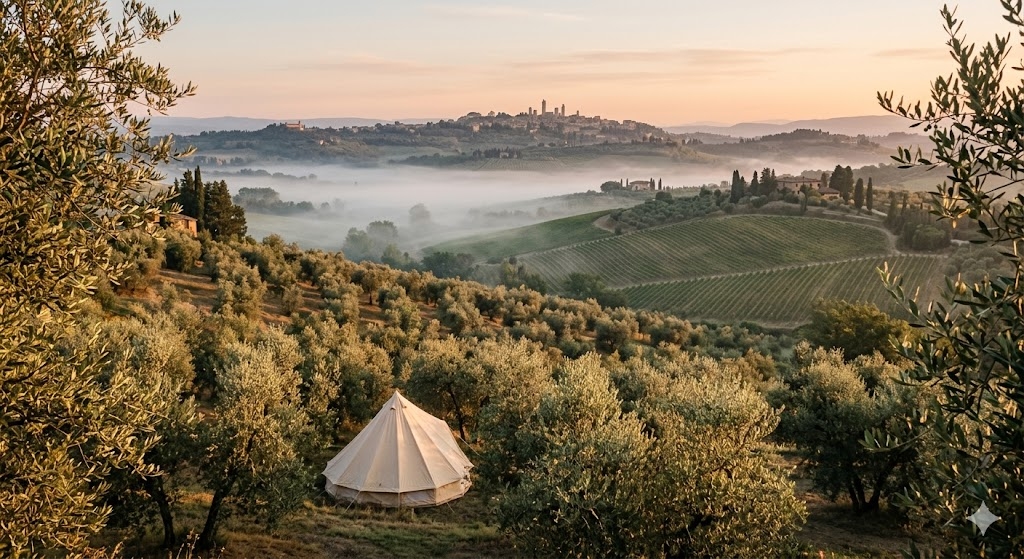
By five in the morning, when the mist is still lying flat across the Sienese hills, the first sound is not a car or an alarm but the call of a fox somewhere in the oak woodland below. By six, the light arrives gold and low across vineyards that produce Brunello and Vernaccia. By seven, you are eating breakfast in an olive grove, looking out over a landscape that has not changed substantially since the 14th century. This is the specific pleasure of glamping in Tuscany — not the novelty of sleeping in a tent, but the quality of the silence and the geography that surrounds it.
The word “glamping” reached the Oxford English Dictionary in 2016, but Tuscany has been offering this combination of countryside immersion and considered comfort for far longer, through the agriturismo tradition that dates formally to Italy’s Legge Quadro of 1985. What the last decade has added is a new architecture of canvas, wood, and stretched cotton — safari tents on volcanic stone plateaus, geodesic bubbles among organic vines, tree-house suites with views of medieval towers — that makes the experience physically distinct from anything a hotel lobby can offer.
I have spent twenty years driving the roads of central Italy, primarily for work as a civil engineer based in Le Marche, and I have learned that the Tuscany most American travelers see — the cypress-lined lane, the wine shop in Florence, the Uffizi queue — is real but partial. There is another layer, accessible only by slowing down: the Maremma’s Etruscan roads carved into volcanic tufa, the cork-oak forest behind the Etruscan coast, the thermal springs that bubble to the surface at exactly 37 degrees Celsius without any human engineering. The eight glamping stays on this list are chosen because they access that second layer directly, and because each one has been selected by a resident rather than assembled by an algorithm.
Why the Slow Traveler Has the Advantage in Tuscany
The compressed Tuscany itinerary — Florence on day one, Siena on day two, Pisa on day three — is a coherent strategy if your goal is maximum landmark density. But it leaves out the specific textures of the region that take time to register: the difference in soil color between the Chianti Classico zone and the Maremma, the way the light moves across the Val d’Orcia between two and four in the afternoon, the particular sound of a truffle dog working through limestone underbrush in late October.
Glamping, by its nature, enforces the slowdown. You arrive at a specific place in a specific landscape and you stay for two or three nights. You are not driving to the next hotel after dinner. You are walking back to a canvas tent in a cork-oak forest with a glass of Morellino di Scansano and a sky that is, without urban light pollution, genuinely dark. The deceleration is structural, built into the accommodation format itself.
The eight stays on this list are distributed across four distinct Tuscan landscapes: the Sienese hills (Chianti, Val d’Orcia, the truffle country around Trequanda); the Etruscan coast and its hinterland (the Maremma Grossetana, the thermal springs of Saturnia, the volcanic tuff country of Sorano and Pitigliano); the Metalliferous Hills inland from Massa Marittima; and the Val di Cornia north of Piombino. Each has its own geology, wine identity, and rhythm.
How We Selected These Eight Properties
This list applies one methodological criterion above all others: would a Tuscany-based resident recommend this place to a close friend? That is a narrower filter than star ratings or Booking.com scores, though most properties here score above 9.0 on those measures as well. The filter excludes large camping villages where glamping-style tents share infrastructure with hundreds of caravans, properties where the “glamping” label reclassifies a standard cabin, and any property where the surrounding landscape is not central to the experience.
The eight properties range from seven tents to a single geodesic vineyard dome. They include a 17th-century customs house on the former border between the Papal State and the Grand Duchy of Tuscany, a tree-house suite overlooking San Gimignano’s medieval towers, and a gypsy caravan that traveled across Europe from a Prague circus. What they share is an emphasis on quiet, on food produced on-site or within twenty kilometers, and on outdoor spaces that are genuinely part of the stay rather than decorative.
Eight Curated Glamping Stays
1. Vedetta Lodges — Five-Star Tents in an Organic Olive Grove, Scarlino (Grosseto)
The property that elevated Tuscany’s glamping conversation to a five-star standard sits on the southeast ridge of Poggio La Forcola in the Maremma region. Nestled among an ancient, organic olive grove, the visionary behind Be Vedetta Relais has positioned a boutique collection of expansive, 50-square-meter tented suites with precise topographical care rather than a standard campsite layout. Each lodge functions as a suspended suite, featuring a private en-suite bathroom with a large glass shower, a king-size bed, independent air-conditioning and heating systems for year-round thermal comfort, and a furnished veranda. Three of the lodges overlook the medieval town of Scarlino, while the others offer sweeping panoramic views across the Tyrrhenian Sea toward the islands of Elba and Corsica.
The detail that distinguishes Vedetta Lodges from aesthetic competitors is the seamless integration of uncompromised hospitality within a raw, natural environment. Named after the Pleiades—the mythical star sisters who guided sailors—the lodges operate with a commitment to sustainable luxury. The exclusive experience here centers around the estate’s own organic extra virgin olive oil production, local wine culture, and proximity to the pristine coastal environment. The limited number of lodges ensures the property functions more like an intimate countryside estate than an organized camp.
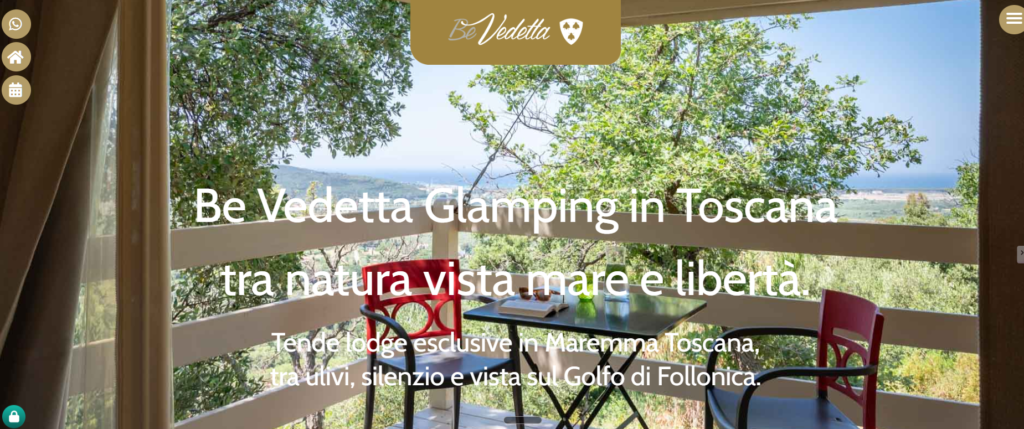
The site provides a deliberate threshold between the untamed beauty of the Maremman landscape and the refined elegance of modern Italian hospitality, proving that proximity to nature does not require sacrificing structural comfort.
Book and information: bevedetta.com/vedetta-lodges
Location: Poggio La Forcola 12, 58020 Scarlino (GR)
Getting there: 1h 15min by car from Pisa International Airport. 2h from Florence. 10 minutes by taxi from Follonica train station.
2. Poderi Arcangelo Glamping Suites — A Tree House with Views of San Gimignano
Eight kilometers from San Gimignano, on a working winery and agriturismo that has operated since 1993, Poderi Arcangelo opened its Glamping Suites in 2025. The collection includes three independent structures: the Quercia Tree House, a two-person nest built around a living oak tree with vine rows and the unmistakable silhouette of San Gimignano’s 14 surviving medieval towers as the visual anchor; and two Lavender Panoramic Suites at ground level, designed with the same palette of natural materials and clean architectural lines.
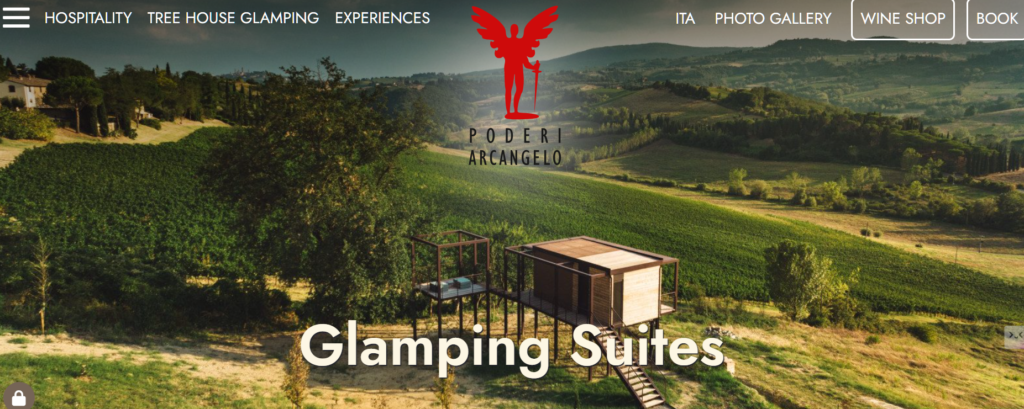
The integration with the estate’s wine production gives Poderi Arcangelo a specificity that purely decorative glamping properties lack. Guests receive a welcome bottle of Vernaccia di San Gimignano DOCG — the only white wine in Tuscany with a Denominazione di Origine Controllata e Garantita classification, produced here since the 14th century — and the property’s restaurant serves organic food from its kitchen garden paired with Chianti Colli Senesi reds produced on-site. The panoramic swimming pool overlooks the towers. The minimum two-night stay is both a policy and a practical recommendation: the surrounding territory of Certaldo, Monteriggioni, and the Chianti hills repays a second full day without effort.
Book and information: poderiarcangelo.it/en/tree-house-glamping
Location: 8 km from San Gimignano (SI), 3 km from Certaldo
Getting there: 1h 10min from Florence. 50 min from Siena.
3. TERRA — Saturnia Tented Lodges: Safari Meets Thermal Spring
Martino and Angela run three safari lodge tents at their property five minutes by car from the Terme di Saturnia, where water at 37.5 degrees Celsius flows from the ground and over a travertine cascade without any pumping or heating infrastructure. The geology here is volcanic — part of the same hydrothermal system that produced the hot springs of Viterbo further south — and the landscape carries the warmth of terrain shaped by sulfurous water over millennia.
TERRA’s three lodges are 38 square meters each, with king-size beds under canvas canopies, private jacuzzis on outdoor solarium decks, infinity showers, and terraces with open views across the Maremma hills. The farm-to-table dinners served in the garden — bookable separately from the room rate — draw from the estate’s organic olive trees, which produce the sharp-edged, slightly bitter extra virgin oil characteristic of good Maremma production. The property’s Booking.com score of 9.8 is supported by guest accounts that consistently describe the hosts as attentive without being intrusive — a balance that is considerably harder to achieve than it sounds.
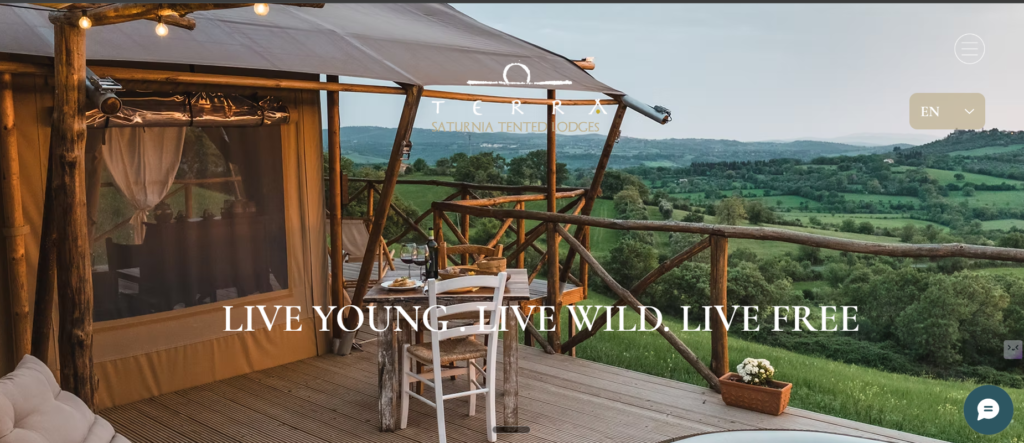
The Terme di Saturnia’s Cascate del Mulino waterfall sits three kilometers away. It is free, open year-round at any hour, and among the most photographed landscapes in southern Tuscany. The main spa complex adjacent charges entry but adds treatment facilities and a larger pool circuit.
Book and information: terrasaturniatentedlodges.com
Location: Loc. Poggio Capanne, Manciano (GR)
Getting there: 2h from Rome Fiumicino. 2h 30min from Florence.
4. Glamping Pian delle Ginestre — Forest Bathing on the Etruscan Coast
Ilaria and Roberto operate seven safari tents in a centuries-old forest of holm oaks and cork trees near Sassetta, a village of 500 people on the Etruscan coast of southern Tuscany. The property is adults-only, which in practice means the ambient sound level is defined entirely by the woodland: woodpeckers, cicadas in summer, the specific acoustic density of a cork-oak canopy on a windless evening. There is no television in any unit. Signal coverage throughout most of the forest is, by design, unreliable.
The property’s stated orientation is toward shinrin-yoku — the Japanese term for forest bathing, the practice of conscious immersion in wooded environments with measurable physiological effects documented in clinical research since the 1980s — and organized forest bathing walks and meditation sessions are available on request. The Terme della Cerreta, a small thermal facility, is a five-minute walk from the entrance gate. The on-site bistro serves home cooking using produce from the organic vegetable garden and wild foraged ingredients from the surrounding woodland, including seasonal mushrooms and herbs that do not appear on restaurant menus in any nearby town.
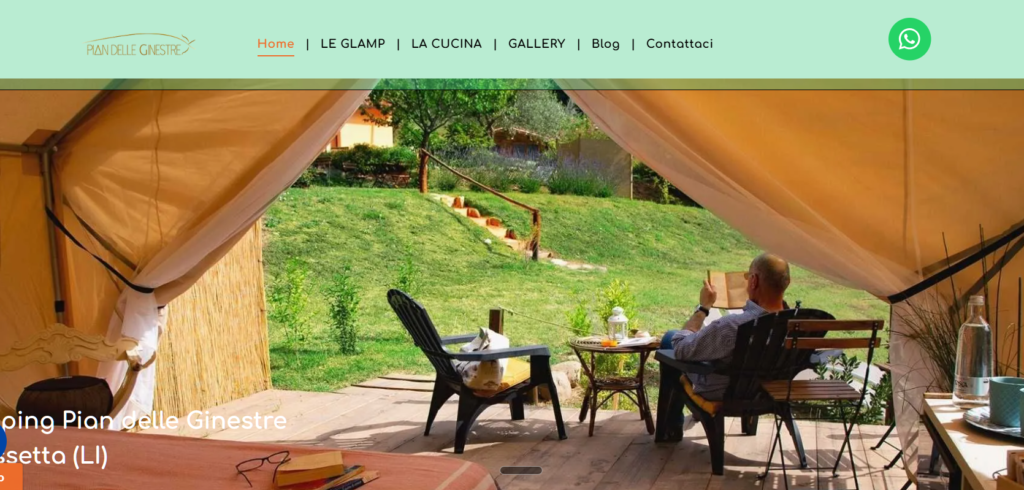
The Booking.com score of 9.4 reflects the property’s operational consistency over multiple seasons. The Etruscan coast beaches at Castagneto Carducci and the vineyards of Bolgheri — where Sassicaia, the wine that created the Super Tuscan category, has been produced since 1968 — are within a 40-minute drive west.
Book and information: glampingpiandelleginestre.it
Location: Via del Corsoio 6, Sassetta (LI)
Getting there: 1h 30min from Pisa Galileo Galilei Airport. 2h 30min from Rome.
5. Sant’Egle — Organic Maremma in a 17th-Century Customs House
In 1600, the building that would become Sant’Egle stood at the border between the Papal State and the Grand Duchy of Tuscany, serving travelers who crossed the frontier in search of rest and customs clearance. Today it is one of Italy’s most rigorously certified ecological properties: organic since 2009, zero-impact in construction and energy use (100% renewable electricity, rainwater recycling for irrigation, thermal and wood-stove heating), and recipient of the WWF Italia award for the best agriturismo in Italy for sustainability and biodiversity conservation. The Tuscany Region classifies it at five sunflowers — the highest sustainability ranking available under regional law.
The two glamping tents at Sant’Egle are 50 square meters each. The Etnica Tent is furnished entirely with antique Middle Eastern pieces from the owner’s private collection, assembled during years of living abroad; the Campagna Tent is in handcrafted shabby-chic furniture restored on-site. Both have private bathrooms, outdoor hot tubs, and access to a saltwater bio-pool. The farm cultivates spirulina, saffron, one hectare of Tuber Brumale truffle (planted since 2015), and stevia, all using biodynamic methods aligned with the lunar calendar. Meals are prepared from on-site ingredients or sourced from within five kilometers.
Sant’Egle does not accept bookings through online platforms and does not welcome children or pets. Contact is direct, by phone or email, and the owners ask potential guests about their values before confirming a reservation. This is not a marketing posture; it is how a property with 4 suites and 2 tents, run by people who live on-site year-round, manages the hospitality relationship.

The property is five kilometers from Pitigliano, one of the three Etruscan tuff stone villages of southern Tuscany — Pitigliano, Sorano, and Sovana — where the Via Cava, roads cut vertically into volcanic tufa by Etruscan hands in the 4th century BCE, connect settlements that predate the Roman presence in the peninsula.
Book and information: agriturismobiologicotoscana.it — direct contact only. Tel. +39 329 4250285
Location: C.S. Sant’Egle 18, 58010 Sorano (GR)
Getting there: 1h 50min from Rome Fiumicino. 1h from Orvieto.
6. Le Stelle di Elisa — Bubble Glamping Between Vineyards and Truffles
The property opened in summer 2025 near Suvereto in the Province of Livorno, with five transparent geodesic dome structures placed within a certified organic vineyard producing DOC-classified Val di Cornia wines. The name references Elisa Bonaparte, Napoleon’s sister, who governed the Grand Duchy of Tuscany between 1805 and 1814 and reputedly favored the wines and night skies of this specific territory.
Each dome is fully transparent — 360 degrees of glass from bed to ceiling — with a king-size bed, private bathroom, air conditioning, minibar, espresso machine, and a private jacuzzi enclosed in a walled courtyard. The night-sky view from inside, with vineyard rows in the middle distance and no external light sources, is the property’s defining experience. The organic winery offers on-site tastings; truffle hunts in the surrounding Val di Cornia terrain can be arranged through the estate for both the Tuber Magnatum Pico (white, autumn) and Tuber Aestivum (summer black). Suvereto, a perfectly intact medieval village seven minutes by car, has a small but serious restaurant scene for an Italian comune of 3,200 people.
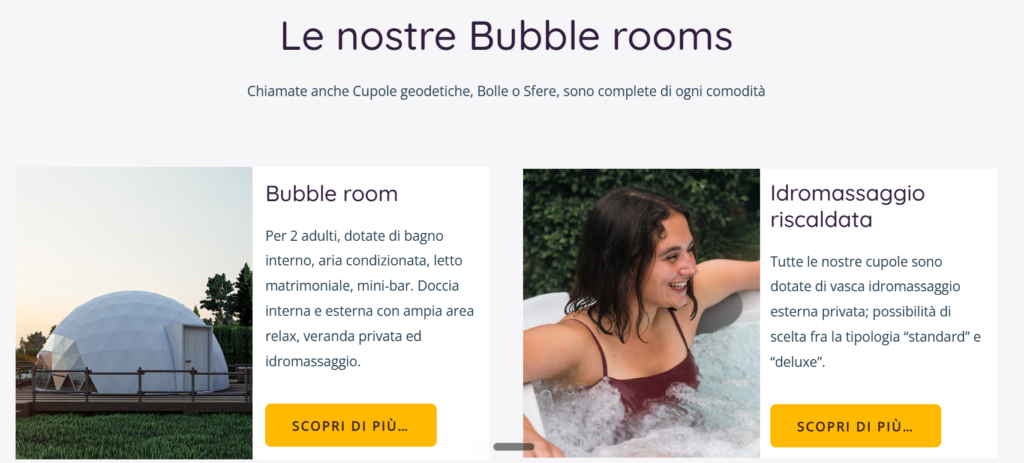
The property is new enough that the review base is still building, but the structural concept — bubble domes, private jacuzzis, vineyard setting — positions it as the most photogenically distinctive stay on this list for an audience that shares content socially.
Book and information: lestelledielisa.it
Location: Località Calzalunga, 57028 Suvereto (LI)
Getting there: 1h 40min from Pisa. 2h 30min from Rome.
7. Agriturismo Pereti — A Witch House, a Gypsy Caravan, and the Magic of Maremma
Gaia and Maitreyi — a Czech couple who left Prague in 2011, she from a production agency, he after twenty years conducting orchestras in the United States — found their hillside in Roccatederighi, in the northern Maremma of Grosseto province, and spent the following decade building a small ecosystem of unusual accommodations around a working organic farm. The result is the most eclectic property on this list, and the one most likely to be remembered specifically because it resists category.
Accommodations at Pereti include: a Witch House, a small pointed-roof structure built from reclaimed wood in a pine grove in explicit reference to folk fairy-tale imagery; a Gypsy Caravan that traveled from Prague in the possession of the Berousek family circus — one of Central Europe’s oldest circus dynasties, founded in the 18th century — heated by a cast-iron wood stove and oriented toward the Maremma valley below; a yurt six meters in diameter; a teepee; and a transparent geodesic dome. A saltwater pool serves all accommodation types. On-request services include horseback riding through the surrounding forest, mountain bike guided tours, and professional massage sessions. Gaia’s background as a music conductor surfaces in occasional evening concerts organized in the farm’s open-air spaces during summer.
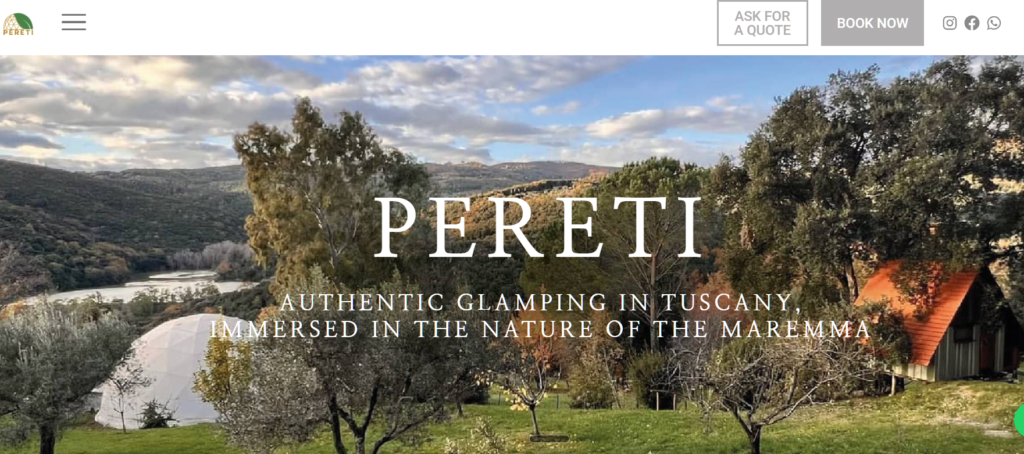
The property’s flexibility — some accommodations share bathroom facilities and are priced from roughly 60 euros per night accordingly, while the bungalow with private pool and king bed sits at the premium end — makes it accessible across a wider budget range than most properties on this list.
Book and information: agriturismopereti.it
Location: Loc. Pereti s.n.c., Roccatederighi (GR)
Getting there: 45min from Grosseto. 2h 10min from Rome.
8. Glamping Stregaia — Lakeside Luxury in the Metalliferous Hills
Glamping Stregaia occupies a hillside above the Lago dell’Accesa — a lake of debated geological origin, with surveys placing its formation either in tectonic activity or volcanic subsidence — in the Colline Metallifere west of Massa Marittima. This is mining country historically: silver, lead, and iron were extracted from these hills since Etruscan times, documented in the Museo della Miniera in Massa Marittima eight kilometers away. The landscape today is recovered forest and agricultural land with a mineral-specific quality of light that reads differently from the gentler Sienese hills further north.
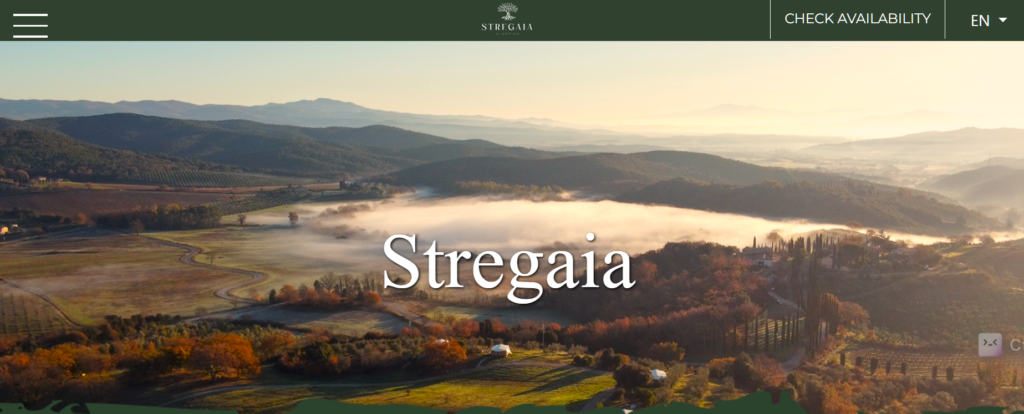
The property offers luxury tents with private swimming pools — a structural feature that distinguishes Stregaia from most glamping operations where pools are shared facilities — along with fully equipped kitchenettes, air conditioning, and terraces oriented toward the lake view. The Booking.com score of 9.7 and TripAdvisor’s ranking of #1 of 2 campgrounds in Massa Marittima reflect the quality of the hospitality rather than a large comparative sample. The town of Massa Marittima, ten minutes by car, has a 13th-century Romanesque-Gothic cathedral — the Duomo di San Cerbone — of exceptional art-historical importance, rarely included on standard Tuscany itineraries. The restaurant scene in town is honest and ingredient-driven in a way that larger tourist centers struggle to maintain.
Book and information: Booking.com — Glamping Stregaia
Location: Strada Comunale Massa Marittima Accesa, Massa Marittima (GR) — Strada Accesa km 2
Getting there: 2h from Pisa. 2h 20min from Rome.
Practical Information
When to visit. The prime glamping season runs from late April through October. May and June combine mild temperatures (22–28°C), low humidity, and the landscape at its most visually dense — green before the summer heat burns the grass gold. July and August are crowded and hot, with daytime temperatures regularly above 35°C in the Maremma; the accommodations manage this with generous ventilation and air conditioning, but the midday hours outdoors are uncomfortable. September and October are arguably the finest months: the harvest light is specific and painterly, the truffle season opens in late September, the vendemmia is visible on the vineyards bordering these properties, and tourist pressure drops sharply after the first week of September. The Terme di Saturnia — accessible from properties 3, 5, and 7 on this list — is a year-round destination, most atmospherically visited in winter or early spring when mist sits in the valley around the cascade.
Getting here. All eight properties require a car. Rural Tuscany’s public transport connects Florence, Siena, and Grosseto at a basic level, but the specific provincial and unpaved roads servicing these properties are not on any bus route. International arrivals are best served by Pisa Galileo Galilei Airport — approximately 1h 30min to the Etruscan coast properties, 2h to the Sienese hills — or by Rome Fiumicino, approximately 2h to the Maremma properties. Reserve a rental car at least three weeks in advance for summer travel; Italian rental inventory at smaller airports sells out before the main booking platforms reflect it.
What to budget. Nightly rates across this list range from approximately 60–90 euros per person at Agriturismo Pereti’s shared-bathroom accommodations to 320–350 euros per couple for the bubble domes of Le Stelle di Elisa and the safari lodges of TERRA Saturnia. The midrange — Glamping Pian delle Ginestre, The Lazy Olive, Glamping Stregaia — runs consistently between 180 and 250 euros per night for two. Most properties include breakfast; dinner availability and policies vary and should be confirmed at booking. Truffle hunting sessions, where offered, typically cost 40–80 euros per person when organized through the property.
Book early. For summer dates at well-established properties, four to six months in advance is a realistic target. The Lazy Olive receives sustained international press coverage and typically fills its June–August and September harvest-weekend availability by March. Newer properties — Le Stelle di Elisa and Poderi Arcangelo Glamping Suites, both opened in 2025 — currently have more summer availability, but this will change as their review base builds and their SEO footprint expands.
Further reading on this blog. For a deep dive into the wine roads of the Maremma and what to drink near properties 3, 5, and 7, see our guide to the Morellino di Scansano DOCG territory (forthcoming). For the archaeological layer of the Etruscan coast and the tuff stone villages of Pitigliano and Sorano, see our article on the Vie Cave of southern Tuscany (forthcoming). For travelers building a slow travel route combining Le Marche and Tuscany — crossing the Apennines via the Frasassi or the Colfiorito Pass — see our overview of the central Italy Adriatic-Tyrrhenian crossing (forthcoming).
FAQ
What is the difference between glamping and a regular agriturismo in Tuscany?
An agriturismo is a working farm that offers accommodation under Italian regulatory law — the Legge Quadro n.730 of 1985 — with rooms or apartments housed inside the existing farm buildings. Glamping adds a category of designed temporary structures placed deliberately in the landscape: canvas tents, geodesic domes, tree houses, restored caravans. Several properties on this list are technically agriturismi that have added glamping structures, which means guests benefit simultaneously from the farm-to-table food tradition of the agriturismo and the outdoor sleeping experience of glamping. Sant’Egle and Poderi Arcangelo are the clearest examples.
Do I need a car to reach glamping properties in Tuscany?
Yes, without exception for the properties on this list. Rural glamping sites in Tuscany are located on unpaved or small provincial roads that public transport does not service. The nearest train stations to most of these properties are 30 to 60 kilometers away, and local taxi services in this part of Italy are inconsistent and expensive. A rental car is not optional; it is part of the logistics. The positive counterpart: a car gives you access to the wine cantinas, weekly markets, and villages that make the surrounding territory readable in depth.
What is the best month to go glamping in Tuscany?
September is the most consistent answer for travelers willing to be specific. The harvest light is distinctive — lower in the sky than July, warmer in color, with longer shadows that make the hill profiles more readable architecturally. The vendemmia (grape harvest) is typically underway on the vineyards surrounding properties 1, 2, 6, and 7. Temperatures are comfortable day and night. White truffle season opens in the last week of September, which activates the truffle hunting experiences at The Lazy Olive and Sant’Egle. Tourist density is noticeably lower than in July and August, particularly on the roads between Pienza, Montalcino, and Montepulciano.
How far in advance should I book a Tuscany glamping stay?
For summer dates at established properties, four to six months in advance is the working target. The Lazy Olive, Glamping Pian delle Ginestre, and TERRA Saturnia receive consistent press coverage from multiple source markets simultaneously, generating booking pressure that fills inventory before the major booking platforms reflect it as scarce. For properties that opened in 2025 — Le Stelle di Elisa and Poderi Arcangelo Glamping Suites — the window is currently shorter, but this will shift as reviews accumulate. For shoulder season (April–May and September–October), six to eight weeks’ advance is typically sufficient.
Is glamping in Tuscany suitable for families with young children?
Several properties on this list are adults-only by explicit policy: Glamping Pian delle Ginestre (explicitly stated), and Sant’Egle (which does not accept children or pets as a matter of operational philosophy). Poderi Arcangelo does not welcome children under ten. The Lazy Olive, with its maximum 20-person capacity and shared kitchen area, functions best as a couples or adult-group experience. Agriturismo Pereti is the most family-flexible property on the list, with accommodation types ranging from shared-bathroom glamping structures to a private bungalow with its own pool, plus on-site horseback riding and a farm environment. Travelers with young children should verify age policies directly with each property before booking.
What wines should I expect to find near these properties?
The eight stays cluster around three wine territories worth understanding before arrival. Properties 1 and 2, in the Sienese hills, sit within or adjacent to the production zones of Brunello di Montalcino DOCG (minimum five-year aging before release; produced exclusively from Sangiovese Grosso), Vino Nobile di Montepulciano DOCG, and Vernaccia di San Gimignano DOCG. Properties 3, 5, and 7, in the Maremma Grossetana, are adjacent to the Morellino di Scansano DOCG zone — a Sangiovese-based red that achieved DOC status in 1978 and DOCG in 2007, with a structure that is consistently more approachable in youth than its Sienese counterparts. Properties 4 and 6, on the Etruscan coast, are near Bolgheri DOC, where the Super Tuscan tradition began with Sassicaia in 1968 and continues with Ornellaia and other estates in the nine kilometers between Bolgheri village and the sea.
Are these stays comfortable enough for travelers with no camping background?
Every property on this list includes a private or semi-private bathroom, a real bed with mattress and linen (not a sleeping bag or air pad), and some form of climate control. These are not camping experiences with a canvas upgrade; they are rural hospitality experiences with a fabric or dome ceiling. TERRA Saturnia and Glamping Stregaia offer the highest physical comfort levels on the list, with 38-square-meter tented rooms, private jacuzzis, and full kitchen facilities. The Lazy Olive sits at the more experiential end — bathroom facilities are attached to the tent rather than enclosed within the main structure, and the kitchen is shared — but the beds, the silence, and the views are of a quality that no hotel room with a landscape photograph on the wall can replicate.
What do Italian travelers think of glamping in Tuscany — is it primarily for foreign visitors?
Glamping in Tuscany has been driven from its earliest iterations by international visitors, with British, German, and Dutch travelers consistently among the top source markets. The format appeals to foreign audiences partly because it offers managed access to a Tuscany that many Italians experience through inheritance — a farmhouse in a cousin’s family, a vineyard belonging to a friend — rather than commercial accommodation. That said, the properties on this list attract Italian guests as well, particularly from Milan, Turin, and Bologna, for anniversary stays and off-season weekends when international pressure is lower. Sant’Egle has a significant Italian following in the sustainability-conscious urban demographic. The short answer: Italians who want this kind of stay and do not have their own countryside connection use exactly these properties.