How to Book Palio di Siena Seats for August 16, 2026
Last updated: July 2026
The tufa is already down in Piazza del Campo by the time most visitors start asking the real question: is there still a seat for me on August 16? The Palio di Provenzano, the first of the year’s two races, ran on July 2 — or rather, it should have. Rain pushed it to Friday, July 3, and the Nobile Contrada dell’Aquila took the drappellone (the painted silk banner that is the only prize) after a 34-year wait, with jockey Giovanni Atzeni, known as Tittia, riding the horse Diodoro. That race is finished. The Palio dell’Assunta on Sunday, August 16, 2026, is the only carriera left this year, and how to book a seat for it is a narrower, more urgent question than most guides make it sound.
Can You Still Book a Seat for the Palio on August 16, 2026?
Yes, seats are still available in mid-July, but the good ones are narrowing fast, and nothing about buying them works the way an American visitor expects. There is no box office, no single website, and no refund policy in the way you’re used to. What exists instead is a patchwork of private sellers, and the earlier you contact one, the more of the Piazza you get to choose from.
I’ve watched this race from three different vantage points over the years, and the single biggest mistake I see visitors make is treating “buying a Palio ticket” like buying a concert ticket. It isn’t. It’s closer to renting a room from a stranger for one evening, and it should be approached that way.
Why There Is No Official Ticket Office
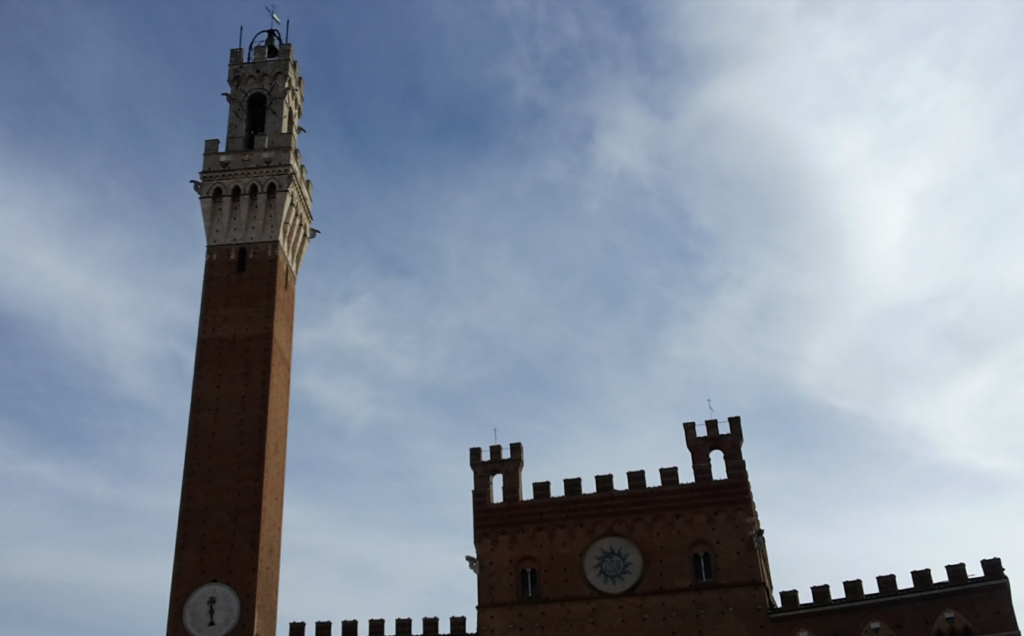
Piazza del Campo has no centralized box office because every seat on it belongs to someone: a private owner, a family, or a palco (grandstand) operator, and each negotiates independently. Watching from the standing center of the Piazza is free and open to anyone; every other seat — on a wooden grandstand, at a window, or on a balcony — belongs to a private building along the square and is rented out for that one evening only.
That single fact explains almost everything else about buying a seat here. There is no comparison site that lists every option, no refund department, and no customer service line if something goes wrong. You are dealing directly with a palcaiolo (grandstand operator) or with the family that owns the apartment above the Costarella, and the transaction runs on trust and a paper or email confirmation.
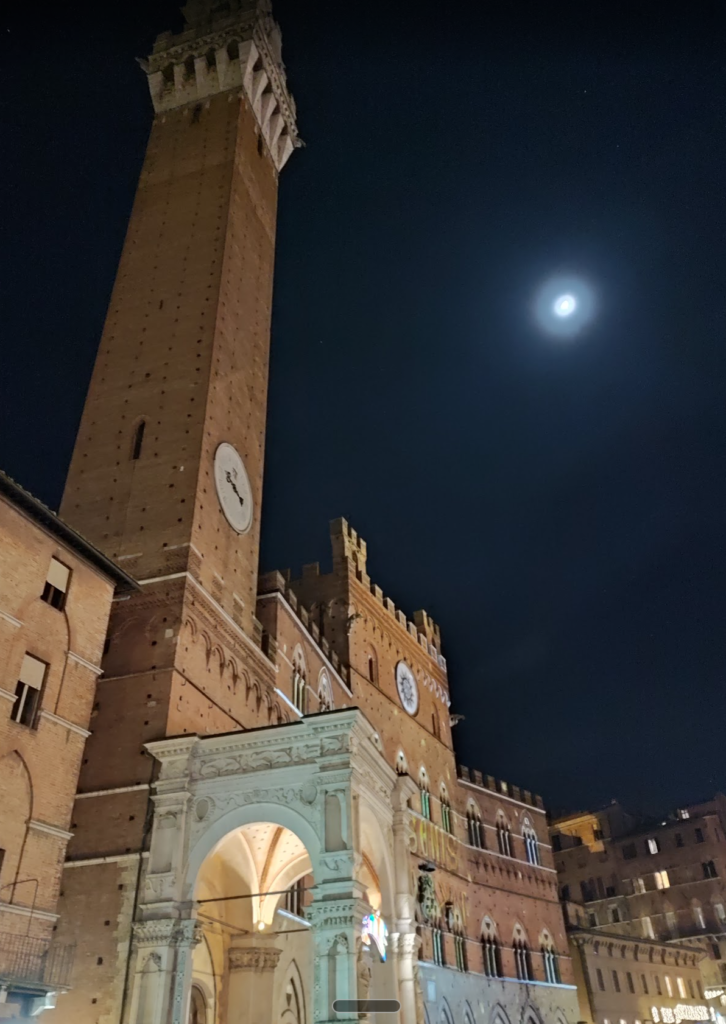
The Four Ways to Watch the Palio
Every visitor ends up choosing between four fundamentally different experiences, and the right one depends on your tolerance for heat, crowds, and cost far more than on how much you’re willing to spend.
| Option | Typical price (per person) | Time commitment | Visibility | Best for |
|---|---|---|---|---|
| Center of the Piazza | Free | 5–7 hours standing, no exit | Ground-level, partial | Budget travelers, under-30s, first-timers who want the raw crowd energy |
| Palco (grandstand) | €350–€700 | Arrive 1–2 hours before | Elevated, mostly shaded, seated | Most visitors — the standard “good seat” |
| Window or private balcony | €200–€850 | Arrive 30–60 minutes before | High, often shaded, small groups | Couples, families with children, anyone who wants a bathroom nearby |
| Terrace or agency package | €400–€1,000+ | Flexible, often includes food | Rooftop or elevated, sometimes without a view of the mossa (start) | Visitors who want the atmosphere with less physical strain |
The center of the Piazza is genuinely free, but once you’re inside — and access typically closes by mid-afternoon — there is no leaving until the race is over. Five to seven hours on your feet in an August crowd is not a minor detail; it’s the entire experience for a large share of the ten thousand or so people who choose it every year.
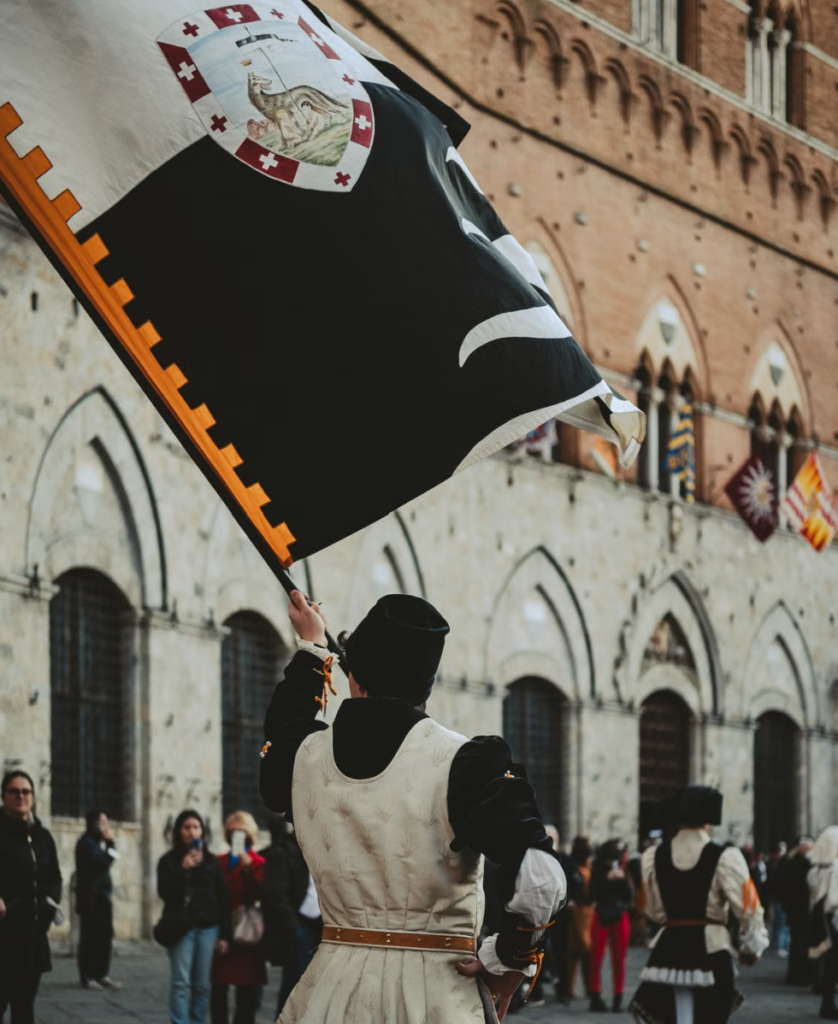
What a Palco Seat Actually Costs in August 2026
A palco seat for the Assunta runs, in July 2026 pricing from established sellers, somewhere between €450 and €700 for a shaded position with a clear view of the mossa (the starting line) near the Palazzo Pubblico, and closer to €520–€575 for positions along the Casato straight or near the Fonte Gaia. Standing balcony spots, which trade comfort for a lower price, can run €450–€690 depending on location. Premium single-balcony packages directly above the mossa, sold by boutique operators, sometimes reach €1,000 per spot precisely because that curve — where ten horses funnel into the canapi (start ropes) — is the most dramatic and the hardest to see well from anywhere else.
Location changes the experience more than price does. A seat at the mossa shows you the tension of the start but not much of the race itself, since the horses are past you within seconds. A seat on the curve of San Martino, the sharpest turn on the course and the one where horses are most likely to lose their riders, shows you the race’s most violent moment but not the start. A seat along the Casato straight gives you the longest sustained view of the horses at speed but misses both dramatic extremes. There is no single best seat — only a best seat for what you want to feel.
How to Book Without Being Scammed
A price meaningfully below €300 for a shaded palco seat in the final weeks before an August Assunta should make you pause, not celebrate. Genuine sellers are usually named businesses or families with a track record — a hotel that has resold the same balcony for years, a palcaiolo whose grandstand has a fixed civic number on the Piazza, or an agency with verifiable reviews outside its own website. Ask for the exact numbered position of the seat, not just the general area, and confirm whether the price includes a printed or emailed ticket versus a verbal promise.
Payment structures worth expecting: most legitimate sellers ask for a deposit — commonly around half the price — at booking, with the balance due roughly a month before the race, by bank transfer or card. Full payment is standard if you’re booking inside that final month. If a seller wants the entire sum in cash upfront with no invoice and no way to reach them again, treat that as the red flag it is. And ask explicitly what happens if the race is postponed — which, as July’s Provenzano just demonstrated, is not a hypothetical.
The Four Days Before the Race
The Assunta is never a single evening; it’s the final stretch of a four-day rhythm that most visitors miss because they arrive only on August 16 itself.
| Date | Event | Cost to watch |
|---|---|---|
| August 13 | La tratta: the ten horses are assigned to the ten competing contrade by lottery, followed by the first two prove (trial races) | Free |
| August 13–15 | Six official trial races, two per day, morning and evening, in Piazza del Campo | Free |
| August 15, evening | Final trial race (prova generale) followed by cene propiziatorie (celebratory dinners) in each competing contrada’s streets | Free to watch; dinners are private |
| August 16, morning | La provaccia, the last trial before the race itself | Free |
| August 16, afternoon | Horse blessings in each contrada’s church, followed by the Corteo Storico entering the Piazza around 4:50 p.m. | Free |
| August 16, evening | Horses exit the Cortile del Podestà for the Palio at approximately 7:00 p.m. | Ticketed or free center |
The trial races are the insider move nobody tells you about. They’re free, far less crowded than race day, and let you study the horses, the contrade‘s tactics, and the geometry of the Piazza without the crush of 30,000 people around you. I’d rather watch a morning prova from the steps near the Palazzo Pubblico than fight for standing room on the day itself, and I say that as someone who has done both.
What You Cannot Know When You Book
Anyone booking a seat in July or early August for the Assunta is booking blind, and that’s normal, not a flaw in the system. The ten contrade competing on August 16, 2026, were only finalized on July 5: Selva, Chiocciola, Oca, Nicchio, Lupa, Istrice, and Torre qualify automatically because they didn’t run in the corresponding August race the year before, while Aquila, Onda, and Giraffa were drawn by lot that evening in the Palazzo Comunale. Notably, l’Aquila — fresh off its emotional July win — is back on the tufo again barely six weeks later.
The horses themselves aren’t assigned to those ten contrade until la tratta on August 13, and the jockeys are locked in only in the days immediately following. This means the drama you’re paying to see — which contrada‘s colors will be dyed into the winning banner — is genuinely unknown at the moment you book your seat, and stays that way until three days before the race. That uncertainty is not a marketing device; it’s the actual mechanism that keeps an event nearly a thousand years old still capable of surprising the city that runs it every single year.
One note for visitors who ask about it before arriving: the Palio does draw sustained criticism over horse welfare, and Siena has made changes over the decades — a modified track surface, veterinary checks before each tratta, and rule changes after serious incidents — while the debate itself remains unresolved and worth knowing about before you decide how you feel watching it live.
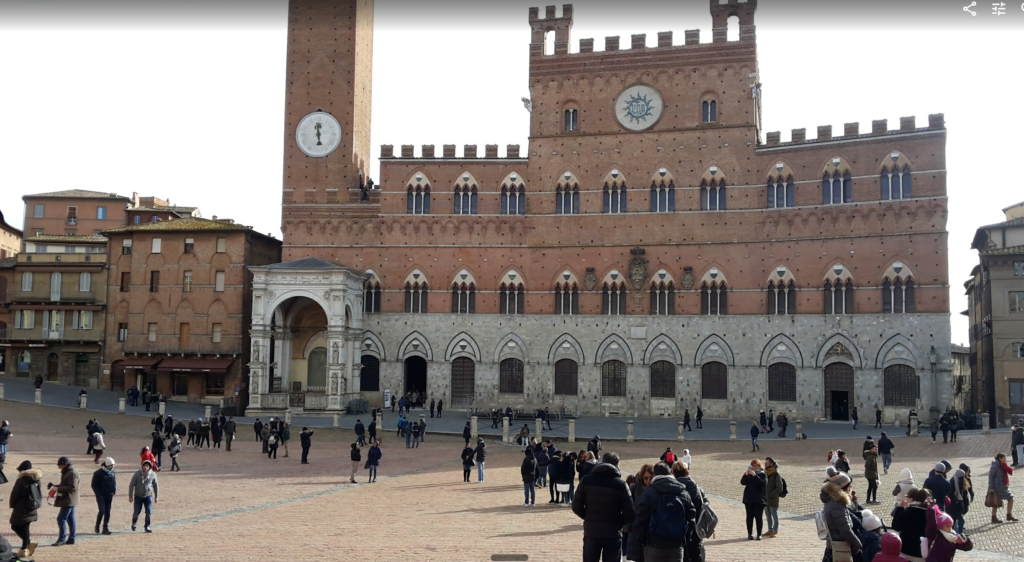
Where to Stay
Siena’s own hotels are largely booked solid by early July for an August 16 date, and what remains tends to be priced for the occasion. The more useful strategy for a visitor booking this late is to look 30–40 minutes outside the walls — towns like Monteriggioni, Colle di Val d’Elsa, or the countryside around Poggibonsi — and to treat the drive as part of the Palio experience rather than a compromise. It also matters that August 16 falls one day after Ferragosto, Italy’s biggest mid-August holiday, when much of the country is simultaneously on the move; if you haven’t already read how that affects trains, restaurant closures, and hotel pricing across the region, it’s worth doing before you finalize where you sleep.
If Siena itself shows nothing, widen the search radius before you widen the budget: availability for the night of August 16 across the Siena area is usually thinner inside the walls than thirty minutes outside them, and the difference in price is not marginal.
Engineer’s Lens: Why the Piazza Decides What You See
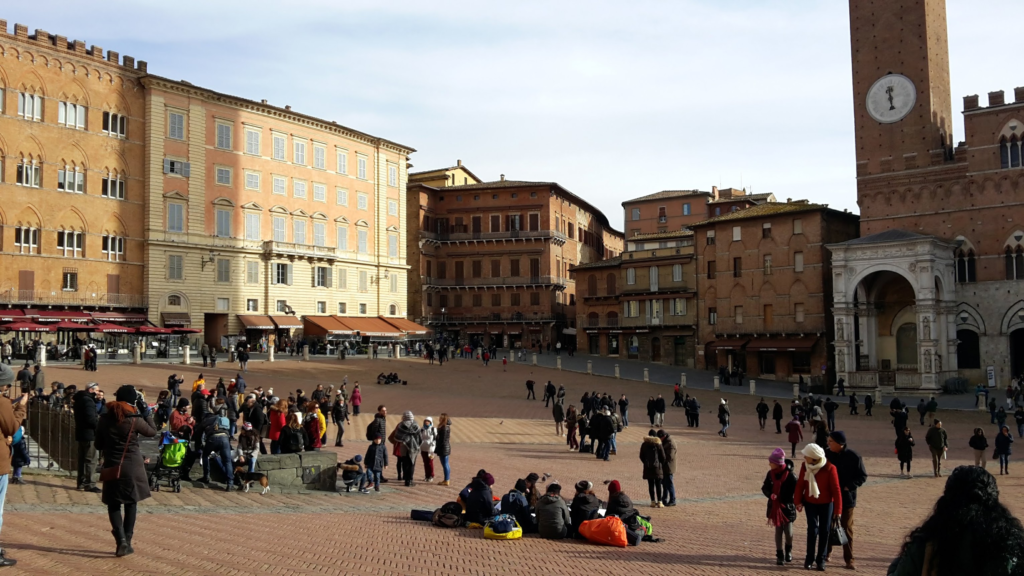
Piazza del Campo is not a flat amphitheater, and understanding its actual shape explains more about seat selection than any price list can. The square slopes downward toward the Palazzo Pubblico in a shell-like curve — the same conchiglia (shell) shape that gives the Piazza its nickname — which means the racing surface itself has a real, measurable gradient, not just a visual one. The horses accelerate on the way down toward San Martino and have to fight gravity and their own momentum simultaneously at that 90-degree curve, which is why San Martino, cushioned with mattresses along the outer wall, is where most falls happen.
That slope is also why a seat’s height matters as much as its position along the perimeter: a ground-level palco on the outer curve sees horses moving fast and close, while an upper-floor balcony on the inner straight sees a slower, more geometrically complete view of the whole race. As an engineer, I find it genuinely satisfying that a medieval Piazza, built centuries before anyone thought about a racetrack, produces exactly the dynamics — banking, camber, sightlines — that a modern circuit designer would calculate on purpose.
What to Do Today, in Order
- Decide which of the four viewing options — free center, palco, balcony, or terrace package — matches your tolerance for heat and crowds, not just your budget.
- Contact two or three sellers this week; shaded palco positions in the €450–€700 range are the first to disappear in the final month.
- Ask each seller for the exact numbered seat location and payment terms before sending any deposit.
- Book accommodation outside the city walls now if Siena itself shows no availability for August 16.
- Plan to arrive for at least one trial race between August 13 and 15 — it’s free, and it’s the best preparation for understanding what you’ll be watching on the night itself.
- If you’re standing in the free center, plan your entry time for early-to-mid afternoon and bring water; there is no exit once the crowd closes in.
If you want more stories like this from an Italian insider’s perspective, explore more on Tastes & Wonders of Italy or subscribe to our YouTube channel for video dispatches from around the country.
https://palio.comune.siena.it/node/5945
—
FAQ — Booking the Palio di Siena for August 16, 2026
Do I need a ticket to watch the Palio di Siena? No. Standing in the center of Piazza del Campo is free and open to anyone who arrives before the crowd closes access, typically in the early afternoon. A ticket is only required for a seated or standing position on a grandstand, window, or balcony.
How much does a good seat cost for the August 16 Palio? Shaded grandstand seats generally run €450–€700, balcony and window positions run €200–€850, and premium balcony spots directly above the starting line can reach €1,000. Prices rise the closer you book to the race date.
Is there an official website to buy Palio tickets? No single official ticket office exists for Piazza del Campo seating. Seats are sold independently by grandstand operators, private apartment owners, and licensed travel agencies, which is why prices and availability vary so much between sellers.
Can I still get a seat two weeks before the race? Yes, but your choices shrink to whatever inventory sellers haven’t placed yet, usually pricier balcony spots or less central grandstand rows. Four to six months ahead is the recommended window for a specific, well-located seat.
What happens if it rains on August 16? The race is postponed to the following day, and this is not rare: the July 2026 Palio di Provenzano was itself postponed by rain for the third year running, moving from July 2 to July 3. Grandstand and balcony tickets remain valid for the rescheduled date, but travelers should plan an extra buffer night in case.
Do I need to book a hotel in Siena itself? It helps but isn’t essential. Siena’s hotels fill up fast for an August 16 date, and towns 30–40 minutes away, such as Monteriggioni or Colle di Val d’Elsa, are a realistic and often better-value alternative.
How long is the actual Palio race? About 90 seconds — three laps of Piazza del Campo. The buildup, from the Corteo Storico’s entry around 4:50 p.m. to the horses’ final exit for the race near 7:00 p.m., takes several hours.
Can I watch the Palio on TV or streaming instead of traveling? Yes. Italian broadcaster La7 has aired the Palio live for years, with a livestream also available on la7.it, though nothing replaces the pressure-drop of standing in the square itself.
Is the Palio di Siena cruel to the horses? It’s a genuinely debated question that Siena itself has responded to over the decades with veterinary checks before each tratta, a modified track surface, and rule adjustments following serious incidents, while critics argue those measures don’t go far enough — it’s worth forming your own view rather than taking either side’s word for it.
What’s the difference between the July and August Palio? The Palio di Provenzano runs July 2 in honor of the Madonna di Provenzano, while the Palio dell’Assunta runs August 16 for the Madonna Assunta; both follow the identical four-day ritual structure, but August draws larger crowds since it falls in peak tourist season and, this year, immediately follows Ferragosto.