Vino Sfuso: How Italy Actually Buys Its Everyday Wine
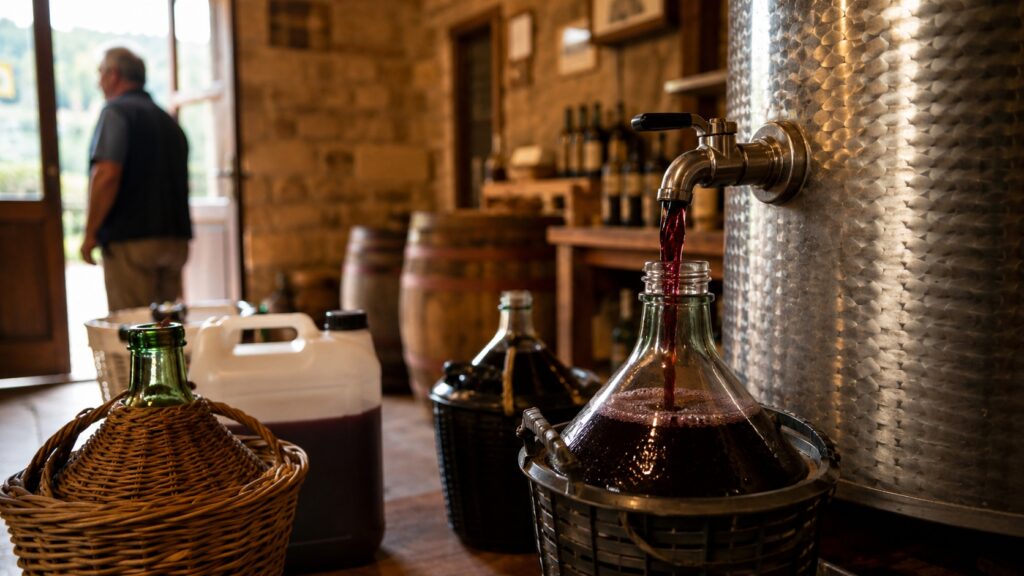
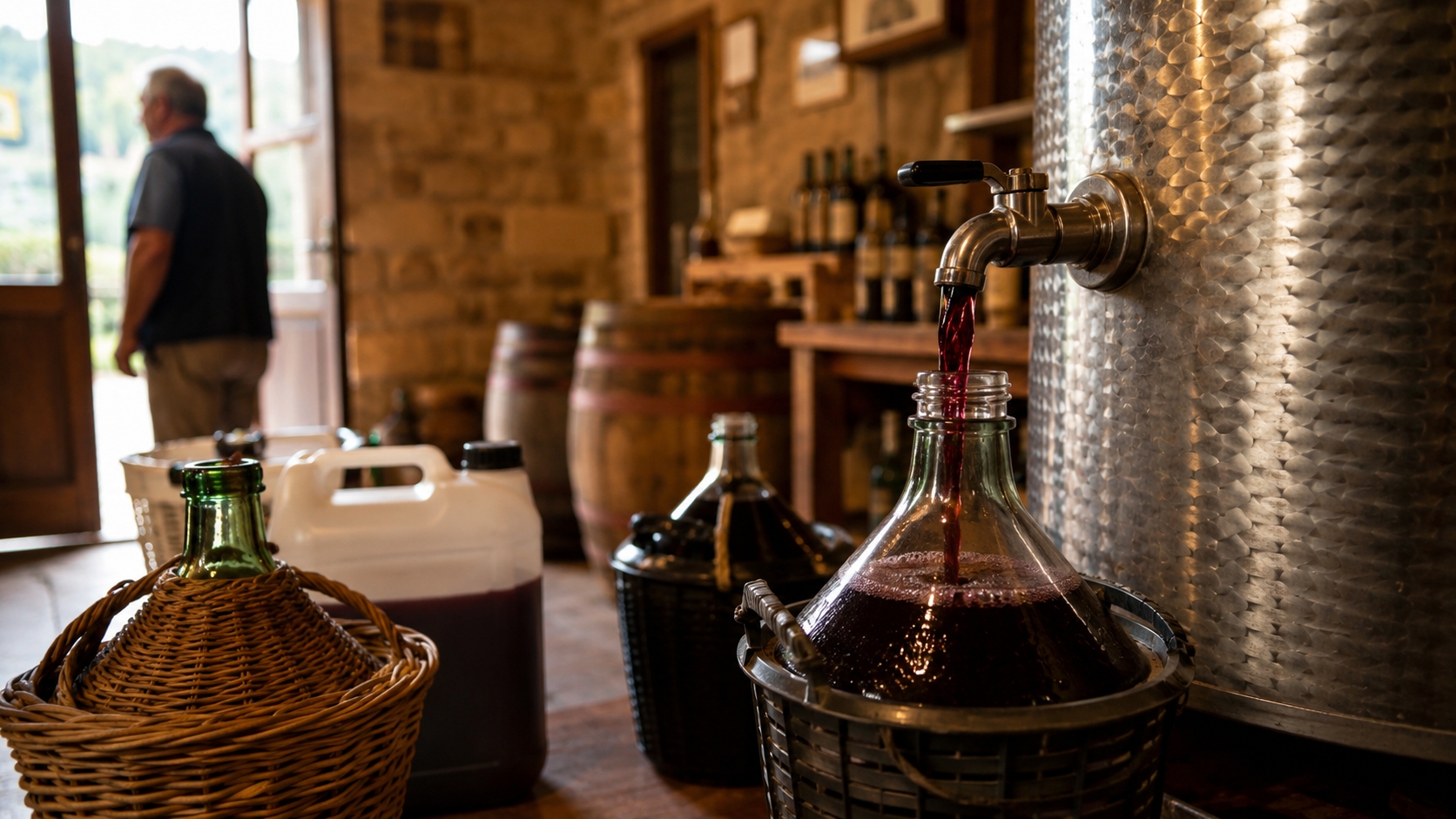
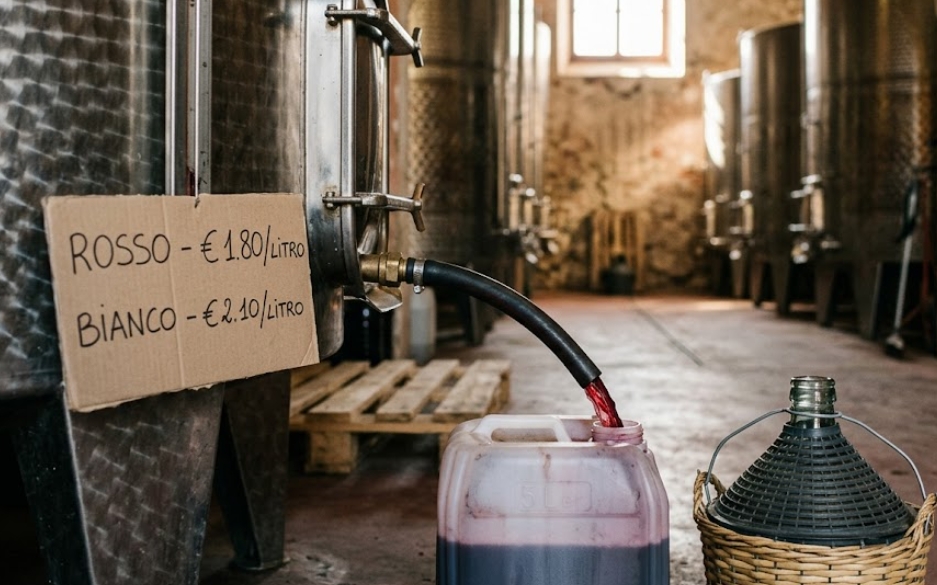
Vino sfuso arrives without a label, without a cork, and without a story printed on the back. It comes out of a rubber hose connected to a stainless steel tank, into whatever container you happened to bring — a five-liter plastic jerrycan, a glass damigiana (a large glass demijohn, often wrapped in wicker or plastic mesh) with a wire handle, sometimes last year’s mineral water bottle rinsed out in the cantina’s own sink. A cardboard sign by the tap gives the price per liter, updated in pen when the tank changes. This is not a specialty product or a nostalgia act. For most of Italian history, and for a great many Italians today, this is simply how wine gets bought.
Vino sfuso — literally “loose wine” — is unbottled wine sold by volume directly from the tank at a winery or cooperative cellar, decanted into a container the buyer supplies or buys on site. Bought directly from a cantina sociale (a wine-producing cooperative) in regions like Emilia-Romagna, Piedmont, or the Marche, it typically runs somewhere between roughly €1.50 and €2.50 per liter, according to 2026 price lists published by producers in those regions. Resold through urban wine shops in cities like Milan or Monza, the same wine can cost €3.20 to €4.00 per liter. It is not the same thing as “bulk wine” in English, which describes industrial wine shipped in tanker quantities for blending or private labeling. Vino sfuso is a small-scale, direct-to-consumer, walk-in-with-your-own-jug transaction, and it is still common across rural Italy.
What Vino Sfuso Actually Is
I do not find this system remarkable, and that is the point. Growing up and working across the Marche, going to fill a container at a cooperative cellar was never framed to me as a discovery — it was an errand, the wine equivalent of buying eggs from the farm down the road. The American conversation about Italian wine runs almost entirely through the bottle: the label, the appellation, the vintage, the critic’s score. That conversation describes a real and important part of Italian wine. It does not describe how most Italians, for most of the twentieth century and a good part of this one, actually drank.
Vino sfuso predates the modern wine industry by generations. Before regulated appellations, before export markets, before glass bottles were cheap enough for everyday use, wine moved from cellar to household in exactly this way: in casks, then in demijohns, then in whatever the buyer had on hand. The practice did not disappear when Italy built its export-facing wine industry in the second half of the twentieth century. It simply became invisible to anyone who only encountered Italian wine through a shop shelf or a restaurant list outside the country.
The Cantina Sociale: The Cooperative Behind the Tap
The structure that makes vino sfuso possible at scale is the cantina sociale, an agricultural cooperative to which member growers deliver — conferire, in the Italian term — their grapes at harvest. The cooperative vinifies the combined harvest, and members are paid according to the quantity and quality of what they brought in, minus the shared costs of running the cellar. Legally, a cantina sociale is a cooperativa agricola di conferimento: a cooperative structure recognized under Italian civil and tax law, distinct from a winery run by a single owner or family.
The logic is straightforward. A grower with two hectares of vines cannot justify buying a bottling line, hiring an enologist, or building a sales network. A cooperative of four hundred such growers can. According to figures from the Alleanza delle Cooperative Agroalimentari reported in Italian wine trade press, more than 400 cantine sociali were operating in Italy as of 2020, together accounting for roughly 60 percent of the country’s total grape production and a combined turnover of around €4.5 billion. I could not verify a more recent aggregate figure at the national level, so treat 2020 as the base year for that number rather than a current snapshot — the structural picture, though, has not changed.
Not every cantina sociale sells sfuso to the public, and not every one that does sells it year-round; many open the taps seasonally, often in the months after the harvest wine has settled. Some cantine sell only in bottle. This piece describes a real and widespread practice, not a guarantee about any specific address.
How You Actually Buy It
The mechanics are consistent from one region to the next. You bring a container — glass and food-grade plastic are both standard — or you buy one at the cellar: a five-liter demijohn, a returnable glass bottle with a small deposit attached, or increasingly a bag-in-box format with its own tap. Some cellars rent out demijohns rather than sell them outright, refunding the deposit when you return the container. You tell the person at the counter what you want — red, white, rosé, and sometimes a specific grape — and they fill it from the tank while you wait. Tasting before you commit to five or ten liters is normal and expected; ask.
The price is per liter, posted or handwritten, and the wine is typically 11 to 14 percent alcohol, stated by the seller rather than printed on any label. Once home, vino sfuso does not keep the way a corked, sulfite-managed bottle does. Producers who sell it are consistent on this point: it should be bottled within days of purchase to avoid unwanted refermentation, and even once bottled, it is built for weeks of drinking, not years of cellaring. This is a wine for the table this month, not an investment.
If tasting at the counter is part of your visit and you are driving afterward, Italy’s legal blood alcohol limit for driving is 0.5 grams per liter for the general population, dropping to zero for drivers who have held a license for less than three years and for professional drivers, under Article 186-bis of the Italian Highway Code. A tasting pour or two before you get back in the car is where this actually matters — plan accordingly.
Why It Stays Invisible to Foreigners
The export machinery that built Italian wine’s American reputation was built around the bottle, and specifically around the labeled, certified, DOP or IGP bottle: a product with a name, an appellation, a producer, and a paper trail that can cross a border and sit on a shelf. Vino sfuso was never built for that system. Under Italian and EU wine regulation, direct sale of DOP or IGP wine straight from the tank into a private buyer’s own container is treated as a distinct, exempted category — precisely because it skips the labeling, sealing, and certification apparatus that bottled retail wine is required to carry. That exemption is what makes the tap-and-jerrycan transaction legal and simple at the local level. It is also exactly why the wine never travels: nothing about its legal packaging is designed to leave the region where it was poured, let alone the country.
What the American wine drinker knows as “Italian wine,” then, is the exportable fraction of a much larger system — the part that was bottled, labeled, and certified for a market beyond the cellar door. The far larger volume that Italians actually drink day to day, sold loose and consumed within the same province, simply never enters that conversation. It is not a secret. It is just not for export, by construction.
Is Vino Sfuso Good? An Honest Answer
I am not going to tell you that vino sfuso is secretly better than bottled wine, because it usually is not, and the blog’s credibility is worth more than a nicer sentence. What it typically is: honest, unpretentious, table wine, made from the same grapes and often the same growers as the appellation-labeled bottles from the same cooperative, without the additional years of aging, blending selection, or marketing that go into a cellar’s flagship bottled line. Quality varies by cellar and by year, the way it does for anything made from an agricultural product. Some of it is genuinely pleasant, food-friendly wine at an unbeatable price. Some of it is forgettable. None of it is a €2-a-liter Barolo, and if a cellar implies otherwise, that is a reason to be skeptical, not excited. Go in expecting a everyday drinking wine, and you will rarely be disappointed by it.
Taking Wine Home: What the Rules Actually Say
Verified July 2026. Customs allowances, duty thresholds, and airline liquid rules change from year to year. Confirm with the official sources linked below before you fly — do not rely on this page alone.
Here is the honest version, because a reader who loses a demijohn at the airport is a reader who stops trusting this blog.
On the customs side, U.S. Customs and Border Protection allows returning residents one liter of alcohol duty-free as part of their personal exemption, provided the traveler is at least 21 and the amount does not exceed what the arrival state permits; state law can be more restrictive than federal rules and CBP will enforce whichever is stricter. Beyond that first liter, there is no federal cap on how much alcohol a traveler can bring in for personal, non-commercial use — additional quantities are simply dutiable, and under the 2026 Harmonized Tariff Schedule, still wine under 14 percent alcohol carries a duty of roughly 6.3 cents per liter, plus applicable federal excise tax. In dollar terms, extra wine is not the expensive part of this story.
On the airline side, TSA’s own guidance states plainly that alcoholic beverages of 24 percent alcohol or less — which covers essentially all wine — “are not subject to limitations in checked bags.” Carry-on is a separate matter entirely: liquids over 100 ml (3.4 oz) are not permitted through security at any U.S. airport regardless of what is inside them, so wine has to travel checked, full stop. A handful of major Italian airports — Rome Fiumicino, Milan Linate, Milan Malpensa’s Terminal 1, and Bologna among them — have begun allowing larger liquid containers through carry-on security screening in 2026 thanks to new CT scanners, but that relaxation applies to your outbound security check in Italy, not to what TSA will accept on your flight home from the U.S. side or at a connecting hub without the same equipment. It does not solve anything for a demijohn either way, since a demijohn is never a carry-on item.
Here is the actual problem, and it is not the volume: vino sfuso arrives in a container with no seal, no label, no stated alcohol percentage, and no producer information — because, as explained above, that is exactly what Italian law permits for this category of direct sale. Nothing in CBP or TSA guidance is written with an unlabeled, unsealed, reused water bottle full of homemade-looking red liquid in mind. A checked bag containing that is a plausible candidate for closer inspection, and if a container leaks, breaks, or simply cannot be identified to an officer’s satisfaction, there is no label to fall back on to settle the question quickly. None of this is illegal by design. It is simply not built for the trip.
The straightforward, honest recommendation: if you want to bring wine home from a cellar you loved, ask whether they also sell a sealed, labeled bottle of the same wine — many cooperatives that pour sfuso also bottle a version of the identical blend — and travel with that instead. Save the demijohn experience for while you’re here.
Official sources, current as of this writing: U.S. Customs and Border Protection, alcohol exemptions and TSA, alcoholic beverages.
Vino Sfuso in the Marche
In the Marche, the practice runs through the region’s two best-known appellations. Producers around Jesi and the Verdicchio dei Castelli di Jesi zone sell both bottled DOC Verdicchio and the same wine sfuso, straight from the tank, alongside Rosso Piceno and simple Marche IGT red and white. The tank version is not a lesser cousin kept out of sight; it is sold openly, at the same cellar door, to anyone who drives up with a container. If you spend any real time in the region’s wine country, you will see the demijohns before you see the export labels — a small, ordinary fact that says more about how Le Marche actually drinks than any tasting note could.
A Practical Guide to Trying It Yourself
Look for a cantina sociale or a family winery near the Verdicchio or Rosso Piceno production zones with a sign reading vino sfuso — sometimes it is only visible from the road during the selling season, typically the months following the harvest. Bring a clean five-liter container if you have one, or plan to buy or rent a demijohn on site; either way, expect to pay a small refundable deposit for glass. Taste before you commit to a full container, and if you are driving, keep the tasting pour modest. Ask the price per liter for what you want — it should be posted — and ask how soon you should bottle it once home, since the answer is measured in days, not weeks. Treat the wine you bring home as this month’s table wine, not a keepsake, and you will get exactly what the system was built to deliver.
The Takeaway
Vino sfuso is not a discovery waiting to be marketed to you. It is the ordinary, working half of Italian wine culture — the half that never needed a label because it was never meant to leave the province. Understanding it tells you more about how Italians actually relate to wine, day to day, than most bottled appellations ever could.
If you want more stories like this from an Italian insider’s perspective, explore more on Tastes & Wonders of Italy, or plan a visit to the Marche’s wine country with some guidance from someone who lives here — you can book a 30-minute consultation with me at TidyCal.
FAQ — Understanding Vino Sfuso
What is vino sfuso?
Vino sfuso is unbottled Italian wine sold directly from the tank at a winery or cooperative cellar, poured into a container the buyer supplies or purchases on site. It is bought by volume, priced per liter, and typically consumed within weeks rather than aged.
How much does vino sfuso cost per liter?
Bought directly from a producer or cooperative cellar, expect roughly €1.50 to €2.50 per liter as of 2026. The same wine resold through a wine shop in a larger city can cost €3.20 to €4.00 per liter.
Do I need to bring my own bottle?
You can bring your own clean container, typically glass or food-grade plastic of five liters or more, or you can buy or rent a demijohn or bag-in-box at the cellar itself, usually for a small refundable deposit.
Is vino sfuso good?
It varies by cellar and by year, the way any agricultural product does. It is generally honest, everyday table wine rather than a hidden premium product, and it should be judged and enjoyed on those terms rather than expected to rival a cellar’s bottled, aged wines.
Can I bring vino sfuso back to the US?
Not realistically. There is no volume limit on wine in checked luggage and the customs duty on extra liters is minor, but vino sfuso travels in an unsealed, unlabeled container by law, which creates real friction with airline and customs screening. Buy a sealed, labeled bottle from the same producer to bring home instead.
What is a cantina sociale?
A cantina sociale is an agricultural cooperative that member grape growers deliver their harvest to for shared vinification, bottling, and sale; it is the structure that makes affordable, small-scale vino sfuso possible across rural Italy.
Can I taste before I buy, and is it safe to drive afterward?
Yes, tasting before committing to a full container is normal practice at most cellars. Italy’s legal driving limit is 0.5 grams of alcohol per liter of blood for most drivers, and zero for anyone who has held a license less than three years or drives professionally, so keep any tasting pours light if you are getting behind the wheel.
Disclaimer
This article is editorial and informational content, not legal, customs, tax, or travel advice. It reflects general practice and publicly available official guidance verified in July 2026.
Customs allowances, duty rates, alcohol import limits, U.S. state liquor laws, and airline and airport liquid-screening rules change frequently and vary by traveler, itinerary, connecting airport, and destination. Nothing on this page should be treated as a guarantee of what any customs officer, airline, or screening authority will permit on a given day. Responsibility for compliance rests entirely with the traveler.
Before transporting any alcohol internationally, verify the current rules directly with the official authorities — in the United States, U.S. Customs and Border Protection and the Transportation Security Administration, plus the relevant state alcohol authority for your point of entry, and the equivalent authority at any connecting airport. Tastes & Wonders of Italy accepts no liability for duties, taxes, fines, confiscated goods, delays, losses, or any other consequence arising from reliance on this article. When in doubt, declare it and ask the officer.