Inside an Italian Historical Reenactment: What It Really Means to Walk in the Corteo
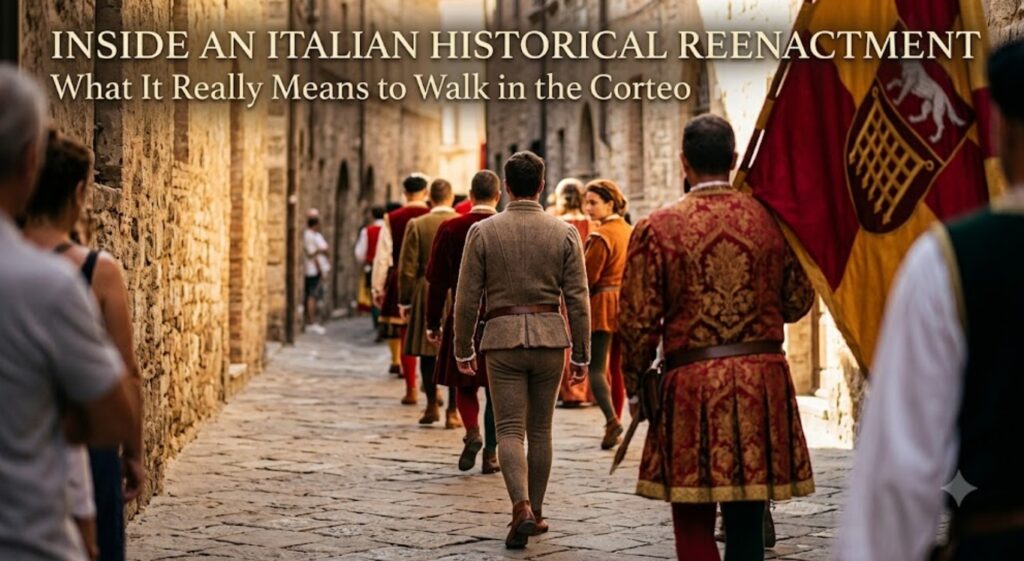
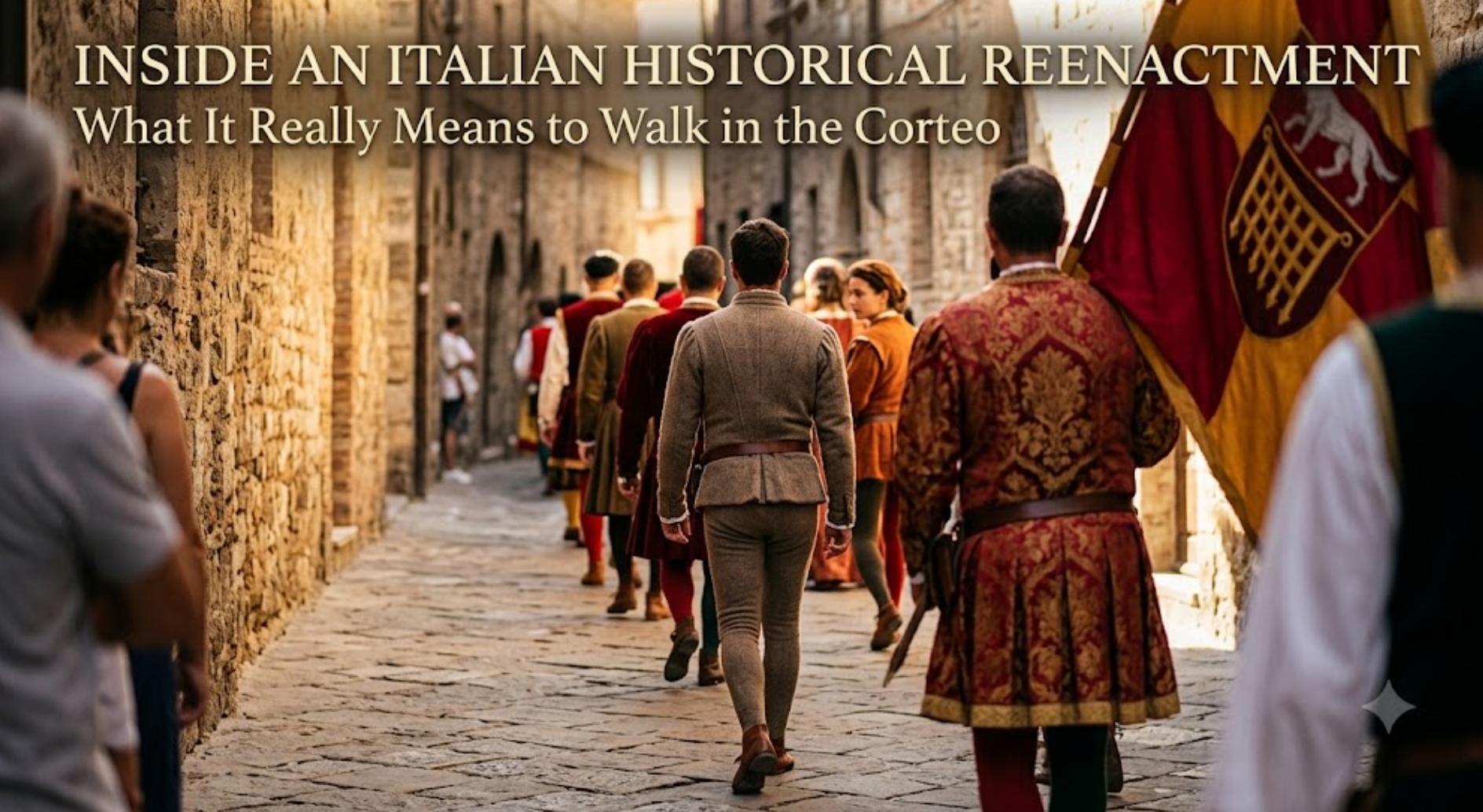
Before the procession moves, there is a particular stillness. The line has formed — fifty, eighty, a hundred people in fifteenth-century costume, each standing in the position that belongs to their role and their Porta — and the only sound is the low vibration of the drums settling into their rhythm. The July air sits on the stone like something physical. The wool doublet is heavier than you expected. The calze (the fitted leg coverings) hold the heat differently from modern fabric. The leather soles of the period-accurate shoes have no give on the cobblestone, so you plant your feet with more deliberateness than you would in sneakers. You are not watching this. You are in it.
This is the experience that no English-language travel writing about Italian medieval festivals has adequately described, because no travel writer has been inside it. The corteo storico — the historical processional that is the visual heart of every major Italian reenactment — is consistently covered from the outside: from the sidewalk, from a press position, from a tribuna seat. The accounts describe what it looks like. This piece describes what it is, from the inside, using San Ginesio’s Giostra dell’Anello as its starting point — specifically the edition of July 5, 2026, the first time in the event’s history that a full historical corteo in costume preceded the ring joust. It was, in the language of the Associazione Tradizioni Sanginesine (ATSG) that organizes it, a novità assoluta: an absolute novelty.
The Shift — From Spectator to Participant in an Italian Historical Reenactment
The difference between watching a corteo storico and walking in one is not a difference of degree. It is a difference of kind.
When you watch, the corteo is a sequence of images: the colors of the Porte’s banners against the stone, the precision of the drummers’ hands, the way the light catches the embroidered velvet at a particular angle. You receive it as a viewer. Your job is to be impressed, to photograph it, to carry the image away.
When you walk in it, none of this is available to you. You cannot see the corteo. You are part of it, which means your field of vision is the back of the person directly ahead and the edges of the street on both sides. What you have instead is something that no photograph captures: the sound of your own footsteps in rhythm with everyone else’s, the weight of the costume telling your body something about the fifteenth century that a museum object never could, and the specific social pressure of belonging to something that has its own rules, its own hierarchy, and its own expectations of you.
That social pressure is not unpleasant. It is, in fact, the thing that makes the experience worth having. You are not a tourist inside a reenactment. You are a figurante — a member of a Porta, assigned a role, expected to carry it. The corteo does not adapt to you; you adapt to it. This inversion, which sounds small, produces a fundamentally different relationship with the tradition you are inside.
The Costume Is Not a Costume
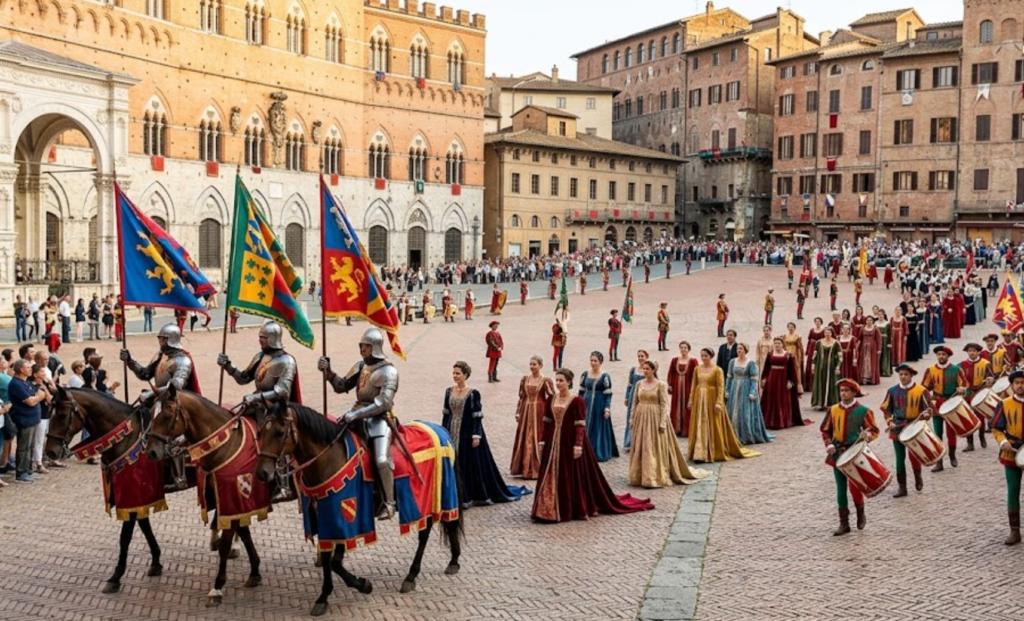
The first thing to understand about the costume of a Marchigiano corteo storico is that it is not called a costume. In Italian, il costume means the garment; in the social register of the reenactment world, la tenuta, the abbigliamento storico, or simply il vestito carries a weight that “costume” in English does not. The word “costume” implies theater, performance, something temporary and external. What you wear in a corteo is more than that — it is a document.
At San Ginesio, as at most serious Marchigiano reenactments, the garments are made by local workshops that work from historical sources: manuscript illuminations, altarpiece paintings, archival inventories. The fabrics are selected for period accuracy — natural fibers, specific weave patterns, dyes that approximate what would have been available in a fifteenth-century Marchigiano commune. The stitching follows historical techniques where possible. This philological care is not pedantry. It is what separates a serious reenactment from a theme park, and it is what the communities of the four Porte of San Ginesio — Alvaneto, Ascarana, Offuna and Picena — take seriously, because they have been maintaining this tradition across generations and they are not willing to let the standard slip.
The physical reality of wearing this kind of garment in July is worth stating plainly. Natural fiber fabric does not breathe the way modern technical clothing does. The multiple layers required by period-accurate dress — linen base, wool doublet, hood or head covering — create a thermal environment that your body adjusts to rather than escapes from. The adjustment takes twenty minutes or so; by the time the corteo moves, you have made your peace with the heat, and the weight of the fabric has become part of your proprioception. You stand differently. You move differently. Historians of material culture have written about this: clothing shapes posture, and period-accurate clothing shapes it in period-specific ways. You notice this from the inside in a way no observer on the sidewalk could.
The garments belong to the Porte. They are maintained, repaired and updated between editions by the community’s tailoring resources. When a figurante’s role requires a specific item — a particular hat, a weapon, a pouch — it comes from the Porta’s inventory, not from outside. You wear what the Porta provides, which means you are wearing something that has been worn by others before you, maintained by hands that know its history.
The Four Gates and the Social Architecture You Enter
San Ginesio’s reenactment is organized around four Porte — the four historic gates of the medieval town: Alvaneto, Ascarana, Offuna and Picena. Each gate corresponds to an actual gate in the fourteenth-century walls and to the community that historically lived and worked closest to it. In the context of the Palio di San Ginesio, these are not teams. They are civic subdivisions with their own colors, their own heraldry, their own section of the medieval town, and their own history of rivalry and identity that precedes the modern reenactment by centuries.
To walk in the corteo as a figurante is to walk in the corteo as a member of a specific Porta. You wear its colors. You walk in its section of the procession. You follow its Priore and its Gonfaloniere. The distinction between the four Porte is not administrative — it is deeply felt and expressed in hundreds of ways that only become visible once you are inside the structure. The Porta Alvaneto supporter is not interchangeable with the Porta Picena supporter; they would tell you this themselves, emphatically.
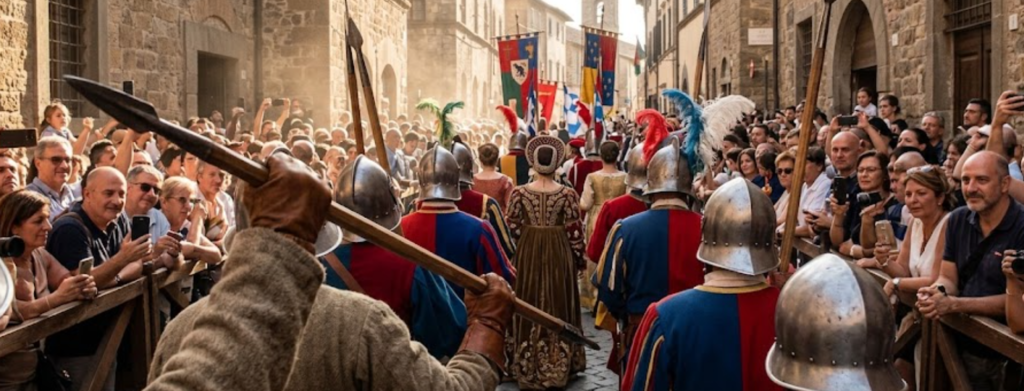
The social architecture of the Porta is the thing that the American visitor rarely understands from the outside and cannot fail to understand from the inside. These neighborhoods have been competing against each other annually — in some form — since the medieval period. The modern reenactment has channeled this rivalry into the specific form of the Giostra dell’Anello and the Palio della Pacca, but the underlying social energy is older than the current format. When you walk in the Porta Picena’s section of the corteo, you are walking in a formation that Picena families have been walking in, in one form or another, for a very long time. The sense of continuity is not performed. It is structural.
This is the context that gives the corteo its weight. It is not a parade of people in period clothing. It is a community’s annual act of self-identification, in which every role — from the Priore at the front to the youngest figurante in the file — is assigned meaning by the community’s own rules and history.
July 5, 2026: The First Corteo Before the Ring Joust
The Giostra dell’Anello at San Ginesio was introduced as a separate summer event in 2024, complementing the Palio della Pacca that has been running on August 15 since 1972. In its first two editions, the ring joust was a full-day competition: morning qualifying rounds, a pause at the Taverna della Giostra, and the afternoon final. The procession before the joust did not exist.
For the 2026 edition — the third — the ATSG took a significant step. For the first time, a corteo storico in costume preceded the equestrian competition, bringing the visual and civic apparatus of the Porta tradition into a summer event that had until that point been purely athletic. The ATSG described it as a novità that “strengthened the link between competition, historical reenactment, and civic identity.” That language is institutional and careful. What it means in practice is that the July event, which had been organized around the joust alone, now had a second register: the processional act of the Porte presenting themselves before competing.
This matters as a development in the tradition’s own logic. A Marchigiano community’s reenactment acquires depth not by getting older but by adding layers — by expanding the number of things it does together, the number of forms in which the Porta’s identity is expressed. The August 15 Palio della Pacca has a corteo storico, a religious ceremony, a joust, a Taverna, a prizegiving and a Festa della Vittoria. The July 5 Giostra, for two years, had only the joust. Adding the corteo is not cosmetic. It is the community deciding that the summer competition is now, properly speaking, a palio — not just a sporting event that happens to have Porta colors on the riders’ jackets.
The Protocol of the Corteo — What You Do, and What You Do Not
Walking in a corteo storico has a protocol, and the protocol matters. This is the part that most outside observers never see because it is invisible from the sidewalk: the rehearsals, the briefings, the specific rules that govern behavior during the processional.
The first rule is the most important: you follow, you do not lead. Your role in the corteo is your role, not any other role. If you have been assigned to walk with the delegation of craftsmen, you do not drift toward the civic authorities. If your Porta’s gonfaloniere is carrying the banner, your job is to walk in the formation around the banner, not to position yourself for a better photograph. The corteo has a spatial grammar, and violating it is noticed — by the people around you, by the organizers, and by the community that takes the correctness of its own ritual seriously.
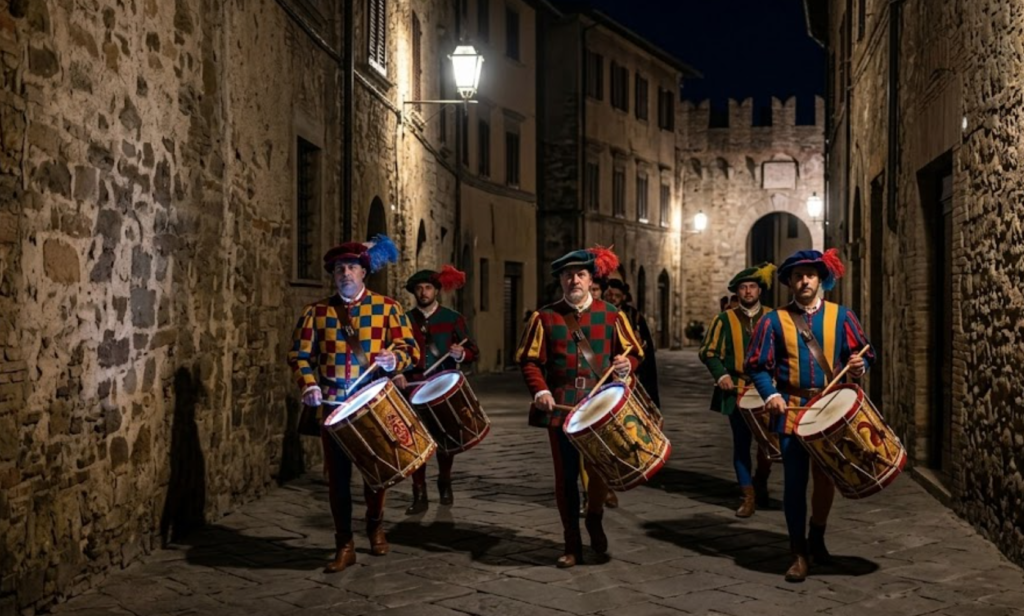
The second rule is about sound. During certain moments, you do not speak. When the procession approaches a point of civic or religious significance — a particular street corner, the threshold of a piazza, the final approach to the event’s focal point — the corteo falls silent except for the drums. The silence is maintained by the figurants without anyone having to remind them. It is something you absorb from the culture around you: when the people near you stop talking, you stop talking. This responsiveness to the group is part of what it means to be in the corteo rather than adjacent to it.
The third rule concerns movement. You walk at the pace of the file. Not faster because you are warm, not slower because you are interested in something on the side of the road. The corteo moves as a body, and its dignity depends on this. A file that stretches and compresses, where individuals speed up or slow down according to personal rhythm, loses the visual quality that makes a corteo worth watching from the outside — and it loses the internal cohesion that makes it worth being inside.
The preparation for these rules begins before the event day. Serious Marchigiano reenactments hold prove — rehearsals, typically in the weeks leading up to the main event. At San Ginesio, the ATSG coordinates the preparatory work; the Porte manage their own figurants’ preparation internally. If you are going to walk in the corteo, you attend the prove. There is no version of respectful participation that involves arriving on the day without having rehearsed with the group.
Can an American Walk in a Corteo Storico?
The honest answer is: rarely, and only with the right introduction.
This is not a bureaucratic restriction. It is a social one, which is simultaneously easier and harder to navigate. There is no application form, no list of rules to comply with, no ticket to purchase. There is only the question of whether the community that owns this tradition has reason to welcome you into it — and whether you come with a relationship that has been established before you ask.
The Italian reenactment communities of Le Marche are not closed. They are not suspicious of foreigners by default. But they have no particular reason to invite a stranger into a role that members of the Porta take seriously and prepare for over months. The invitation comes from a relationship: with someone who is already inside, who is known to the community, who can guarantee that the person they are bringing in will behave with the seriousness the role requires and the respect the tradition deserves.
This is worth being clear about, because there is a version of this experience — sold in various forms by various operators — that consists of renting a period costume and standing in or near a reenactment for a photograph. That is not what I am describing. What I am describing is harder to access, requires more of the person seeking it, and produces a completely different experience. Walking in the corteo as a genuine figurante, guaranteed by someone the community trusts, given a role and expected to fill it — this is an encounter with the tradition, not a consumption of it.
For travelers who want to understand whether this kind of access might eventually become part of how Le Marche’s reenactment communities engage with serious visitors — and I want to say “eventually” with care, because this is not yet a structured offering anywhere I know of — the conversation starts long before the event. It starts with building the kind of relationship that makes an introduction possible. It starts, honestly, by attending as a spectator first, knowing what you are watching, and making yourself known to the people who organize it.
FAQ — Italian Historical Reenactments for the American Visitor
What is an Italian corteo storico and how is it different from a parade? A corteo storico is a historical processional — a structured procession of figurants in period costume, organized according to the social hierarchy of a specific historical moment. Unlike a parade, which moves for the entertainment of spectators, a corteo storico is a community’s ritual act of civic and historical self-expression. The spectators are incidental; the figurants are the primary audience of their own tradition. The distinction sounds subtle and is, in practice, total.
What is a figurante in an Italian reenactment? A figurante is a participant in the historical processional — someone who walks in the corteo in period costume, filling a specific role assigned by the organizers and the community’s own structure. The role might be a craftsman, a civic official, a soldier, a lady of the court, or any number of other figures from the historical period the reenactment depicts. Each role has its own position in the corteo, its own costume, and its own behavioral expectations during the processional.
What was significant about San Ginesio’s July 5, 2026 Giostra dell’Anello? The July 5, 2026 edition of San Ginesio’s Giostra dell’Anello was the first time a full historical corteo in period costume preceded the ring-jousting competition. The ATSG (Associazione Tradizioni Sanginesine) introduced the procession as a novelty that year, deepening the event’s civic dimension beyond the purely athletic competition. It marked a stage in the Giostra dell’Anello’s development from a new summer event into a full-format reenactment with the processional ritual that characterizes San Ginesio’s August 15 Palio della Pacca.
How should an American visitor approach attending a corteo storico? First: attend as a spectator, and attend knowing what you are watching. The Italian Palio guide provides the tassonomic context. Then: understand that the corteo is not for you — it is for the community. It will happen regardless of your presence. Your task as a visitor is to observe without obstructing, to be silent when the procession requires silence, to position yourself so you are watching rather than performing the role of tourist. Finally: if you want to understand the tradition more deeply, begin building the kind of relationship with the community and its organizers that might, over time, make a more immersive encounter possible.
What makes Le Marche’s reenactments different from those in other Italian regions? The concentration of active ring-joust traditions in Le Marche is higher than in any other Italian region. The communities are generally smaller than those associated with famous events like the Siena Palio, which means the social density of the tradition — the percentage of the population that actively participates — is higher. In a town of two thousand people, the Porta is not a subculture. It is a primary social institution. This produces reenactments where the community investment is proportionally deeper, and where a visitor willing to engage seriously will find more genuine access to the tradition than the famous events, with their industrialized tourism infrastructure, typically permit.
How do the four Porte of San Ginesio work? The four Porte — Alvaneto, Ascarana, Offuna and Picena — correspond to the four historic gates of San Ginesio’s fourteenth-century walls. Each Porta has its own colors, heraldry, section of the town, and civic identity that predates the modern reenactment. In the Palio di San Ginesio, the Porte compete across two events: the Giostra dell’Anello (July 5) and the Palio della Pacca (August 15). The Porta with the best combined performance wins the year’s painted palio banner. Within each Porta, the social structure includes a Priore, a Gonfaloniere, figurants, a cavalier, and supporting community members who prepare the Porta’s appearance and sustain its presence in the broader civic life of the town.
What is the physical experience of wearing a period costume in an Italian reenactment? Heavier and warmer than you expect, and more interesting than either of those facts suggests. Natural fiber fabric in multiple layers holds heat differently from modern clothing; the adjustment is real but not incapacitating, and once made, the warmth becomes part of the experience rather than a distraction from it. The weight of the garment affects posture — it is harder to slouch in a fitted wool doublet than in a t-shirt — and the leather soles of period-accurate footwear require more deliberateness on cobblestone. The cumulative effect is a physical relationship with the historical period that no amount of museum-visiting produces.
The Final Word
The deepest form of knowing an Italian tradition is not photographing it, not reading about it, and not watching it from the optimal angle. It is the moment when you are inside the file and the drums start and the line begins to move, and your job is simply to walk correctly — in your assigned position, at the assigned pace, in the costume your Porta provided — while the tradition moves through the streets around you and inside you simultaneously.
I have been watching these reenactments for decades. I know the organizers at San Ginesio, and I have stood at both ends of the experience. What I can tell you is that the corteo storico is not a tourist attraction that happens to be very good. It is a community’s annual act of existing as itself, and the question of what it means to be inside that act rather than in front of it is the question that all serious travel in Italy eventually arrives at.
Building a Le Marche itinerary around the reenactment circuit? I can help you plan the timing, the right events, and the right approach. Book a consultation at TidyCal. And if you want to follow how access to these traditions is developing for serious visitors, the newsletter is where that conversation will happen first.
For the full context of San Ginesio’s Palio — the ring joust mechanics, the Siena connection, the four Porte in competition — the companion guide is here: San Ginesio, Le Marche: The Hill Town That Shares Its History With Siena. For what to see and do in the town beyond the Palio, the destination guide is here: San Ginesio, Le Marche: What to See in Italy’s Balcony of the Sibillini. And for the wider tradition of Italian medieval contests: The Italian Palio, Decoded.