San Ginesio, Le Marche: What to See in Italy’s Balcony of the Sibillini
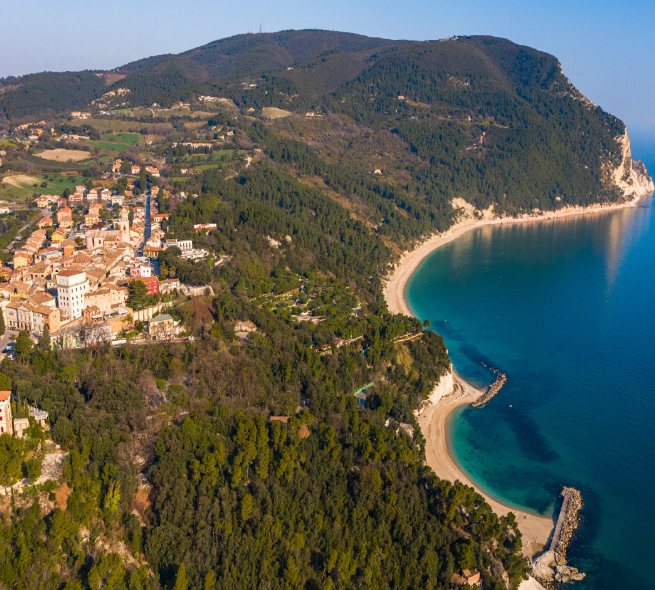
The road crests a ridge and, without announcement, opens onto a view that stops the car. To the west: the grey-blue rampart of the Sibillini, eight peaks above two thousand meters, still carrying snow into May. To the north: a succession of Apennine ridges folding away toward Macerata. Directly ahead: the rooftops and bell tower of San Ginesio at 691 meters, sitting on its hill the way medieval Marchigiano towns tend to sit — with the settled authority of something that chose its position carefully and has not needed to reconsider since.
San Ginesio is one of the Borghi più belli d’Italia, recognized in 2021 by UN Tourism as a Best Tourism Village, and listed as a Touring Club Bandiera Arancione. These are credentials the town carries without advertising them. The village has about two thousand residents, a compact medieval center that takes twenty serious minutes to walk, a July joust and an August festival, and a main piazza named after a man who changed the legal architecture of the modern world and is almost entirely unknown to the international visitors who pass through. That last fact is the reason this article exists.
—
San Ginesio at a Glance
San Ginesio sits in the territory of the Unione Montana dei Monti Azzurri, in the Maceratese hinterland of Le Marche — equidistant, roughly, between the Adriatic coast and the Sibillini mountain range. From Macerata it is 35 kilometers; from Civitanova Marche on the coast, 40; from the trailheads of the Sibillini at Bolognola, under 30 minutes by car. This positioning makes it genuinely versatile: a day trip from the coast, an overnight base for mountain hiking, or the cultural core of a Le Marche interior itinerary that doesn’t touch a single beach.
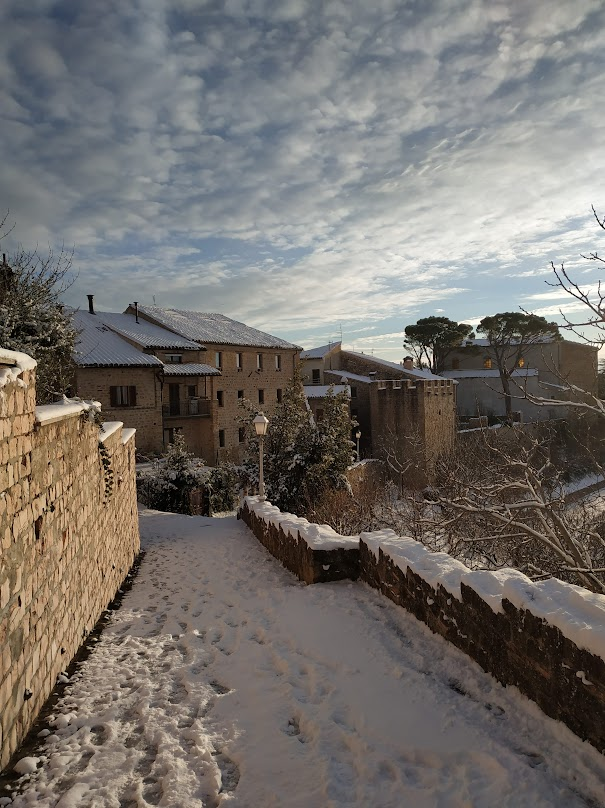
The centro storico is enclosed by fourteenth-century walls with four named gates and is small enough to navigate without a map after thirty minutes. The borough is not flat — it wraps the top of a hill — and the streets slope in ways that reward walking slowly. A full day covers everything comfortably; two days allows for the kind of sitting in a piazza that Italy exists to permit. The civic calendar concentrates in summer, but as a destination San Ginesio works in every season: spring for the Sibillini in bloom, autumn for the beech woodland colors below the walls, winter for the fog that fills the valleys and leaves the town sitting in clear cold air above the cloud line.
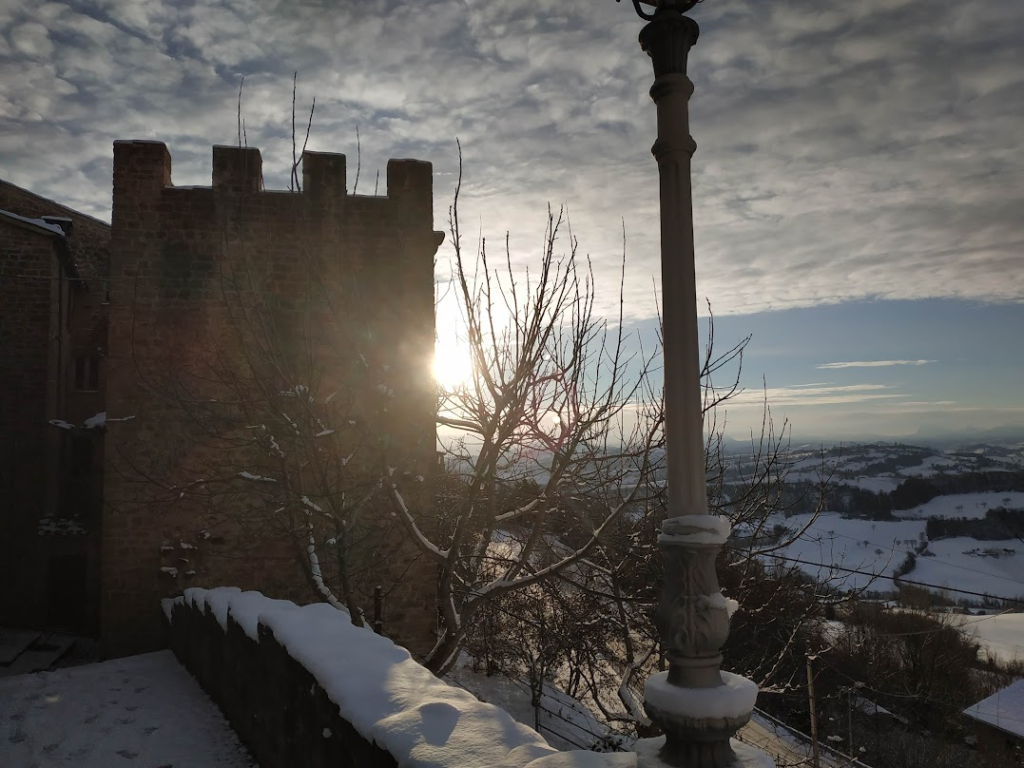
This is not an article about San Ginesio’s Palio or its six-century friendship with Siena — that story, with all its historical detail and summer event dates, lives in our dedicated guide: San Ginesio, Le Marche: The Hill Town That Shares Its History With Siena. What follows is the borough itself: the stone, the art, the man, the earthquake, the recovery.
—
The Jurist Who Changed International Law — and Grew Up Here
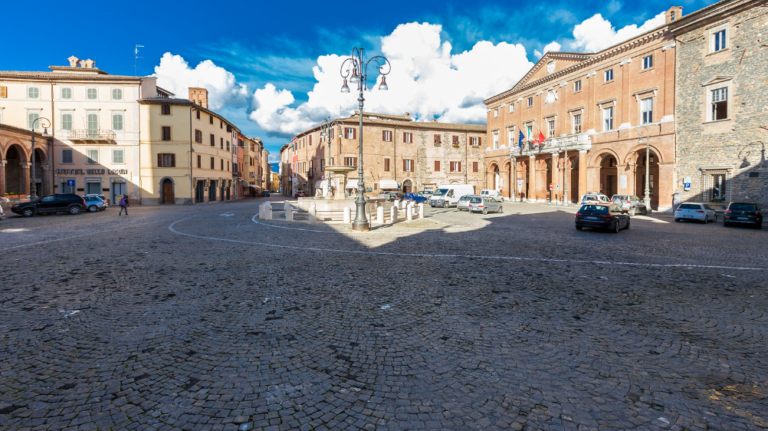
Piazza Alberico Gentili is San Ginesio’s main square. It is named, without apology or explanation on any visible plaque, after a man born here on January 14, 1552, who went on to become one of the founders of modern international law, held the most prestigious law chair in Elizabethan England, and has been referenced in legal scholarship continuously for four hundred years.
Alberico Gentili’s story begins in the way many important intellectual careers of the sixteenth century begin: with forced exile. He studied civil law at the University of Perugia, graduated with a doctorate in 1572, and returned to the Maceratese to work — first as a judge at Ascoli Piceno, then as an advocate in San Ginesio itself. He was good at the work. He was also, in an era when this was dangerous, a Protestant. By 1579 the Inquisition’s interest in his family had become impossible to ignore, and Alberico, his father Matteo — a physician of some reputation — and his brother Scipio fled Italy together, making their way north through the Holy Roman Empire.
Alberico reached London in 1580. Within a year he was teaching at Oxford, introduced to the university through the patronage of Robert Dudley, the Earl of Leicester. In 1587, at thirty-five, he became Regius Professor of Civil Law — the most senior law appointment in England — and the first non-Englishman to hold the position. He taught at Oxford for the remaining twenty-one years of his life, dying in London in 1608.
The work that makes him matter is concentrated in two texts. De Legationibus libri tres (1585) addressed the legal status of ambassadors and diplomatic immunity — the principles that still govern how nations interact through their representatives. De Jure Belli libri tres, published in full form in 1598, went further: it articulated, for the first time in a systematic secular framework, the laws governing the conduct of war between states — who can declare it, how it must be fought, what protections are owed to civilians and prisoners. Hugo Grotius, often called the father of international law, would publish his own foundational texts decades later. He read Gentili first.
The American dimension of this matters for an anglophone reader. The tradition of international law that Gentili inaugurated — a framework in which states operate as members of a community of nations, bound by rules that exist above any single sovereign’s authority — is the tradition that the United States inherited from English legal culture, developed in its own constitutional framework, and still invokes when it argues cases before international tribunals. The Geneva Conventions, the UN Charter, the laws of war: none of these emerged from nowhere. They emerged from a legal tradition that Gentili helped build, from a desk in Oxford, after leaving this hilltop village in the Marche.
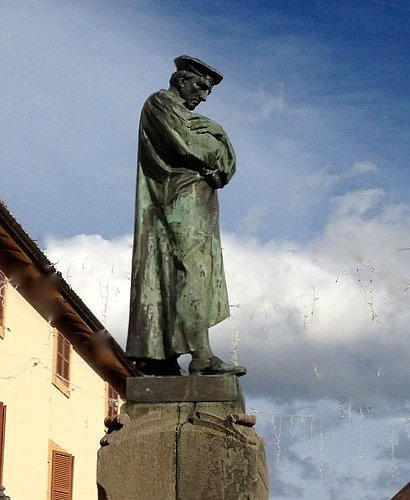
There is a statue of him in the borough. There is a Centro Internazionale di Studi Gentiliani that maintains his scholarly legacy. And there is Piazza Alberico Gentili — the square around which the town’s civic life organizes itself, where the Palio’s joust riders assemble, where the summer festivals fill the outdoor tables, where a plate of pasta and a glass of Verdicchio cost what they cost in a small Italian town that has not yet figured out how to charge tourist prices. Standing in it and knowing who it is named for changes how the square feels. That is the point.
—
The Collegiata dell’Annunziata — Art Under Restoration
In the center of Piazza Alberico Gentili, occupying the position that the town’s entire civic geometry organizes around, is the Collegiata della Santissima Annunziata. It is San Ginesio’s main church, its most important artistic monument, and — since the earthquake sequence that began on August 24, 2016 — it is closed.
This needs to be said plainly, because the church appears on every list of reasons to visit San Ginesio, and any visitor who arrives expecting to walk inside will find scaffolding, barriers, and a building in the careful early stages of a 7.38-million-euro restoration project approved by the Italian government’s earthquake reconstruction commissioner. The Collegiata was declared a National Monument of High Antiquity in 1905. The 2016 seismic sequence damaged it extensively — structurally, the central and northern naves took the worst of it, which is exactly what an engineer would predict from the building’s heterogeneous planimetric structure. The project now underway involves the consolidation of the masonry, repair of vaults and roofing, seismic improvement of the whole fabric, and the restoration of the artworks inside — frescoes, altarpieces, the carved organ loft from 1645.
What you can see from the exterior is already significant: the Romanesque-Gothic façade, the civic tower built at the end of the fourteenth century that is structurally connected to the church, and the sense of a building that has been the physical center of civic life here for six hundred years. The exterior alone, in the quality of its stone and the specificity of its architectural language, is worth time.
Inside, when the restoration is complete, you will find frescoes executed in 1410 by the Salimbeni brothers — Lorenzo and Jacopo, the most important painters of the Marchigiano Quattrocento, working in the crypt-oratory of San Biagio that was incorporated into the church’s structure in the late fourteenth century. The sixteenth-century chapels of the right nave were decorated by Simone De Magistris and other artists of the Ginesino circle. The octagonal Chapel of the Crucifix, built between 1728 and 1744, houses the wooden Crucifix carried back from Siena by the returning exiles — a thread of the town’s history described in full in the Palio guide linked above.
The restoration is ongoing. Before visiting, check current access status through the Comune di San Ginesio or sanginesioturismo.it — there are plans, supported by the commissario, to allow “open worksite” visits that let the public watch the restoration in progress. If that initiative is active when you arrive, take it: watching skilled conservators work on a medieval church interior is an experience that most visitors to Italy never get.
—
The Walls — An Engineer’s Reading
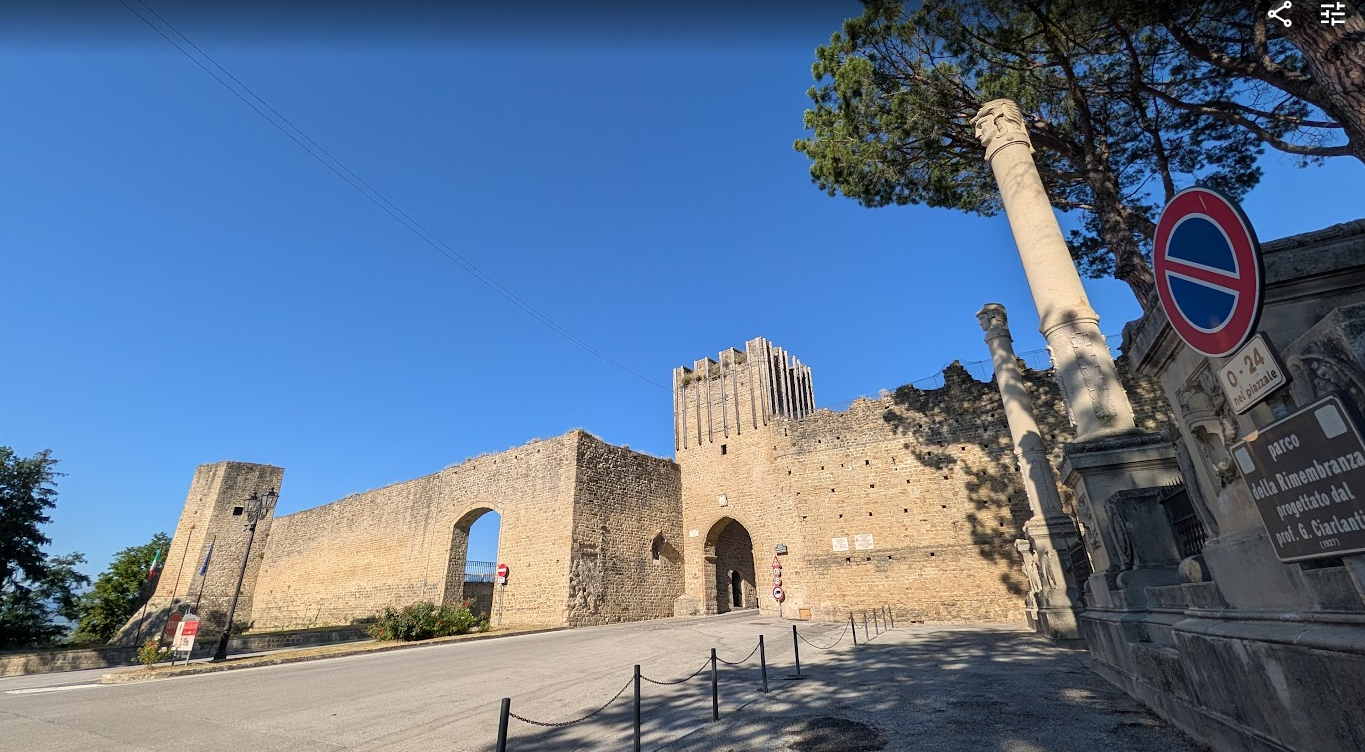
The walls of San Ginesio are from the fourteenth century, and they are in better condition than they have any right to be. For a civil engineer who has spent decades working with historical masonry in the Marche, they are also among the more instructive stretches of medieval military architecture in the region.
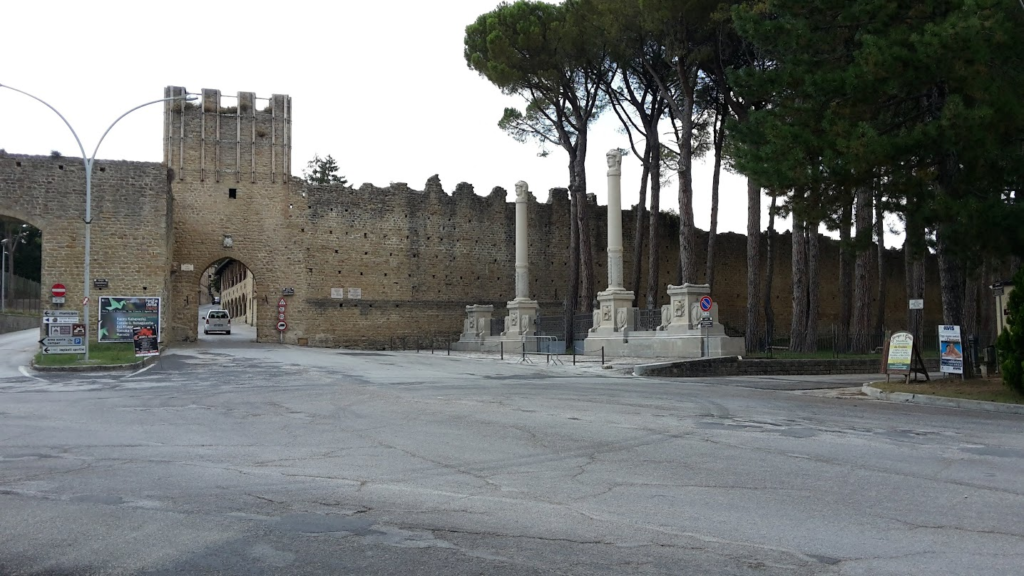
A mountain town wall is a different engineering problem from a valley town wall. The ground is rarely flat, which means the base of the curtain wall must respond to irregular terrain without creating structural weaknesses at the joints. At San Ginesio, the builders solved this by tying the wall’s base into the natural rock outcrops of the ridge, using the geology rather than fighting it. The result is a circuit that reads, in cross-section, as a series of structural conversations between quarried stone and bedrock — the medieval equivalent of a retaining wall that also has to stop an army.
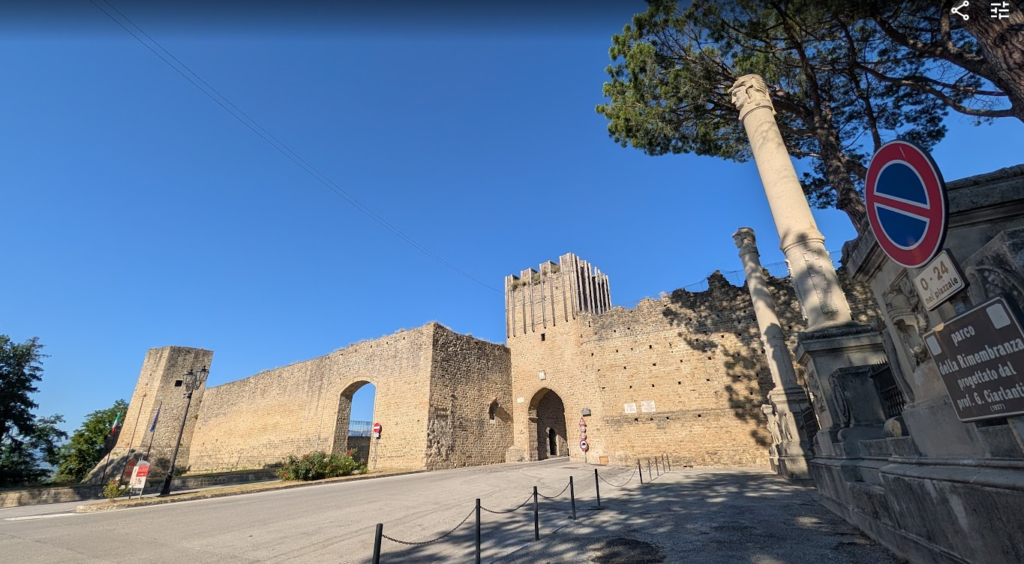
The four gates — Porta Alvaneto to the north, Porta Ascarana at the hill’s crown, Porta Offuna to the east, Porta Picena facing south — are not just passages. They are the load-bearing nodes of the wall system: the points where the curtain changes direction, where the structural forces concentrate, and where the defensive investment was highest. Walking the circuit of the walls takes about forty minutes at a comfortable pace. The views change direction continuously as you move from gate to gate: the Adriatic coast from Porta Ascarana on clear days, the Sibillini from Porta Picena, the Monti Azzurri ridge to the north from Alvaneto. The town exposes a different face at each gate, which is partly why the Palio is organized around them: they are not arbitrary subdivisions.
The walls survived the 2016 earthquake with less damage than the built fabric inside. Stone circuits anchored to bedrock, with no vertical ornamental elements to shear off, perform differently in seismic events than the freestanding church towers and vaulted interiors that tend to take the worst of a tremor’s horizontal forces. This is not luck. It is the empirical validation of six hundred years of mountain fortification logic.
—
The Ospedale dei Pellegrini
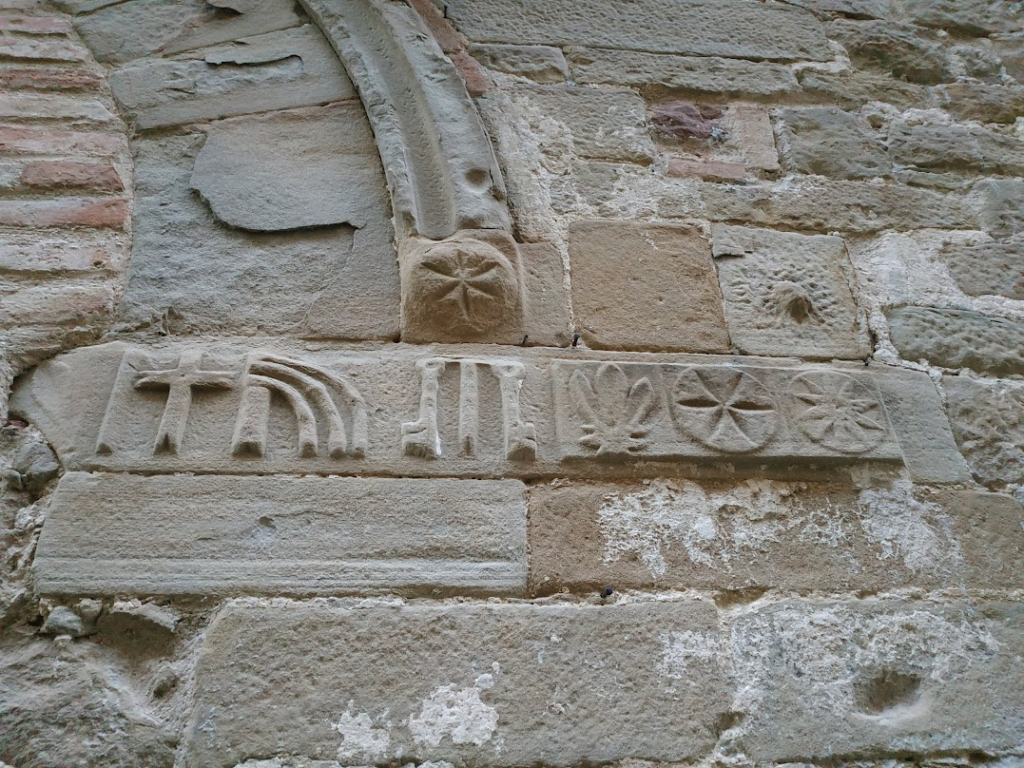
On the edge of the historic center, between the walls and the main piazza, stands one of the most eloquent small buildings in the Maceratese: the Ospedale dei Pellegrini, the medieval hospital for pilgrims. Its loggia — the arcaded ground floor that opens onto the street — is still standing in its original form, a row of round arches in local stone that provided shelter to travelers on the routes crossing the Apennines between the Adriatic and Rome.
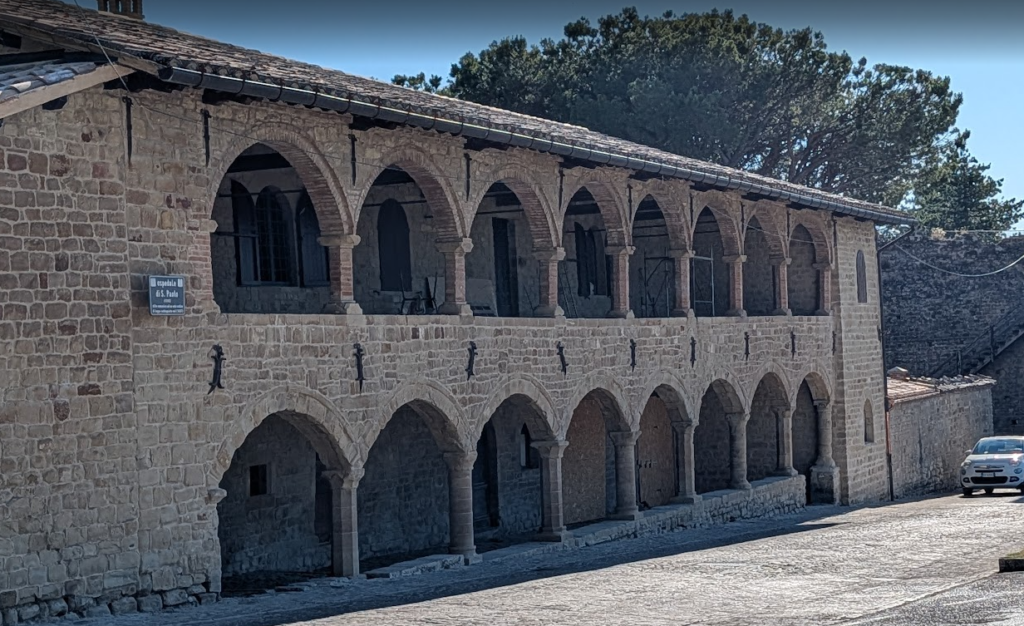
The pilgrimage routes through the Marche connected major sanctuaries: Loreto on the coast, the Benedictine complexes in the hills, the routes to Assisi and Rome. San Ginesio, at its altitude with its walls and its market, was a natural stop. The Ospedale was not a hospital in the modern medical sense: it was a place of civic and religious hospitality, where the town’s charity was organized institutionally. The loggia provided the outdoor sleeping space that pilgrims without funds could use; the rooms inside offered more protected accommodation for the sick or the wealthy.
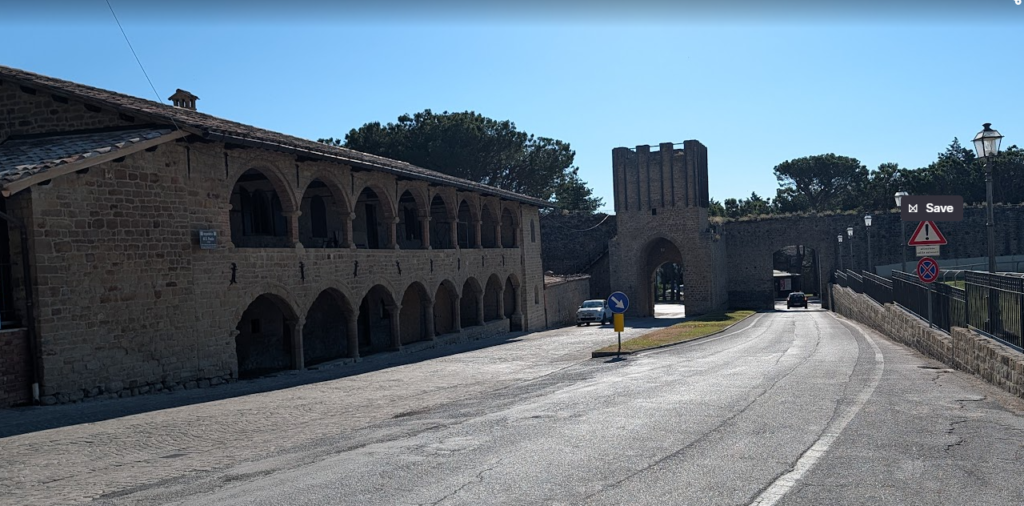
The building is not open for tours in the way a museum is, but the exterior loggia is always visible from the street and is worth stopping at: it is one of the few buildings in San Ginesio that has not been substantially altered since the medieval period, and its proportions — the specific relationship between arch height, pier depth, and the width of the sheltered passage — carry the engineering logic of its original function without modification.
—
The Town’s Summer: Palio, Theater, and a Patron Who Protects Actors
July and August transform San Ginesio’s pace. The Palio di San Ginesio — the ring joust between the town’s four Porte on July 5 and August 15 — is the larger event, detailed in full in the dedicated guide already linked above. What it does to the town’s atmosphere is worth noting here: from late June, the colors of Alvaneto, Ascarana, Offuna and Picena appear in windows and doorways, the osterie of each Porta open their outdoor tables for neighborhood dinners, and the Campo del Palio below the walls becomes the focus of the town’s collective attention.
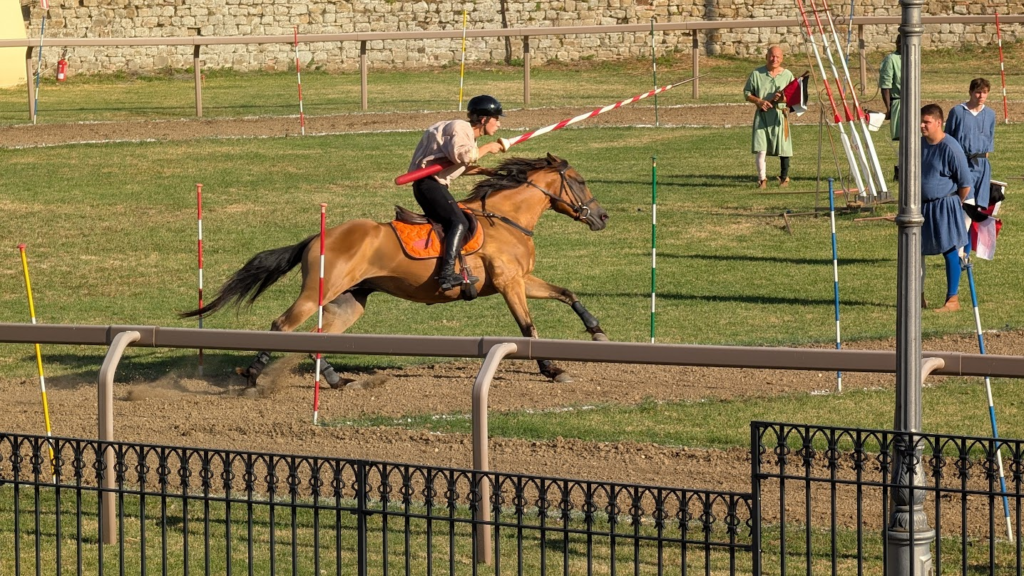
Overlapping with this is the Ginesio Fest, San Ginesio’s international theater festival. The festival’s connection to the town’s patron saint is not incidental: San Ginesio is named for Genesio of Rome, the third-century mime who, according to the tradition, converted to Christianity on stage during a performance before Emperor Diocletian — and was martyred for it. Genesio is the patron saint of actors worldwide. A festival dedicated to the art of the actor, in a town that carries his name, is not a branding exercise. It is a logical consequence of six hundred years of civic identity. The Ginesio Fest deserves its own article — it will have one — but its presence in the summer calendar is worth knowing when you plan.
—
After the Earthquake: What Reconstruction Looks Like
On August 24, 2016, a magnitude 6.2 earthquake struck the central Apennines south of Norcia, and the sequence that followed over the next weeks — culminating in a 6.6 magnitude event on October 30 — affected dozens of municipalities across Umbria, Lazio and the Marche. San Ginesio was inside the crater zone.
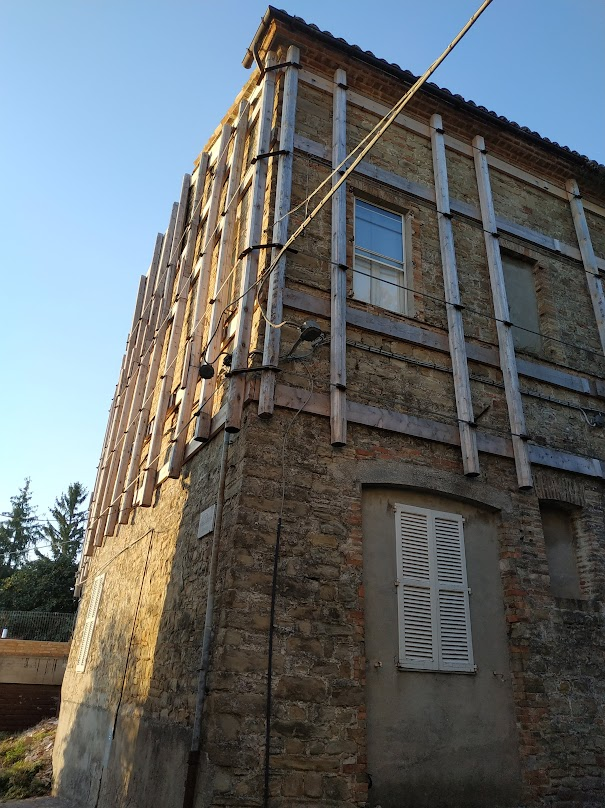
The town lost its central church. Other historic buildings were damaged to varying degrees. No one was killed in San Ginesio — the seismic culture of the Marchigiano Apennine towns is real, and the building stock, for all its age, was not as vulnerable as equivalent construction in the valley floors — but the damage to the civic and cultural fabric was significant and is still being addressed. As of mid-2026, the emergency period of the post-earthquake reconstruction has been extended to December 31, 2026. The state of emergency has been active for nearly ten years.
What that looks like on the ground is a town that functions — the walls are there, the piazza is there, the osterie are open, the Palio is running — with scaffolding on some buildings and active work crews on others. The Commissario Straordinario’s office has funded a comprehensive urban regeneration program for Piazza Gentili and the historic center’s infrastructure (sewage, utilities, road surfaces): the kind of below-ground work that is invisible to visitors but essential to a town’s long-term habitability. The school reconstruction is funded. The Collegiata project is approved and underway.
An engineer looking at a seismic reconstruction ten years in does not see failure. A major seismic event in a medieval stone borough produces a reconstruction timeline of fifteen to twenty years as a minimum — this is not Italian inefficiency, it is the physical reality of restoring masonry structures with cultural heritage constraints, public procurement law, and the need to get the engineering right the first time. San Ginesio is on track. The community is still there, which is the only metric that ultimately matters.
If you visit now, you visit a town in the middle of its own story. That is, arguably, a more honest encounter with the Marche than visiting somewhere whose history is already finished.
—
The Sibillini at the Door
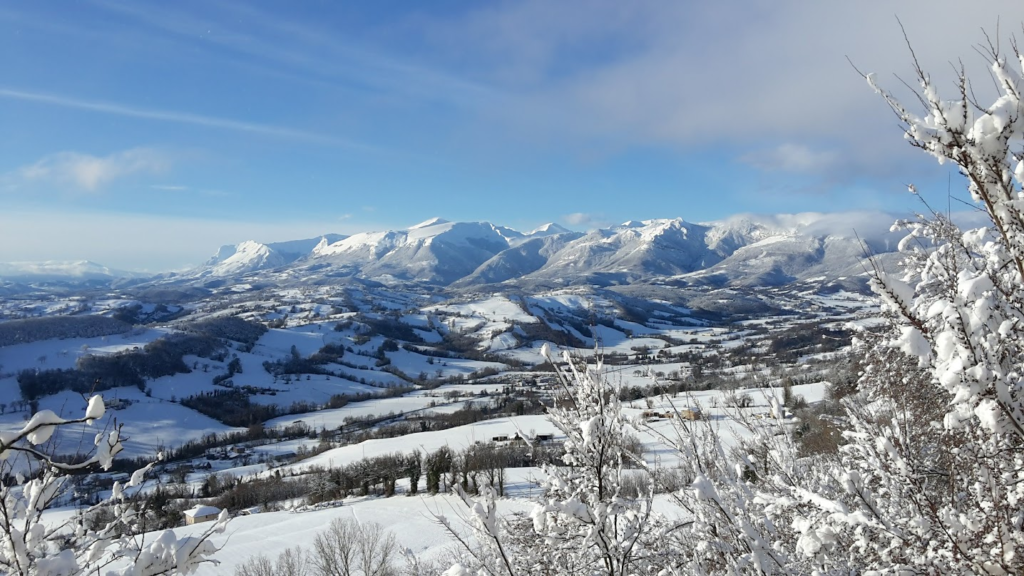
San Ginesio’s tagline — il balcone dei Sibillini, the Sibillini’s balcony — is not metaphor. The mountain range is visible from the town walls, and the nearest trailheads are under thirty minutes away by car. Bolognola, a ski station in the winter and a hiking base in summer, is the closest entry point to the Sibillini National Park from the San Ginesio side. The trails above Bolognola access the high plateau that connects to the ridge above Ussita and, beyond it, to the summit zones.
Sarnano, ten minutes south of San Ginesio, is the thermal spa town of the Maceratese: the Terme di Sarnano operate through the summer season and offer the standard Italian mineral-water treatment program alongside the more casual use that locals make of the facilities on a Saturday morning. The medieval centro storico of Sarnano itself — smaller than San Ginesio, better preserved in some respects — is worth an afternoon.
For longer excursions, Camerino (the university town, thirty minutes northwest) has a fine Romanesque-Gothic centro storico still partially affected by the 2016 earthquake and in active restoration; the archaeological museum and the botanical garden are open. Tolentino (forty minutes north) has the Basilica di San Nicola da Tolentino and a well-preserved historic center. Macerata (forty minutes north) is the provincial capital and the home of the Sferisterio opera festival in July and August — an open-air Roman-revival arena that hosts Verdi and Puccini under the Marchigiano summer sky, and whose combination with a trip to San Ginesio makes one of the better two-day Marche itineraries I know.
—
Planning Your Visit
Getting there. San Ginesio has no train station. The nearest are Macerata (35 km northwest) and Civitanova Marche (40 km northeast on the coast), both connected to the main Italian rail network. From either, a car or taxi is necessary for the final stretch. From the A14 motorway (Bologna-Bari), exit at Civitanova Marche and follow the SS485 inland to Macerata, then the SS78 toward San Ginesio. From Rome, the A24 to the Marche via L’Aquila and then north takes approximately three hours. From Ancona, the coast road south to Civitanova and then inland is under ninety minutes.
When to go. The summer calendar — Palio in July and August, Ginesio Fest in July — is the obvious draw, but I have driven to San Ginesio in every month of the year for professional reasons, and the most memorable visits have not always been in summer. March and April bring wildflowers to the Sibillini slopes and light that has none of July’s bleached flatness. October turns the beech woodland below the walls the color of old copper. February, on a clear morning after snow, puts the Sibillini into a resolution that summer haze never manages. Plan around the events if the events are why you are coming; otherwise, any month works.
What to eat. The kitchen of the Sibillini hinterland is the kitchen of high-altitude interior Italy: agnello (lamb from the upland pastures), lenticchie di Castelluccio (the celebrated small lentils from the high plain, forty minutes south), pecorino aged in the mountain farms, and the bread that surprises every visitor who didn’t know — the Marche’s traditional bread contains no salt, a custom that dates to a medieval salt tax and that produces a loaf with a different, denser texture than the Tuscan version. The appropriate response is not to conclude it is wrong, but to understand that it was designed to be eaten alongside the strongly flavored cured meats and cheeses of the territory. It is a system. The osterie of the four Porte operate during the Palio weeks; outside those dates, the town’s restaurants offer the standard Marchigiano menu at prices that reflect a town with a local clientele.
Internal links for your planning. The Palio di San Ginesio and the Siena connection is the companion piece to this article and covers the summer events in detail. For the wider context of Le Marche’s medieval jousting tradition, see The Italian Palio, Decoded. For another of the region’s most beautiful hill towns, Cingoli — the Balcony of the Marche follows the same logic from a different ridge. And for the food and landscape context that frames all of this, our guide to Le Marche and the Mediterranean Diet explains why this particular territory produces what it produces.
—
FAQ — San Ginesio for the American Visitor
What is San Ginesio and why should I visit? San Ginesio is a medieval hilltop borough in the Maceratese interior of Le Marche, at 691 meters, with views across the Sibillini mountain range. It is one of Italy’s Borghi più belli (Most Beautiful Villages) and a UN Tourism Best Tourism Village (2021). The reasons to visit are specific: the main piazza is named for Alberico Gentili, a sixteenth-century jurist born here who became one of the founders of modern international law; the medieval walls and gates are among the most intact in the region; the town runs a twice-annual medieval ring joust; and it sits at the gateway to the Sibillini National Park. It is not a famous destination, which is part of the point.
Who was Alberico Gentili and why does he matter to Americans? Alberico Gentili (January 14, 1552 – June 19, 1608) was born in San Ginesio, studied law at Perugia, fled Italy as a Protestant exile in 1579, and spent the rest of his life at the University of Oxford, where he was appointed Regius Professor of Civil Law in 1587 — the first non-Englishman to hold that position. His books De Legationibus (on diplomatic law) and De Jure Belli (on the laws of war) were the first systematic secular treatment of international law in Western Europe, preceding and influencing Grotius. The tradition he initiated — that states are bound by rules above any single sovereign’s will — is the tradition that runs through English legal culture into American constitutionalism and, eventually, the UN Charter and the Geneva Conventions. The town’s main piazza bears his name.
Is the Collegiata dell’Annunziata open to visitors? No — as of mid-2026, the Collegiata is closed for restoration following damage from the 2016 earthquake sequence. A 7.38-million-euro project was approved in late 2023 and works are underway, covering structural consolidation, seismic improvement, and restoration of the artworks inside. The exterior and tower are visible from the piazza. Check current access status at sanginesioturismo.it before visiting — there are plans for supervised “open worksite” access that would allow visitors to observe the restoration in progress.
What is the Ginesio Fest? Ginesio Fest is San Ginesio’s international theater festival, held each summer. Its connection to the town is direct: the borough is named for Genesio of Rome, a third-century mime and martyr who is the patron saint of actors worldwide. A theater festival in a town named for the patron saint of actors is not arbitrary — it is one of the more logical cultural decisions in Italian festival programming. The festival brings national and international theater companies to perform in the piazza and the Auditorium di Sant’Agostino. Check the current year’s program at sanginesioturismo.it.
How long does San Ginesio take to visit? The centro storico is compact — a twenty-minute walk covers the main points. A full day at comfortable pace visits the piazza and the Collegiata exterior, walks the wall circuit (forty minutes), sees the Ospedale dei Pellegrini loggia, eats lunch in the town, and has time to sit. A second day allows for the Sibillini or Sarnano. If you are combining San Ginesio with the July 5 joust, arrive the afternoon or evening of July 4 for the pre-Palio atmosphere in the Porte osterie.
Is San Ginesio affected by the 2016 earthquake reconstruction? Yes, and visibly. The Collegiata is closed for restoration. Some other buildings carry scaffolding or show repair work in progress. The town is functioning — the streets, piazza, restaurants and Palio are all operational — but the reconstruction of its central architectural monuments is ongoing and will continue through the late 2020s. Visiting during an active reconstruction is a different experience from visiting a town where the history is finished: it has its own authenticity, and the town’s civic life does not pause for the scaffolding.
What are the best things to combine with a San Ginesio visit? Within thirty minutes: the Sibillini National Park trailheads at Bolognola; the thermal baths and medieval center of Sarnano; Camerino (university town, partially restored after 2016). Within forty-five minutes: Tolentino (Basilica di San Nicola); Macerata and the Sferisterio opera festival (July–August). On the coast, 40 kilometers east: Civitanova Marche and the Riviera del Conero. For a two-day Marche interior itinerary, San Ginesio paired with Macerata and Sarnano covers a coherent cultural and landscape arc.
—
The Final Word
San Ginesio’s claim on the visitor’s attention is not spectacular and is not meant to be. It is a small hilltop town that produced one of the most important legal thinkers of the early modern period, maintained its medieval walls through a sequence of centuries and a major earthquake, runs a genuine community competition every summer with a lance and a brass ring, and sits within a day’s walk of mountains serious enough to require preparation. The piazza named after Gentili is the town’s center of gravity — physically and, once you know who he was, intellectually.
The question the town poses, without asking it directly, is the same one that the best of the Marche’s interior borghi always pose: how large a thing can a small place be the origin of? In San Ginesio’s case, the answer involves the legal framework governing how nations go to war, how diplomats are protected, and how the international community is supposed to conduct itself. Not bad for a hilltop of two thousand people at 691 meters in the Maceratese Apennine.
Building a Le Marche itinerary and want an Italian insider’s perspective on sequencing, timing, and what’s actually worth the trip? You can book a 30-minute consultation at TidyCal.
If San Ginesio has you wondering what it would take to own a house behind those medieval walls, I should mention that I inspect these buildings for a living. Before any foreign buyer signs here, I offer an independent property survey — the technical read the notary won’t give you.
—-
Written by Mirco Vitellozzi, a structural engineer from Le Marche who writes about Italy from the inside. More essays at Tastes & Wonders of Italy, and short films on YouTube.