Things to Do in Siena: Reading the City Tourists Walk Through
For roughly ten months of the year, the single most extraordinary floor in Christendom lies buried under sheets of protective hardboard, and the crowds compiling their list of things to do in Siena walk straight across it without knowing it is there. Fifty-six marble panels, worked by more than forty artists between the fourteenth and the nineteenth century, disappear beneath the feet of a million visitors until the Opera della Metropolitana lifts the covers for a few precious weeks each year. I have spent three decades reading buildings for a living — why a wall cracks, why a floor settles, why an ambitious project stalls halfway through — and Siena rewards that kind of looking more than almost any city in Italy. This is not a list of ten sights. It is a guide to what most people are standing on without seeing.
The essential things to do in Siena fit into a single, focused day: the Duomo di Siena and its inlaid marble floor, the adjoining Museo dell’Opera and the Facciatone terrace, Piazza del Campo with the Palazzo Pubblico and the Torre del Mangia, and the Complesso di Santa Maria della Scala, the former pilgrim hospital directly across the square from the cathedral. The historic center sits inside a strict Zona a Traffico Limitato — a low-emissions zone closed to unauthorized traffic — so every one of these stops is reached on foot. A committed visitor covers the highlights in one day; the cathedral floor is only fully visible during limited windows each year, and a second day rewards anyone willing to slow down.
The Duomo and the Floor Beneath It
A Pavimento Five Centuries in the Making
The technique has a name most visitors never learn: commesso marmoreo, a form of marble inlay related to intarsia, built up from colored stone fitted together like a wooden mosaic. The earliest panels used a simpler method called graffito, where outlines were incised into white marble and packed with black stucco. Both techniques appear across the cathedral floor’s fifty-six scenes, a program that began in the 1300s and was still being completed in the 1800s — five hundred years of continuous work by generation after generation of Sienese artists, with one notable outsider: the Umbrian painter Pinturicchio, who in 1505 contributed the design for the Allegory of the Hill of Wisdom. Giorgio Vasari, writing decades after the project began, judged it “the most beautiful, the greatest, and the most magnificent [floor] ever made.” Contemporary art historians have not found much to argue with in that verdict.
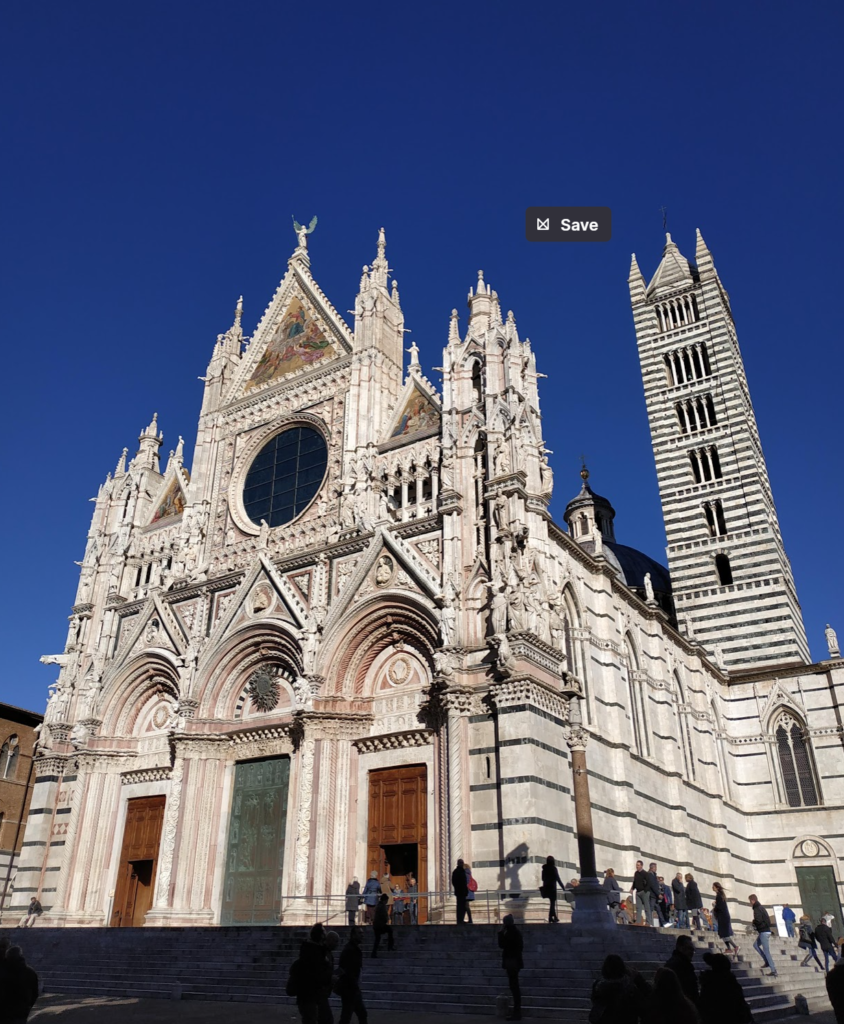
Walk the nave and the iconographic logic reveals itself in layers: pagan antiquity along the side aisles — ten Sibyls, the philosopher Hermes Trismegistus, Crates of Thebes tossing his fortune into the sea — giving way, toward the altar, to Old Testament narrative and the darker Massacre of the Innocents by Matteo di Giovanni. Near the crossing, the Sienese Mannerist painter Domenico Beccafumi worked scenes from the life of Moses with a chiaroscuro so advanced it is easy to forget you are looking at inlaid stone rather than paint.
Because the floor is fragile, it spends most of the year protected, and the Opera della Metropolitana schedules a handful of uncovering windows that shift from year to year according to the liturgical calendar and, in 2026, an additional civic occasion: 2026 marks the eight-hundredth anniversary of the death of Saint Francis of Assisi, and the Archdiocese of Siena has extended this year’s uncovering to two long stretches, June 27 through July 31 and August 18 through November 15. In an ordinary year the window runs shorter, typically clustered in late summer and early fall — so treat any specific date you read, including these, as something to reconfirm on operaduomo.siena.it before you build a trip around it.
The Libreria Piccolomini and an Engineer’s Read on the Duomo Nuovo
Inside the cathedral, a doorway leads into the Libreria Piccolomini, commissioned by a Sienese cardinal to house his uncle’s book collection and decorated by Pinturicchio with ten luminous scenes from the life of Pope Pius II. It is one of the few interiors in Italy where the ceiling, the walls, and the marble floor beneath your feet were all conceived as a single artistic program, and it is routinely skipped by visitors moving too fast toward the exit.
The real structural drama at the Duomo, though, is outside — in what Sienese call the Facciatone, “the big façade.” In 1339, at the height of its wealth, Siena’s General Council approved a plan to triple the cathedral in size, turning the existing building into a mere transept of a much larger church meant to rival, and outdo, the new cathedral rising in Florence. Work began quickly under the sculptor Giovanni di Agostino. Then, in 1348, the Black Death arrived and killed a large share of the city’s population, including Agostino himself. What is less often explained to visitors is that the plague alone did not kill the project: the parts of the new nave already built were showing serious cracking and structural failure, and by 1357 the Twelve Governors of the Republic ordered a partial demolition of sections judged unsafe. As someone who has spent a career assessing why buildings crack, I read that combination — a workforce and treasury gutted by disease, layered onto a structure that was already failing under its own ambition — as the far more common story than either cause alone. Overreach rarely fails for one reason. What survives today is an enormous freestanding wall with three empty arches behind it, the beginnings of columns still visible in the piazza, and a rooftop terrace with one of the widest views in Tuscany. A crypt beneath the older cathedral, sealed with rubble in the fourteenth century and rediscovered only in 1999, still holds thirteenth-century frescoes in colors so vivid that conservators are still studying who painted them.
Piazza del Campo and the Government That Built It
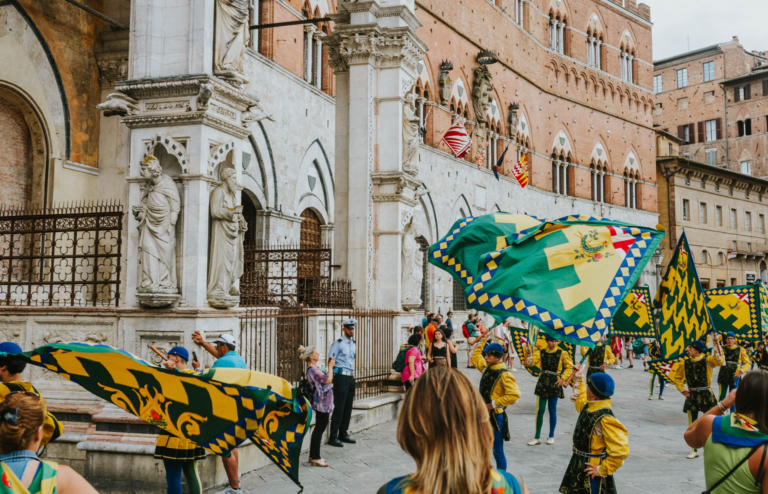
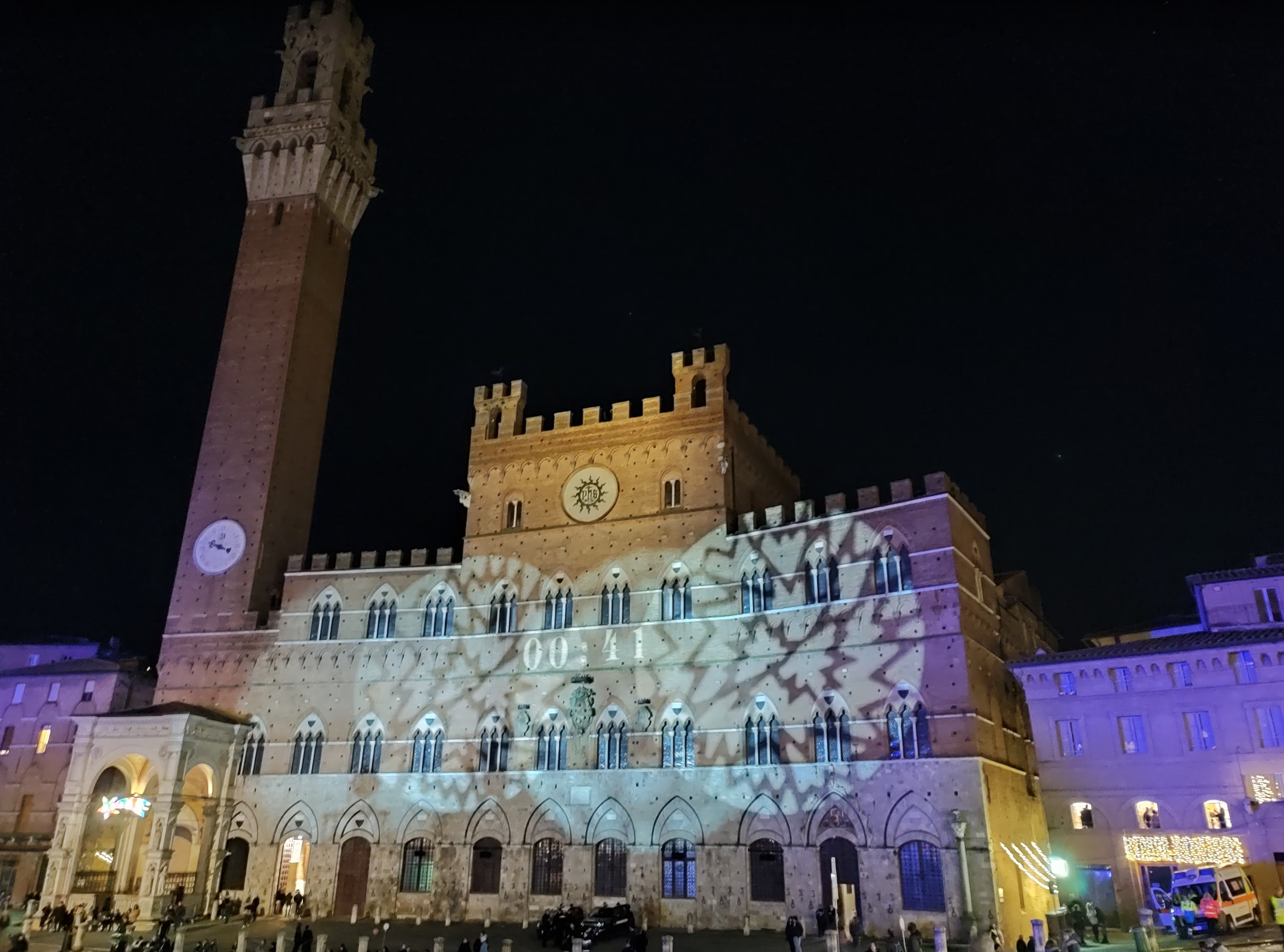
Piazza del Campo slopes downhill in a shape Sienese have compared to a scallop shell for centuries, its herringbone brick paving divided by pale travertine strips into nine wedge-shaped sections. The number is not decorative. Between 1287 and 1355, Siena was governed by the Government of the Nine, a rotating council of nine merchant magistrates, and when the piazza’s brick surface was laid around 1349 the nine sections were built as a literal, walkable reminder of who ran the city.
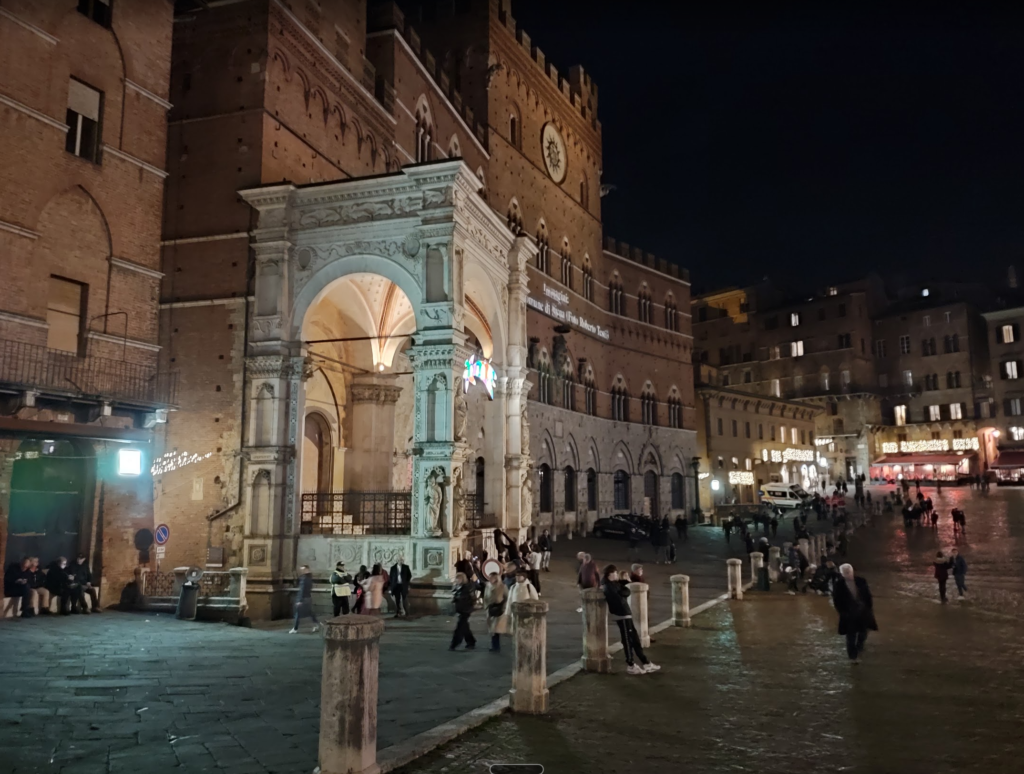
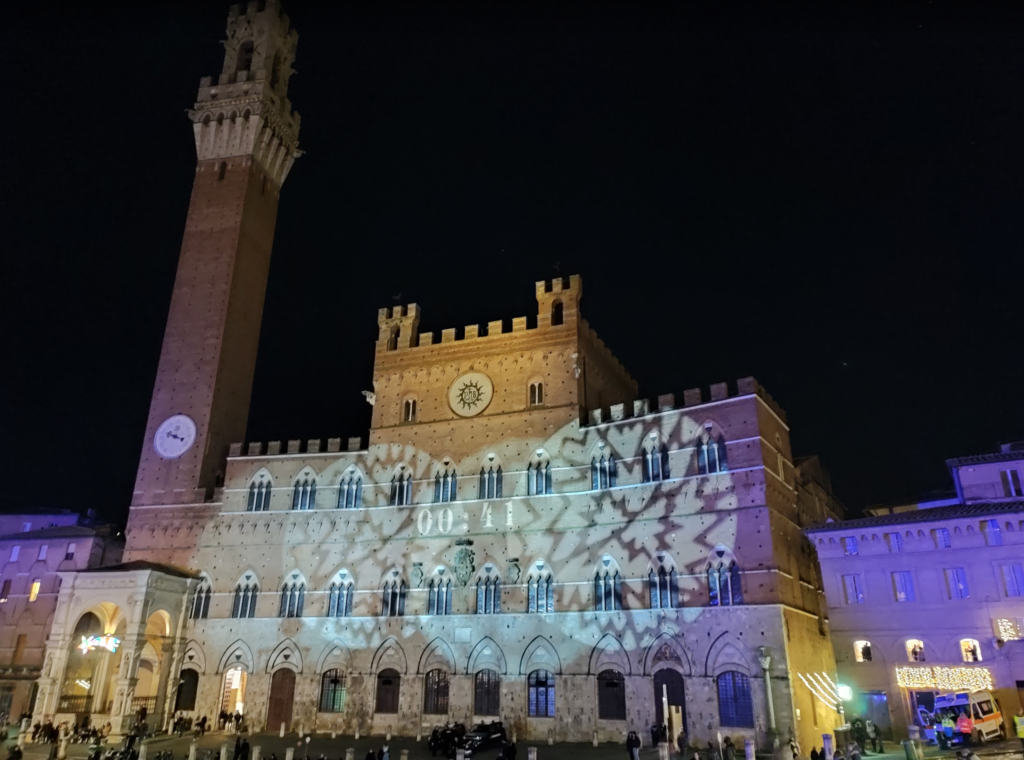
The Nine also commissioned the piazza’s dominant building, the Palazzo Pubblico, and inside it, between 1338 and 1339, they had the painter Ambrogio Lorenzetti cover their council chamber with what remains one of the only surviving secular fresco cycles from the Middle Ages: the Allegory of Good and Bad Government. One wall shows a city of trade, dancing, and cultivated countryside; the opposite wall shows the same city under tyranny — crime, drought, ruin. The magistrates who met in that room, replaced every two months to prevent corruption from taking root, worked beneath a painted warning about exactly what their decisions could produce either way.
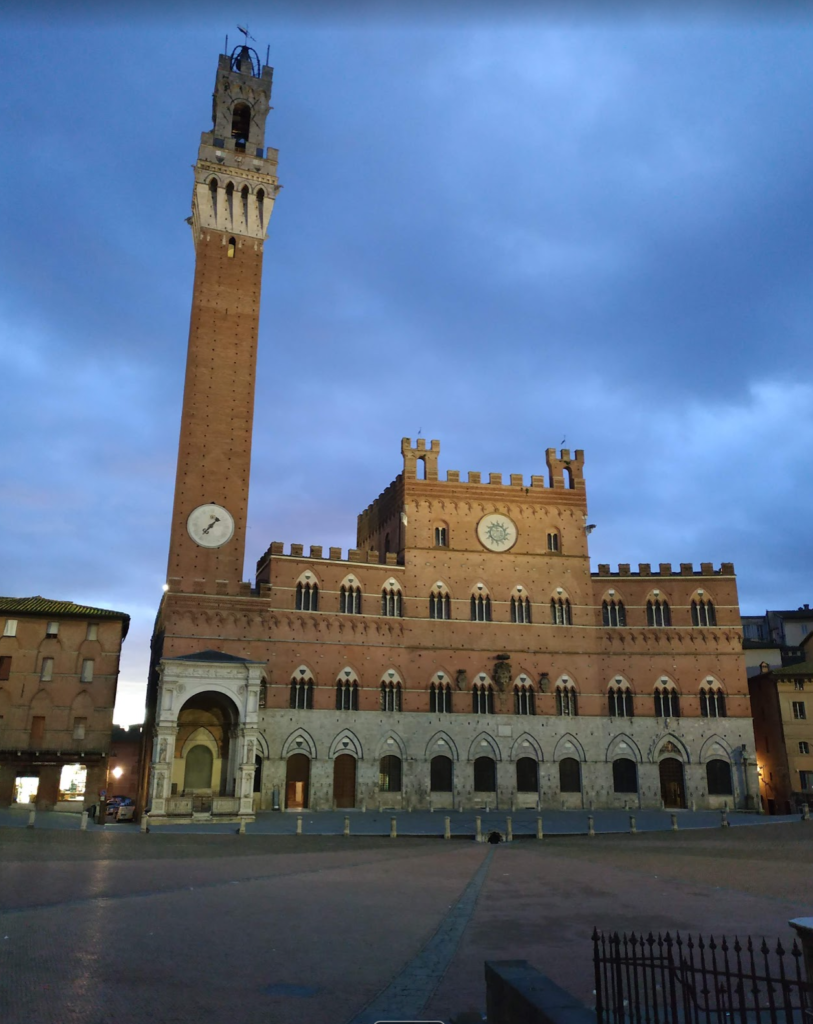
Beside the palazzo rises the Torre del Mangia, roughly eighty-seven meters tall — a hundred and two if you count the lightning rod at its tip — built between 1338 and 1348 to stand, deliberately, at almost exactly the same height as the cathedral’s bell tower, a piece of civic symbolism balancing secular and religious power. Climbing it means about four hundred narrow, unevenly worn stone steps with no elevator and a daily visitor cap; the city closes it in bad weather or during maintenance, so it is worth confirming it is open before you plan your afternoon around it. Piazza del Campo is also, twice each summer, the track for the Palio di Siena, the bareback horse race run around its perimeter. This piece will not attempt to explain the Palio’s contrade and rivalries here — that history deserves its own space, and I have already given it one.
Santa Maria della Scala, the Hospital Almost Everyone Skips
Directly across Piazza del Duomo from the cathedral sits a building most itineraries mention in a single sentence and most visitors walk straight past: the Complesso di Santa Maria della Scala. It began as a hospice for pilgrims traveling the Via Francigena sometime before the late twelfth century, with its earliest surviving statute dated 1257, and it went on to function as a working hospital for the city of Siena until it finally closed its medical wards in the early 1990s. According to the English-language Wikipedia entry on the complex, Santa Maria della Scala was among Europe’s first hospitals and remains one of the oldest still standing anywhere in the world.
Inside, the Pellegrinaio — the long pilgrims’ hall built in the 1300s — is covered floor to ceiling with fifteenth-century frescoes by Domenico di Bartolo and others, depicting the hospital’s own daily functions: distributing alms, nursing the sick, educating orphaned children. It is a rare thing in Italian art, a fresco cycle about a hospital’s administrative life rather than a saint’s. Below ground, tunnels cut into the tufa rock lead to a national archaeological museum built into the hospital’s old cisterns and granaries — Etruscan and Roman material displayed in corridors that were, centuries ago, the supply route for a working infirmary. Almost nobody who photographs the Duomo’s façade crosses the piazza to see any of it.
What Separates Seeing Siena From Passing Through It
The floor beneath the cathedral, the arithmetic built into the piazza’s paving, the hospital that hides an archaeological museum in its cellars: none of it is hidden in the sense of being hard to find. All of it sits in plain sight, in the most visited square in the city, and almost none of it registers with someone moving through Siena at the pace a checklist demands. The difference between checking items off a list of things to do in Siena and actually seeing the city is mostly a matter of slowing down enough to ask what you are looking at, rather than only where to stand for the photograph.
Things to Do in Siena in One Day: Getting There and Getting Around
Siena connects to Florence by direct regional train in about ninety minutes, with departures roughly every hour throughout the day from Firenze Santa Maria Novella — there is no high-speed line to Siena, so do not expect a Frecciarossa journey time. Driving covers the same distance faster on paper, but it delivers you to a historic center you cannot enter: Siena’s Zona a Traffico Limitato has closed the center to unauthorized vehicles since 1965 (Piazza del Campo itself has been car-free since 1962), with camera-controlled gates that issue automatic fines to anyone who drives through without authorization. Park in one of the structures ringing the walls — Il Campo, San Francesco, and the Fortezza lots are the most central — and walk in, in some cases via mechanized escalators built into the old city gates.
For entry to the cathedral complex, the combined ticket is called the OPA SI Pass, valid for three consecutive days and covering the cathedral, the Libreria Piccolomini, the crypt, the baptistery, the Museo dell’Opera, and the Facciatone terrace. It runs sixteen euros per adult during the floor’s uncovering periods and fourteen euros the rest of the year, figures worth reconfirming before you travel since museum pricing changes. It does not cover the Torre del Mangia, the Palazzo Pubblico’s Museo Civico, or Santa Maria della Scala, each ticketed separately.
A single day built around these stops runs something like this:
- Morning: the Duomo and the marble floor, before tour groups arrive, followed by the Libreria Piccolomini and the Facciatone terrace
- Midday: lunch in one of the streets off Via di Città, then Piazza del Campo
- Afternoon: the Palazzo Pubblico’s frescoes, the climb up the Torre del Mangia if the legs allow it
- Late afternoon: Santa Maria della Scala, before the museum complex closes for the evening
If your dates fall near July 2 or August 16, build in slack: those are Palio days, when much of the center closes to normal tourism and the city runs on its own rhythm entirely. Booking the day before or after is the easier trip.
What’s Worth Booking in Siena
A note on the links below: some are affiliate links. If you book through them, I earn a small commission at no extra cost to you, and it helps keep this blog independent. I only point to things I would send a friend to.
For a first pass at the city’s layout and its contrade — the seventeen historic districts behind the Palio — a local guided walking tour does more in two hours than a guidebook does in an afternoon, because a good guide reads the neighborhoods for you the way I have been reading the buildings in this piece. The single most on-topic booking for everything above, though, is a skip-the-line Duomo and Libreria Piccolomini tour: go early, before the tour groups arrive, and you will have something close to a private audience with Pinturicchio’s frescoes and, if your dates align with an uncovering window, the floor itself. For anyone staying past a single afternoon, a hands-on pasta and tiramisù cooking class is a good use of an evening, and travelers with a spare day should consider a Chianti countryside tour with castles and a wine tasting departing directly from Siena.
The logic that makes Siena worth this kind of attention — a floor covered for most of the year, a piazza whose shape is a civics lesson, a hospital doing double duty as an archaeological museum — is exactly the logic behind central Italy’s most underrated region. If Siena rewards you for looking past the postcard, Tuscany’s more famous towns compared against Le Marche makes the case for where that same instinct pays off even more. And if the idea of a small hill town holding an unexpected piece of Sienese history appeals to you, San Ginesio in the Marche shares an actual historical bond with Siena worth knowing about before you leave Tuscany behind.
FAQ — Planning Your Siena Visit
When is the Siena Cathedral floor uncovered? The uncovering dates change every year and are set by the Opera della Metropolitana. In 2026, an extended edition tied to the Year of Saint Francis runs June 27 to July 31 and August 18 to November 15; in a typical year the window is shorter and falls in late summer through early fall. Always confirm current dates on operaduomo.siena.it before planning around them.
What is there to do in Siena in one day? A focused day covers the Duomo and its marble floor, the Libreria Piccolomini, the Facciatone terrace, Piazza del Campo, the Palazzo Pubblico’s fresco cycle, the Torre del Mangia, and Santa Maria della Scala. All of it is within a fifteen-minute walk of the cathedral.
Is the Siena Duomo worth it? Yes, independent of the floor’s uncovering schedule. The building itself, the Libreria Piccolomini’s frescoes, and the Museo dell’Opera hold masterpieces by Nicola Pisano, Donatello, and Bernini, and the OPA SI Pass bundles all of it with skip-the-line access.
Do you need a car in Siena? No, and it works against you. The historic center has been a camera-enforced traffic-limited zone since 1965, closed to unauthorized vehicles, so a car only means paying for parking outside the walls and walking in anyway.
What is the OPA SI Pass and what does it include? It is the combined ticket for the Duomo complex — cathedral, Libreria Piccolomini, crypt, baptistery, Museo dell’Opera, and Facciatone — valid three consecutive days. It runs fourteen to sixteen euros depending on the season and does not include the Torre del Mangia or Santa Maria della Scala.
How many steps are there to the top of the Torre del Mangia? Roughly four hundred, with no elevator, over a stone staircase that narrows in places. The city caps daily visitor numbers and closes the tower in poor weather.
Is Santa Maria della Scala worth visiting? Yes, and it is the piece of Siena most itineraries shortchange. It is one of Europe’s oldest surviving hospital complexes, its Pellegrinaio hall carries a fifteenth-century fresco cycle unlike anything else in Tuscany, and its lower levels hold a full archaeological museum most visitors never learn is there.
The Final Word
Siena gives up its best material to whoever is willing to look twice — at the floor under a covering, at the arithmetic in a piazza’s paving, at the hospital nobody photographs. That habit of looking twice, more than any single entry on a list of things to do in Siena, is what separates a day spent in the city from a day spent walking through it.
If you want more stories like this from an Italian insider’s perspective, explore more on Tastes & Wonders of Italy or subscribe to our YouTube channel for video dispatches from around the country.
Written by Mirco Vitellozzi, a structural engineer from Le Marche who writes about Italy from the inside. More essays at Tastes & Wonders of Italy, and short films on YouTube.