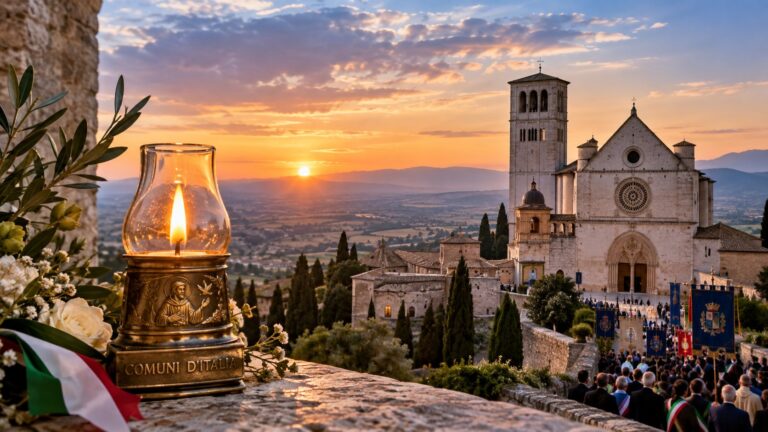
Italy in November: The Month Italy Turns the Heat On
Italy in November begins at the flower stalls, where chrysanthemums outsell everything else. Then dusk arrives before five o’clock, because the clocks went back on the last Sunday of October. Woodsmoke hangs over the piazza for the first time this season.
At the market, chestnuts, persimmons and cabbage have replaced the summer fruit. And in Rome and Florence, the radiators are finally allowed to come on. Nobody announces the change, yet every Italian feels it.
This guide explains what that switch means for a traveler. It covers the holidays, the weather, the fairs and the closures, and it tells you what to ask, what to pack and what to skip. I write it as an engineer who spends his working life inside Italian buildings.
A note on links: a few booking links below are affiliate links. If you book through one, I earn a small commission at no extra cost to you. I picked them for one reason this article explains: in a wet month with short days, the only bookings worth making early are the ones you can cancel, and the ones that happen indoors.
Italy in November: The Short Answer
Italy in November is a good month for food, art and empty streets. It is a poor month for beaches, islands and long evenings. Days are short and often wet, and heating starts by climate zone, so some rooms stay cold.
Truffle fairs, olive mills and Eurochocolate give the month its best reasons to travel. Choose cities and hill towns, and skip the coast.
One letter a month from inside central Italy.
The places, seasons and stories I don't put on the blog. No itineraries, no spam.
Prices are also the lowest of the year before Christmas. However, museums close earlier, and Venice may flood. Everything below explains how to plan around those facts.
The Day the Heating Is Allowed to Come On
In Italy, a building does not heat when the weather turns cold. It heats when the law allows, and a national decree sorts every municipality into six climate zones, from A to F. Each zone has a start date, an end date and a daily limit on hours (Presidential Decree 412 of August 26, 1993, article 9).
The zone comes from degree-days, or gradi giorno in Italian. A degree-day measures how far the outdoor temperature falls below 20 degrees Celsius on a given day. Add those gaps over a year, and each municipality gets a number. The higher the number, the colder the zone, and the longer the heating season (Presidential Decree 412 of 1993, Annex A).
Our guide to Italy in October covers zone E, which started on October 15. Milan, Turin and Bologna are therefore already warm, so this article picks up from there.
Two Dates That Matter
First comes November 1, when zone D may switch on. That zone includes Rome, Florence, Genoa and Ancona, and its systems may run up to twelve hours a day until April 15.
Then comes November 15, when zone C follows. Naples, Bari and Cagliari sit in that zone. They may heat up to ten hours a day, until March 31. Palermo, in zone B, waits until December 1.
Mayors can change these dates by local order, and a cold snap often triggers one. So check the city notice as well as the calendar. Outside the window, a system may also run for fewer hours when the weather justifies it.
Why Stone Buildings Stay Cold for Days
Here is the part the calendar does not tell you. The switch-on date is not the warm-up date, and in old buildings the gap is wide.
A farmhouse wall in the Marche hills is often sixty centimeters of stone, roughly two feet. That mass stores heat, which is why the same wall keeps a kitchen cool in August. In November it works against you, because the wall has spent six weeks losing heat to the night air. The first days of heating therefore go into the stone rather than into the room.
In my own assessments of such buildings, this is the most common complaint I hear in the first cold week. The heating works. The house is simply still charging. A modern insulated apartment reaches a comfortable temperature within hours, while a stone farmhouse can take three or four days of continuous running, and most systems do not run continuously.
So if you arrive at a converted farmhouse on November 2, do not judge it on the first evening. Ask instead whether the heating ran in the days before you came.
What It Means for Your Room
For a traveler, this shows up in three places. First, apartments in zone D stay cold until at least November 1, and a central system sometimes starts days later. Second, churches and many museums have no heating at all. Stone holds the cold, so a two-hour visit can feel long.
Third, the bathroom is usually the coldest room, and there is a technical reason for that. In most Italian homes it is served by a single heated towel rail, which puts out a fraction of the heat of a normal radiator. Meanwhile the room is lined with tile and stone, which pull warmth out of the air fast. Small emitter, high losses. The result is a room that warms last and cools first.
The same rules cap indoor temperature at 20 degrees Celsius, or 68 degrees Fahrenheit. A tolerance of two degrees applies (Presidential Decree 74 of April 16, 2013, articles 3 and 4). A room that feels cool at 68 is therefore not broken, just legal.
What to Ask the Host Before You Book
Ask four questions, and ask them before you pay. First, is the heating independent, meaning your own boiler, or central, meaning one system for the whole building?
Second, if it is central, what date does it start, and for how many hours a day? Third, is there a second source of heat, such as a wall unit that also heats? Finally, is the bathroom heated?
The distinction matters more than it sounds. With an independent boiler, the person at reception can simply turn it up within the legal limits. With a central system, they cannot. The schedule belongs to the building, set by a vote of the owners and run by an administrator who may live in another town. A polite request at the desk cannot override it, and the apologetic answer you get is honest. So if the replies are vague, book a place with its own heat.
The First Week: Two Days That Stop the Country
November opens with two days for the dead. November 1 is All Saints, or Ognissanti, and it is a national holiday. In 2026 it falls on a Sunday, so there is no long weekend and no bridge day. Shops and banks close, many restaurants shorten their hours, and regional trains follow a holiday timetable.
November 2 is the Commemoration of the Dead. It is not a public holiday, so offices and most shops open as usual. Yet cemeteries fill with families, candles and flowers, so visitors should keep a respectful distance.
This is why chrysanthemums matter, because in Italy they are cemetery flowers. Nobody gives them as a gift, and a bunch of them would read as condolences. Bring roses, pastries or a bottle of wine to a dinner host instead. In many regions, bakeries sell seasonal sweets for the dead, such as ossa dei morti, hard almond cookies shaped like bones. They make a good gift, and they tell your host you know the calendar.
On November 4, Italy marks National Unity and Armed Forces Day. It is not a day off, so you may see flags and wreath-laying in city squares while ordinary life continues. For planners, the rule is short: book trains and tables early for November 1, then check each museum before you go.
What the Weather Actually Does
Averages hide the point, because Italy in November does not have one climate. It has five, and they sit a few hours apart by train. The figures below are long-term averages, rounded, so treat them as a guide and check the forecast before you leave.
The North: Fog and Cold
The Po Valley is fog country, and around Milan, Turin and Bologna a low gray layer called nebbia can sit on the plain for days.
Milan’s daytime highs average about 12 degrees Celsius, 54 Fahrenheit, and nights fall toward 5 degrees, or 41. Drivers should slow down and leave extra time.
The Center: Rain
Rome and Florence get rain, and November is the wettest month in Rome. Highs there average about 17 degrees Celsius, 63 Fahrenheit, but a wet day feels colder. Cobblestones turn slick, so waterproof shoes matter more than a heavy coat.
The Apennines: First Snow
The first snow reaches the high Apennines this month. That includes the Sibillini on the Marche and Umbria border and the Gran Sasso in Abruzzo. Snow on the summits does not close the towns below. Still, from November 15, signed mountain roads may require winter tires or chains.
Venice: Acqua Alta
Venice enters its flood season, and acqua alta, the high water that spills into the lowest streets, is most likely in autumn and early winter. The record was 194 centimeters, in November 1966. In November 2019 the tide reached 187 centimeters.
The MOSE barrier is raised when the forecast tide reaches 110 centimeters. However, Saint Mark’s Square starts to flood at about 80 centimeters. People read that gap as a failure, and it is not one. It is a question of levels. The square is the lowest ground in the city, so it goes under long before the rest of Venice is at risk, and closing the barriers has real costs: the lagoon stops exchanging water with the sea, and the port stops working. The threshold is a compromise between the city and the lagoon, not a broken machine.
In early 2026 the barrier went up 24 times in the first 50 days of the year. The city’s tide center described that run as unusual. In practice, pack waterproof boots and keep one spare day. The city’s tide center, the Centro Previsioni e Segnalazioni Maree, publishes the forecast every day, and the morning forecast is reliable enough to reorganize a single day around.
The South: Still Mild
The south and Sicily stay mild, and Palermo’s highs average about 20 degrees Celsius, 68 Fahrenheit. Still, the sea is too cool for most swimmers, and the days are good for walking. If you want to sit outside, this is the region to choose.
Daylight: The Short Afternoon
Light matters as much as weather, because in Rome and Milan the sun sets between about 4:30 and 5 p.m. through the month. So plan outdoor sights for the morning and museums for the afternoon. Dinner still starts late, because Italian restaurants rarely fill before 7:30 p.m.
One warning for photographers and church visitors. Many small Romanesque churches have no artificial lighting worth the name. By three in the afternoon on a gray November day, the fresco you traveled to see is a shadow on a wall. Go in the morning.
The Events That Make November Worth It
Five events anchor a trip to Italy in November. Each has its own guide, so here is only what you need to choose.
Acqualagna in the Marche holds the last days of its white truffle fair on the All Saints weekend and the first two full weekends of November. The last weekend is the quieter one, and our Acqualagna truffle fair guide explains all seven days. If you want the regional picture instead, our roundup of truffle fairs across Le Marche covers the smaller ones.
Alba in Piedmont runs a much larger fair every weekend into early December. It is the best-known truffle market in the country, and rooms sell out early. See the Alba truffle fair guide before you book. November, not October, is when the white truffle is actually at its best, and our truffle season calendar explains why the legal opening date and the good weeks are not the same thing.
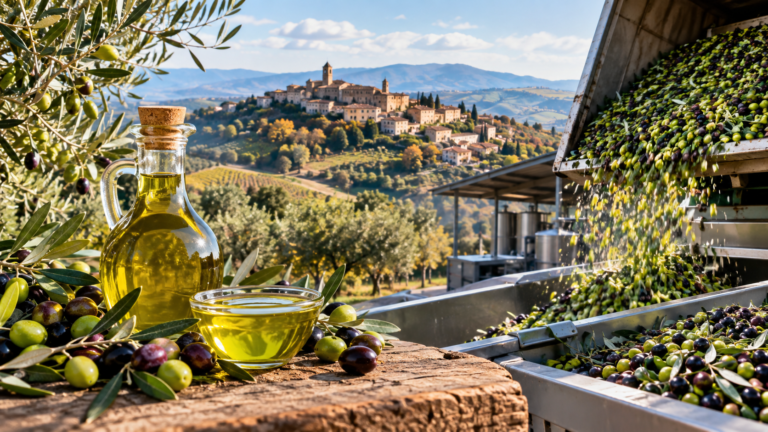
Frantoi Aperti in Umbria opens working olive mills on weekends until mid-November. The olives are milled within hours of picking, so you taste oil straight from the press. Our Frantoi Aperti guide lists the details, and what actually happens inside a frantoio explains the machinery you will be standing next to.
Eurochocolate takes over Perugia for ten days in the middle of the month. Weekdays are calmer. The Eurochocolate guide explains what is new this year.
San Martino, on November 11, marks the new wine. An old proverb says that on Saint Martin’s Day every must becomes wine. Many cellars mark it with a first tasting, and roasted chestnuts appear beside the glass. Marche villages also hold chestnut fairs into early November, as our chestnut festivals guide shows.
What Italians Actually Eat in November
The menu changes more sharply this month than in any other, and the change is easy to miss if you order the same dishes you ordered in July.
The new oil arrives first. Olio nuovo is cloudy, green and aggressive, and it bites the back of your throat. That burn is not a flaw. It comes from the phenolic compounds that fade over the following months, so the oil you taste in November is the most potent version of itself you will ever meet. Italians pour it raw on toasted bread rubbed with garlic, which in Tuscany is called fettunta and in Umbria bruschetta. Order it. Our piece on novello olive oil and the new harvest explains what to look for, and the olive oil culture guide gives the wider context.
Then comes vino novello, which is a legal category rather than a style of marketing. A ministerial decree of August 13, 2012, Annex 7, requires at least 40 percent of the blend to come from carbonic maceration of whole grapes, and it sets the release at one minute past midnight on October 30. That is why the bottles appear overnight, all at once, in the same week across the country. It is a young red, low in tannin, meant to be drunk within months rather than cellared. Drink it cool, and do not expect depth.
After that the rest of the month follows the woods and the cold. Chestnuts arrive roasted in paper cones on street corners. Porcini and other mushrooms go into pasta and polenta. Game appears on menus in the hill towns, often as a ragù of wild boar or hare. Pumpkin turns up in ravioli in the north, and the cabbage family takes over the market stalls, which is why you suddenly see black kale, or cavolo nero, in everything from soup to bread.
In the countryside, this is also sagra season for a different reason. The summer village festivals are about the crowd. The November ones are about the harvest, and they are smaller, colder and considerably more local. Our guide to the sagre of Le Marche explains how one of these evenings actually works.
Where November Works, and Where It Does Not
Italy in November rewards cities of art and hill towns.
Museums are quiet and churches are calmer, while menus turn to game, mushrooms and chestnuts. Rome, Florence, Bologna and Perugia all suit the month. So do the towns of the interior. Our Le Marche guide and Umbria guide show where to start, and Le Marche in autumn describes the region in exactly these weeks.
The coast is a different story, because beach towns on the Adriatic and Tyrrhenian seas are largely closed. Hotels, beach clubs and many restaurants shut for the season. Small islands are harder still, because ferries thin out and many hotels close until spring.
So say it plainly: do not plan a beach week, a boat day or an island-hopping route in November. Several lake gardens and mountain lifts are closed too. If sun and sea are the goal, read our September guide instead.
Opening hours shrink as well, and the Colosseum closes at 4:30 p.m. from late October through February, with last entry an hour before. Archaeological parks near Naples close in mid-afternoon in early November, according to their published tables. Always check the official site for the day you plan to go.
Prices, Crowds and the One Exception
Italy in November is the cheapest stretch of the travel year before Christmas. City hotels, rental cars and many flights cost less than in summer. Queues shrink, and a good table is often free the same day. Fair weekends lift prices locally, in Alba, Acqualagna and Perugia, but only in their own valleys. Everywhere else stays soft until the very end of the month, and that exception deserves its own section.
The Bridge Week Nobody Warns You About
Two things happen in the last days of November, and together they end the cheap season.
The first is the Alpine Christmas markets. Bolzano opens on the evening of November 26, 2026, and runs to January 6, with the other South Tyrol markets starting within a day or two. From that evening, rooms in Bolzano, Merano, Trento and the valleys around them move to winter rates, and the weekend availability goes first.
The second is a piece of Italian calendar arithmetic that visitors never see coming. December 8 is the Immacolata, the Feast of the Immaculate Conception, and it is a national holiday. Italians treat it as the start of Christmas: the tree goes up, the lights come on, and the shopping begins. When the holiday falls near a weekend, people build a ponte, a bridge of days off, and travel on it.
Here is the part that affects November. The domestic booking wave for that bridge starts weeks earlier, so by the third week of November the attractive rooms in the market towns are already gone. In 2026 the Immacolata falls on a Tuesday, which makes a four-day bridge from Saturday, December 5. Expect the last days of November to feel busier and pricier than the first three weeks, especially in the north.
The practical consequence is simple. The value window is the first three weeks of November. If markets and Christmas lights are what you came for, you are really planning a December trip, and if you are heading further into winter our Italy in January guide picks up after the holidays. Either way, choose rates with free cancellation, because the weather can still change your plans.
Booking Notes: What I Would Book, and What I Would Skip
November punishes rigid plans. Rain arrives in concentrated systems rather than drizzle, and the light is gone by five. So the rule is short: book the indoor things in advance, keep the outdoor things cancellable, and leave one day of the week unplanned.
The working olive mill. If you are in Umbria while the mills are still running, this is the thing I would book. A guided visit to a traditional stone mill with a bruschetta tasting costs around 16 dollars, takes ninety minutes and can be cancelled free. It rates 4.9 across roughly 140 reviews, it is wheelchair accessible, and it happens under a roof, which in this month is half the argument. Go in the first fortnight, while the presses are actually working.
The rainy-day fallback. Every November itinerary needs one indoor thing you can move a wet day onto. A pasta class in Bologna, three hours of tagliatelle and ragù from about 57 dollars, does that job: 4.9 across more than 1,300 reviews, free cancellation, and it ends with lunch. Bologna is also the right city for it in November, because the food is heavy, the porticoes keep you dry and the fog is part of the experience.
Perugia during the chocolate week. Eurochocolate fills the old town, and the city is vertical, medieval and confusing when crowded. A guided walk of the old town and the Rocca Paolina, about 34 dollars for ninety minutes, solves the orientation problem on the first morning. It rates 4.8 across more than 350 reviews. Book it for a weekday.
What I would skip, and this one is specific. Do not book a truffle hunt in the Marche or Umbria through a booking platform this month. I checked the listings for November, and the problem is not the price, which runs from about 110 to 180 dollars a head. The problem is the evidence. Most of these experiences carry between one and six reviews. A hunt is only as good as the hunter and his dog, and three reviews tell you nothing about either. In the same weeks, the fair at Acqualagna is free to enter, the truffles on the tables are real, and you can talk to the people who dug them up. Spend the money on the truffle, not on the walk. If you want to know what you are buying before you hand over cash, read how to buy real truffles in Italy first.
The same caution applies to the expensive private chocolate tours in Perugia during Eurochocolate. One of them asks close to 350 dollars a person and rates 3.3. During the festival, the chocolate is in the street and it is free to walk among.
What to Pack
Pack for Italy in November as wet and cool, not as cold. Bring a waterproof shell with a hood, a wool or fleece mid-layer and waterproof shoes with a rubber sole. Cobblestones and church floors punish smooth soles.
The coat is the classic error, since a heavy down parka is too much for Rome or Naples, where you will sweat on trains and in shops. A thin fashion coat is too little for Milan or the Alps. Layers solve both problems, because you add or remove them as the day changes.
Add a scarf, a small umbrella that survives wind and warm socks for churches. Above all, pack the merino layer for indoors rather than a bulkier coat for outdoors, because in this month the cold you actually feel is usually inside a building.
Five Mistakes Americans Make in November
Five errors come up again and again when people plan Italy in November.
Assuming the heating is on everywhere. Until the zone date, an apartment can feel colder than the street. Ask the host, and pack a sweater to sleep in.
Bringing chrysanthemums as a gift. They are cemetery flowers, so a host will read them as condolences. Choose roses, pastries or wine instead.
Booking the coast or the islands. Hotels and ferries close for the season, so the trip you imagine does not exist. Stay inland instead.
Planning long days after dark. Fog and rain slow country roads further. Plan the drive for daylight and the dinner for later.
Trusting one forecast for the whole country. Milan can sit in fog while Palermo has sun. Check each city, and keep a spare day free for Venice.
FAQ — Italy in November
Timing and Weather
Is November a good time to visit Italy? Yes, if you want food, art and fewer people. It is a poor choice for beaches and islands. Prices are the lowest of the year before Christmas, the truffle fairs are at their best, and the new olive oil is on the table. The trade-offs are rain, early sunsets and cold interiors.
Is Italy too cold in November? No, but it is damp, and highs run from about 12 degrees Celsius in Milan to about 20 in Palermo. Indoors can feel colder than outdoors, because heating starts by zone, on November 1 in Rome and Florence and November 15 in Naples. Old stone buildings then take several more days to warm through.
What is closed in Italy in November? Beach clubs, many seaside hotels and some island ferries reduce service or stop. Museums also shorten their hours, and the Colosseum closes at 4:30 p.m. from late October. Cities and hill towns stay fully open.
Booking and Getting Around
Are the Christmas markets open in November? Not for most of the month. Bolzano opens on the evening of November 26, 2026, and other Alpine markets start within days. Before that date, November is not a Christmas market trip. Check each city’s official calendar before you book.
When do prices go up again in November? In the last week. The Alpine markets open on November 26, and the domestic booking wave for the December 8 Immacolata holiday begins weeks earlier. The cheap window is therefore the first three weeks.
Do I need a car in Italy in November? In cities, no, because trains connect them well, but in hill towns and truffle country, yes. Fog and early dark make driving slower, and winter tires or chains may be required on signed roads from November 15.
What about Venice and acqua alta? Acqua alta is most likely in autumn and early winter. The MOSE barrier is raised when the forecast tide reaches 110 centimeters, but Saint Mark’s Square floods at about 80, because it is the lowest ground in the city. Bring waterproof boots, check the city’s daily forecast and keep a spare day.
The Takeaway
November is not a smaller October or an early winter. It runs on a schedule. A decree lights the radiators by zone, and two days belong to the dead. A tide decides whether Venice is dry, a second decree decides the night the new wine appears, and fairs fill every weekend until the markets open and the prices turn.
Once you know the schedule, Italy in November is easy to use.
So choose cities and hills, book the first three weeks and ask about the heating before you pay. Leave the chrysanthemums at the cemetery, and take the extra layer. Then walk out at five o’clock, into the dark and the smell of woodsmoke. That is when Italy in November feels most itself.
If you want an Italian to check your November route against the heating zones, the fair calendar and the Venice tide, you can book a consultation with me. And if your November trip is really a house-hunting trip, which for many readers it is, our guide to viewing a house in Italy in autumn explains why this is the best month of the year to see a building honestly, with the heating on and the rain falling.
Explore more at Tastes & Wonders of Italy, or watch the video dispatches on YouTube.
Last reviewed for the 2026 season. The fixed rules in this guide — the heating zones, the holidays, the release date of the new wine — do not change from year to year. Four things do, and they are checked each September: the dates of the truffle fairs and Eurochocolate, the weekday the clocks go back and All Saints falls on, the opening night of the Bolzano market, and the winter hours of the major sites. In 2027, note that All Saints falls on a Monday, which creates the long weekend that 2026 does not have.