Truffle Season in Italy: The Legal Calendar No One Explains
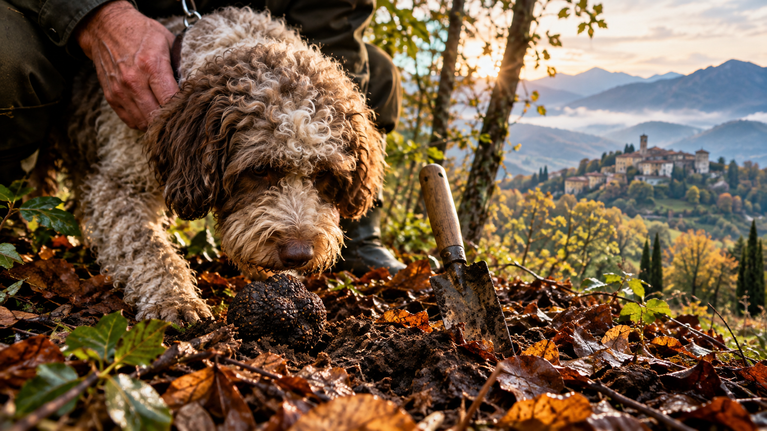
Truffle season in Italy has a start date, an end date, and, for nine separate species, nine different sets of both. Every October, the woods above Acqualagna fill with the same sound: a dog snapping into a tight, urgent circle, then digging. What almost no visitor realizes is that the date on which that dog is allowed to dig is not decided by the truffle, the weather, or the dog. It is decided by regional law, enforced with fines that fall under the same statute governing everything from labeling to night-hunting hours.
Truffle season in Italy runs on a legal calendar, species by species and region by region. It is built on a national framework from 1985 that hands the actual dates to each region to set for itself. Understanding that calendar, not just the folklore around it, makes the difference. It’s the gap between a trip that lands in the right week and one that lands in a fair with half-empty stalls and last month’s leftovers on the menu.
A note on links: a couple of the booking links further down are affiliate links, to truffle-hunting operators in Piedmont. If you book through them, I earn a small commission at no cost to you. I only link operators whose reviews and story I would trust with my own booking, and I say plainly, below, which option I would skip.
The season is not weather. It’s regulation.
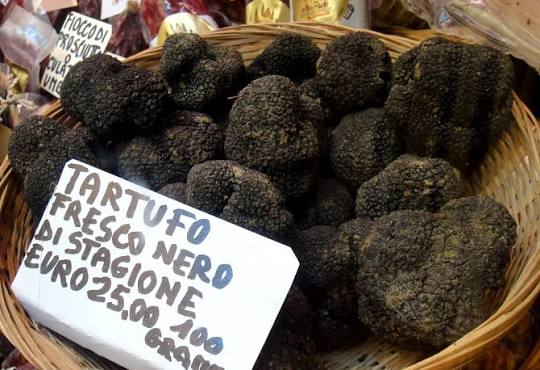
Here is the direct answer, before the detail. In most of central and northern Italy, the prized white truffle can be legally collected only between roughly October 1 and mid-January or late January, depending on the region. The prized black winter truffle follows a separate window, roughly December to mid-March. Neither window is folklore or tradition passed down through families of hunters. Both are set out in regional law, built on a national framework, and enforced with fines.
What the national law actually says
The foundation is Legge 16 dicembre 1985, n. 752, Italy’s national framework for truffle collection, cultivation, and trade. Article 2 names nine legally recognized species, each with its own Italian common name and its own default collection window. Article 6 lists those national default periods, and then adds a single, crucial sentence: regions may vary the calendar by ordinance, after consulting specialized research centers. That one clause is why a white truffle hunter in Piedmont and one forty minutes across the Marche border operate under different rules for the same fungus.
Why regions set their own dates
Regions do not adjust these dates for fun. Warmer autumns delay maturation, and a truffle pulled from the ground before it ripens loses both flavor and, more importantly, its ability to release spores for the next generation. Every recent calendar revision I found while researching this piece cites the same reason. Marche in 2024, Piedmont in 2024, Tuscany in 2023: climate change is pushing maturation later, so opening dates move later too. The law is chasing the fungus, not the other way around.
Italy’s nine legal truffle species
Casual writing about Italian truffles tends to collapse into two categories: white and black. The law recognizes nine. Here they are, with the default national window from Legge 752/1985 before any regional adjustment:
| Species | Common name | National default window |
|---|---|---|
| Tuber magnatum Pico | White truffle | October 1 – December 31 |
| Tuber melanosporum Vitt. | Prized black truffle (Norcia black) | November 15 – March 15 |
| Tuber brumale var. moschatum | Musky truffle | November 15 – March 15 |
| Tuber aestivum Vitt. | Summer truffle / scorzone | May 1 – November 30 |
| Tuber uncinatum Chatin | Hooked truffle | October 1 – December 31 |
| Tuber brumale Vitt. | Winter black truffle | January 1 – March 15 |
| Tuber borchii Vitt. (or T. albidum) | Bianchetto / marzuolo | January 15 – April 30 |
| Tuber macrosporum Vitt. | Smooth black truffle | September 1 – December 31 |
| Tuber mesentericum Vitt. | Ordinary black truffle | September 1 – January 31 |
One nuance worth flagging honestly: Tuber uncinatum is treated as a fully separate legal species under Italian law, distinct from Tuber mesentericum. Some modern mycological literature outside Italy classifies uncinatum differently: as a northern ecotype of Tuber aestivum, rather than a species in its own right. It would be the same fungus in a cooler climate, under a different name. For a traveler this distinction rarely matters at the table. For anyone reading a regional calendar closely, it explains why some tables list uncinatum and aestivum with nearly identical autumn windows.
It’s not just which months. It’s which hours.
The law does not stop at dates. Article 5 of Legge 752/1985 bans truffle hunting at night, defined nationally as the hour after sunset through the hour before sunrise, though regions can adjust this for local custom. Some take that latitude seriously. Tuscany’s current calendar sets a different legal hunting window for every single month, tied to actual sunrise and sunset times. It even adjusts twice a year for daylight saving. The window runs from 7:00 to 18:00 in January, stretches to roughly 4:00 to 21:30 in July, then folds back down as autumn arrives. A visitor picturing a truffle hunt as a loosely timed woodland stroll is picturing the wrong country.
The permit system is just as formal. To hunt truffles legally, a resident needs a tesserino di idoneità. It is issued only after a regional exam, and it is off-limits to anyone under fourteen. Once granted, it is valid across the whole country.
Hunters must also use a trained dog. The law is explicit on this point: the search itself has to be dog-led. Extraction is restricted to a small hand tool, the vanghetto or vanghella, so the truffle bed underneath is disturbed as little as possible. Every hole dug has to be refilled before the hunter moves on. Leaving it open is its own separate violation.
None of this is a formality. It is the reason there is still a truffle season in Italy at all, a century after unregulated, industrial-scale foraging could easily have exhausted it.
The month-by-month calendar for truffle season in Italy
This is the part that actually changes a trip. Below is what is legally in season, region by region, moving through the year.
September is closed to nearly everything. Marche and Piedmont both ban all species outright through the month. Piedmont calls this the fermo biologico, a biological rest period pushed through in 2024 specifically to protect white truffle quality. If a restaurant menu anywhere in central Italy advertises fresh white truffle in September, be skeptical. Legally, there should not be any to sell. September has plenty else to recommend it — it is, after all, the month Italians quietly keep for themselves — but fresh white truffle is not part of the offer.
October is when white truffle season opens almost everywhere. The closing date is where regions diverge sharply, and there is more on that below. October is also when the smooth black truffle (macrosporum) and the ordinary black truffle (mesentericum) come into season across most regions. The autumn run of scorzone begins around the same time, alongside the tail end of its own summer window.
November is the overlap month. White truffle is at its peak. The ordinary and smooth black truffles are still legal, and in Marche’s municipalities bordering Abruzzo, the prized black truffle season has already opened two weeks early. This is also the busiest month for fairs, for good reason: it is the only month when nearly every species is simultaneously in season somewhere in central Italy.
December closes the white truffle window in most regions and opens the main prized black truffle season everywhere. By mid-December, Piedmont’s black truffle season has started. By December 1, Marche’s has too, except in the Abruzzo-border municipalities, where it opened back on November 15.
January is black truffle territory, plus the tail end of white truffle wherever the regional window runs longer. Piedmont keeps white truffle legal until January 31. Marche and Tuscany close it on January 15. Umbria closes it earlier still, at the end of December. Mid-January also opens the bianchetto season in most regions.
February and March belong to the prized black truffle and its relatives. Most regions taper this window out by March 15. Bianchetto and the winter black truffle run a little longer, into April.
April is bianchetto’s last stretch, and the only species still legally in season anywhere in central Italy.
May is closed almost everywhere for a second biological rest period, ahead of the scorzone’s summer opening.
June through August belong to scorzone, the mildest and most widely available truffle of the year, easy to find in shops and restaurants at a fraction of the price of its cousins.
The white truffle divergence: same species, different law
Here is the fact that makes the “it’s regulation, not folklore” argument concrete. Tuber magnatum is the same fungus whether it grows in the Marche, Tuscany, Umbria, or Piedmont. As of the 2024–2025 regional updates, though, its legal collection window is not the same length in any two of those regions:
| Region | White truffle legal window | Season length |
|---|---|---|
| Umbria | Last Sunday of September – December 31 | Roughly 13 weeks |
| Marche | October 1 – January 15 | 15 weeks |
| Tuscany | October 1 – January 15 | 15 weeks |
| Piedmont | October 1 – January 31 | 17 weeks |
A truffle hunter working the Marche side of the Apennines and one working the Piedmont side of the Langhe are collecting the identical species. Yet their legal windows differ by roughly a month. Piedmont’s law, revised in April 2024, deliberately gives its truffle the longest legal runway in the country. Marche and Tuscany, revised within a year of each other, arrived independently at the same fifteen-week window. None of this is arbitrary. Each region set its dates after consulting the same kind of specialized research centers the national law requires them to hear from. They simply reached different conclusions about their own soil and climate.
Why the calendar moves: the ground beneath the truffle
Tuber magnatum is not indifferent to where it grows. It needs a specific combination of alluvial or marly-sandstone soil, good drainage, and a host tree — oak, poplar, willow, lime, or hazel. It also needs a moisture regime that swings from a dry summer into a wet autumn. That swing is what triggers fruiting, and it is exactly the variable that climate change has been shifting later across the past decade. That shift is the reason every regional calendar revision I found cites warming seasons as its justification.
Reading a regional truffle calendar, in other words, is not so different from reading a geotechnical report. Both are a region’s attempt to legislate around a specific, local set of soil and drainage conditions that no national formula can capture. The Marche’s own most productive ground sits in the Metauro valley, below Acqualagna and Sant’Angelo in Vado, on exactly this kind of terrain. That is one reason the province of Pesaro and Urbino alone handles roughly two-thirds of Italy’s national truffle trade.
This is also why the calendar gets stricter, not looser, near administrative borders. In Marche’s municipalities that share a boundary with Abruzzo, the prized black truffle season opens two weeks earlier than in the rest of the region, matching Abruzzo’s own dates rather than Marche’s interior. Truffle mycelium does not recognize a provincial line drawn on a map centuries after the soil formed. When two neighboring regions set different dates for genuinely continuous ground, the border municipalities end up governed by whichever calendar fits their actual soil best. Sometimes that means a shorter season than the rest of their own region. Sometimes it means a longer one.
What this means if you’re actually planning a trip
The practical consequence of all this regulation is simple: the fair calendar and the eating calendar are not the same thing, and conflating them is the most common mistake visitors make.
A fair held in late October or early November sits near the start of the legal white truffle window, not its peak. Quality and volume typically build through November as the season matures. Visiting on the fair’s opening weekend guarantees crowds and ceremony. Visiting two or three weeks later, quietly, on a weekday, often gets a better truffle for less money. If that is the trip you are building, the highest-rated hunt in the Langhe runs out of Monforte d’Alba and ends with black truffle shaved over cheese and a glass of wine, which is a more honest introduction to the ingredient than a market stall at nine in the morning.
Those same weeks are the densest eating window of the year across Le Marche: white truffle opening in the Metauro valley, the olive harvest running in the frantoi of the same hills, and the vineyards finishing their work. If a trip has to be built around one stretch of the Italian calendar, that is the one I would choose. What is happening inside those mills during the same weeks is described in Olive Harvest in Italy: Inside a Frantoio.
Be equally skeptical of any menu offering fresh white truffle outside its legal window. What you are being served in April is either preserved product, honestly labeled, or bianchetto. Bianchetto is a real, legal truffle, but a far milder one, often sold under the more famous name. Neither is a scandal. But neither is quite what the price on the menu usually implies.
If preserved truffle is what you are actually buying, the label is worth reading with the same attention as the calendar. Italian law grades conserved truffle into fixed categories, from Super extra and Extra down through Prima scelta and Seconda scelta, to pezzi (pieces) and tritume (fragments). The grading depends on how whole, regular, and well-colored each piece is. A jar labeled pezzi or tritume is not lower-quality truffle. It is the same truffle in smaller, less presentable form, usually at a noticeably better price. For anyone buying to bring home rather than to eat that night, it is often the smarter purchase.
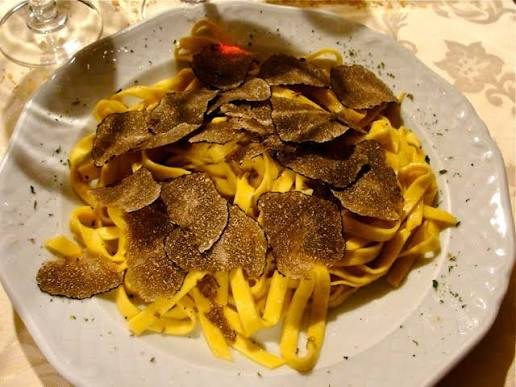
If eating truffle authentically, rather than simply seeing a fair, is the goal, I have written separately about where to actually eat it well: a direct comparison of Acqualagna’s white truffle culture against Alba’s. One more distinction is worth making here, too. A truffle fair is a commercial market event. A sagra is a community-run food festival, and the two follow entirely different rhythms.
The 2026 fairs: when the calendar becomes a festival
Acqualagna, Marche — the 61st Fiera Internazionale del Tartufo Bianco runs across seven days in 2026: October 25 and 31, then November 1, 7, 8, 14, and 15, as published by the Marche regional tourism board. Those dates are not arbitrary, and the rule behind them is worth knowing, because it lets you anticipate the fair years ahead: it opens on the second-to-last Sunday of October, takes the All Saints’ weekend, then runs the first two full weekends of November. The town sits in the Metauro valley near Urbino and handles roughly two-thirds of Italy’s national truffle trade. That fact surprises visitors who assume Alba holds a monopoly on the white truffle economy. Acqualagna actually hosts three separate truffle fairs across the year: this autumn one for the white truffle, a smaller February event for the prized black, and a July fair for scorzone. The rhythm mirrors the legal calendar almost exactly. Worth keeping straight, though: this is a commercial market event, running in the same autumn weeks as the region’s community-run food festivals, which offer a completely different kind of evening at a fraction of the price.
Alba, Piedmont — the 96th Fiera Internazionale del Tartufo Bianco d’Alba runs far longer than any single-weekend event, from October 10 through December 6, 2026. The World Truffle Market is open every Saturday and Sunday across that whole span. This year’s theme, “Autentiche Relazioni,” centers on the relationship between trifolao and truffle dog. The sheer length of Alba’s fair season reflects something specific: Piedmont’s legal window for Tuber magnatum runs a full two and a half weeks longer than the Marche’s.
The market stalls are only half the experience. Several local trifolao run actual hunts through the same hills during fair season, and a sunset version pairs the hunt with a truffle and wine tasting at a family winery afterward, echoing the fair’s own pairing of the two this year.
Sant’Angelo in Vado, Marche — a short drive from Acqualagna, and easily reached from Urbino as a base, this fair has run since 1963, organized by the National White Truffle Fair Committee. As of mid-August 2026, its 2026 dates have not yet been published. In 2025 it ran across three consecutive October weekends plus the first Sunday of November. Check the official program before booking travel around it. Even a one-week shift changes which weekend of the season a visitor actually catches.
Norcia, Umbria — Nero Norcia, dedicated to the prized black winter truffle rather than the white, is a February event, not an autumn one. Its 2026 edition already took place, across February 20–22 and February 27–March 1. It is worth knowing about anyway, for planning a black-truffle trip the following winter. The autumn white-truffle circuit tends to eclipse it in most English-language coverage. That’s a real gap, since Umbria is, by its own regional government’s account, the only Italian region with some truffle species legally in season every month of the year.
What a kilo actually costs in 2026
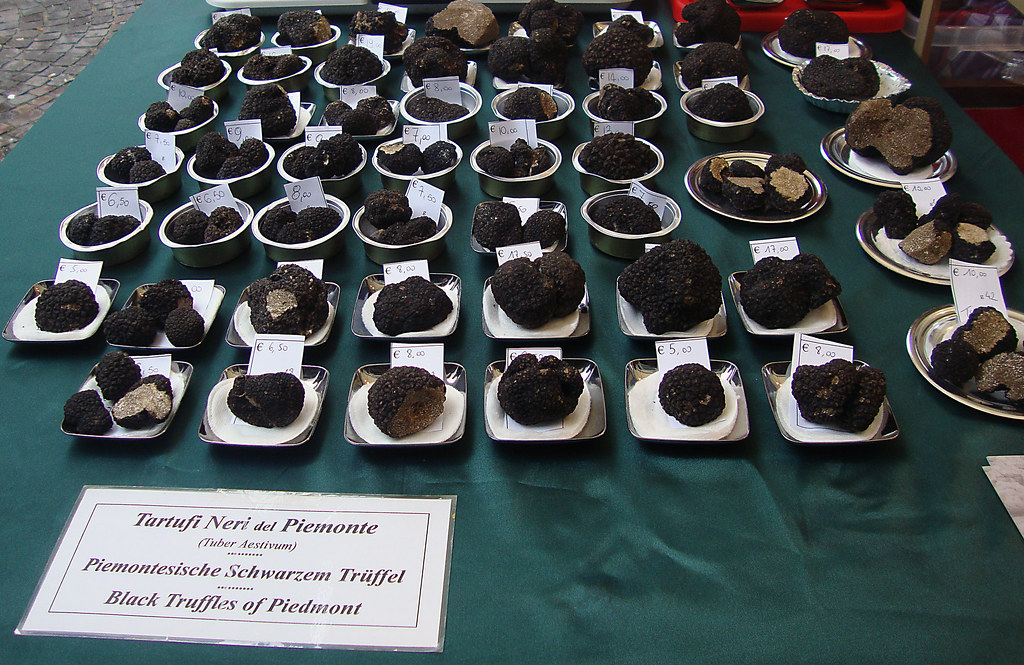
Truffle prices swing daily and by size, so any figure needs a date attached. At Acqualagna’s official Borsa del Tartufo in October 2024, white truffle under 15 grams was pricing around €1,600 per kilo. Pieces between 15 and 50 grams sat closer to €2,500, and anything over 50 grams reached about €3,200. Those figures were broadly in line with Alba’s own quotation that same season, roughly €4,000 per kilo for 15–20 gram pieces.
A separate price tracker, updated in late July 2026, put the average white truffle closer to €1,850 per kilo overall. Its common market range ran €2,100 to €4,500, with occasional spikes to €5,000–7,000 for exceptional specimens. Scorzone, by contrast, can run as low as €100 per kilo in summer.
The spread is the point. Within the same species, size and season can move the price by a factor of three or four in a single winter.
Booking Notes: Which Truffle Hunt Is Worth Booking
The one worth booking is run by a family three generations into the trade near Alba: a trifolao whose grandfather hunted truffles in the years after the war, who trained his son, who trained him. The longer version of the tour adds a tasting at a family-run winery afterward, which is where the wine actually earns its place next to the truffle rather than as an afterthought. An English-speaking guide translates throughout, which matters more than it sounds like it would once the trifolao starts explaining, in rapid dialect, exactly how the dog knew where to dig.
If you are traveling without a car, read the meeting instructions before you book. Most Langhe hunts, including the one above, ask you to drive yourself from the meeting point to the trifolao’s ground, which is a problem if you flew into Turin and took the train down. One full-day outing solves it by leaving from Turin, driving out to the woods, and closing with lunch in a trattoria where anything found that morning goes onto the plates. It costs roughly twice the half-day hunts, and for a car-free traveler it is the only version that actually works.
For a more romantic version of the same idea, a sunset hunt through the Langhe hills folds the walk into golden hour and closes with truffle and wine tasting at a family winery — a fair pairing of exactly the two things Alba is actually known for.
What I would skip is the cheapest, shortest group option: ninety minutes in the woods, flat, with nothing at the end of it. No tasting, no wine, no table. You watch the dog work, you watch the trifolao dig, and then you drive away. One point of fairness here, because it is the most common misunderstanding I see: on almost every hunt in Piedmont, including the ones I recommend above, the truffles found during the outing stay with the trifolao and are sold separately. That is not a trick, it is how the trade works, and no operator is hiding it. The reason to avoid the ninety-minute version is simply that for an hour more and a modest amount of money you get to sit down and taste what you just watched come out of the ground.
FAQ — Truffle season in Italy, explained
What is truffle season in Italy?
It is not one season but nine, one for each legally recognized truffle species under Italian law. The white truffle season runs roughly October through mid-January or late January depending on the region; the prized black truffle season runs roughly December through mid-March.
When is the best time to visit Italy for truffles?
Mid-to-late November typically offers the widest overlap: white truffle near its peak, ordinary and smooth black truffles still legal, and the busiest fair calendar of the year. For a quieter, often better-value visit, the weeks just after a fair’s opening weekend tend to beat the opening weekend itself.
Do I need a permit to hunt truffles myself?
Yes. Italian residents need a tesserino after passing a regional exam. Visitors join hunts through a licensed local guide, who already holds the required permit. That is standard practice, and the only legal way for a tourist to take part.
How much does fresh white truffle cost in Italy?
Expect roughly €1,600 to over €4,000 per kilo depending on size and the point in the season, based on official Acqualagna and Alba quotations from recent seasons. Smaller pieces and scorzone in summer cost dramatically less.
How long does a truffle-hunting excursion take?
Most guided outings run two to three hours, including time in the woods with the dog and a tasting or light meal afterward. One family-run outfit near Alba, three generations of trifolao deep, runs exactly that format, with an English-speaking guide translating throughout. Serious hunters go out for longer, but that is not the format offered to visitors.
Is Acqualagna or Alba better for a truffle trip?
They are not really comparable, and I have written a separate, direct comparison of the two. In short: Alba offers a longer, more international fair season with a wine region built around it. Acqualagna offers the same species, arguably fresher access given its trade volume, and far fewer crowds.
Why do some restaurant menus advertise white truffle outside the legal season?
Almost always, it is either preserved product — legal and often clearly labeled if you ask — or bianchetto, a genuine but milder relative sold under the more famous name. Neither is illegal, but neither is what a diner expecting fresh Tuber magnatum in April is likely picturing.
The takeaway
The truffle calendar looks, from the outside, like folk knowledge — dates half-remembered, half-invented, passed between hunters and grandmothers. It is not. It is regional law, revised almost every year somewhere in Italy, built on a national framework that hands the details to the people closest to the ground. Marche, Piedmont, and Tuscany have all rewritten their calendars within the past three years, each time for the same stated reason: the climate is changing faster than the old dates could keep up with.
None of that shows up on a fair poster or a restaurant menu. It shows up in the fine print of a regional bollettino ufficiale that almost no visitor ever reads. Reading it anyway, even in outline, before booking a trip is the difference between arriving in the right week for truffle season in Italy and simply arriving in autumn and hoping the dog finds something.
If you want more stories like this from an Italian insider’s perspective, explore more on Tastes & Wonders of Italy or subscribe to our YouTube channel for video dispatches from around the country.
https://tasteandwondersofitaly.com/ – https://www.youtube.com/@TasteWondersofItaly