Ancona, Italian Capital of Culture 2028: A Local’s Guide
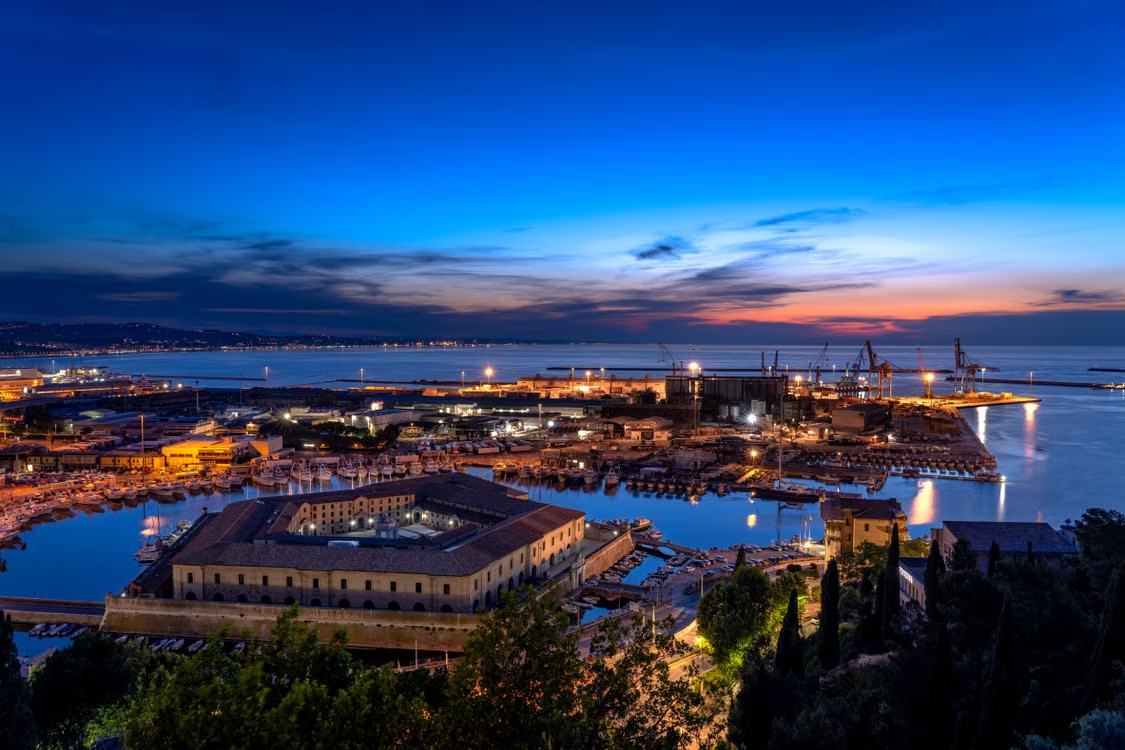
Ancona, Italian Capital of Culture 2028, sits on a promontory shaped like a bent arm — ankón in ancient Greek, the word its Syracusan founders gave the settlement in 387 BC, and the word the city still carries in its name. Sail up the Adriatic coast and the geography explains itself before any guidebook does: the headland folds sharply around its own harbor, so that from a handful of points along the waterfront you can watch the sun rise and set over the same stretch of sea. Locals call this stretch of shoreline the Passetto, and on a clear morning the water below runs from slate gray to pale green before the light has fully arrived. On March 18, 2026, that same folded coastline became the subject of a different kind of announcement. In the Sala Spadolini, the ministry’s reception hall inside the Collegio Romano in Rome, Minister of Culture Alessandro Giuli named Ancona — not Catania, not Forlì, not eight other finalists — Italy’s Capital of Culture for 2028.
What the Italian Capital of Culture 2028 title actually is, and why Ancona won
Capitale Italiana della Cultura is an annual title the Italian Ministry of Culture has awarded since 2014 to one city, backed by a one-million-euro grant, on the strength of a year-long program of cultural regeneration. Twenty-three cities and municipal unions applied for the 2028 edition; a seven-member independent jury narrowed the field to ten finalists, who presented their projects at public hearings in Rome on February 26 and 27, 2026. The jury, chaired by AdnKronos director Davide Maria Desario, recommended Ancona unanimously. Its dossier, titled Ancona. Questo Adesso (“Ancona. This Now”), takes its name from a line by the Anconetan poet Francesco Scarabicchi, who died in 2021. The commission called the project “excellent,” praising its Mediterranean outlook and the way it treats culture as a lever for urban and social regeneration rather than a program of one-off events.
Ancona succeeds L’Aquila, the 2026 titleholder, and Pordenone, which holds the title in 2027; it is only the second Marche city to win, five years after Pesaro’s turn in 2024. Beyond the ministry’s one-million-euro contribution, Mayor Daniele Silvetti has stated that the city has planned roughly fifty million euros in infrastructure and investment tied to the designation, with an additional seven million earmarked specifically for the 2028 celebration year — one million of that from the ministry, the remaining six from municipal funds and private sponsors.
The ten finalist cities, Ancona included, spent the months before the final decision inside a Ministry of Culture program called Cantiere Città, a capacity-building track designed to keep every dossier’s ideas alive regardless of who won. Ancona’s own dossier organizes more than eighty individual projects into four macro-areas, each fronted by a figure from the city’s own history rather than a generic theme header: Questo Mare treats the working port as cultural space; Via Maestra, named for the Renaissance traveler and antiquarian Ciriaco Pizzecolli, strings the city’s museums and historic buildings into a single walkable route; Adesso Parco covers the urban and regional parks discussed below; and Mare Culturale is aimed squarely at digital projects and younger residents. It is an unusually specific structure for a program that, in past editions, has sometimes read as a wish list rather than a plan.
A city built on ground that moves
I have spent thirty years assessing the structural condition of buildings across this region, and Ancona is one of the few Italian cities where you can read its history in the ground itself, not only in its facades. The city has been shaken twice in living memory, ten years apart, and both events still shape how it looks and moves today.
The first was an earthquake sequence that opened on January 25, 1972, with a shock estimated at the seventh degree of the Mercalli intensity scale, and continued for eleven months before peaking on June 14, 1972, at the tenth degree — among the strongest ever recorded in the city’s history. Estimates of the magnitude vary by source, but the damage pattern is well documented: the Istituto Nazionale di Geofisica e Vulcanologia describes it as widespread but not severe, concentrated in the historic center and the older rural buildings around it. Roughly thirty thousand residents were evacuated into tents pitched at fifty-six sites across the city, into railway carriages, gymnasiums, and even a docked ship. Of some thirty-five thousand dwellings within the urban perimeter, more than seven thousand were declared unsafe. No one died directly in a building collapse; the mayor at the time, Alfredo Trifogli, became known locally as “the earthquake mayor” for keeping his office light burning at Palazzo del Comune through the following months.
Ten years later, on the night of December 12 to 13, 1982, the hillside above the Posatora and Borghetto neighborhoods gave way. Locally, it is remembered as the frana Barducci — the Barducci landslide — and it remains one of the largest urban landslides in modern Italian history: roughly 342 hectares of ground slid toward the sea, displacing the coastal state road and pushing the Adriatic railway line some ten meters from its original bed. More than 3,600 people were evacuated. Of 865 housing units in the affected area, close to 85 percent were later declared unsafe or destroyed outright; two hospitals and the university’s medical faculty were damaged beyond repair. Once again, no one died. The northern slopes of the city carry that scar to this day, and the area is now monitored around the clock by an early-warning system that, according to recent reporting, researchers in the United States, Asia, and Norway have studied as a model.
Today, national seismic hazard maps still classify this stretch of the central Adriatic coast among the more exposed in Italy, a fact that shapes how anyone who builds or renovates here has to think about foundations, retrofitting, and slope stability — not as an occasional concern, but as a baseline condition of working in this landscape. None of this is trivia. It is why Ancona’s historic center has the particular density and uniformity of a fast, near-total postwar reconstruction, and why its northern edge still looks unfinished in places where other Italian hill cities look merely old. The 2028 dossier folds this fragility directly into its cultural program rather than around it: one of its four macro-areas, Adesso Parco, is built on the Cardeto urban park and the Conero regional park — green space chosen, in part, because it sits on ground the city has learned, twice, not to take for granted.
What to see
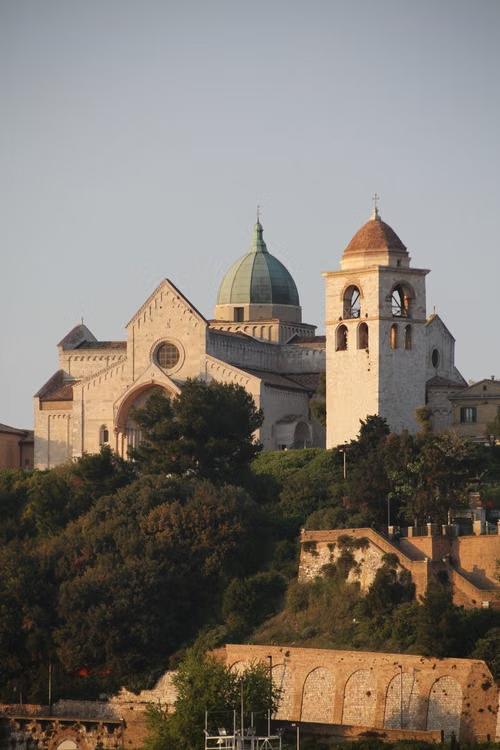
Ancona’s Roman arch, the Arco di Traiano, was raised around AD 115 in white marble to honor Trajan’s expansion of the harbor, and it is usually attributed to the Syrian architect Apollodorus of Damascus, who also designed Trajan’s Forum in Rome. It stands directly on the harbor mole, and its proportions — taller and narrower than most Roman arches of its kind — are its most distinctive feature. A short walk uphill, on the Colle Guasco overlooking the port, the Cattedrale di San Ciriaco rises in Romanesque-Gothic style with Byzantine touches, built over the foundations of a fourth-century-BC Italic temple and a later paleo-Christian church. Two marble lions guard its entrance, and its roofline, seen from below, is often compared to the hull of an overturned ship — an image that feels less like a metaphor here than it does most places.
Down at water level, the Mole Vanvitelliana is impossible to miss: a pentagon-shaped artificial island inside the harbor, designed by the papal architect Luigi Vanvitelli between 1733 and 1743 as a lazaretto, or quarantine station, for ships arriving from the East. It now hosts rotating exhibitions — three shows tied to the Capital of Culture buildup, on Corrado Cagli, Osvaldo Licini, and the Transavanguardia movement, were scheduled there through 2026. Nearby, fragments of a Roman amphitheater — likely built under Augustus — survive partly embedded beneath later construction; less of it is visible than visitors expect, so it is worth checking current access before planning around it.
The National Archaeological Museum of the Marche, one street back from the cathedral, traces the region from the Paleolithic through the Roman period, with a strong collection of Picene civilization finds — the pre-Roman culture that gave the region its name and that filled its tombs with imported Greek ceramics and worked bronze centuries before Rome arrived. The Pinacoteca Civica Podesti, the city’s fine arts museum, holds work spanning the Middle Ages to the nineteenth century, including paintings by Titian, Carlo Crivelli, and Lorenzo Lotto. For anyone with an extra hour, the Loggia dei Mercanti, a Venetian Gothic merchants’ hall near the port, and the Romanesque church of Santa Maria della Piazza, with its arcaded facade and carved portal figures, both sit within easy walking distance of the cathedral and rarely draw a queue.
The port: Ancona as an Adriatic crossroads
Ancona’s port carries roughly a million and a half travelers a year, making it Italy’s principal gateway to Croatia and one of its main links to Greece. Jadrolinija sails to Split year-round and to Zadar in summer; Snav adds a seasonal Split route; Anek Lines and Superfast, along with Grimaldi Lines, run to Igoumenitsa and Patras all year and to Corfu in season; Adria Ferries connects to Durrës in Albania. The port has carried this role since antiquity, when the Greeks who founded the city chose the same natural harbor for the same reason: it is the shortest crossing point between Italy and the opposite Adriatic shore.
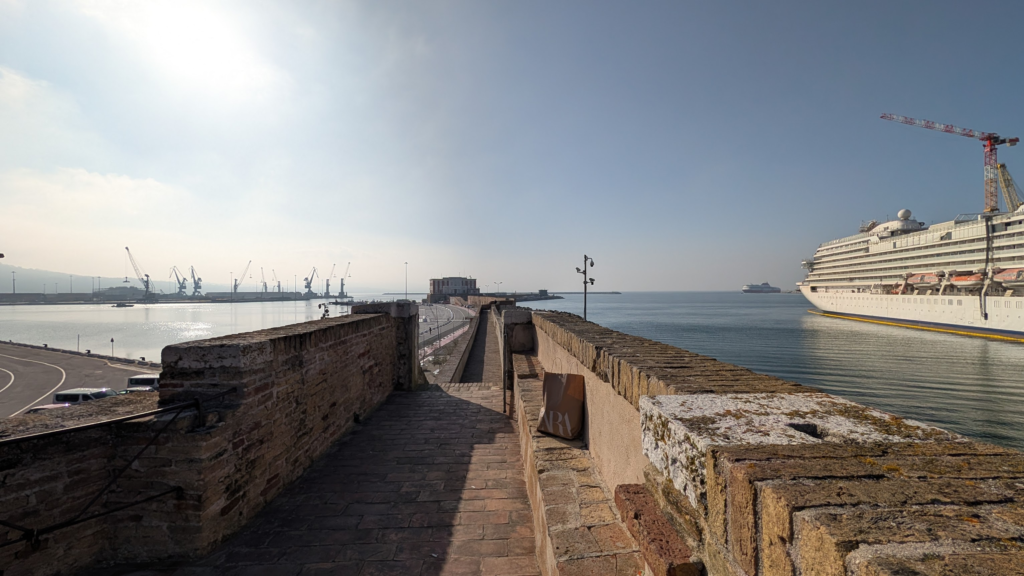
That maritime identity now has a formal diplomatic dimension. Ancona was recognized as the symbolic capital of the Adriatic under the 2000 Ancona Declaration, and it hosts the permanent secretariat of the Adriatic-Ionian Initiative, the intergovernmental body behind the EU’s EUSAIR macro-regional strategy — a role that gives a mid-sized Italian port city a diplomatic weight most visitors never suspect as they wait to board a ferry. The Capital of Culture dossier’s Questo Mare macro-area treats the port not as infrastructure but as cultural and social space, and its flagship project is a planned Museo della civiltà del mare Adriatico — a museum of Adriatic maritime civilization — under the artistic direction of Dante Ferretti, the three-time Oscar-winning production designer for The Aviator, Sweeney Todd, and Hugo. Ferretti shot his earliest films in Ancona before working with Federico Fellini, whose 1983 film E la nave va drew directly on the city’s port for inspiration; Ferretti has said publicly that his career began here, and that he wanted to serve as a kind of ambassador for his home region through the project.
None of this changes what the port feels like on an ordinary Tuesday: container cranes beside cruise-ship berths beside the low white hull of a Jadrolinija ferry idling toward Split, with the Arco di Traiano standing over all of it as it has for nineteen centuries. That coexistence of function and monument, rather than either alone, is what the dossier is betting visitors will notice.
The city-park: Conero at the edge of town
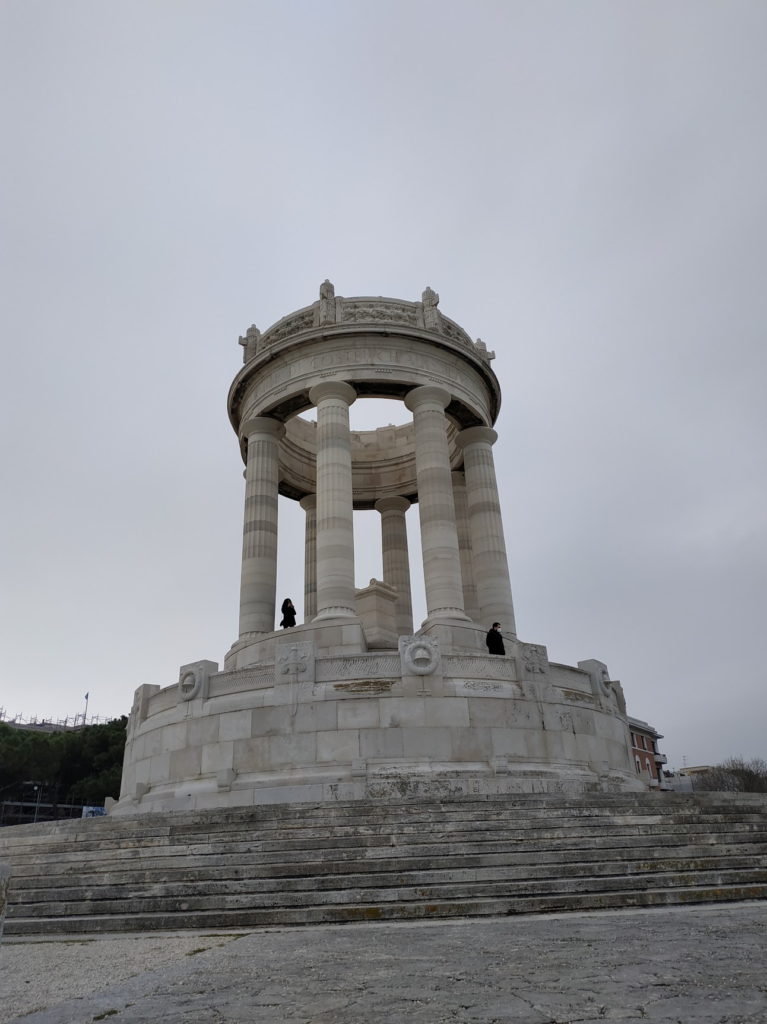
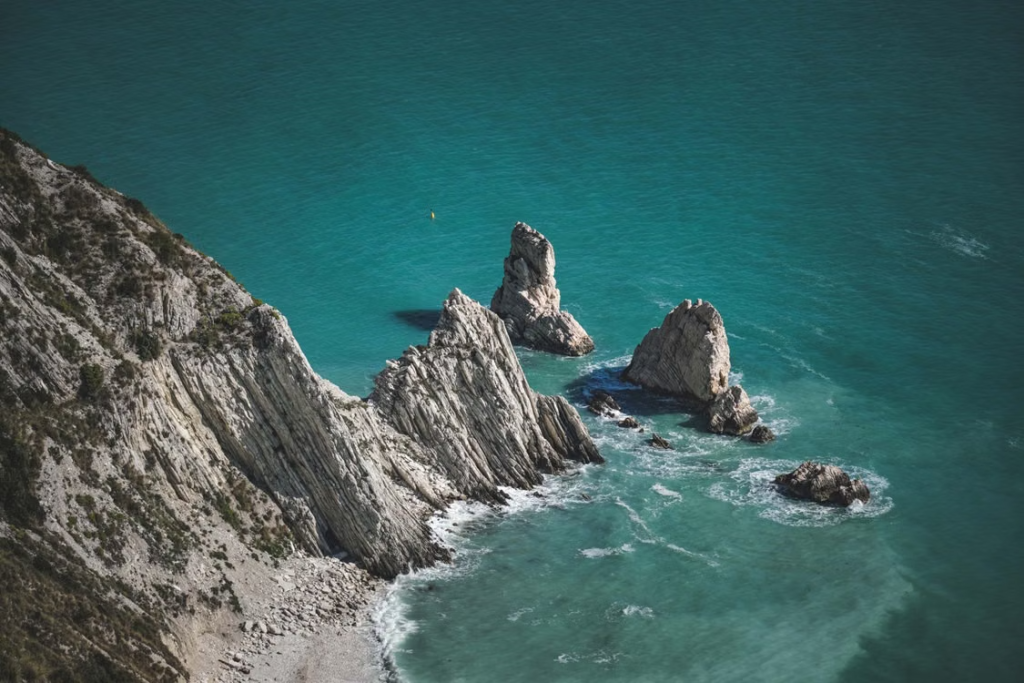
South of the harbor, Monte Conero rises directly from the Adriatic to a height of roughly 572 meters, the only point on Italy’s eastern coast where a mountain meets the sea without a buffer of flat coastline in between. It is currently a regional park, managed from the town of Sirolo, but a bill to convert it into a national park has already passed its first vote in the Chamber of Deputies’ Environment Committee and was headed to the Senate as of mid-2026 — a change that, if enacted, would bring the area under national rather than regional management and funding. The park protects a stretch of coastline that includes the beaches of Portonovo and Mezzavalle and the cove known as Due Sorelle, reachable on foot or by boat rather than by road, along with hiking trails through Mediterranean scrubland that in spring fills with wild orchids.
Inside the city itself, the Parco del Cardeto occupies a former military fortress on a hilltop overlooking the harbor, its lighthouse and disused gun emplacements now surrounded by open lawn and, in late spring, wildflowers pushing up through what used to be a parade ground. It is a five-minute walk from the cathedral and offers one of the clearest views in the city of how the harbor, the arch, and the open Adriatic line up along a single sightline. The 2028 dossier pairs Cardeto and Conero under a single macro-area, treating the city’s relationship to its own high ground — urban park and regional park alike — as part of the same cultural argument about how Ancona lives with the land beneath it. It is worth noting that neither park is static: the regional park authority took over management of a former military radio installation on Monte Conero’s slopes in 2026, closed to visitors but earmarked for habitat protection, a reminder that this coastline remains a working landscape even as it becomes a cultural showcase.
Eating in Ancona
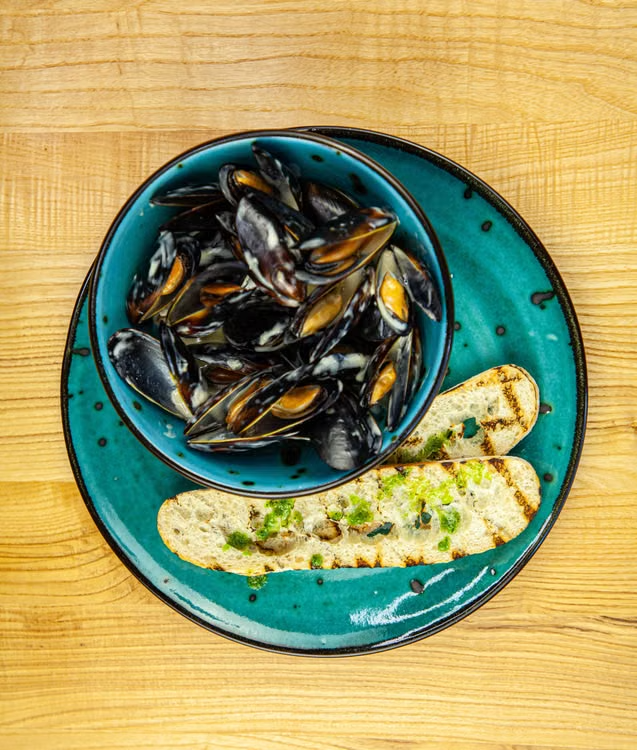
Three dishes anchor the local table, and all three depend on the sea just offshore. Stoccafisso all’anconetana is air-dried, unsalted cod — distinct from the salted baccalà found elsewhere in Italy — stewed slowly with potatoes, tomatoes, and olives until it falls apart at the touch of a fork. Moscioli del Conero are wild mussels that grow directly on the rocks along the Conero coastline rather than on farmed ropes; they are hand-gathered by local divers, recognized as a Slow Food presidium product, and taste noticeably more mineral than farmed mussels served elsewhere on the Adriatic. Brodetto, the Adriatic fish stew, has its own Anconetan version, built on a tomato base with a wider variety of fish than the versions found in Porto Recanati or San Benedetto del Tronto further south — a difference locals will happily argue about at length.
All three dishes pair naturally with Verdicchio, the crisp white wine grown across the hills just inland from Ancona, though a good stoccafisso can just as easily stand up to a lightly chilled red from the same territory. Rather than naming specific restaurants, which turn over faster than any guide can track, look for a trattoria near the Mercato delle Erbe, the covered produce market close to the harbor, where the day’s fish supply tends to set the menu rather than the other way around.
When to go
Spring and fall bring mild weather, a working city rather than a crowded one, and the best conditions for walking the historic center’s steep streets. Summer opens up the Conero beaches for swimming but brings heat and August crowds, particularly around Portonovo. As the Capital of Culture year, 2028 will carry a denser calendar of exhibitions and events than usual, though the detailed program has not yet been published this far in advance; check ancona2028.it closer to the date for confirmed dates and venues.
Getting there and getting around
Ancona is served by its own airport, Aeroporto Internazionale delle Marche “Raffaello Sanzio,” named for the Renaissance painter born in nearby Urbino, roughly eighteen kilometers from the city center in Falconara Marittima. As of 2026, direct routes connect to London Stansted, Brussels Charleroi, Madrid, Barcelona, Munich, Paris, Tirana, and Catania, with new seasonal links to Kraków and Düsseldorf Weeze and a returning summer route to Olbia. Domestic continuity flights to Rome Fiumicino and Milan Linate recently gained a single-ticket interline agreement with ITA Airways, opening dozens of additional connections through those hubs with baggage checked through to the final destination.
By train, Ancona sits directly on Italy’s Adriatic line, with regular connections north toward Bologna and south toward Bari and Lecce, making it a realistic stop for anyone already routing through central or southern Italy by rail rather than a detour that requires its own dedicated trip. By car, the A14 motorway serves the city at the Ancona Nord and Ancona Sud exits, roughly three and a half hours from Rome and just over two from Bologna in ordinary traffic. Once you arrive, the historic center is compact and steep enough that walking is faster than driving; the ferry port sits within walking distance of the main square, and a local bus service connects the airport at Falconara to the city’s principal transit points, including the central train station and Piazza Cavour, the square nearest the archaeological museum.
FAQ — Planning your Ancona visit
What is the Italian Capital of Culture, and what does the 2028 title mean for Ancona? It is an annual designation from Italy’s Ministry of Culture, awarded since 2014, that funds a year-long program of cultural events and urban regeneration in one Italian city. Ancona holds the title for 2028, following L’Aquila (2026) and Pordenone (2027).
When is the best time to visit Ancona? Spring and fall offer the mildest weather and the fewest crowds for exploring the historic center. Summer is better for the Conero beaches but brings heat and heavier tourist traffic, especially in August.
Do I need advance tickets for Ancona’s main sights? Most of Ancona’s landmarks, including the Arco di Traiano and the Cattedrale di San Ciriaco, are freely accessible without reservations. The National Archaeological Museum and the Pinacoteca Civica Podesti are ticketed state or municipal sites; Italy’s state museums are traditionally free on the first Sunday of each month, though it is worth confirming current policy before you go.
How much does a visit to Ancona cost? Many of the city’s key sights, including its churches and its Roman arch, cost nothing to see. Museum admission follows standard Italian state and municipal pricing, with discounts for young visitors and free entry on designated days; check current rates directly with each site before your trip.
How much time should I plan for Ancona? A focused day covers the historic center, the port, and the Arco di Traiano comfortably. Two days allow time for the Conero coastline or a museum visit without rushing either.
Should I combine Ancona with other parts of the Marche? Yes. The Conero Riviera lies immediately south of the city, and the Sibillini Mountains and the Frasassi Caves are both reachable as day trips from Ancona, making it a practical base for exploring central Italy’s Adriatic side rather than only a port to pass through.
What should visitors watch for that most guides miss? Ancona’s northern edge still bears visible traces of the 1982 landslide, decades after the event — a detail that helps explain why the city reads differently from other Adriatic ports its size, and why its 2028 cultural program treats its parks and high ground as seriously as its museums.
The final word
Most Americans who reach Ancona do it by accident, catching a ferry to Croatia or Greece with a few hours to kill before boarding. That is a mistake worth correcting before 2028 turns the city into a harder-to-ignore destination. Ancona rewards a visitor willing to read it the way an engineer reads a building under stress — not despite the cracks in its history, but because of what they explain about everything built since.
If you want more stories like this from an Italian insider’s perspective, explore the rest of Tastes & Wonders of Italy.