The Feast of St Francis in Assisi: An Italian’s Guide to October 3 and 4
The feast of St Francis in Assisi does not begin with a parade. It begins at dusk on October 3, inside a small stone chapel that stands, improbably, in the middle of a much larger church on the plain below the town. That chapel is the Porziuncola, and Francis died beside it on the evening of October 3, 1226. Italians call that moment the Transito, the passing over. Eight hundred years later the same hour is still marked in the same place. The country that made him its patron saint still stops to watch it on television. This guide explains what actually happens on those two days, how to be there, and what most visitors miss.
The 2026 centenary is now behind us, and the sections below describe what happened at it, because the structure of the feast repeats every year. The next feast falls on October 3 and 4, 2027. It will be the first since October 4 became a national holiday again to land on a working day, and that changes how far ahead you need to book.
A note on links: some of the booking links in this article are affiliate links. If you book through them, I earn a small commission at no additional cost to you. No tour operator can sell you a place at the Transito or at the Mass of October 4: the liturgies are free, and so is the basilica.
What the feast of St Francis in Assisi actually is
The feast is a two-day event, not a one-day one, and the two days do different work.
October 3 belongs to the death. In the Franciscan calendar the day begins at sunset. So the evening liturgy of the Transito, at the Porziuncola in Santa Maria degli Angeli, opens the feast rather than closing it. The tone is quiet and interior. Friars read the account of Francis’s last hours, including the psalm he asked to hear as he died.
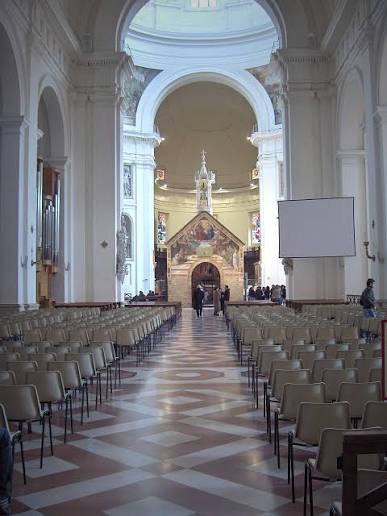
October 4 belongs to the saint. This is the liturgical feast day, celebrated across the Catholic world, and in Assisi it turns into a national ceremony. The solemn Mass takes place in the Upper Church of the Basilica of St Francis, it is broadcast live on Rai 1, and the Italian state attends in person.

Two churches matter here, and visitors confuse them constantly. Santa Maria degli Angeli is the enormous basilica on the flat ground near the train station, built around the Porziuncola chapel where Francis died. The Basilica of St Francis is the one on the hillside, in the town itself, where he is buried. The evening of October 3 happens down on the plain. The morning of October 4 happens up on the hill. Between the two, on foot, lies a climb of about three kilometers.
The votive lamp, and the ritual no guidebook explains
Here is the part that Italians absorb as children and foreign visitors almost never hear about.
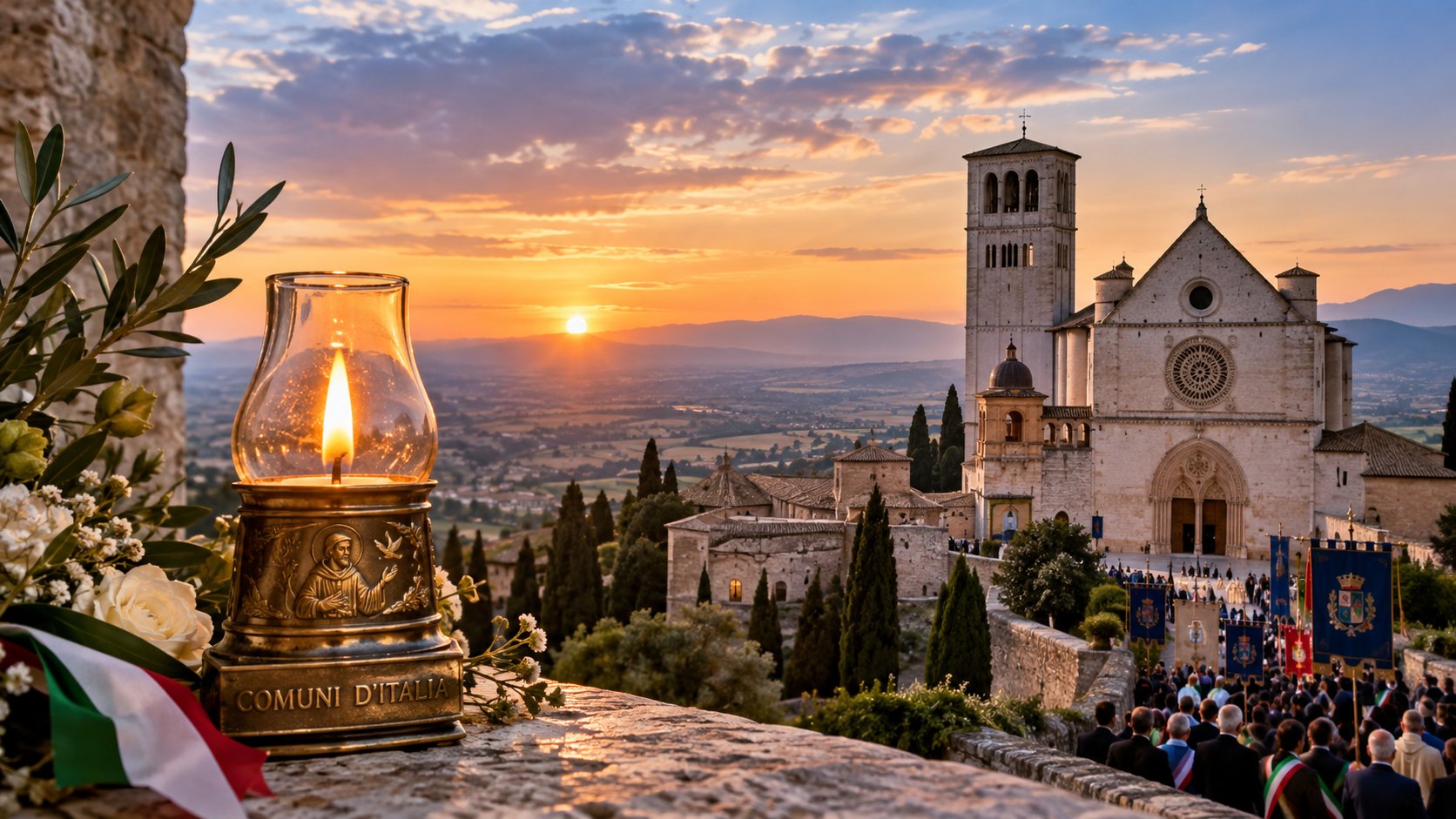
A lamp burns permanently at the tomb of Francis. It is called the Lampada votiva dei Comuni d’Italia, the votive lamp of the municipalities of Italy. It has burned since October 4, 1939, a few months after Pius XII proclaimed Francis the principal patron saint of the country. The oil that feeds it for a year is donated by one Italian region, and the regions take turns. The mayor of that region’s capital city lights the lamp during the Mass on October 4, speaking on behalf of every town in Italy.
So each year the feast has a second, civic layer. In 2024 it was Sicily’s turn, and the Sicilian dioceses brought a thousand liters of oil. In 2025 Abruzzo sent five hundred liters in a painted ceramic amphora. Le Marche, my own region, had already taken its turn five times by 2020.
Understand the lamp and you understand the rest. You see why Italian regional presidents and mayors fill the front rows of a religious service, and why the oil is treated so seriously. It is not decoration. It is a small annual act of federal unity performed in a crypt.

The 2026 centenary: what the eight hundredth anniversary changed
The 2026 edition was the largest in living memory, because it fell exactly eight centuries after the death. It is worth describing in detail, both because the structure repeats every year and because the scale set a new reference point.
The program ran from September 24 to October 5, 2026. It opened with a novena called Nove giorni con Francesco, nine days with Francis. That meant nine consecutive evenings of vespers, each one in a different place connected to his life. The sequence followed his biography rather than the map. It started at the Chiesa Nuova, built over the house tradition assigns to his family. It moved on to the cathedral of San Rufino, where he was baptized, and then to the Sanctuary of the Spogliazione, where he renounced his inheritance. The last evenings took in the Eremo delle Carceri, San Damiano, Rivotorto and finally the Porziuncola.
On Saturday, October 3, flowers were offered at Santa Maria degli Angeli at 10:30 a.m., followed by a solemn Mass at 11. In the afternoon, at the Sanctuary of the Spogliazione, there was a reading of Francis’s final hours before he asked to be carried down to the Porziuncola to die. A civic procession with the banners of Italian towns crossed Piazza Garibaldi at 4:30 p.m. The commemoration of the Transito began in the basilica at 5:30 p.m.
Then came the part I would choose if I could only attend one thing. At 8:30 p.m. a night pilgrimage set out on foot from the forecourt of Santa Maria degli Angeli. It stopped at San Damiano, at the Basilica of Santa Chiara and in Piazza del Comune, then ended inside the Basilica of St Francis. In reverse, it retraced the route his body took in 1226. At midnight, Mass was celebrated at the tomb. Both the walk and the midnight Mass required free advance registration.
On Sunday, October 4, the authorities met the municipality at 8:15 a.m. A second banner procession crossed Piazza del Comune at 8:50. The solemn Mass began in the Upper Church at 9:45, live on Rai 1. President Sergio Mattarella attended, and for the first time the mayor of Assisi himself lit the votive lamp on behalf of the whole country rather than a single region. Cardinal Matteo Maria Zuppi presided, assisted by Cardinal Ángel Fernández Artime, papal legate for the Assisi basilicas. At 11:20 a.m. the Franciscan family and the president delivered their messages from the loggia of the Sacro Convento. Pontifical vespers, a procession and a blessing addressed to Italy and the world closed the day at 4 p.m.
One number explains the pressure on the town. When the mortal remains of Francis were displayed between February and March 2026, nearly 400,000 pilgrims came to see them. Assisi is a town of about 25,000 people, and only a few thousand of them live inside the walls.
Italy has a new national holiday, and you should know about it
This is recent, it is genuinely useful, and almost no English-language source has explained it properly.
Law no. 151 of October 8, 2025, published in the Gazzetta Ufficiale no. 236 of October 10, 2025, made October 4 a national holiday in honor of St Francis, patron saint of Italy. It took effect on January 1, 2026. The date had been a public holiday until the 1970s, then lost that status. Now it is back.
The practical consequence arrives later than you might expect. In 2026 October 4 fell on a Sunday, so nothing visibly changed. From 2027 onward it lands on a working day, and October 4, 2027 is a Monday. That means public offices, schools and many businesses close. Italians get a three-day weekend at the exact moment the weather is still good and the olive harvest is starting. For a wider view of the month, see our guide to Italy in October.
Plan accordingly. A long domestic weekend will fill hotels across Umbria, not only in Assisi itself. And it will fill them with Italian travelers, who book earlier than you do. If you want that weekend, reserve six months ahead. If you want the feast without the crowd, 2027, with its three-day weekend, is the hardest year to try it for the first time. In 2028 October 4 falls on a Wednesday. Or simply arrive on October 2.
Reading the basilica: what an engineer notices
I have spent thirty years as a structural engineer in Le Marche, the region that shook together with Umbria in 1997. So I cannot look at this building the way an art historian does.
Start with the fact that it is two churches stacked on top of each other, begun in 1228, less than two years after the death. The Lower Church is dim, low and heavy, with thick walls and short spans. The Upper Church above it is tall, bright and Gothic, with large windows and a slender vault. The whole complex sits on the edge of a slope, carried on a system of arches and buttresses that continues below ground. The lower level is not a crypt in the ordinary sense. It is, among other things, the foundation of the church above.
That stacked geometry also gave the painters a high, well-lit wall to work on, in the Upper Church cycle attributed to Giotto and his workshop.

Then came September 26, 1997. Two earthquakes struck the Umbria-Marche border that day, the second with a moment magnitude of 6.0. A vault in the Upper Church collapsed during an inspection and killed four people. They were two technicians of the heritage authority, Bruno Brunacci and Claudio Bugiantella, and two friars, Angelo Api and Zdzisław Borowiec. A camera was running, and the footage went around the world within hours. Around 200 square meters of fresco were lost or badly damaged, including a section of Cimabue’s Evangelists.
What followed is the part worth carrying with you into the building. Workers recovered more than 300,000 fragments, sorted them by pigment and technique against life-size photographs taken before the earthquake, and put back what could be put back. The basilica reopened in late November 1999, a little over two years after the collapse. Stand in the Upper Church today and you are looking at two things. One is a restoration that became a reference case for the whole profession. The other is a set of gaps that were honestly left as gaps.
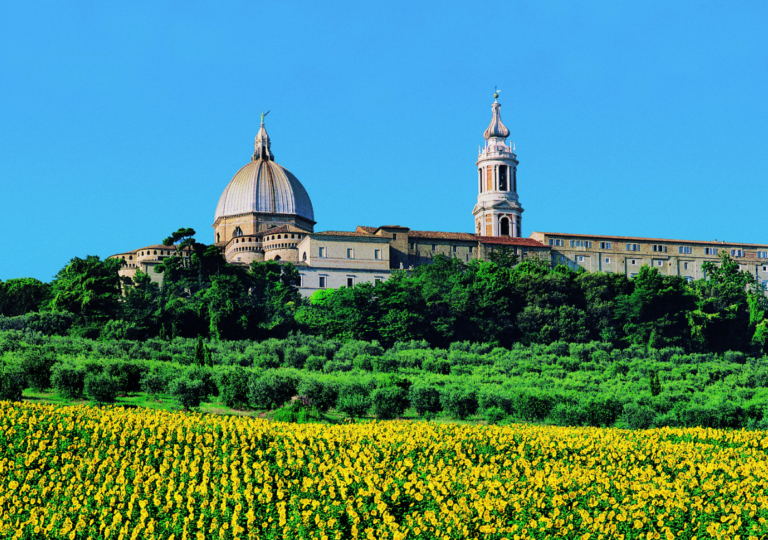
This is why I find the phrase “eternal Italy” irritating. These buildings are not eternal. They are maintained, and sometimes they are rescued. I made a similar argument about the Holy House at Loreto, another sanctuary that reads very differently to an engineer.
Planning your visit
Getting there
The station is called Assisi, but it stands in Santa Maria degli Angeli, on the plain about three kilometers below the old town, on the Foligno-Terontola line. From Rome, change at Foligno. From Florence, change at Terontola. Neither journey is difficult, but allow at least two hours from either city.
From the station, bus line C and the Assisi Link shuttle climb to Piazza Unità d’Italia and Piazza Matteotti in about fifteen minutes, with departures roughly every half hour. The published fare is €1.30 and stays valid for 90 minutes (checked September 2026). Walking up is possible and takes about forty minutes, most of it uphill in full sun.
Perugia’s small airport, named after Francis, is twelve kilometers away and has a shuttle connection. For anyone arriving from the United States, though, Rome is the practical gateway. If Rome is your only base and you cannot give Assisi a night, the guided day trip from Rome that pairs Assisi with Orvieto is the honest compromise; I explain its limits in the booking notes below.
If you drive, aim for the parking structures below the walls and walk in. The historic center is a restricted traffic zone, and on October 3 and 4 access is reduced further for security reasons, especially in years when the head of state attends, as he did in 2026.
Hours, tickets and behavior
Entry to the Basilica of St Francis is free for individual visitors, and no ticket is required. Groups must book. The Upper Church normally opens at 8:30 a.m. and closes in the early evening. The Lower Church opens at 6 a.m., and the tomb closes around 6 p.m. Exact times shift with the season and the liturgical calendar. Check the basilica’s own site before you go, not a third-party listing. On October 3 and 4 the schedule is rewritten entirely.
Shoulders and knees covered, no photography inside, no raised voices. The friars run their own guided visits. In summer they leave at 10:30 a.m. and 3:30 p.m., Monday to Saturday. Check the basilica’s site for the autumn schedule and book ahead. There is an elevator to the crypt; ask at the desk of the Sacro Convento.

Where to stay
Inside the walls, Assisi has a limited number of rooms and they sell out for the feast months in advance. Santa Maria degli Angeli, on the plain, is the obvious second choice and puts you next to the Porziuncola for the evening of October 3. Spello is a short train ride away and is a better place to have dinner. Foligno and Perugia work if you are willing to commute.
What to pair it with
Early October in Umbria is the best-timed week in the Italian calendar, and the feast is only one reason to come. The olive harvest starts within days, and the region’s mills open their doors for the Frantoi Aperti weekends. Montefalco is about forty minutes away by car and pours Sagrantino, a tannic red that nearly disappeared in the twentieth century. Spello and Spoleto are short train rides. Above the town, the Eremo delle Carceri sits in a holm-oak wood on Monte Subasio, and at eight in the morning it is nearly silent. Walkers can also pick up the long-distance Way of St Francis, which passes through Assisi and can be sampled in single-day sections.
What visitors most often get wrong
They come for October 4 and skip October 3. That is backwards. The daytime ceremony on the fourth is formal, crowded and heavy with protocol; you will see it better on television than from the back of a packed square. The evening of the third is the feast that Italians who care about Francis actually attend.
They also assume Assisi is a museum town that empties in winter. It is a working sanctuary. The Perdono d’Assisi on August 1 and 2 fills the Porziuncola with pilgrims in the worst heat of the year. Calendimaggio in May hands the town over to two competing halves, in a medieval contest that owes nothing to tourism.
And they underestimate the walk. Assisi is built on a slope, the stone is polished by eight centuries of feet, and the distance between the two basilicas is not flat. Wear shoes you would hike in.
Booking Notes: A Guide for the Town, Not for the Feast
The feast itself cannot be bought. What can be booked is the context around it: someone to explain the town on an ordinary day, and a way in from Rome if a night in Umbria is not possible. Two things are worth reserving, one is not, and none of them belongs on October 3 or 4.
A guided walk through the town, on any day except the feast. The friars’ own visits are the best way to see the basilica, and I would book them first. What they do not cover is the town that shaped Francis before the basilica existed: the Basilica of Santa Chiara, the Roman Temple of Minerva in Piazza del Comune, the tiny sanctuary of San Francesco Piccolino, where one tradition places his birth. The Assisi walking tour with a visit to the Basilica of St Francis, run by a local operator and among the best reviewed in town, links those places in two and a half hours and ends on the lower piazza of the basilica, which is the natural place to carry on alone. Book it for October 2 or 5, not for the feast. The operator’s own conditions note that guided tours inside the basilica are not allowed on Sundays or on major religious and national holidays, and October 4 is now both.
A day trip from Rome, if Rome is your only base. I wrote below that two nights is the minimum that works, and I stand by it. But if your Italy trip is built around Rome and the real choice is between one day in Assisi and none, the Assisi and Orvieto day trip from Rome is the version I would accept. It is long, about twelve hours door to door, and it includes hotel pickup, lunch on Lake Trasimeno and a two-hour guided walk in Assisi that reaches the basilica, Santa Chiara and the Sanctuary of the Spogliazione. Two hours is enough to understand why the place matters, and not enough to feel it. Orvieto gets about an hour of free time, which is a preview rather than a visit. Do not use it to see the feast: it heads back to Rome in the late afternoon, exactly when the Transito begins at the Porziuncola.
What I would skip: the “entry with audio guide” listing for the basilica. The wording suggests a ticket, and there is no ticket: entry to the Basilica of St Francis is free. What the listing sells is the rental of the basilica’s own audio guide device, which you collect at the information office on the lower piazza, leaving a passport or ID card as a deposit. The same office rents the same device directly, and travelers in the listing’s own reviews report paying noticeably less at the desk. Walk in, ask, and keep the difference for dinner in Spello.
FAQ
What is the feast of St Francis in Assisi?
It is the annual commemoration of the death of St Francis, held on October 3 and 4. The evening of October 3 marks the Transito, the hour he died at the Porziuncola in 1226. October 4 is his liturgical feast day and Italy’s national celebration of its patron saint.
When is the best time to go?
For the feast itself, arrive on October 2 and stay through the fourth. For Assisi in general, late September and early October combine mild weather, the olive harvest and fewer tour groups than summer.
Do I need a ticket or a reservation?
Entry to the basilica is free and needs no booking for individuals. Some feast events have required free advance registration: in 2026 that included the night pilgrimage and the midnight Mass at the tomb. Check the official program before you travel. Groups must always book, and guided visits are best reserved ahead.
How much does it cost?
The churches cost nothing. The bus from the station costs about €1.30. Hotel prices in Assisi climb sharply around October 3 and 4, so book months ahead, or stay in the weeks either side.
How long do I need in Assisi?
Two nights is the minimum that works. One day for the two basilicas and the town, one morning for San Damiano and the Eremo delle Carceri, and the evening of October 3 if your dates allow it.
What else should I combine with the trip?
Spello, Spoleto, Montefalco and the open olive mills of early October. If you want to walk rather than drive, the long-distance Way of St Francis passes through Assisi and can be sampled in single-day sections.
Which day should I choose if I can only attend one?
October 3, without hesitation. The Transito at the Porziuncola and the night walk up to the tomb give you the meaning of the feast. October 4 gives you the ceremony of the state, which is a different and more formal thing.
The takeaway
Assisi is one of the few places in Italy where the tourist calendar and the real one still coincide. On October 3 the town does not perform anything for visitors. It marks the death of a man who asked to be carried out of a comfortable house and laid on the bare ground. And it does so at the hour it happened, in the place it happened, as it has done for eight hundred years. Arrive early, stay for the evening, and let the crowds have the morning.
If you want more of Italy explained from the inside rather than from the outside, there is a great deal more on Tastes & Wonders of Italy.