Abbazia di Fiastra: The Abbey Built From a Dead Roman City
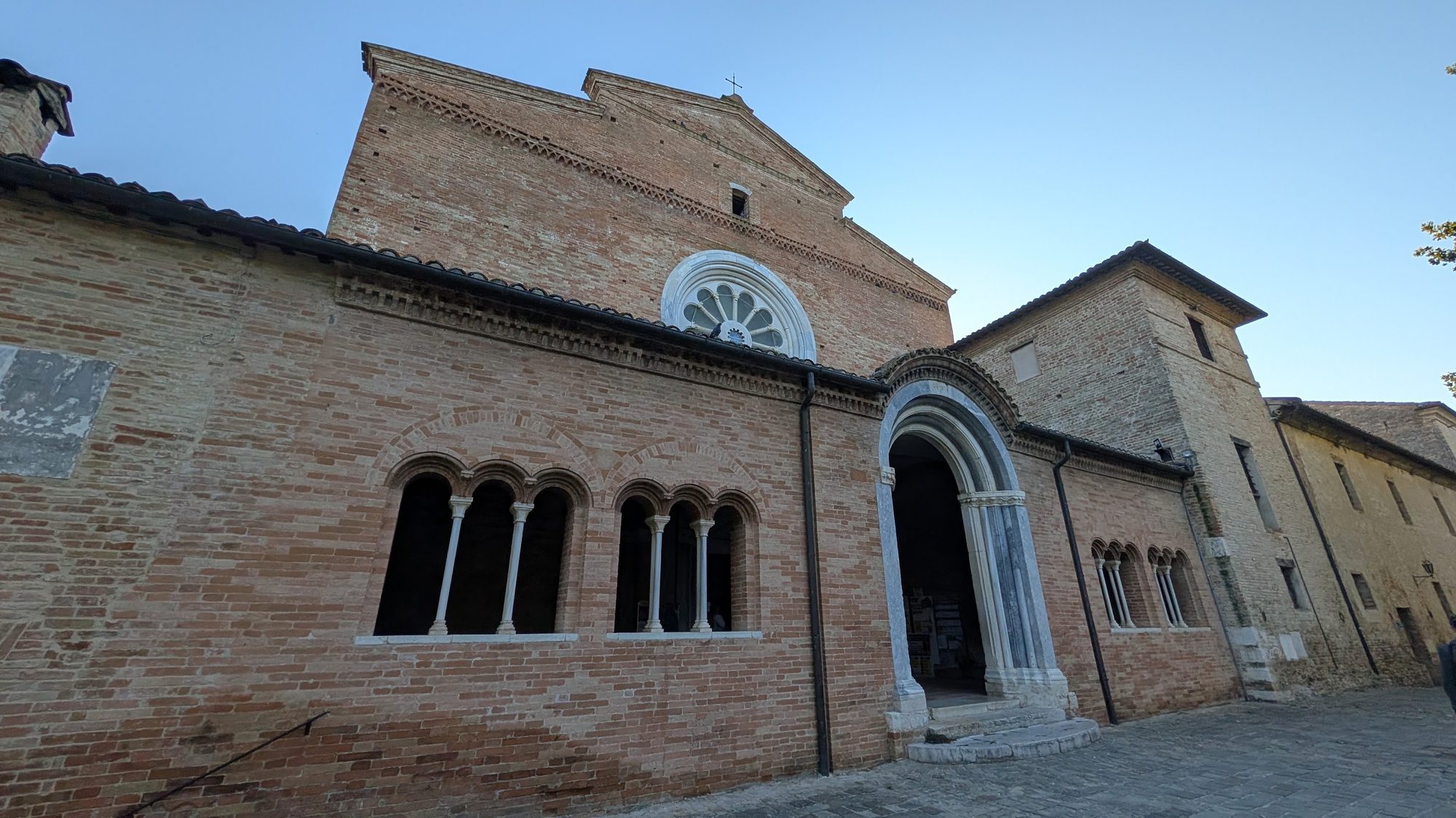
The Abbazia di Fiastra keeps its light low and its stone honest. Inside the nave, sunlight falls through small round windows set high in brick walls. It lands flat and grey-gold, pulling your eyes toward the altar and nowhere else. The air stays cool even in July. It carries the mineral smell of stone that eight centuries of rain have worn into the same cracks. Walk toward the apse and the floor rises just slightly. It is a Cistercian trick that makes the altar feel farther than it is. Then look down. Find the hall where the conversi, the lay brothers who did the abbey’s physical work, once ate their meals. Its vaults rest on seven columns. The travertine is pale and sun-worn against the abbey’s red brick. Still, not one of these columns is medieval. Their bases, shafts, and capitals are Roman. All of it was carved more than a thousand years before the monks who reused it were ever born.
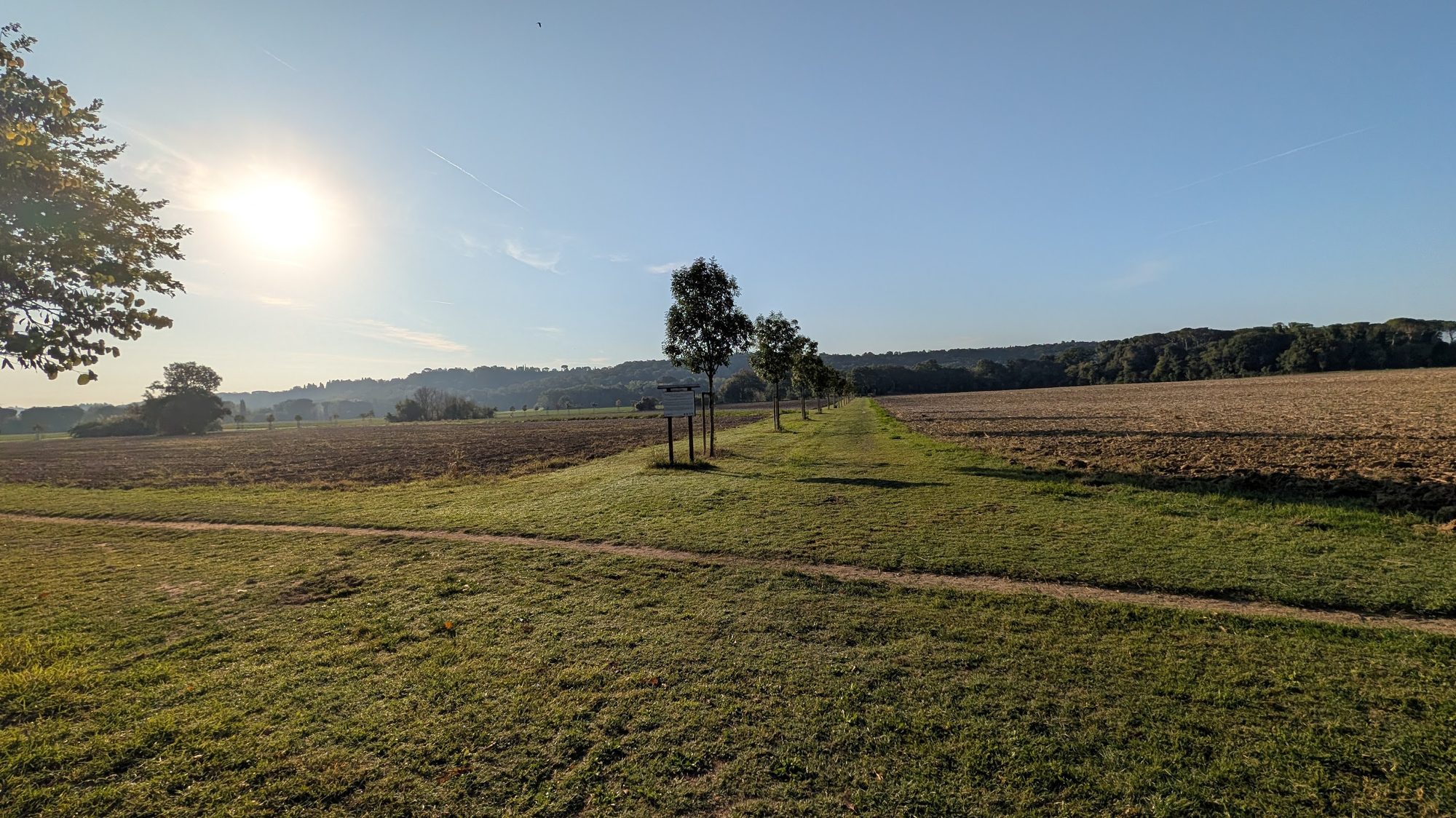
Outside, the Selva begins where the cloister garden ends. It is a wall of old oak holding a kind of silence that modern Italy rarely offers. No coach buses idle in the gravel lot. No gift shop competes with the architecture. The quiet here was not curated for visitors. It is simply what is left when a place survives, mostly on its own terms, for nine hundred years.
This is the short version of what happened here. The long version is worth the walk.
The Abbazia di Fiastra is also known as the Abbey of Santa Maria di Chiaravalle di Fiastra. It sits near Urbisaglia, in the Marche region of central Italy. Guarnerio II, Duke of Spoleto and Margrave of Ancona, founded it in 1142. He granted monks from the Chiaravalle Abbey in Milan a stretch of land between the Chienti and Fiastra rivers. Those monks built the church and cloister largely from brick. But they carved the portals, rose windows, and capitals from stone they salvaged out of nearby Urbs Salvia. The Visigoths under Alaric had destroyed that Roman city around 408 to 410 AD, roughly seven centuries before the Cistercians arrived. The abbey still stands today, at the heart of a protected nature reserve.
A Roman City That Became a Quarry
In fact, Urbs Salvia was not a village. It was a Roman colonia, founded in the second century BC along the Via Salaria Gallica. That inland road once linked Ascoli to the Adriatic coast. Augustus later resettled veterans there and gave the town its final name. By the first century AD, Urbs Salvia had a theater, an amphitheater, a temple complex, and city walls. Its population was wealthy enough to import marble from Africa, Greece, and the Middle East. One of its sons, Lucius Flavius Silva, left to serve Rome. He ended up commanding the siege of Masada, the Jewish fortress in Judea, in 73 AD. He returned home a patron of his own town. After 81 AD, he paid for the amphitheater that still stands in the valley below Urbisaglia today.
Then it was gone. In 408, and again in 410, the Visigoths under Alaric swept through central Italy and destroyed Urbs Salvia. Earthquakes and plundering finished what Alaric started over the following centuries. Later, the surviving population moved uphill, to the defensible ridge that became Urbisaglia. Instead, the valley floor, where the colonia once stood, reverted to fields and ruin. Dante wrote about Urbisaglia in the early 1300s. He used it as his example of a city erased by time, naming it alongside Luni and Chiusi in Paradiso. For a medieval Italian reader, the name alone meant a place that used to matter and no longer did.
That is the condition Guarnerio II’s land grant found in 1142: a dead city, visible, accessible, and unclaimed. The Cistercians who arrived from Milan did not import their building stone from a quarry in the hills. They carried it from Urbs Salvia instead, a few kilometers downhill, where cut blocks and finished elements already lay waiting. It was the medieval version of buying from a salvage yard instead of cutting new timber. This was common practice across this part of the Marche. The nearby Abbey of Santa Maria delle Macchie, near San Ginesio, did much the same thing with the same ruins. At Fiastra, though, the scale and the craftsmanship went further. Here, the monks did not simply stack the recovered stone. They carved it. The capitals on the abbey’s portals and rose windows carry floral and geometric patterns. Monks cut those patterns directly into reused Roman material. They turned spolia, the technical term for reused building material, into something new.
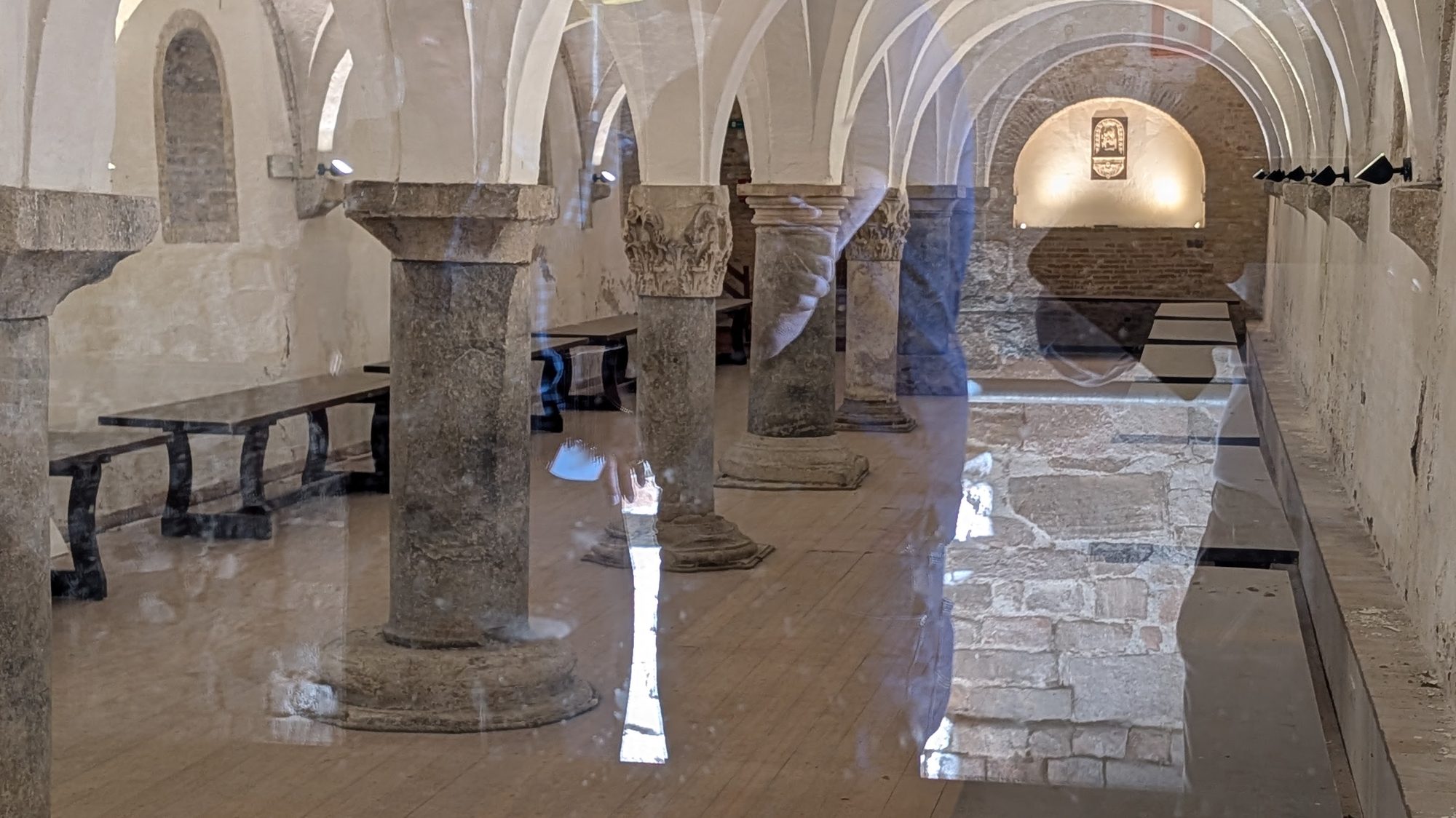
Inside the abbey’s exhibition hall, you can see the raw inventory the monks were drawing from. It holds about 88 carved stone pieces, most of them Roman and most of those from Urbs Salvia. The collection includes portrait heads identified as Augustus and his stepson Nero Claudius Drusus. There is also a funerary inscription for a sixteen-year-old named Gaius Turpidius Severus. Drive about ten minutes down to the Parco Archeologico di Urbs Salvia, and you can stand in the quarry itself. Look for the amphitheater. Look too for a Roman theater that is the most substantial in the Marche by size and form. It is also one of the few in Italy that still shows traces of its original painted decoration. There is a reservoir too, one that once fed the whole town by gravity alone. Then drive back up and look at the columns again. The quarry and the finished building, ten minutes apart, in the same afternoon.
The Monks Who Engineered a Valley
Choosing Urbs Salvia’s ruins for raw material was only the most visible decision the Cistercians made here. The harder one was choosing the site itself. It was a low, often marshy stretch of the Fiastra valley, hemmed between two rivers, that nobody else particularly wanted. Cistercian monks did not pick marginal land by accident. Their rule called for isolation and self-sufficiency. Low valley land, once drained, gave them water power and farmland that hill towns could not easily contest. At Fiastra, the monks diverted water from the river into an engineered channel. That channel fed their mills and reclaimed the surrounding wetlands for cultivation. Within a generation, bog became farmland. Farmland fed a growing community of monks and lay brothers. The abbey grew wealthy enough to oversee 33 dependent churches and monasteries across the region.
I have spent thirty years assessing buildings other people built. Most of them are considerably younger, and considerably less successful, than this one. What strikes me walking through Fiastra is not the reuse of Roman stone. Impressive as that is, the real story is the restraint of the building around it. Cistercian rule forbade decoration: no figured capitals on the main church, no stained glass, no bell tower reaching for attention. Today that sounds like a cost-saving measure, and in part it was. But austerity is also the harder design problem. A carved capital, a painted vault, a soaring spire: any of these can distract the eye from a flawed proportion. They can hide a joint that does not quite close. Strip that away, and the building has nowhere left to hide a mistake. Light becomes the only decoration. That means the geometry has to be exactly right, because nothing will cover for it if it is not.
Three hundred miles north, in Florence, Giotto’s Bell Tower makes the opposite argument. Color, sculpture, and ornament, it says, can carry their own structural and symbolic logic. Fiastra argues for bare geometry instead. Neither position is wrong. They are simply two different answers. Each one asks: how do you make stone hold weight, and also hold meaning?
That geometry has now survived nine centuries, three serious human shocks, and one modern one. Braccio da Montone’s mercenaries sacked the abbey in 1422, tearing the roof off the church and killing several monks. The abbey then passed through commendatory cardinals, then to the Jesuits, then, after 1773, to the Bandini family. Their heirs became the Giustiniani Bandini Foundation, which still owns the complex today. None of that, in the end, did as much structural damage as the earthquake that struck the Marche in 2016. The monastery and the Giustiniani Bandini palace were declared unsafe, and the church itself took real damage.
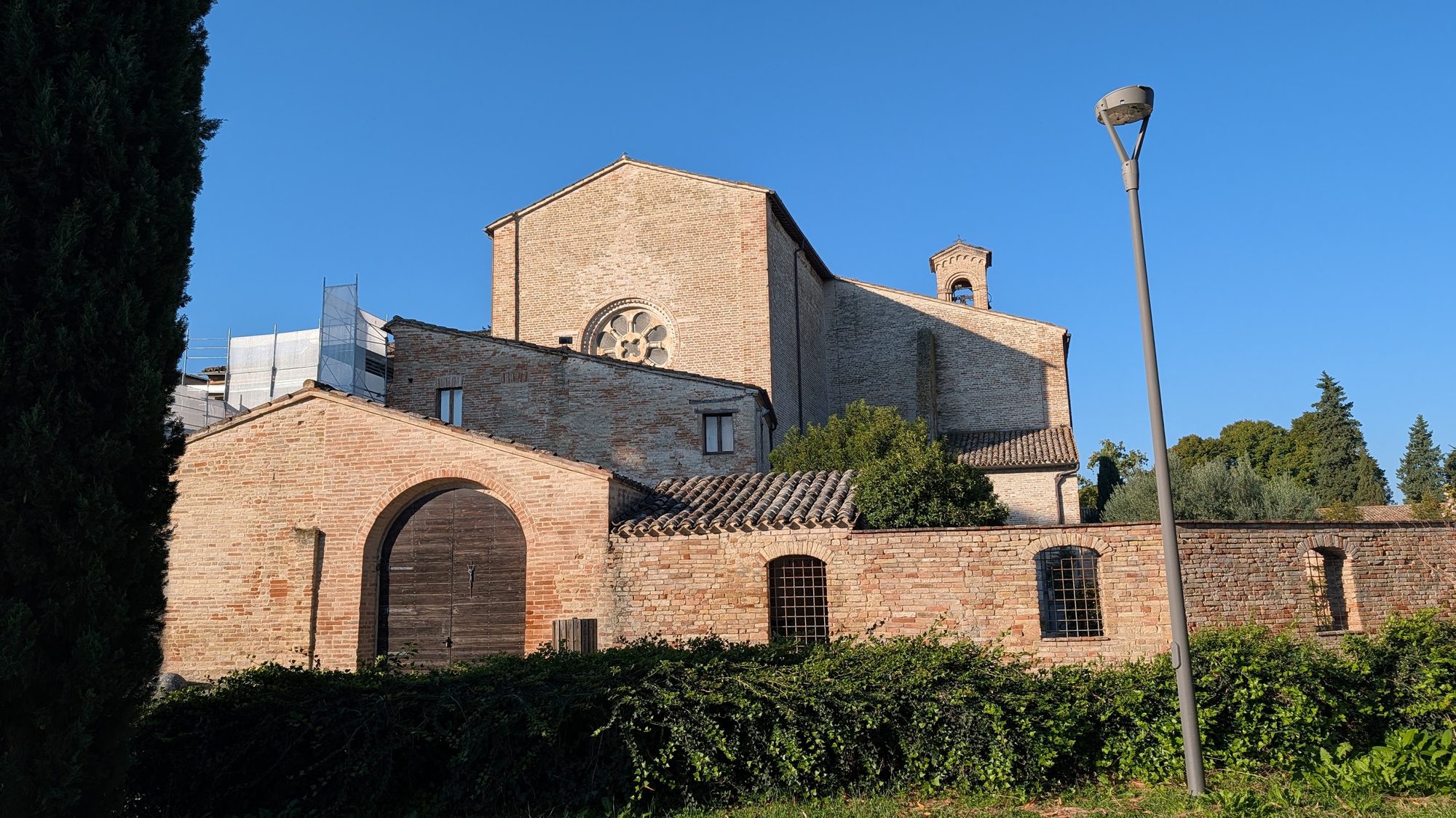
It is a strange thing to stand inside a building that outlasted a medieval war band. That same building nearly lost a fight with twenty-first-century seismology. Most of the complex has since reopened. That required the kind of structural assessment and reinforcement that is now routine work across this part of Italy. It is work I spend a fair amount of my own career doing.
Getting There and Making the Most of a Visit
The Abbazia di Fiastra sits in Contrada Abbadia di Fiastra. It lies between the towns of Tolentino and Urbisaglia, in the province of Macerata. There is no train station nearby. Public transit to this part of the Marche is limited, so a rental car is the practical choice. From Rome, plan on just under three hours by car. From Florence, figure closer to three hours as well. Bologna sits about two hours away. The Adriatic coast, with the regional capital of Ancona, is roughly thirty minutes east. The nearest airports are Ancona-Falconara and Perugia Sant’Egidio. Both connect to the abbey by a straightforward drive through the Marche’s hill country.
Meridiana manages visits for the Giustiniani Bandini Foundation. The company runs the abbey together with the Parco Archeologico di Urbs Salvia. The two sites are typically sold and visited as a pair. That combination is worth building a half-day around. Start at the abbey in the morning. That is when the nave stays coolest and the light comes in low through the clerestory windows. Then walk or drive the short distance down to the archaeological park to see where the stone actually came from. Opening hours generally run daily, in a morning block and an afternoon block. Hours and admission shift by season, though. So confirm them directly with the Riserva Naturale Abbadia di Fiastra before you plan a day around them.
Give the combined visit at least three hours. Allow more time if you plan to walk the reserve’s marked trails. They run through the Selva or toward the wetlands at Le Vene. Spring and early autumn bring the mildest weather and the thinnest crowds. Summer works too, since the brick nave stays notably cooler than the courtyard outside it. This is also, unmistakably, Verdicchio and Rosso Piceno country. The Colli Maceratesi DOC zone wraps around Macerata. The rarer Vernaccia di Serrapetrona comes from a town less than half an hour away. It is a sparkling red unlike anything else made in Italy. If you are building a longer central Italy itinerary, Cingoli sits within easy reach. It was recently crowned Italy’s most beautiful village. The broader case for this region’s Mediterranean diet heritage runs directly through towns like these.
A Monument That Doubles as a Backyard
I live about fifteen minutes from here. For anyone who grew up in this part of the Marche, the Abbadia di Fiastra is not primarily a monument. It is where Sunday afternoon happens. Today, families spread blankets on the lawn in front of the church. Kids run the gravel paths into the Selva until their parents call them back. Cyclists stop at the bar near the entrance for a coffee before continuing on toward Tolentino. None of this is staged for visitors. For most of the year, there are barely any visitors to stage it for.
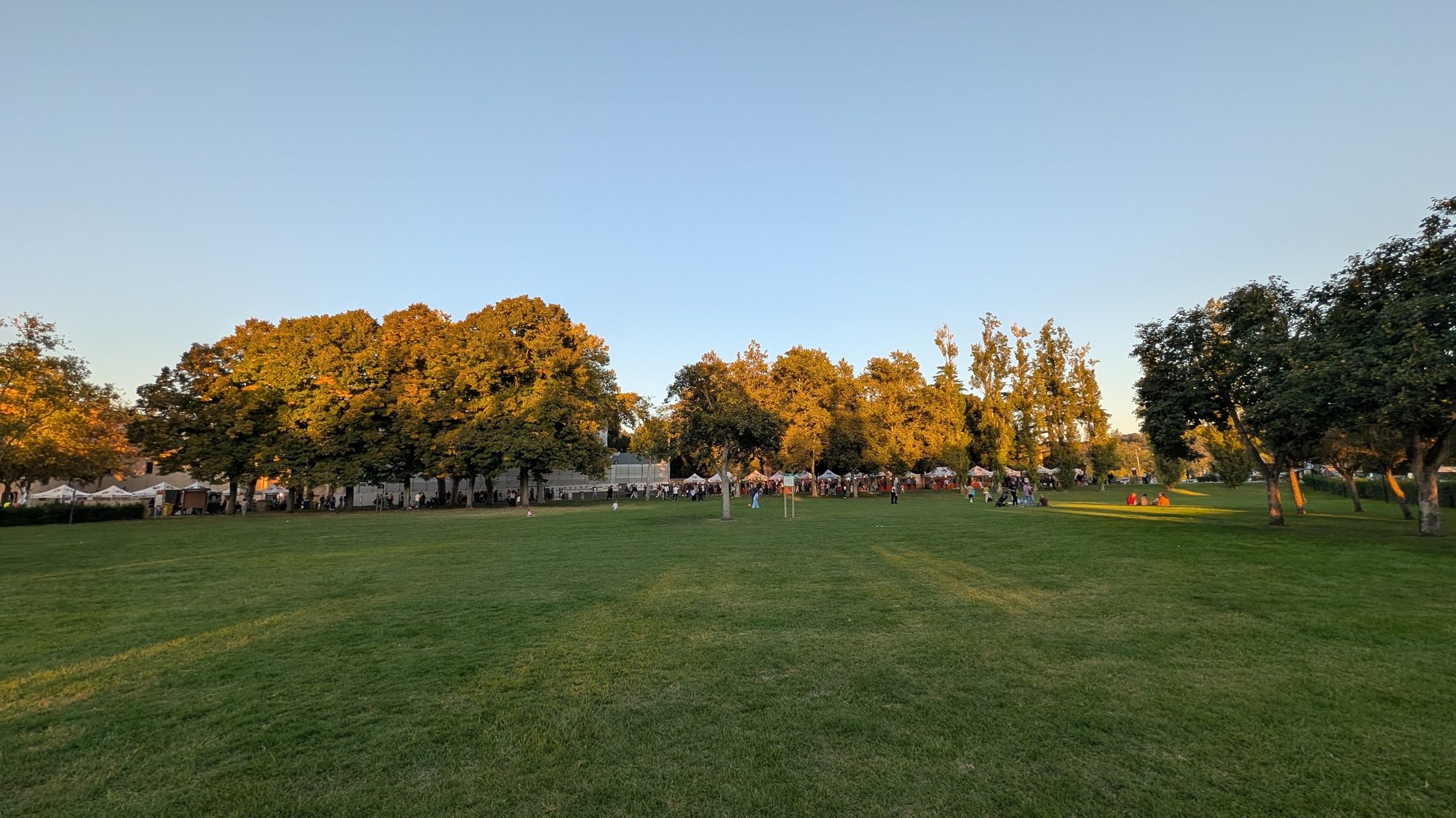
That contrast is the real story here, more than the Roman stone or the engineering. This building has nine hundred years of continuous use behind it. A duke founded it. A mercenary captain sacked it. Cardinals, Jesuits, and princes each held it in turn, and a conservation foundation manages it now. On an ordinary Sunday, though, it is simply where a Macerata family lets the kids burn off energy before dinner. This is a twelfth-century Cistercian abbey, built from the bones of a Roman city. Dante once used that city’s name as shorthand for oblivion. Now the abbey doubles as a neighborhood park. Very few monuments in Italy manage both roles at the same time.
FAQ: Planning Your Visit to the Abbazia di Fiastra
What is the Abbazia di Fiastra? The Abbazia di Fiastra is a Cistercian abbey near Urbisaglia, in the Marche region of central Italy. Monks from Milan founded it in 1142. They built it largely from stone salvaged out of the ruined Roman city of Urbs Salvia nearby.
When is the best time to visit the Abbazia di Fiastra? Spring and early autumn bring mild weather and thin crowds. Summer works well too, since the brick nave stays notably cooler than the surrounding courtyard. The reserve’s outdoor trails, though, are more comfortable outside the midday heat.
Can I visit the abbey and the Urbs Salvia ruins in one trip? Yes. The same organization manages both sites and typically sells them as a combined visit. Plan at least three hours for both, more if you want to walk any of the reserve’s nature trails.
Do I need a car to get to the Abbazia di Fiastra? Yes, practically speaking. There is no train station nearby, and public transit to this part of the Marche is limited. A rental car gives you the flexibility this rural valley requires.
What are the Abbazia di Fiastra’s opening hours? The abbey and reserve generally open daily, in a morning block and an afternoon block, but hours shift by season. Confirm the current schedule directly with the Riserva Naturale Abbadia di Fiastra before you plan your day around it.
Why does the Abbazia di Fiastra look so plain compared to other Italian churches? Cistercian rule forbade decorative carving, stained glass, and tall bell towers. The order treated ornament as a distraction from prayer. The abbey relies on brick, proportion, and light instead of sculpture or color.