Olive Harvest in Italy: What Really Happens Inside a Frantoio
The olive harvest in Italy begins in mid-October and ends, in most of the center of the country, before the last week of November — and if you arrive at a working frantoio (olive mill) during those six weeks expecting the hushed, wood-paneled hospitality of a winery, you will be badly misinformed. A mill in full production is loud. The floor is wet. Someone is shouting over the noise of the malaxer about whether the next load can wait until midnight. There is no tasting counter, no gift shop, and often no one free to talk to you for the first twenty minutes. It is also, hands down, the most interesting food-production process you can watch in Italy, and it is open to you if you understand how it works.
When the olive harvest in Italy actually happens
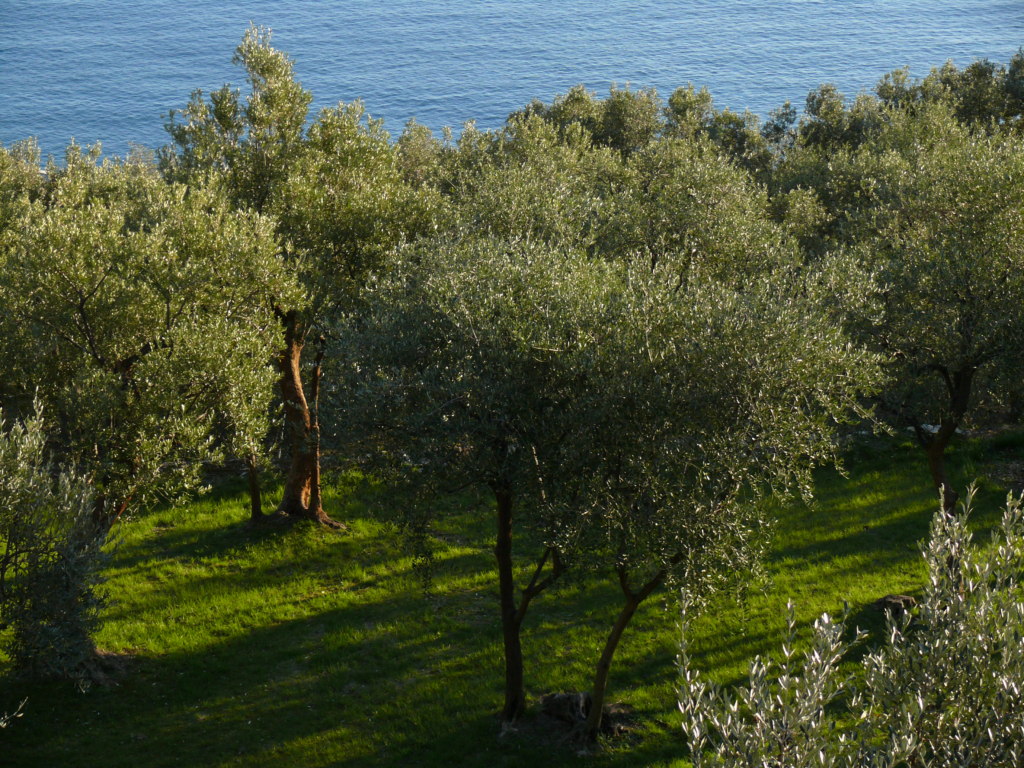
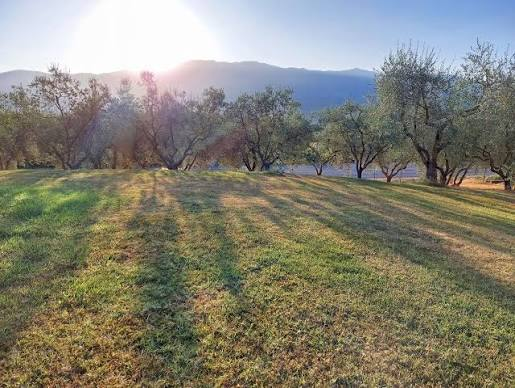
Across central Italy, picking starts in the second half of October and finishes by late November. The early-ripening cultivars come first, the later ones follow, and the whole thing is compressed into roughly a five- to six-week window that shifts by up to two weeks depending on the year’s weather.
The regulations for Cartoceto DOP, the only protected-designation olive oil in Le Marche, give you a useful calendar in writing: harvesting begins as the fruit starts to change color, generally from the second ten days of October for Leccino and from the first days of November for Raggiola and Frantoio, and in all cases it must be finished by November 25.
That last clause matters. It is not a suggestion about quality — it is a legal deadline in the production rules. Olives left on the tree past a certain ripeness produce more oil per kilo but a duller, flatter product, and the designation simply forbids it.
Why the dates move every year
Heat pushes everything forward. The 2026 growing season has been exceptionally hot across Italy, and it showed first in the vineyards: the grape harvest opened on July 28 in the Oltrepò Pavese, roughly ten days ahead of the local average, with Coldiretti tying the anticipation to extreme heat and the drought accompanying ripening across the peninsula. Olives respond to the same pressures on a longer fuse.
So treat any published date as provisional. If you are planning a trip around the harvest, book the region and the two-week window, then confirm the specific mill ten days out. Every producer I know decides the actual picking date by walking the grove and biting a few olives, not by consulting a calendar.
A frantoio is not a winery
This is the single most useful thing an American visitor can understand before booking anything around the olive harvest, and almost no English-language guide says it plainly.
A winery has a natural rhythm of hospitality: fermentation takes weeks, aging takes years, and the cellar is a calm place for eleven months out of twelve. An olive mill is the opposite. It is idle for ten months, and then for six weeks it runs eighteen or twenty hours a day because every load that arrives has a clock on it.
The clock is real and it is short. The Cartoceto DOP rules require olives to be transported in perforated crates holding no more than 25 kilos each, kept there only briefly, and milled within two days of picking. Serious producers cut that to twelve or twenty-four hours. Olives sitting in a heap begin to ferment and heat from the inside, and heat is the enemy of everything that makes the oil worth making.
What this means in practice: the mill is not performing for you. You are being allowed into a factory during its only busy season. Behave accordingly and you will be treated extremely well — Italian frantoiani (mill operators) are proud people who love explaining their work to someone genuinely interested. Show up unannounced at seven in the evening on a Saturday in early November, and you will be, correctly, ignored.
From tree to bottle in one afternoon
Watching the sequence is the reason to come during the olive harvest. Modern mills in central Italy are almost all continuous-cycle systems, and the whole run takes under an hour.
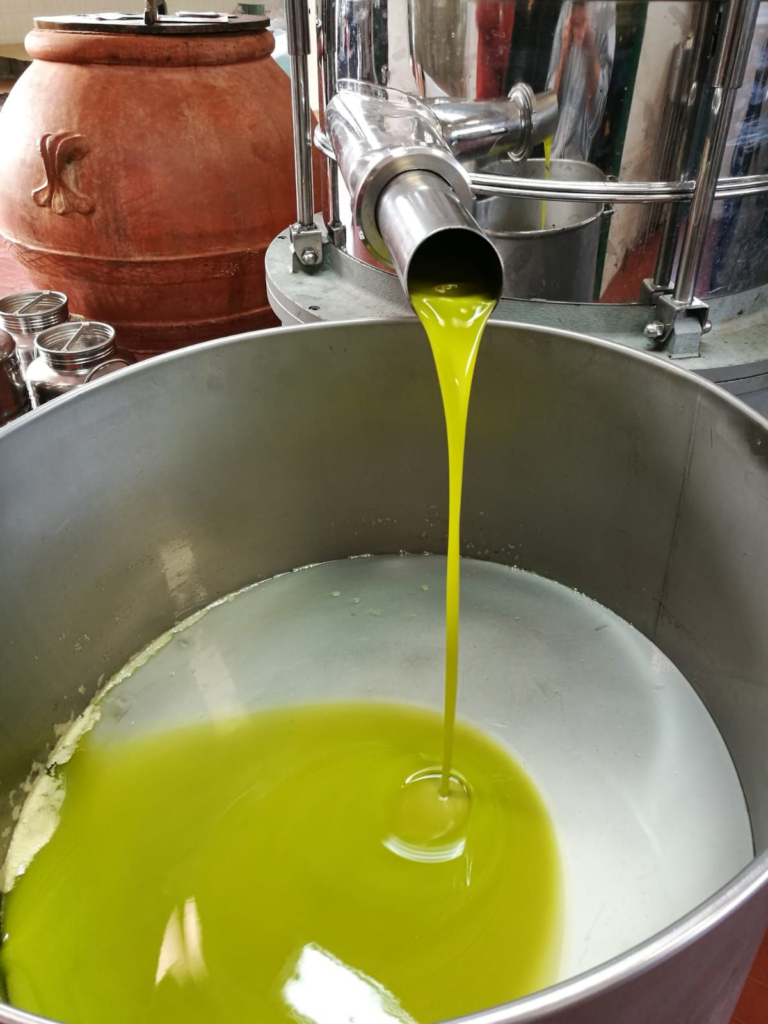
The olives arrive and go straight into a machine that strips leaves and twigs and washes the fruit. From there they are crushed whole — pits included — into a paste. The paste then moves into the gramola, a long stainless steel trough with slow-turning blades that kneads it for twenty to forty minutes. This is the malaxation step, and it is where the oil droplets, dispersed through the paste, find each other and merge into a phase large enough to separate.
Then the paste is fed into a horizontal centrifuge, the decanter, which spins the mass hard enough to throw the water and solids one way and the oil the other. What comes out of the spout at the end is finished oil. Nothing is added, nothing is heated beyond a strictly controlled threshold, and no chemistry is involved anywhere.
If you have been sold on the romance of the old stone wheels and the fiber mats stacked under a hydraulic press, I have bad news that every Italian producer will confirm: those systems are slower, harder to keep clean, and expose the paste to far more oxygen. A handful of mills keep one running for demonstration or for tiny lots. Almost nobody who cares about the result uses them for the main production anymore. Nostalgia and quality diverge here.
The other phrase worth retiring is “cold-pressed.” Nothing is being pressed in a modern mill; it is being centrifuged. The meaningful legal term is “cold extraction,” which caps the process temperature. Ask about the malaxation temperature, not the press.
Why the new oil burns your throat
Take a spoonful of oil that came out of the decanter an hour earlier and two things will happen. Your tongue will register a distinct bitterness at the sides. Then, three or four seconds after you swallow, the back of your throat will catch — a peppery scratch that can make a first-timer cough.
Americans routinely read this as a defect, or as “acidity.” It is neither. Acidity in olive oil is a laboratory value measuring free oleic acid, invisible to taste, and the legal ceiling for extra virgin is 0.8 percent — the Cartoceto rules tighten it to 0.5. You cannot perceive it in the mouth at all.
What you are tasting is the phenolic compounds. The bitterness comes largely from oleuropein and its relatives. The throat pepper comes from oleocanthal, a phenol that acts on oral sensory receptors in a way that has been compared to ibuprofen. Both are antioxidants, both protect the oil from oxidizing, and both fade steadily over the months after milling. An oil that slides down like water with no bitterness and no catch is usually old, or made from fruit picked too late.
The European Food Safety Authority took this seriously enough to authorize a health claim in 2011 connecting olive oil polyphenols to the protection of blood lipids from oxidative stress — permitted on a label only where the oil carries at least 5 milligrams of hydroxytyrosol and its derivatives per 20 grams. The bitterness is, in the most literal sense, the label of the good stuff.
New oil is also cloudy, green-tinged, and slightly opaque, because it has not yet settled or been filtered. It will not look like the clear gold bottle in your kitchen at home. That cloudiness is fine now and a liability by spring, which is why most producers filter before the oil goes into commerce.
The Marche variables: twenty cultivars and one DOP
Here is where my own region gets interesting, and where the standard Tuscany-and-Puglia coverage of the olive harvest leaves a gap.
Italy has something on the order of five hundred olive cultivars, an agricultural biodiversity with no equal anywhere. Le Marche alone accounts for roughly twenty native varieties catalogued by the regional agency — names like Raggia, Raggiola, Mignola, Coroncina, Orbetana, Piantone di Falerone, Piantone di Mogliano, Sargano di Fermo, Rosciola dei Colli Esini, and the Ascolana Tenera that most of the world knows only as the fat green olive stuffed with meat and fried.
Cartoceto DOP, produced in a small group of municipalities in the Metauro valley behind Fano, is built mainly on Raggiola, Frantoio and Leccino, which must together account for at least 70 percent of the grove, with a permitted 30 percent of Raggia, Moraiolo, Pendolino, Maurino, Carboncella, Nebbia and Rosciola. It is the region’s only DOP oil, and the olive presence in that territory is documented back to the thirteenth century.
But — and this is the insider correction — the DOP is not where most of the good oil in Le Marche is. Protected designations account for only about two or three percent of Italian olive oil production overall. In this region the real picture is thousands of small groves in the hands of families who are not commercial producers at all.
The national numbers make the shape of it clear. ISMEA estimates that at least three million Italian families are involved in producing their own oil, and while no official figure exists for the volumes, the sector’s own estimate is that at least 35 percent of Italian olive oil never enters the market: it is consumed at home or given to relatives and friends. Of roughly 620,000 olive-growing holdings in the country, 42 percent work less than two hectares.
That is the Italy you are actually driving through in November. The oil in the unlabeled bottle on a Marchigiano family’s table is very often better than anything for sale within fifty miles of it, and it is not for sale at any price. It is given. Why that bottle is given rather than sold is the whole subject of Italian olive oil culture.
How to visit a working mill without getting in the way
Olive oil tourism has a legal identity in Italy, which surprises most visitors. Law 160/2019 (article 1, paragraphs 513 and 514) defined oleoturismo and extended to it the framework already established for wine tourism, with ministerial guidelines following in a decree of January 26, 2022 covering the minimum standards for the activity. Guided visits to groves and mills, tastings, and educational activities are all formally recognized categories.
There is a further development worth knowing: the national labor inspectorate and the Associazione Nazionale Città dell’Olio signed a protocol regulating tourist olive picking across Italy, following the model already established for tourist grape harvesting. If a producer invites you to pick, that is now a framed activity rather than a legal gray zone.
Practical rules, learned the direct way:
- Call, do not email. During the campaign nobody reads email. A phone call two or three days ahead, in the late morning, gets you a yes or a specific time.
- Ask for late morning or early afternoon on a weekday. The heaviest deliveries come in at the end of the day, when pickers finish. Midday is when a frantoiano can actually stand still and talk.
- Do not touch anything, and stay out of the delivery lane. Crates move fast on trolleys and the floor is slick with oil and water.
- Bring cash. Many small mills sell direct and are not set up for foreign cards.
- Do not ask for a discount. In a bad year the producer may be selling at a loss already, and haggling reads as an insult rather than a negotiation.
- Accept the bread. If someone hands you a piece of grilled bread with new oil poured over it, that is the tasting. There is no other one.
Where the olive harvest becomes a public event
If you want the olive harvest with organized infrastructure rather than cold-calling mills, two fixtures anchor the season in central Italy.
Frantoi Aperti in Umbria runs from October 17 to November 15, 2026, structured as five consecutive weekends across the towns of the Strada dell’Olio EVO DOP Umbria — Trevi, Spello, Assisi, Montefalco, Bevagna, Spoleto, Todi, Amelia and Orvieto among them. It is the largest oil festival in the country and the one event where mills across a whole region are staffed and prepared for visitors during production. Quality-sector observers describe it as the leading Italian oleotourism event.
La Camminata tra gli Olivi, the national olive-grove walk organized by the Associazione Nazionale Città dell’Olio, falls on the last Sunday of October — October 25 in 2026. It is a single-date, nationwide event: over a hundred member towns each mark out a route of two to seven kilometers through the groves, ending at a mill or farm with bread and oil. Recent editions have involved around 140 municipalities across eighteen regions. Pesaro’s Marche edition, held in the hills at Monteciccardo, pairs the walk with mill visits and a producers’ market.
In Le Marche, the Cartoceto DOP Festival, running since 1977, brings the oil and olive market to the town of Cartoceto in November. Confirm dates with the comune before planning around it.
Buying oil, and not wasting the money
Oil bought at the mill during the olive harvest is not a souvenir with an indefinite shelf life. The Cartoceto guidance is direct: store it between 14 and 18°C, away from light, heat and strong odors, and consume it within four to six months of milling for the fullest expression of its flavor. It is perishable food, not a decorative bottle.
A few things worth knowing before you spend:
Buy a five-liter tin rather than three pretty bottles if you can — it is cheaper per liter, better protected from light, and it is what Italians actually buy. Decant into a small dark bottle at home and keep the tin closed. What to ask at the counter before you hand over the money, and how to get the tin home, is set out in this guide to buying oil at the frantoio.
Flying home, oil goes in checked luggage; the 100-milliliter cabin limit applies to it like any other liquid. Wrap tins in clothing and expect one in twenty to weep slightly at altitude.
Ask when the oil was milled, not what year it is. A November milling and a February milling from the same harvest year are very different products by the time you get them home.
Finally, ignore color. Green does not mean better; it reflects cultivar and picking date. Professional tasters use blue glasses specifically to prevent color from influencing judgment.
If you are buying a house with olive trees
This comes up more often than you would expect, because a great many Marchigiano farmhouses on the market come with anywhere from twenty to three hundred trees, and buyers rarely think about them until after the deed is signed.
Olive trees are not decoration. They require pruning every year or two by someone who knows the form, they carry phytosanitary obligations, and an abandoned grove degrades fast — the regional agricultural agencies treat grove abandonment as a serious structural problem, not an aesthetic one. On the other hand, thirty productive trees will give a family more oil than it can use, and the local mill will process small lots for a fee, which is how most of my neighbors get their year’s supply.
In thirty years of assessing rural buildings in this region, the questions I get asked about the roof are constant and the questions about the land are almost nonexistent. They should not be. What the grove costs you annually, whether the access track can take a tractor, and whether the terracing is holding are all things to establish before you sign, not after.
FAQ
What is a frantoio?
A frantoio is an olive mill: the facility where harvested olives are crushed and the oil extracted. The word also names one of Italy’s most widespread olive cultivars, which causes reliable confusion. Context tells you which one is meant.
When is the best time to see the olive harvest in Italy?
Late October through mid-November in central Italy. That window catches both picking in the groves and mills running at full capacity, and it overlaps with Frantoi Aperti in Umbria, which in 2026 runs October 17 to November 15.
Do I need to book a mill visit in advance?
Yes, and by phone. During the six-week campaign mills operate on unpredictable schedules driven by deliveries. Call two or three days ahead and ask for a weekday late morning. Turning up unannounced during peak season will not work.
How much does it cost to visit an olive mill?
Many small mills charge nothing for a look around during production, expecting you might buy oil. Structured oleotourism experiences with a guided tasting and food typically run in the range of a paid winery visit. Confirm when you book, and bring cash.
How long does the milling process take?
Under an hour from crushing to finished oil in a modern continuous-cycle mill, with malaxation — the kneading step — accounting for twenty to forty minutes of it. The visit itself is worth budgeting an hour and a half.
Can I join the olive picking myself?
Increasingly yes. Tourist olive picking has been formally regulated nationwide through a protocol between the national labor inspectorate and the Città dell’Olio association, following the model used for tourist grape harvesting. Ask the producer directly whether they participate.
Why does the new oil make me cough?
Oleocanthal, a phenolic compound that stimulates receptors at the back of the throat. Along with the bitterness from oleuropein, it is a marker of a fresh, polyphenol-rich oil, not a fault or a sign of acidity. Italian tasters count the cough — un tossitore, a one-cougher, is a compliment.
The takeaway
The olive harvest is the one time of year when the Italian countryside is doing something rather than displaying something. Nobody is dressed for you. The pace is set by fruit that cannot wait, and the hospitality you get, when you get it, is real precisely because it was not scheduled.
Come in the second half of October or the first two weeks of November. Pick a base in the hills — Umbria’s Assisi-to-Spoleto olive belt, or the Metauro valley behind Fano, where the same weeks open the legal white truffle season — and call two mills before you arrive. Eat the bread with the oil poured over it standing up, in the noise, next to the machine that made it ten minutes earlier. There is no version of that experience available in a shop.
If you are planning a trip through central Italy during the harvest and want help building it around the real calendar rather than the published one, or if you are looking at a property here with a grove attached and want to know what you would actually be taking on, you can book an orientation call.