Marostica Chess Game 2026: An Italian’s Guide to the Match
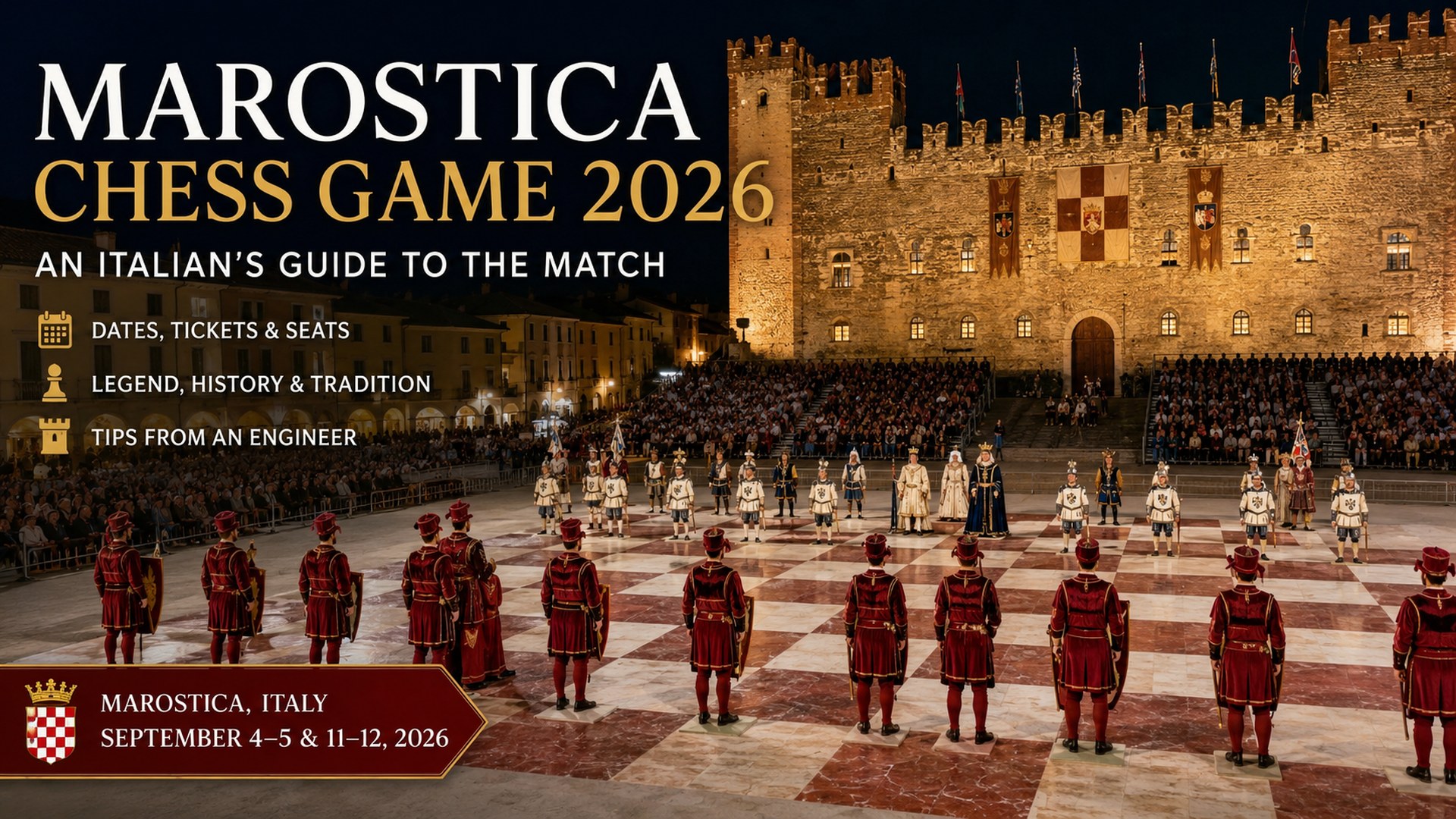
The Marostica chess game 2026 opens on the evening of Friday, September 4, when the floodlights come up on a marble board sixteen meters across and thirty-two people in wool and velvet take their squares in front of a fourteenth-century castle wall. The stone still holds the day’s heat. Somewhere behind the porticoes a drum starts. Over four nights this September, a town of roughly fourteen thousand people in the province of Vicenza will stage the largest living chess match in the world, as it has every second year since 1954. This guide covers the 2026 dates, what the spectacle actually is beneath the legend, how to buy a seat, and which seat to buy.
A note on links: some of the booking links below are affiliate links, and if you book through them I earn a small commission at no extra cost to you. The chess game itself is not one of them. Tickets are sold only by the Associazione Pro Marostica, there is no resale channel that pays me anything, and I would tell you to buy direct even if there were.
Marostica Chess Game 2026: dates, times, and the two-year rule
The 2026 edition runs across four performances: Friday, September 4; Saturday, September 5; Friday, September 11; and Saturday, September 12, each beginning at 9:00 PM in Piazza Castello, Marostica. There is no matinée in this edition, and no Sunday show.
The single most important planning fact is the calendar itself. The Partita a Scacchi is biennial and runs in even-numbered years, traditionally on the second weekend of September. If you miss September 2026, the next opportunity is September 2028. This is not a festival you can catch next summer instead, and it is the reason Americans who stumble on Marostica in an odd-numbered year find a beautiful square with a marble chessboard and nothing happening on it. If you are already building a trip around this date, it lands in the month Italians quietly keep for themselves, which is the best argument for the whole itinerary.
Each performance seats roughly 3,600 spectators in numbered grandstand chairs erected around the board. Plan on more than two hours from curtain to fireworks. The chess portion itself is shorter than most visitors expect: the match averages twenty-two moves and takes about an hour, with the parades, the court scenes, the flag throwers, and the fire eaters filling the rest.
One local convention that catches foreign visitors badly: if the weather turns, the organizers postpone to the following week rather than cancel. That is manageable if you are staying in Veneto for two weeks. It is a problem if your flight home leaves Monday. Build the risk into your itinerary rather than assuming a refund, because the published terms of sale do not provide date changes or refunds when you cannot attend for personal reasons.
The piazza is not a backdrop. It is a piece of engineering.
I have spent thirty years assessing masonry buildings and the surfaces around them, and Piazza Castello reads differently once you know what you are standing on.
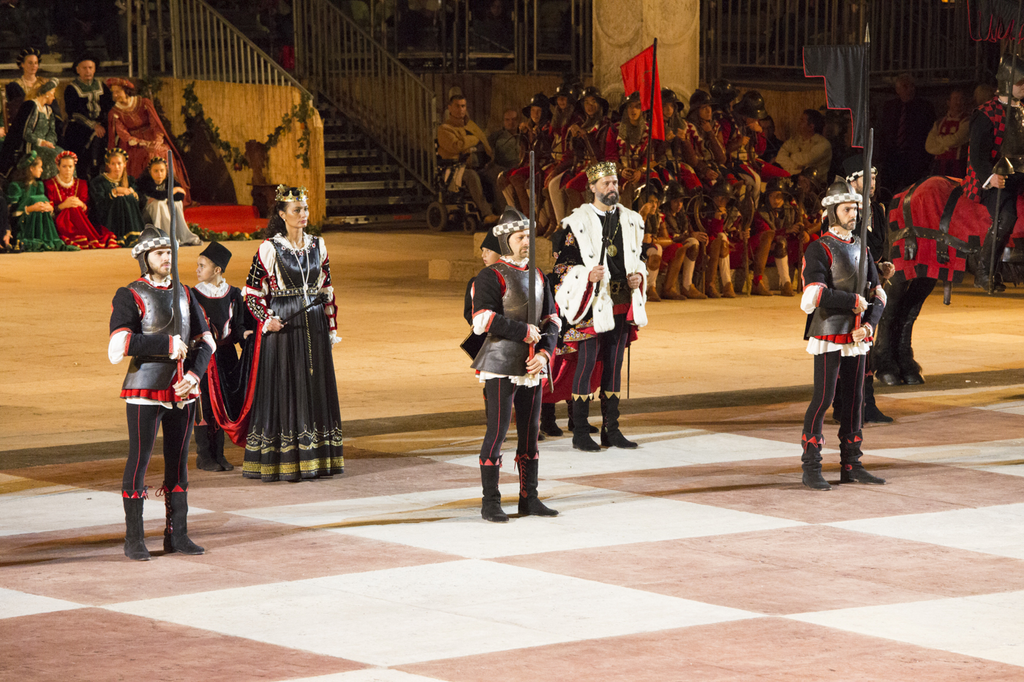
The performance takes place on the liston, the raised paved platform the Venetians built in 1462 for trading and for the evening stroll — the same civic function that Italians still call the passeggiata. The chessboard itself is much younger. It was laid in 1954, when the game resumed after the interruptions imposed by Fascism and the Second World War: a black basalt frame measuring sixteen meters on each side, enclosing sixty-four squares of four square meters each, cut from red marble and the pale local stone called biancone di Asiago. Two meters to a square, 256 square meters of board. The lower castle closes one side and supplies the backdrop.
That geometry dictates the entire experience, and it is where the engineering matters to you as a ticket buyer. The grandstands wrap the square, which means half the audience is always watching the actors from behind. The direction compensates by rotating bodies, banners, and shields through the choreography so that every sector eventually sees the front of each figure. The consequence is simple and nobody puts it on the ticket page: seats facing the board along its length give you the chess — the ranks and files, the geometry of the position, the moment a piece walks diagonally across four squares of red marble. Seats on the curved ends give you the square as a whole: the processions entering, the castle lit above, the crowd. Both are good evenings. They are not the same evening.
The legend of 1454, and the part Italians tend not to say out loud
The story goes like this. Marostica, 1454. Two young noblemen, Vieri da Vallonara and Rinaldo d’Angarano, both in love with Lionora, daughter of the Venetian governor Taddeo Parisio, challenge each other to a duel. Her father forbids bloodshed and orders them instead to settle the matter with a game of chess played in the town square with living pieces. The winner takes Lionora; the loser is consoled with the hand of Oldrada, the governor’s younger sister. Bells, fireworks, dancing.
It is a good story. It is almost certainly not history.
The account is attributed to a manuscript by Lunardo da Fiatolongo, described as historian and secretary to the Venetian governor — two pages of faded parchment said to have been rediscovered in the old chancery of Marostica in 1923 and destroyed in an archive fire in 1958. A document that surfaces exactly when a town needs a founding legend and burns before anyone can subject it to modern scholarship is, to put it gently, a convenient document.
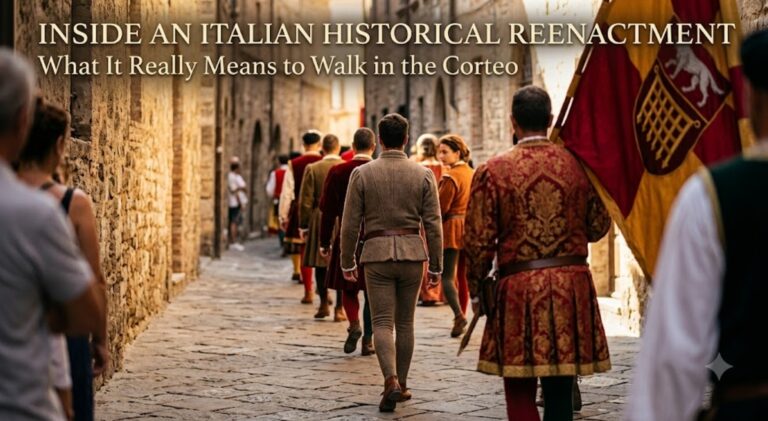
Here is the Italian reading of that, which differs from the American one. In the United States, discovering that a tradition was invented in the twentieth century tends to deflate it. In Italy it deflates nothing, because we have hundreds of these. The rievocazione storica — the historical re-enactment — is a recognized civic genre, and the honest ones are open about their own construction. Some are genuinely documented: the Cavalcata dell’Assunta in Fermo, in my own region, has an archival paper trail running back to the thirteenth century. Marostica does not, and says so in its own words. Marostica’s own history page names its authors without embarrassment: Francesco Pozza, a local chess and theater enthusiast, staged the first human chess game in costume in 1923 after seeing the idea in a magazine, recruiting thirty-six volunteers from the student circle; the poet Gabriele D’Annunzio flew his airplane over the square in tribute. In 1954 the Pro Marostica association commissioned the artist Mario Mirko Vucetich to write the script that is still performed today.
What is genuinely old here is not the plot. It is the town’s willingness to organize itself around it. Several hundred residents take part — the organizers put the 2026 cast at more than 650 costumed performers — and the roles of Lionora and Oldrada are recast by public selection every cycle. The Italian Ministry lists the Partita a Scacchi among the national events designated Patrimonio d’Italia per la Tradizione, the only one in Veneto alongside the Regata Storica of Venice. The legend is the pretext. The community machinery is the tradition.
What you are actually watching: real chess, borrowed from history
This is the detail that changes the evening, and English-language coverage almost never leads with it.
In 1923 the match was played live by two champions of the local chess club. It quickly became clear that live play made poor theater — a real game has no dramatic timing — so from 1954 the organizers began re-enacting celebrated matches from international chess history on the square. The moves you watch have been played before, by name, on record.
The repertoire draws on games such as Adolf Anderssen’s “Immortal Game” against Lionel Kieseritzky in London in 1851, in which Anderssen gave up both rooks and his queen to deliver mate with the three minor pieces that remained; Paul Morphy’s “Opera Game,” played in Paris in 1858 against the Duke of Brunswick and Count Isouard during a performance, where the American sacrificed his queen to disorient two opponents at once; and the 1914 St. Petersburg encounter between Semyon Alapin and Aron Nimzowitsch, a demonstration of Nimzowitsch’s principle of restraining, blockading, and only then destroying.
So the fifteenth-century duel over a woman’s hand is settled, on the marble, by a nineteenth-century Prussian mathematician or a New Orleans lawyer at the opera. Nobody hides this. It is printed on the association’s own pages. But it reframes what you are attending: not a suspense event with an unknown outcome, but a performance of a known masterpiece, the way an audience attends a Beethoven symphony knowing exactly how it ends. If you play chess at all, look up the game announced for 2026 before you go. Watching a queen sacrifice you recognize, executed by a woman in a velvet gown walking four squares of red marble, is a different order of pleasure from watching pieces move.
One more warning that belongs here rather than in the fine print: the dialogue is delivered in archaic Venetian, not in modern Italian and not in English. Italians from Naples or Palermo do not follow it either. Read the synopsis in advance, then stop trying to translate and watch the choreography.
Planning your visit
Tickets and booking
Tickets are sold directly by the Associazione Pro Marostica through its own ticketing site at ticket.marosticascacchi.it, and in person at the box office in the Castello Inferiore on Piazza Castello. Availability is shown seat by seat at checkout. There is no need for a resale platform, and I would avoid one.
On price: seats are tiered by sector — Platinum, Gold, Silver, and the curved end stands — and by night, with Saturday priced above Friday and reductions for children. In the most recent editions for which Pro Marostica published a full public price list, seats spanned roughly €15 to €80 depending on sector and performance. I could not locate a published 2026 price list at the time of writing, checked August 24, 2026, so treat that range as an order of magnitude and read the current figure at checkout. The Italian travel portal Visititaly reported a 2026 range of €40 to €98 depending on sector, and one Italian corporate club advertised discounted Silver end-stand seats for the Friday, September 11 performance at €48 each. Both are consistent with the same structure.
Book now rather than later. With two weeks to go, the good sectors on Saturday nights are the first to close, and a sold-out edition is normal here.
Choosing your seat
Apply the geometry above. If you want the chess, take a sector facing the long side of the board, as close to the center of the run as your budget allows. If you want the spectacle — the processions, the castle, the fireworks over the walls — the end stands cost less and frame the whole square. Families with children under ten are usually happier at the ends, where there is more to look at during the slower middle passages.
Bring a jacket. September evenings at the foot of the Asiago plateau turn cool by 10:00 PM, and you will be sitting still on a plastic chair for two hours.
Getting there
Marostica has no train station. The practical gateway is Bassano del Grappa, about eight kilometers east, which Trenitalia connects to Venezia Santa Lucia roughly hourly in about an hour and fifteen minutes, and to Padova in about an hour. From Bassano’s bus station, next to the rail station, regional buses reach Marostica in roughly fifteen minutes.
By car, Marostica is about seventy kilometers from Venice, an hour and a quarter of driving, and about thirty from Vicenza. The nearest airports are Treviso, Venice Marco Polo, and Verona. Parking is organized in lots a short walk from the square on performance nights, but leave a wide margin: four thousand people converge on a walled town of narrow streets, and the last kilometer is slower than the first sixty.
If you are relying on the last train back, check the return time from Bassano before you buy your ticket. A show that starts at nine and runs past eleven, plus the bus, is exactly the kind of arithmetic that strands people.
The daylight hours
Come early and treat Marostica as a half-day in its own right. The Castello Inferiore houses the costume museum, where the court dress worn on the board is displayed at arm’s length — genuinely worth forty minutes before you see the same fabrics under floodlight. A walled walkway climbs the hill to the Castello Superiore, with the Venetian plain opening out below; allow an hour up and back, and do it in the morning heat rather than the afternoon.
Marostica is also cherry country — the Ciliegia di Marostica carries IGP protection — but the season runs May into June. In September you will find the cherries only in jars and in grappa, the local pomace brandy, which is Bassano’s specialty rather than Marostica’s. Bassano del Grappa itself, with Palladio’s covered wooden bridge, is the obvious pairing for the afternoon before the show, and the distilleries are the reason to go rather than an afterthought. Nardini works at the foot of that bridge and describes itself as the oldest distillery in Italy; its guided visit with a tasting of five house products runs around $20 and takes the mystery out of what someone will pour you after dinner.
If you would rather have wine than spirits, Villa Angarano sits a few minutes outside town — a Palladio villa on the UNESCO list, still farmed by the family that owns it. The estate runs an hour-long tasting of five organic wines for about $41, and the building alone justifies the detour: the barchesse, the long arcaded wings flanking the villa, were working agricultural sheds before anyone called them architecture, and at Angarano they still are.
Booking Notes: The Hours Before Nine
The performance runs from nine to past eleven, which leaves an entire day to fill in a town you can walk across in twenty minutes. Here is what I would and would not reserve around it.
Book the show first, and book it direct. There is no authorized reseller and no package operator with better access. Anything that appears to bundle a seat is bundling a seat someone bought from Pro Marostica at the same price you can pay.
If you want the landscape, walk into it. The hills between Marostica and Bassano are the reason the two towns sit where they do — spring lines, mule tracks, hamlets built around water. A guided four-hour hike through those hills runs about $128 and passes hermitages and hamlets like Valrovina and Valle San Floriano that no coach tour reaches. One caveat I will state plainly: this is a newly listed activity with no review history yet. I am pointing at it because it is the only guided option that actually covers the Marostica hills, not because it has a track record.
If you have a second day, spend it on Prosecco rather than on Venice. Valdobbiadene is roughly an hour east, and the UNESCO hills there are steep enough that an electric bike is the honest way to see them. The guided e-bike tour of the Prosecco hills runs about $138 and holds a 5.0 rating across thirty-odd reviews, which for a small operator is a meaningful sample. Venice will still be there, and it will still be full.
What I would skip: the smartphone treasure hunt in Bassano. There is a self-guided app-based puzzle sold for around $40 that walks you two and a half kilometers through the historic center with no guide and no supervision. Bassano’s center is small enough to read on foot in ninety minutes with a paper map and no fee, the exercise is unattended by anyone who could tell you what you are looking at, and it carries the lowest rating in the local inventory. Spend the same money on the distillery instead.
FAQ — Common questions about the Marostica chess game
What is the Marostica chess game?
It is a biennial historical re-enactment in which a full game of chess is played on a permanent marble board in Piazza Castello, Marostica, using costumed people as the pieces. Several hundred townspeople take part. It dramatizes a legend set in 1454 about two noblemen settling their rivalry over Lionora with a chess match instead of a duel.
When is the next Marostica chess game?
The 2026 edition runs on September 4, 5, 11, and 12, 2026, all performances at 9:00 PM. The event is held in even-numbered years only, so the following edition falls in September 2028.
How do I book tickets?
Buy directly from the Associazione Pro Marostica at ticket.marosticascacchi.it, or in person at the box office in the Castello Inferiore. Seats are individually numbered and selected at checkout. Advance booking is effectively mandatory; performances regularly sell out.
How much do tickets cost?
Prices vary by sector and by night, with Saturdays costing more than Fridays and reductions available for children. Recent published price lists ranged from about €15 to €80 per seat. Confirm the 2026 figures at checkout, as the association publishes them there rather than in a separate list.
How long does the performance last?
Budget more than two hours. The chess match itself averages twenty-two moves and lasts about an hour; the parades, court scenes, and closing fireworks account for the remainder.
Is the show in English?
No. The dialogue is performed in archaic Venetian dialect, which is not modern Italian and is not fully comprehensible to Italians from other regions either. Read the plot summary before you arrive and follow the action visually.
What happens if it rains?
The organizers postpone the affected performance to the following week rather than canceling it outright. The published terms of sale do not allow date changes or refunds when a ticket holder cannot attend for personal reasons, so plan your itinerary with slack if your travel dates are rigid.
The takeaway
Marostica rewards a traveler who knows what to look for and frustrates one who arrives expecting a medieval mystery. The legend is a twentieth-century construction. The chess is borrowed from the great masters. The board was laid in 1954. None of that makes the evening less real, because what is actually being staged is a town of fourteen thousand people organizing itself, every second September, around a story it decided to keep. That is a more interesting thing to watch than a myth would have been.
Two weeks out from the 2026 edition, the practical advice is short: buy directly from Pro Marostica, choose a long-side sector if you care about the chess, arrive in the afternoon for the castle and the costume museum, and bring a jacket.
If you want more of Italy read this way — landscapes, buildings, and traditions explained by someone who works on them for a living — there is more of it on Tastes & Wonders of Italy.