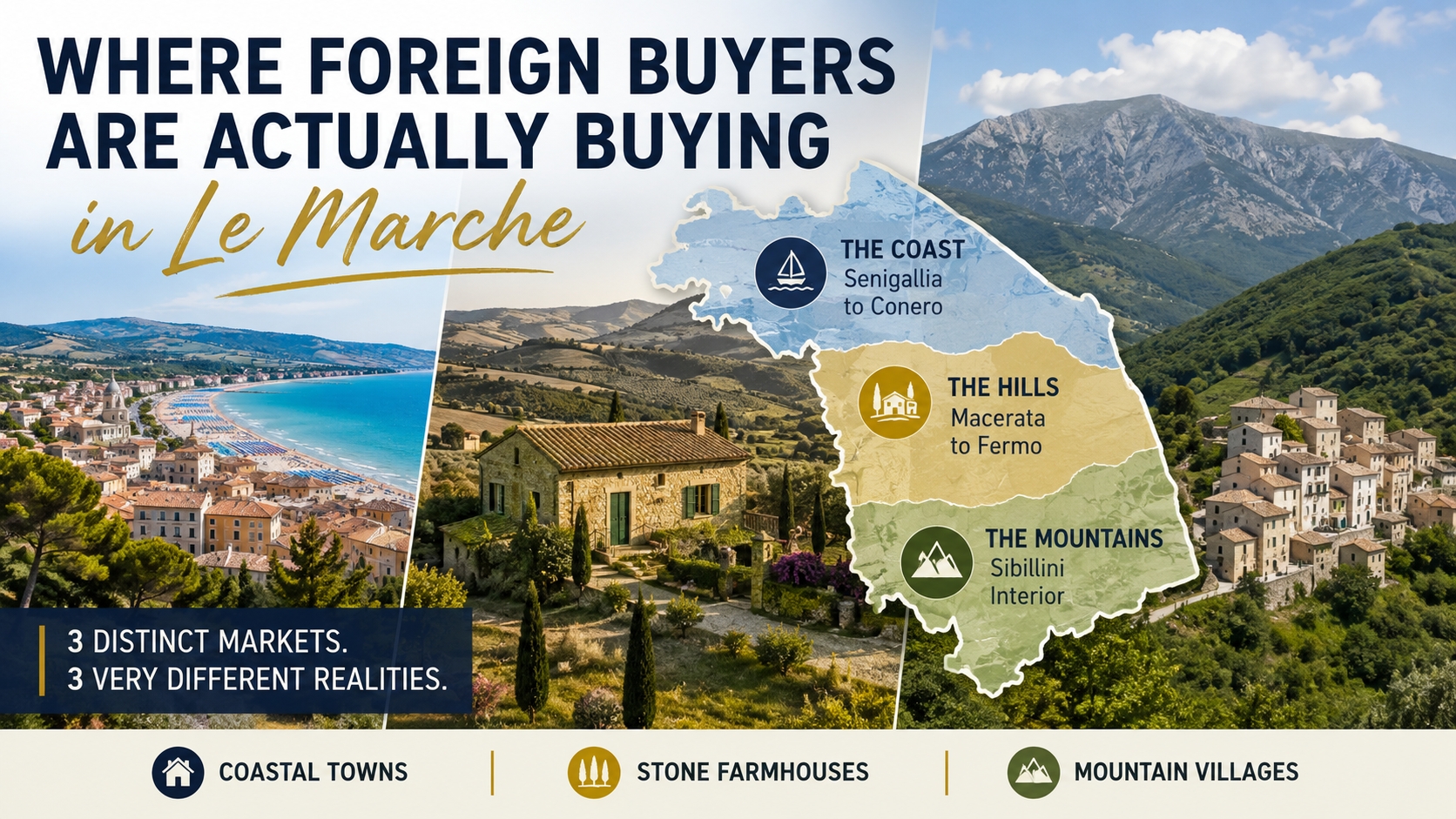
Where Foreign Buyers Are Actually Buying in Le Marche
I get some version of the same email every few weeks. An American reader tells me they are looking for “a farmhouse in Le Marche,” as though the region were a single address rather than four provinces stretching from a beach umbrella on the Adriatic to a mountain pass above 1,200 meters. In the second quarter of 2026, the cheapest square meter of housing in this region sold in Falerone, a hill town in the Fermo countryside, for 689 euros. The most expensive sold in Numana, a fishing town turned resort on the Conero promontory, for 3,503 euros — five times as much, ninety minutes apart by car. Buying a house in Le Marche is not one decision. It is a choice between markets that behave nothing alike, and almost nobody selling you a plane ticket will tell you that up front.
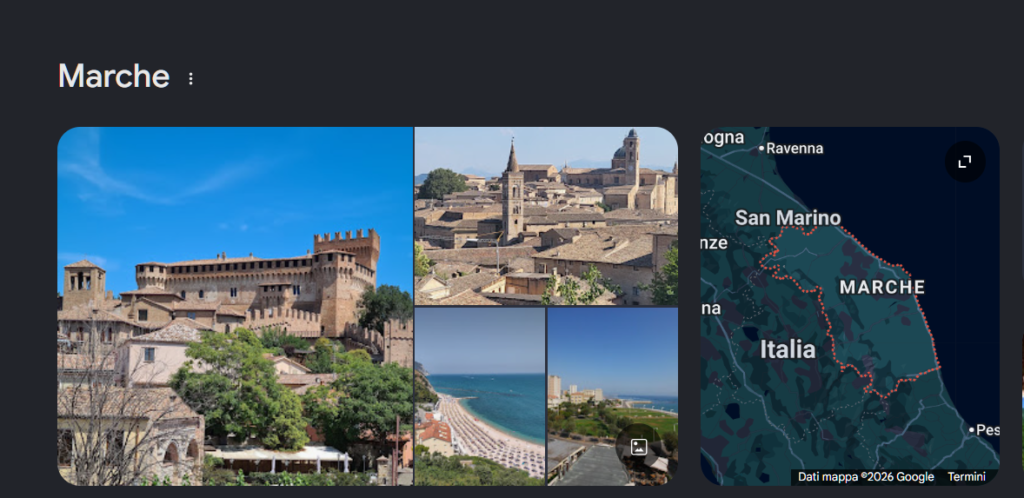
Le Marche has at least three real estate markets, not one
Foreign buyers researching Le Marche usually encounter it as a single narrative — cheaper than Tuscany, hill towns, olive groves — without the internal map. In practice the region splits into three distinct markets: the Adriatic coast from Senigallia to the Conero, driven mostly by Italian domestic demand and priced accordingly; the inland hills between Macerata and Fermo, home to the stone casali (farmhouses) that draw most foreign interest; and the mountain interior around the Sibillini range, where the cheapest prices in the region sit inside the same territory still working through reconstruction from the 2016 earthquake. Each has a different buyer, a different structural risk profile, and a different price per square meter.
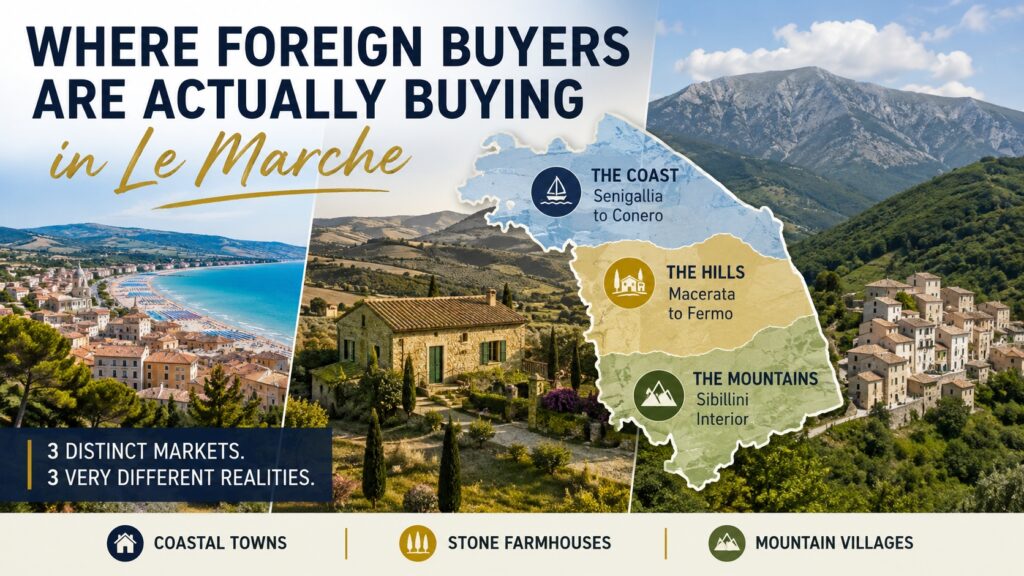
The three markets, side by side
| Zone | Who’s actually buying | Typical property | Price range (per m², 2026) | Main risk an engineer flags |
|---|---|---|---|---|
| Coast — Senigallia to Conero | Mostly Italian second-home and retirement buyers; foreign interest concentrated in a handful of resort towns | Post-war apartments and villas, condominiums | roughly €1,250–€3,500, prime seafront higher | Condominium liability, coastal ground conditions, less pre-war stone stock |
| Inland hills — Macerata to Fermo | The core of foreign buyer demand | Stone farmhouse (casale), village townhouse | roughly €690–€1,300 | Unreinforced load-bearing masonry, undocumented renovation history |
| Sibillini interior — crater and mountain foothills | Value-driven buyers, some pensioners using the 7% flat-tax regime | Stone hill-town house, often partially reconstructed | roughly €600–€1,100 in the lowest-priced comuni | Incomplete or cosmetic post-2016 seismic repair |
Figures are drawn from Idealista’s regional price index for the second quarter of 2026 and reflect asking prices, not closed sale prices; treat them as orientation, not appraisal.
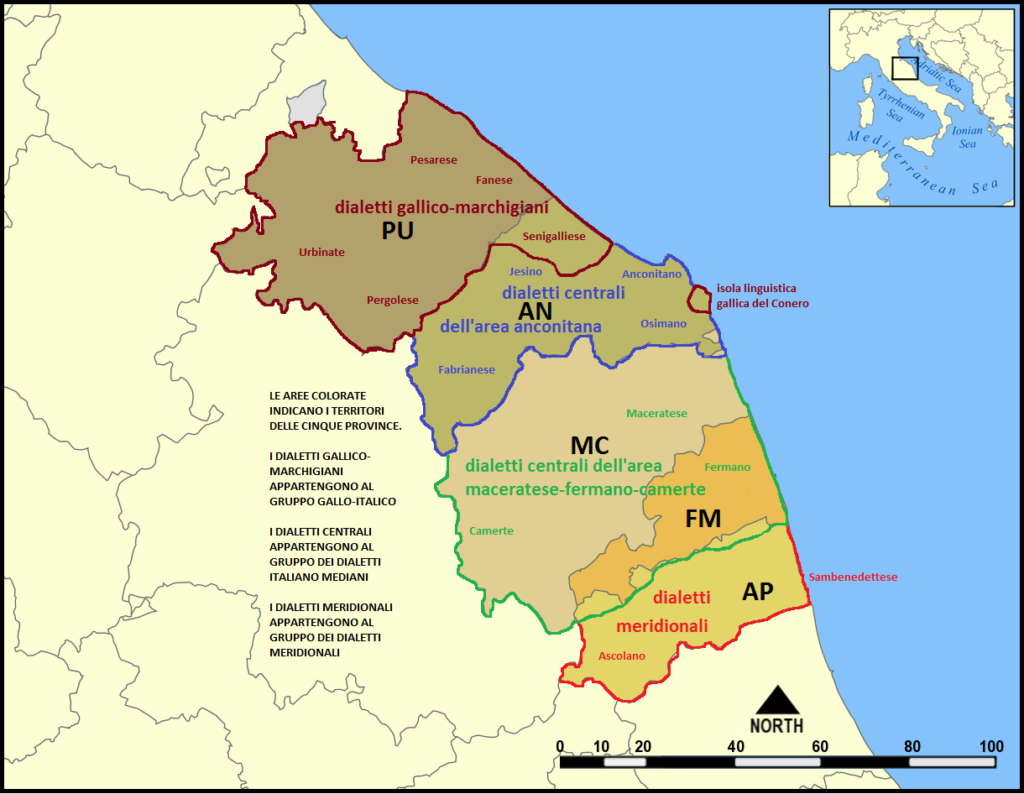
The coast: Senigallia to the Conero
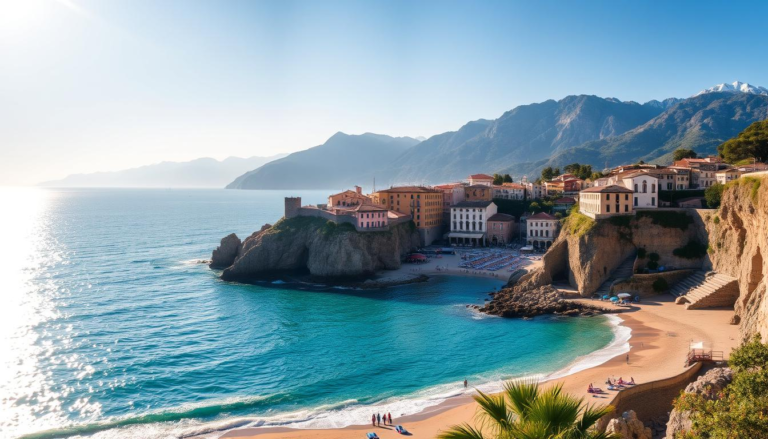
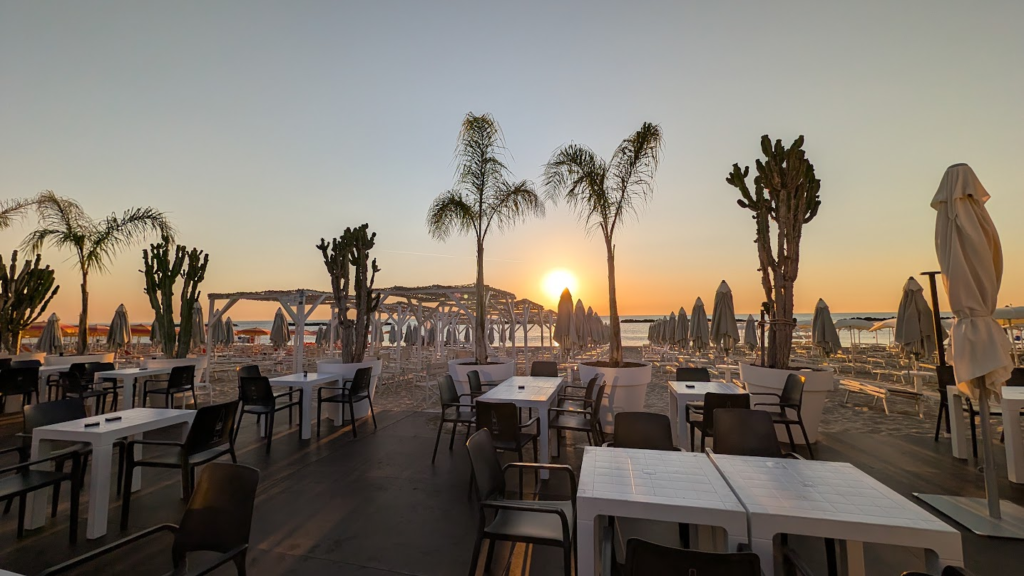
This is the market an American buyer notices last and understands least, because it is the one that looks least like the Le Marche in the photographs. Along the Adriatic, from Senigallia’s Art Nouveau seafront down through Ancona to the cliff towns of Sirolo and Numana on the Conero promontory, the housing stock is mostly twentieth-century: reinforced concrete apartment buildings, postwar villas, a scattering of newer construction. There are relatively few casali here, because this was never farmland in the way the hills further inland were.
The buyers are, for the most part, Italian. Ancona province and the towns along it see steady domestic demand for beach apartments and retirement homes, which keeps prices firmer than in the interior and less exposed to the swings that hit a market dependent on a single type of foreign buyer. Numana, in particular, recorded the highest municipal price point in the region in mid-2026, driven by its stretch of cliffside villas and proximity to the Conero Regional Park. Senigallia’s prime seafront, the Lungomare di Levante, asks a comparable premium.
For a structural engineer, the coast is the least dramatic of the three markets, and that is mostly a good thing. Reinforced concrete construction from the postwar decades, built and later retrofitted under Italy’s modern building codes, carries a fundamentally different risk profile than unreinforced stone. What I check for here is different: how a condominium’s shared structural elements have been maintained, whether ground conditions near the shoreline have caused settlement, whether an older seafront building has ever had a proper structural assessment at all rather than only cosmetic renovation. It is a market where due diligence matters, but the starting risk is lower than what a buyer will find an hour inland.
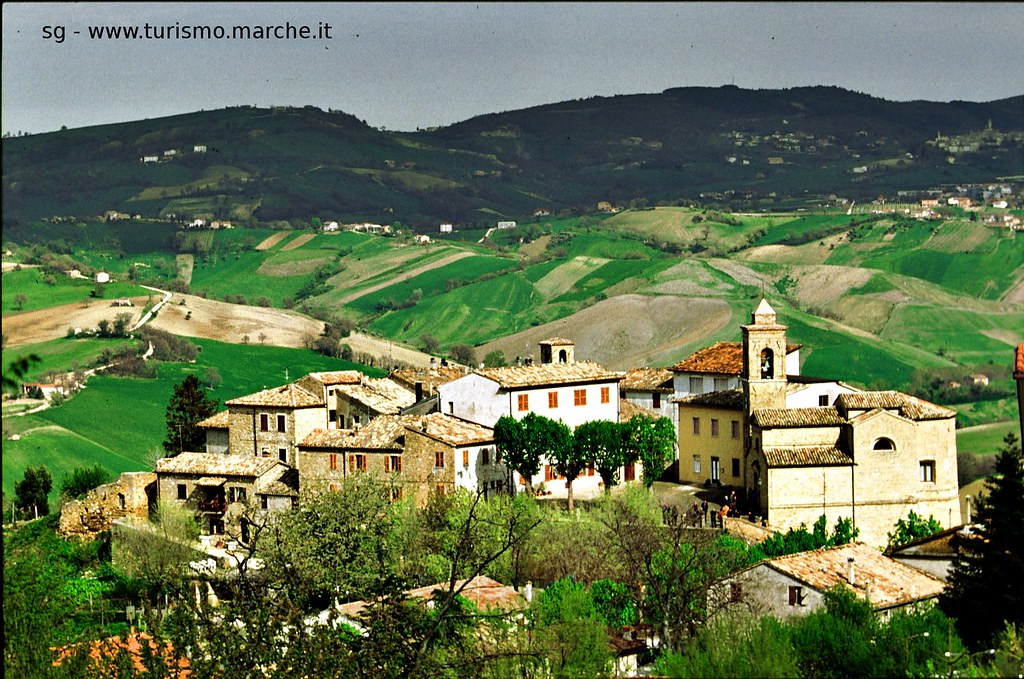
This is also the one submarket where a foreign buyer is competing directly with Italian demand rather than filling a niche nobody else wants. That changes negotiating dynamics: a casale an hour inland can sit on the market for a season with no local interest at all, while a well-positioned apartment near Sirolo or on Senigallia’s Lungomare draws Italian retirees and second-home buyers who know the area and move quickly. Anyone planning to buy on the coast should expect the process to feel more like a conventional real estate transaction, and less like the extended, patience-testing negotiations that characterize the hill towns further inland.
The inland hills between Macerata and Fermo
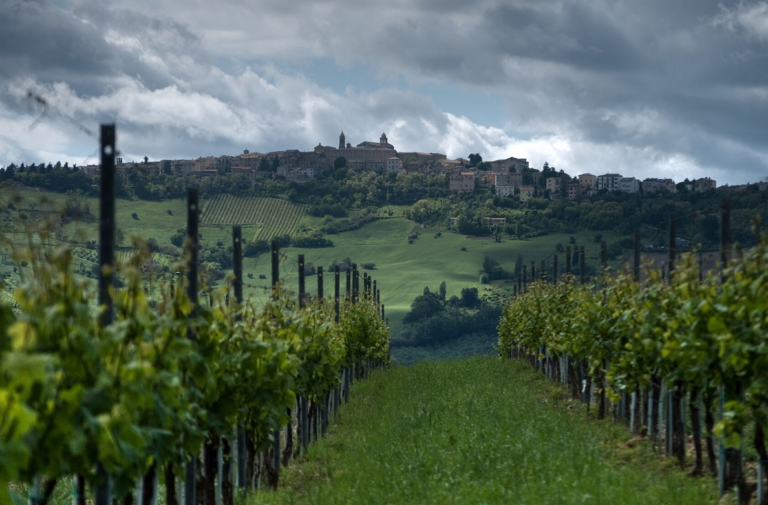
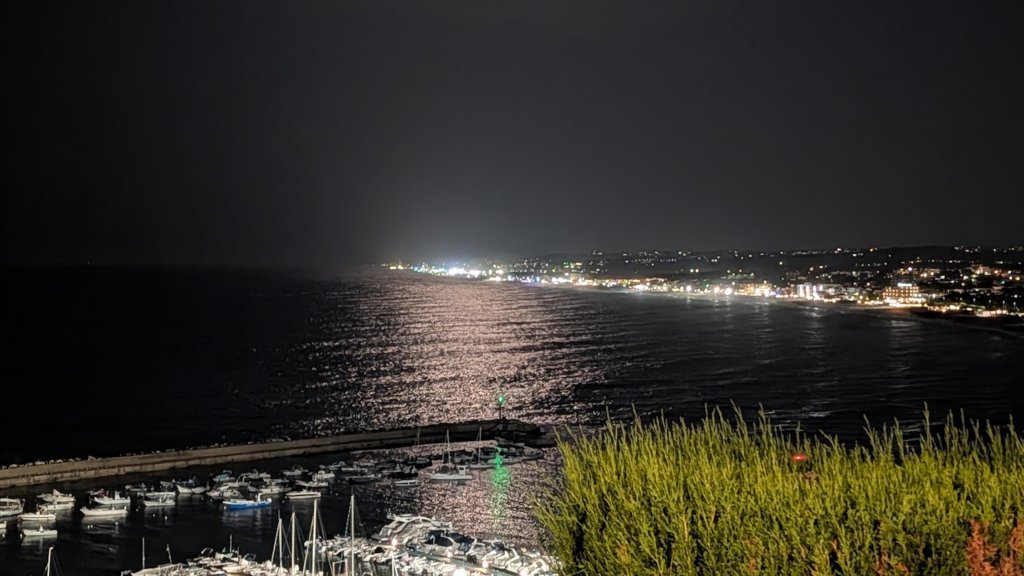
This is the market the American imagination actually means when it says “Le Marche”: rolling hills terraced with vineyards and olive groves, a stone farmhouse at the end of a gravel lane, a view that runs for kilometers with barely another roofline in it. It is also, structurally, the market that needs the most caution, and the two facts are connected — the qualities that make a casale desirable are frequently the same ones that make it a liability nobody has disclosed.
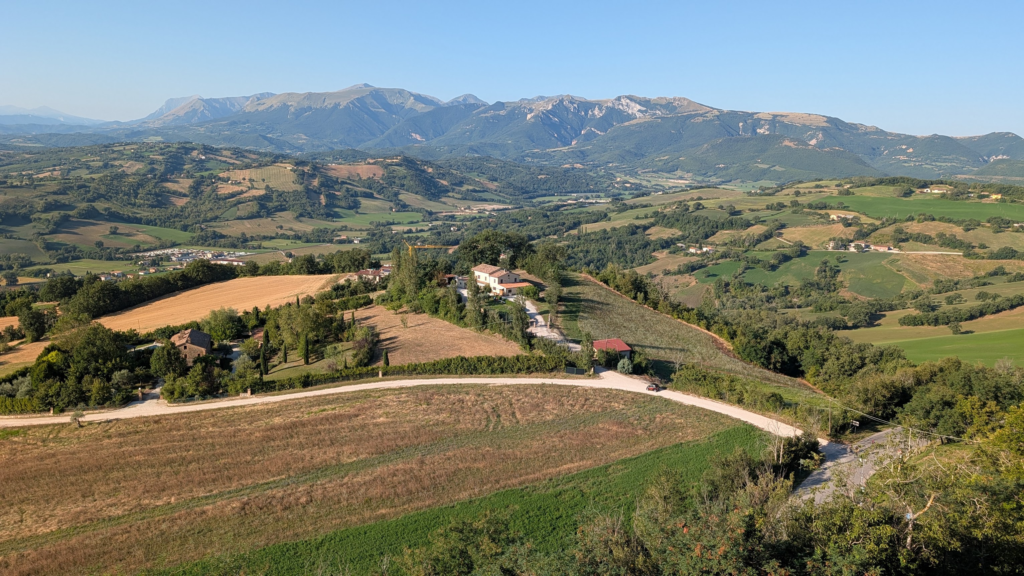
Macerata and Fermo are the two most affordable provinces in the region on a per-square-meter basis, with Fermo’s rural comuni among the cheapest anywhere in central Italy; Montegiorgio and Falerone, both in the Fermo countryside, priced under 750 euros per square meter in the most recent regional report. This is where the bulk of American, British, Dutch, and Belgian buyers concentrate, and it is where the largest share of my own survey work happens.
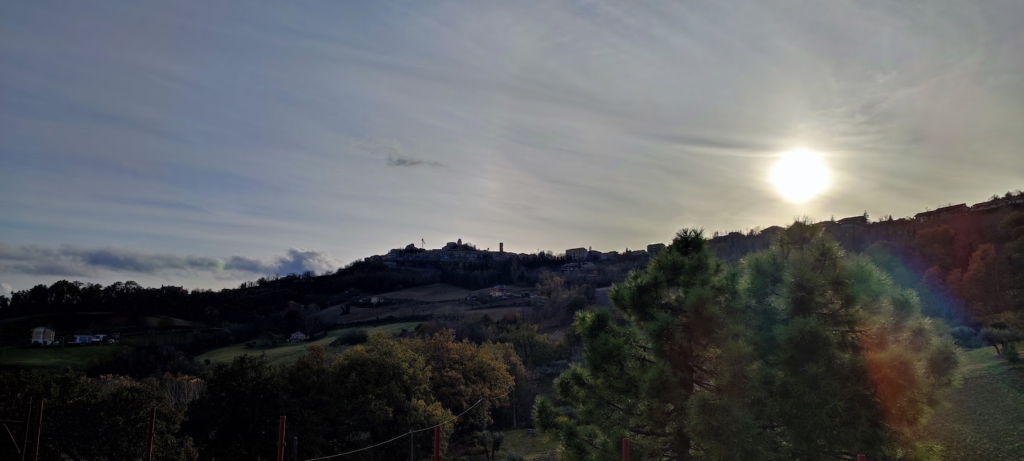
The failure I find most often here is not dramatic and rarely visible from the road. It is a load-bearing stone wall, built without any tensile reinforcement, carrying a timber floor that was never properly tied into the masonry — a construction method that was completely ordinary when these farmhouses went up over a century ago, and completely inadequate by the seismic standards Italy adopted after later earthquakes proved how these buildings actually fail. A beautifully restored facade tells you nothing about what happened, or didn’t happen, to the wall behind the plaster. I go into this in more detail, with real cost figures for bringing a casale up to current seismic standards, in the renovation cost guide I published earlier this year.
There is also a scale question buyers underestimate. A casale rarely comes alone; the same listing usually includes several hectares of land, a scattering of outbuildings that once housed animals or tools, and sometimes a second, smaller structure in various states of collapse. Each of those outbuildings carries its own structural condition, independent of the main house, and a buyer who inspects only the building they intend to live in can miss a boundary wall or a barn roof that will need attention within a few years. Land maintenance in this zone is not optional either: two hectares of untended hillside becomes a fire and erosion liability faster than most first-time buyers expect.
The Sibillini interior: mountain foothills and earthquake crater, together
American guidance on this region tends to treat “the Sibillini Mountains” and “the earthquake crater” as two separate topics — one aesthetic, one cautionary. On the ground they are largely the same places. Sarnano, San Ginesio, Amandola, Montefortino: these hill towns sit in the foothills of the Sibillini range and, because the epicenter of the 2016–2017 central Italian earthquake sequence sat in this same mountain belt, they are also officially inside the reconstruction perimeter known as il cratere, the crater. A property listing that markets itself purely on mountain views, without mentioning that the town is still, ten years on, working through post-earthquake reconstruction, is not lying — it is simply choosing which half of the truth to tell.
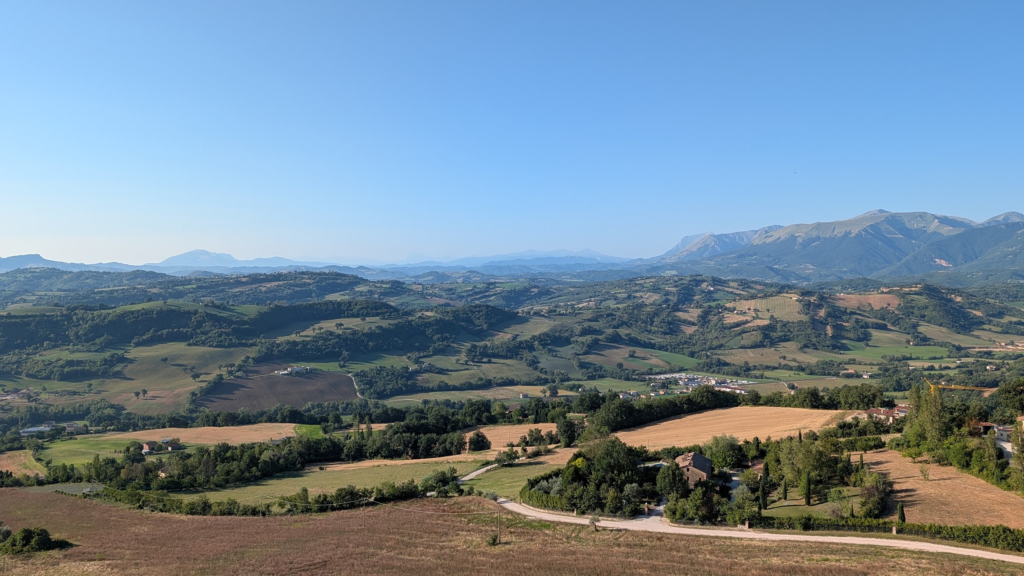
This is the cheapest submarket in the region, and it comes with the longest timeline attached. In June 2026, the government’s Special Commissioner for Reconstruction approved a new unified price schedule for reconstruction work across the crater — covering Abruzzo, Lazio, Marche, and Umbria — replacing the one that had been in use since 2022. As of late 2025, Camerino, one of the hardest-hit towns in the province of Macerata, was still working through the technical constraints on its most damaged zones before contractors could even begin, with new construction sites only starting across the worst-affected Macerata province towns in 2026. Reconstruction in this territory is not a finished project with a few loose ends. It is an active, decade-long process, and buying a house in it means buying into that timeline, whether or not the listing mentions it.
There is a real financial upside that is specific to this zone and does not extend to the coast or the inland hills: foreign retirees who relocate their tax residency into a qualifying crater comune can access Italy’s 7% flat tax on foreign-source income, the same regime more commonly associated with southern Italy. I have written the full mechanics of that regime, including which towns actually qualify and where the outdated population figures still circulating online get it wrong, in a dedicated guide. One town in this zone, Sarnano, gets its own close look in a piece I wrote on why people are quietly buying homes there.
For a structural engineer, this is the zone where “seismic risk” stops being a general category and becomes a specific documentation question. Some buildings here have been fully reconstructed under Italy’s Testo Unico della Ricostruzione Privata, with proper reinforcement and a complete paper trail. Others received only cosmetic repair — plaster over a wall that was never structurally consolidated — and some were never touched at all, because the visible damage looked minor or because a previous owner never filed for the public reconstruction grant. None of that shows up in photographs. It shows up in the fascicolo del fabbricato, the building’s technical file, if one exists, and in an inspection if it does not.
There is a practical layer to this zone beyond structure, and it is the one American buyers underestimate most. These towns sit higher and further from services than the inland hills further east: winter driving on mountain roads is a genuine consideration, the nearest hospital or supermarket can be thirty to forty minutes away, and a construction site next door — a common sight anywhere in the crater right now — means living beside scaffolding and noise for months or years, not weeks. None of that makes the Sibillini interior a poor choice. It makes it a choice that rewards buyers who want genuine remoteness and are prepared for what remoteness actually costs in daily convenience, rather than buyers looking for a lock-up-and-leave second home.
What the published price ranges above do, and don’t, tell you
The ranges in the table are asking prices from a single regional index, useful for orientation and nothing more. They say nothing about the condition of a specific building, its documented seismic history, or whether the renovation someone completed five years ago actually reached the load-bearing structure or stopped at the plaster. Italy’s official reference for property valuation, the Osservatorio del Mercato Immobiliare run by the national tax agency, publishes its own zone-by-zone ranges twice a year and is worth cross-checking against any figure an agency quotes you, particularly for tax and mortgage purposes. For the national-level version of this guide, covering how the purchase process works across Italy rather than region by region, see my complete guide to buying a house in Italy.
None of the three submarkets above is inherently the “right” one. A buyer prioritizing rental income and easy resale usually does better on the coast. A buyer chasing the postcard image of Le Marche is choosing the inland hills, structural risk included. A buyer willing to trade certainty for the lowest entry price and a genuine tax advantage is choosing the Sibillini interior, reconstruction timeline included. What changes the outcome is not which zone you pick. It is whether you know, before you sign, which of these three markets you are actually buying into.
Before you commit to any of these zones
I run independent, pre-purchase structural surveys for foreign buyers across all three of these markets — coast, inland hills, and the Sibillini interior alike — with no referral relationship to any selling agency. The same applies beyond Le Marche: if you’re evaluating a property anywhere in Italy and want a technical opinion before you commit, that’s the starting point regardless of region.
If you want a second, technical opinion on a specific property before you make an offer, or just want to talk through which of these three markets actually fits what you’re looking for, you can book a 30-minute orientation call and we’ll go through it together.
FAQ — Buying property in Le Marche
What is the cheapest area to buy a house in Le Marche?
The inland hill towns of Fermo and Macerata provinces, along with the Sibillini mountain interior, have the lowest prices in the region. In the second quarter of 2026, the comune of Falerone in Fermo province recorded the lowest municipal average in Le Marche, at 689 euros per square meter.
Is Le Marche cheaper than Tuscany for foreign buyers?
Yes, consistently. Le Marche’s regional average price sits well below the national average and far below comparable Tuscan hill-town markets, which is the primary reason the region has drawn increasing foreign interest over the past several years.
Which part of Le Marche do most foreign buyers choose?
Most foreign buyers, including American, British, Dutch, and Belgian buyers, concentrate in the inland hills between Macerata and Fermo, where the stone farmhouse archetype most people associate with the region is most common and most affordable.
Do I need a structural survey before buying a stone farmhouse in Le Marche?
Given how common undisclosed structural issues are in older Marche farmhouses, an independent pre-purchase survey is strongly advisable, particularly for load-bearing stone masonry. The cost is minor relative to the purchase price and can prevent a far larger post-purchase expense.
Is property in the Le Marche earthquake crater zone safe to buy?
It can be, but it depends entirely on the specific building’s documented reconstruction history, not on the town’s general reputation. Some properties in the crater have been fully reinforced under current seismic code; others received only cosmetic repair. This has to be verified building by building.
Can I get Italy’s 7% flat tax if I buy on the Le Marche coast?
No. The 7% flat-tax regime for foreign retirees applies only to qualifying comuni within the designated earthquake crater in the Marche interior, not to the coast or the inland agricultural hills. Eligibility depends on the specific municipality’s inclusion on the official crater list.
How much does it cost to renovate a farmhouse in Le Marche to current seismic standards?
Costs vary widely by the building’s existing condition and the extent of reinforcement required, from targeted structural interventions to a full seismic retrofit. Detailed current cost ranges are broken down in the dedicated renovation cost guide.
The takeaway
Le Marche rewards a buyer who does the regional homework most listings skip. The coast, the inland hills, and the Sibillini interior are not variations on the same market; they are three different ones, with three different price floors and three different things that can go wrong structurally. Knowing which one you are actually buying into, before you fall for a view, is the entire difference between a good decision and an expensive one.