Cycling the Conero Riviera: Rosso Conero, Limestone Cliffs, and the Climb Out of Sirolo
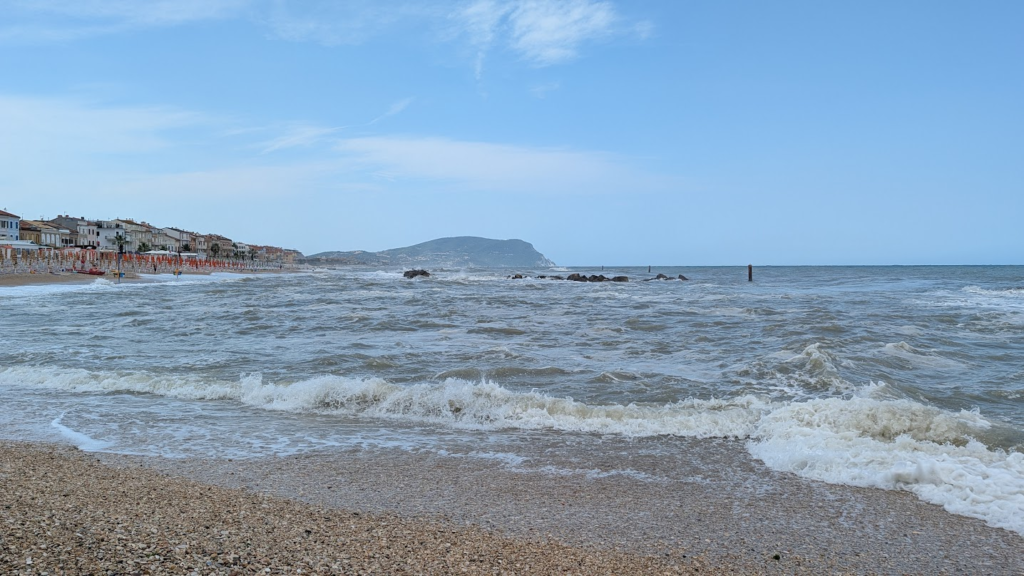
Leave Numana at seven in the morning before the beach umbrellas open, and the road out of town is flat for exactly as long as it takes to clear the last cluster of pedal boats stacked on the sand. Then it tilts. Not gradually — the asphalt simply turns uphill at a bend by a fig tree, and for the next five kilometers you are climbing toward Sirolo with the Adriatic dropping away behind your right shoulder and a wall of limestone rising ahead of you that has no business standing this close to the sea. This is cycling the Conero Riviera: a stretch of coast barely thirty kilometers wide where a rider can go from beach-flat to mountain-steep in under ten minutes, on a promontory that produces one of Italy’s most underrated red wines and that most visitors to the Adriatic never think to climb. A serious self-guided loop of just over fifty kilometers circles the whole of it, with close to a kilometer of elevation gain packed into that distance — steeper, kilometer for kilometer, than anything else in this cycling cluster through Le Marche wine country.
How hard is the Conero, really?
Every cyclist who looks at a map of the Conero peninsula makes the same mistake: they see a loop of fifty-odd kilometers hugging a promontory that tops out at 572 meters, and they assume an easy half-day. The numbers don’t support that read. The most complete documented road loop starting and finishing in Numana — 51.1 kilometers, roughly 950 meters of elevation gain, rated Hard on the cycling platform Komoot, mostly on paved surfaces, and threading directly through the Parco Regionale del Conero — packs nearly as much climbing into its distance as some of the longer, gentler rides elsewhere in this cluster manage in twice the kilometers. The short answer for the American cyclist deciding whether to bring a bike to this stretch of the Adriatic: yes, but bring the legs for repeated short, steep efforts rather than one long grind, and don’t let the modest total distance talk you out of a rest day afterward.
Route card: the Conero loop from Numana
- Distance / elevation gain: 51.1 km, approximately 950 m of elevation gain, per the most complete publicly documented GPX track for a road loop of the peninsula (source: Komoot, last updated January 2026). Treat this as the best available figure rather than an official regional measurement — no single government agency publishes a definitive number for this exact loop, and I say that rather than pretend otherwise.
- Loop or point-to-point: Loop, starting and finishing near a parking area in Numana.
- Bike type: Road or gravel bike; the surface is mostly paved with some secondary roads.
- Difficulty: Hard. Not because of altitude — 572 meters is not a mountain by Alpine standards — but because the climbing comes in short, repeated pitches rather than one sustained grade, which is exactly what makes a rider misjudge it from the elevation profile alone.
- The signature climb: Out of Numana toward Sirolo, roughly five kilometers averaging a 7 percent grade. Riders who want more can continue from Sirolo toward Portonovo and the summit road, where the grade tightens to 15 to 18 percent for another five kilometers on a shaded, switchbacked lane through the woods — genuinely hard riding, and the reason the guided tours based in Marcelli di Numana default to e-bikes for casual visitors.
- Wineries on route: Fattoria Le Terrazze in Numana and Cantina Moroder in the hills above Ancona both sit within or just off variations of this loop; see the wine section below for visiting details.
- Where to stop: Sirolo’s clifftop piazza for the view, Camerano for the underground city carved beneath the town, Portonovo for the beach at the bottom of the hardest descent on the route.
- Getting there and back: No town on the Conero peninsula sits directly on the Adriatic rail line, since the promontory forced the railway to curve inland around it. Camerano-Aspio, on the Ancona–Pescara line roughly nine minutes from Ancona’s main station, is the nearest stop, though it still leaves several kilometers of road between the platform and Sirolo or Numana.
- Best season: Late spring (May–June) or September through mid-October. Avoid the peak of July and August, when the coast road narrows under beach traffic and the midday heat turns the exposed sections of the Sirolo climb into an unpleasant test of patience rather than a good ride.
For a shorter, guided introduction to the same terrain — a 25-kilometer e-bike loop with a winery stop, based in Marcelli di Numana — see the Le Marche wine cycling pillar, where that route is the featured card. The loop above is its harder, self-guided sibling: same peninsula, same climb out of Numana, considerably more of it.
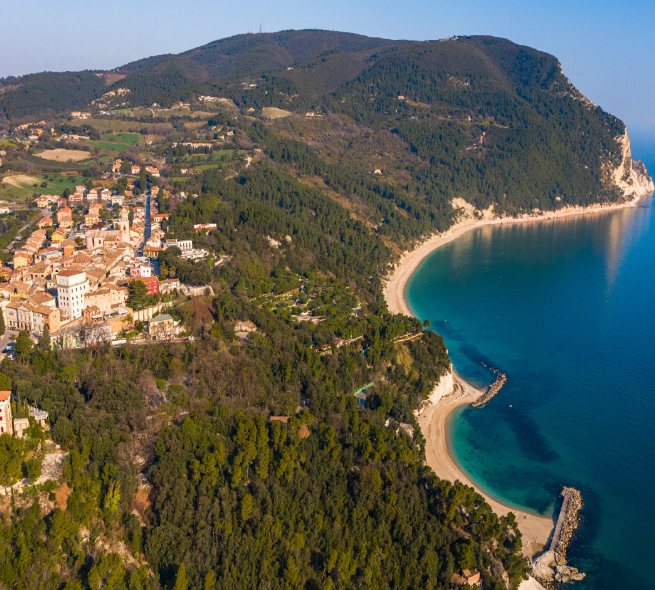
Why this stretch of coast climbs like nothing else on the Adriatic
Monte Conero is the only true high point on the entire Adriatic coastline between Trieste and the Gargano promontory in Puglia — roughly four hundred kilometers of otherwise flat, sandy shore interrupted by exactly one limestone mountain, and you happen to be riding up it. Geologically, the Conero is the outermost anticline of the Apennine fold belt that runs the length of Le Marche: a slab of Calcare Massiccio, a hard, pale limestone laid down as marine sediment long before the Apennines themselves existed, thrust upward and tilted so sharply toward the sea that its seaward face drops in near-vertical cliffs while its landward slope descends in the long, terraced hillsides where the Rosso Conero vines grow.
That single geological fact explains almost everything a cyclist feels on this loop. The road can’t follow a valley floor the way routes do inland, because there is no valley floor here worth following — Monte Conero simply rises out of the water, so the roads run across its flank instead, climbing and descending in short pitches that track the contour lines rather than any gentler logic. It also explains why the climbing feels harder than the modest 572-meter summit suggests: on a fold this steep, five percent grades don’t last long before the road either kicks up past ten percent or the engineers who built it had to switch back.
Where the massive limestone sits atop softer, younger clays — a boundary you can feel underfoot on parts of the Sirolo–Portonovo road, where the surface occasionally shows the faint waviness of ground that has moved — is where I would look twice at any retaining wall built into the hillside above the road. It is the kind of slope where the failure I see most often on assessments elsewhere in Le Marche is not the rock itself giving way, but water finding a path through the softer material underneath it after a wet winter. None of this should worry a cyclist riding through on a dry day in May. It is simply the reason the road under your wheels behaves the way it does, and it is the same limestone, several dozen meters below, that generations of residents of Camerano hollowed out by hand into the tunnels, cellars, and chapels now open to visitors as the Grotte di Camerano — a city carved into the identical rock formation you have just climbed over.
Sirolo, Numana, Camerano, and the edge of the park
The Parco Regionale del Conero, established in 1987, covers the promontory itself and the towns most directly built into it: Ancona to the north, and Camerano, Numana, and Sirolo along the coast and its immediate hinterland. Offagna and Castelfidardo, both of which fall partly within the Conero DOCG wine zone, sit outside the park’s actual boundary — a distinction worth knowing before you plan a route, since a loop that swings out toward Offagna’s hilltop rocca leaves protected parkland for ordinary countryside roads, pleasant riding but a different regulatory and scenic register from the park itself.
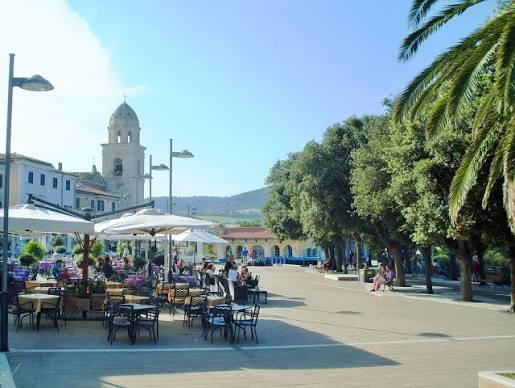
Sirolo earns its reputation honestly. The town sits directly above the cliffs, its central piazza built as a literal balcony over the sea, and the climb up from Numana delivers you into it at exactly the moment the effort starts to feel worthwhile. Below the town, paths lead down to San Michele and Sassi Neri beaches and, a little farther along the coast within the park, to the view over the Due Sorelle — two isolated limestone stacks rising out of the water below sheer white cliffs, visible from several points along the ridge road without leaving the bike.
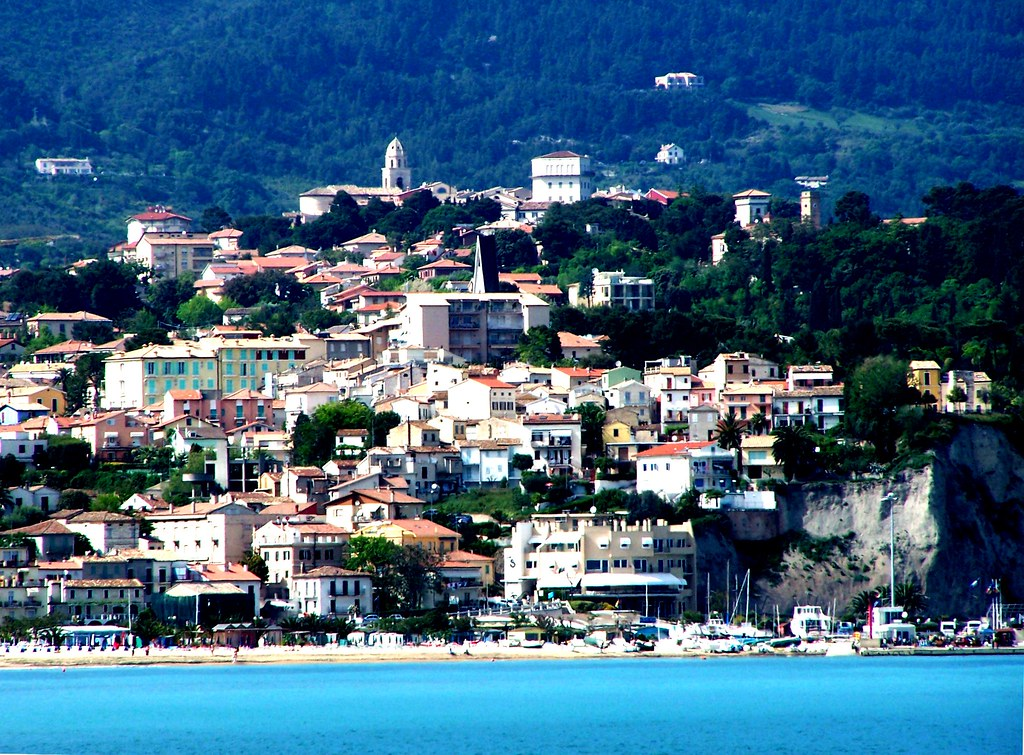
Numana, lower and busier, is less about the view and more about the practical base: rental shops, bike-focused hotels, and the flat lungomare that makes a good warm-up or cooldown before or after the climb. Camerano, inland and less visited by beach tourists, is where the geology of the previous section becomes something you can walk into rather than just ride over — the Grotte di Camerano, a network of tunnels and chapels excavated into the same Calcare Massiccio limestone, open for guided visits with mandatory reservation. English-language tours run Thursdays at 5:00 p.m. from mid-June through early September; book through the town’s official ticketing platform, since walk-up availability in peak season is unreliable. Camerano also holds a Festa del Rosso Conero each September, a good excuse to time a visit around it if the calendar allows.
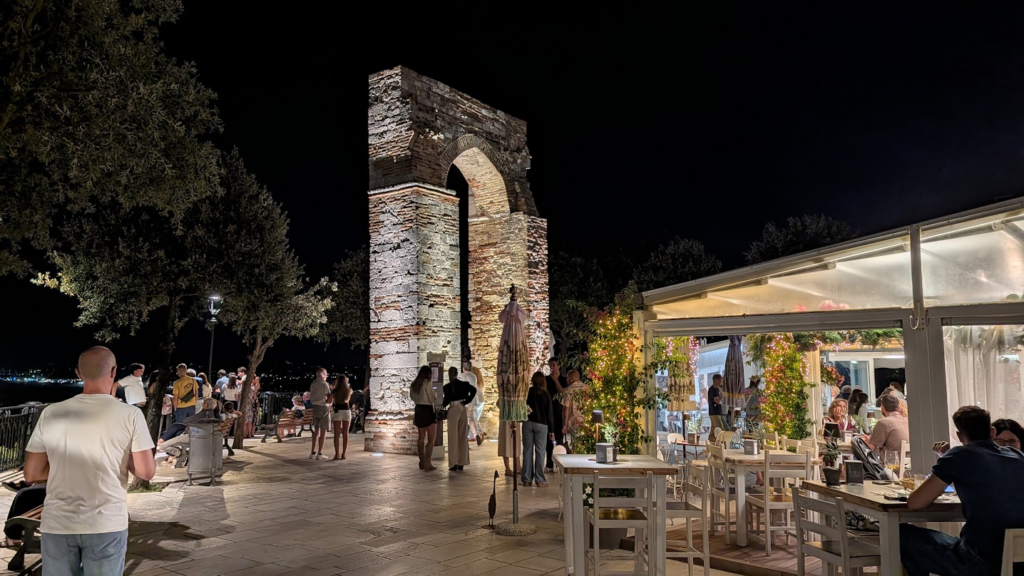
Conero DOCG and Rosso Conero DOC, explained
Two separate denominations share the same production zone — Ancona, Offagna, Camerano, Sirolo, Numana, and parts of Castelfidardo and Osimo — and get routinely confused even by Italians who don’t follow wine closely. Rosso Conero DOC is the base-level wine of the territory: fresh, food-friendly, released relatively young. Conero DOCG is the stricter, higher tier, requiring a minimum of two years’ aging before release and a slightly narrower yield; until 2004 it was simply labeled Rosso Conero Riserva before the zone’s producers petitioned for it to become its own denomination. Both are built on the same grape, Montepulciano — a minimum 85 percent of it, sometimes blended with up to 15 percent Sangiovese — and it is worth stating plainly for the American reader that Montepulciano here is a grape variety, not the Tuscan hill town of the same name, which grows an entirely different wine. The confusion is common enough among visitors that it is worth resolving before you order a glass in Sirolo and end up in an unnecessary argument with a very patient waiter.
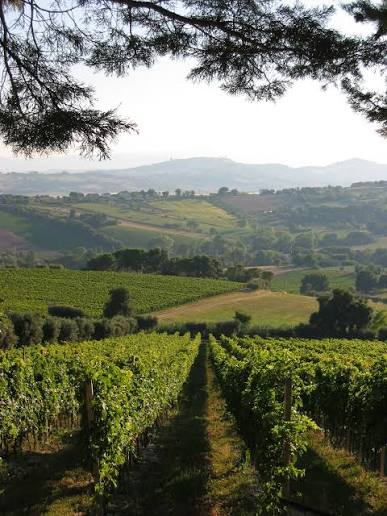
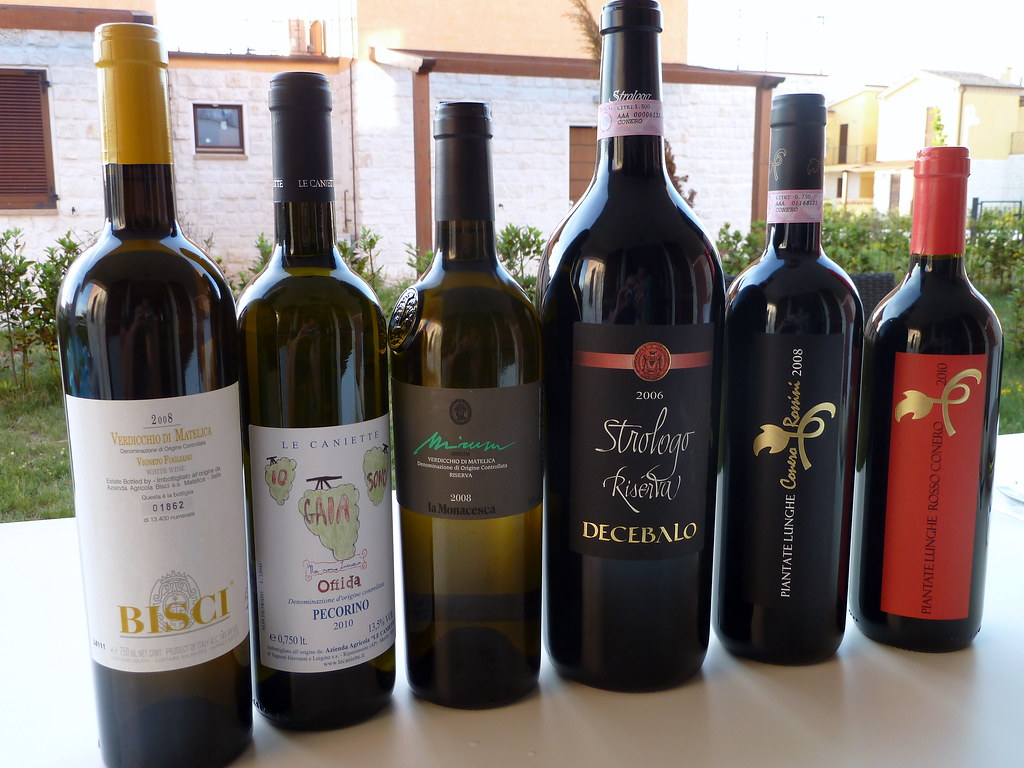
The wine itself tends toward real structure: dense, dark-fruited, with a tannic backbone in youth that softens over several years into something closer to leather and dried cherry. Two producers along or near the loop above are worth building a stop around. Cantina Moroder, in the hills above Ancona, has worked this land since 1837 and ages its wines in cellars cut underground; visits and tastings run by reservation only, arranged by phone or email rather than a walk-in policy, and its Dorico bottling is the estate’s flagship. Fattoria Le Terrazze, closer to the coast in Numana, sits directly on several of the shorter loop variants around the peninsula and is a regular stop on the area’s guided e-bike tours. Neither producer publishes drop-in hours for cyclists, so calling or emailing a day or two ahead — in July and August, considerably more — is the difference between a tasting and a locked gate.
Planning the ride: Portonovo, trains, and when to go
Portonovo, the beach at the base of the hardest descent on this loop, runs a seasonal vehicle access scheme rather than open parking. In 2026, a controlled-access zone (Zona ad Accessibilità Controllata, locally called the ZAC) limits car entry to the bay on specified summer dates — weekends through June and July, daily from July 27 through the end of August, and eight further weekend days in September, active between 8:00 a.m. and 7:00 p.m. — routing overflow traffic to an upper car park connected by a free shuttle bus. The scheme applies to cars, not bicycles, which means the days it is active are, if anything, better days to ride down into Portonovo: fewer vehicles squeezed onto the narrow, switchbacked SP1 that carries both the shuttle traffic and the hardest kilometers of this route. Riders who would rather skip that road stretch altogether have an alternative: an eleven-kilometer dedicated cycling and pedestrian path connects central Ancona to Portonovo along a gentler grade through vineyards and woodland, resurfaced for the 2026 season and suitable for a far wider range of riders than the SP1 climb.
Getting a bike to the peninsula by train takes some planning. Ancona is the rail hub for the area, and Camerano-Aspio is the nearest stop directly on the peninsula’s edge, but neither Sirolo nor Numana sits on the line itself, so most cyclists either rent locally at the coast or bring a bike by car and base themselves in one of the beach towns. Trenitalia’s regional trains marked with the bicycle pictogram accept assembled bikes, though the fee structure is not entirely consistent across sources at the time of writing — some routes and seasons describe the service as included, others reference a modest supplement — so it is worth checking Trenitalia’s dedicated Marche cycling page before buying a ticket rather than assuming either way. For rentals, several operators cluster around Marcelli di Numana and Camerano, offering everything from e-bikes for the guided loop to gravel and enduro bikes for riders who want to tackle the full peninsula loop or the park’s rougher tracks unassisted.
Season matters more here than the modest elevation numbers suggest. Late spring, from May into June, and September through the first half of October give the best combination of manageable heat, open wineries, and light traffic on the coast road. July and August bring both the Portonovo access restrictions described above and beach-season crowds on the same narrow roads the climb depends on — rideable, but not the version of this loop that shows the Conero at its best.
Who should ride the Conero, and who should choose another territory
This is the shortest, steepest territory in the wine-cycling cluster through Le Marche, and it rewards a specific kind of traveler: someone with a base on the coast for two or three nights, comfortable riding hard for a morning and then trading the bike for a beach towel by early afternoon. It is not the territory for a rider who wants one long, scenic day in the saddle — that traveler is better served by the gentler terraced roads of the Vallesina to the north, or by the high valleys around Matelica and Serrapetrona further inland, where the climbing is more sustained and the distances longer. What the Conero offers instead is concentrated: a serious climb, a genuinely rare stretch of limestone coastline, an underground town carved into the same rock you just rode over, and a glass of Rosso Conero waiting at the bottom of the hill you will have earned by the time you get there.
FAQ — Cycling the Conero Riviera
What is the best cycling route on the Conero Riviera?
A documented 51.1-kilometer road loop starting and finishing in Numana, with roughly 950 meters of elevation gain, is the most complete self-guided option; a shorter 25-kilometer guided e-bike loop from the same starting point offers an easier introduction to the same terrain.
How hard is cycling the Conero, really?
Harder than its modest 572-meter summit suggests. The climbing comes in short, repeated pitches rather than one long grade, including a signature stretch out of Numana toward Sirolo averaging 7 percent and, for riders who continue toward the summit road, sections reaching 15 to 18 percent.
When is the best time to cycle the Conero Riviera?
Late spring, from May into June, and September through mid-October offer the best combination of manageable heat, lighter coastal traffic, and open wineries. July and August bring both peak heat and seasonal vehicle restrictions at Portonovo.
Do I need to book anything in advance?
Winery visits along the route, including Cantina Moroder and Fattoria Le Terrazze, run by reservation rather than walk-in policy. The Grotte di Camerano also require a booked guided-tour slot, with English-language tours running Thursday evenings from mid-June through early September.
How much does a guided e-bike tour of the Conero cost?
Guided e-bike loops based in Marcelli di Numana typically run as half-day or full-day rentals with tour pricing set by individual operators; confirm current rates directly when booking, since they vary by season and group size.
Can I combine the Conero with other Le Marche wine territories?
Yes. The Conero is one stop in a five-territory cycling cluster across Le Marche wine country, and pairs naturally with the gentler Vallesina wine roads to the north or a coastal detour toward the Piceno hills to the south.
What should I know about visiting Portonovo by bike in summer?
Portonovo runs a seasonal vehicle-access scheme on specific 2026 summer dates that restricts car entry, not bicycles — meaning those dates are, if anything, quieter and safer for cyclists on the narrow SP1 descent into the bay.