Cycling the Verdicchio di Matelica Wine Roads, Ten Years After the Quake
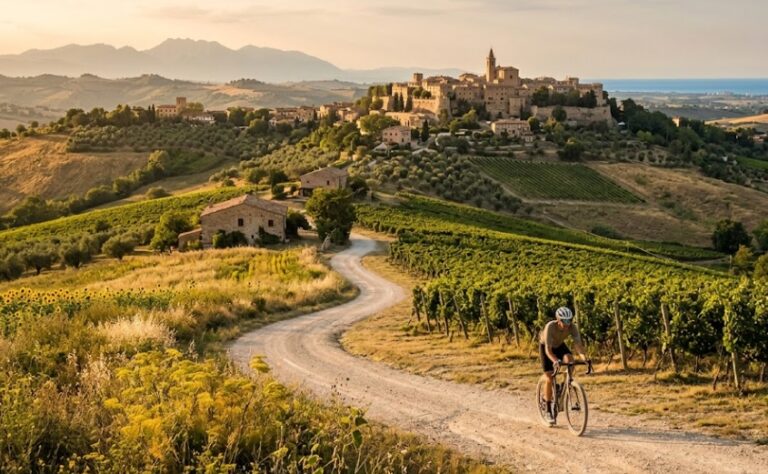
The road out of Matelica climbs slowly, and for the first two kilometers there is nothing but vineyards, the low autumn sun flattening across rows of Verdicchio vines gone the color of rust. Then, past a bend where the valley narrows, the first scaffolding appears: pale steel poles cinched around a bell tower, holding up stone that has stood since the thirteenth century. A cyclist who does not know how to read that scaffolding sees only an obstacle, something out of place against the hillside. I see a diagnosis. Ten years after the earthquakes of 2016, the wine roads of Matelica and Serrapetrona still carry both signatures side by side: vines trained in disciplined rows on one slope, temporary steel bracing holding a church together on the next.
This guide covers the Verdicchio di Matelica wine roads and the neighboring Vernaccia di Serrapetrona district, two small, mostly overlooked wine zones in the Marche region of central Italy, and what a structural engineer notices while pedaling through a landscape that is still, quite literally, under repair.
The Verdicchio di Matelica wine roads run through the Alta Valle dell’Esino, an inland valley in the province of Macerata, roughly one hour by car or train from the Adriatic coast. Two wine denominations define the territory: Verdicchio di Matelica, a mineral, high-acid white wine made in a valley closed off from the sea, and Vernaccia di Serrapetrona, the only red sparkling DOCG wine produced anywhere in Italy. Both zones sit inside the region reshaped by the earthquake sequence that began in August 2016, and both reward a slow, two-wheeled visit over a long weekend rather than a rushed afternoon.
Two Valleys, One Mountain: The Geography Behind Verdicchio di Matelica
Matelica sits at 354 meters above sea level in the valley of the Esino river, the only valley in the Marche that runs, at least partly, north to south rather than draining straight toward the Adriatic. The Monte San Vicino massif, rising to the east, blocks the sea’s moderating effect almost entirely, so Matelica’s vineyards never feel a maritime breeze the way the Verdicchio vineyards around Jesi do, some forty kilometers away on the other side of the mountain. Locals have a shorthand for this: Jesi makes “Verdicchio di mare,” Matelica makes “Verdicchio di montagna.”
The distinction is not marketing. It is measurable. Matelica’s continental climate brings cold winters, hot summers, and wide swings between day and night temperatures that slow ripening and concentrate acidity. The wine that results is leaner and more mineral than its coastal cousin, with lower alcohol and a saline, almost stony finish. Verdicchio di Matelica became a DOC in 1967, the first denomination of its kind recognized in the Marche; the Riserva version, aged a minimum of eighteen months, was elevated to DOCG status in 2010. The production zone is deliberately narrow: the comuni of Matelica, Esanatoglia, Gagliole, Castelraimondo, Camerino, and Pioraco in the province of Macerata, plus two communities across the regional border in the province of Ancona, Cerreto d’Esi and Fabriano.
I have spent thirty years reading the buildings of towns like these for a living, and the valley’s geology explains more than the wine. The same limestone ridges that seal this valley off from the Adriatic and give the vineyards their mineral edge are part of why this stretch of the Apennines is seismically active. It is not a coincidence that the wine tastes of stone. The valley is stone, folded and compressed over millions of years into the ridge line a cyclist has to climb to leave it.
The Only Red Sparkling DOCG in Italy: Vernaccia di Serrapetrona
Fifteen kilometers south of Matelica, across a low ridge and down into the Chienti valley, sits Serrapetrona, a hill town of fewer than one thousand residents that makes a wine unlike anything else produced in Italy. Vernaccia di Serrapetrona is the country’s only DOCG red sparkling wine, and it is worth pausing on what that sentence actually means, because nothing in the American wine vocabulary prepares a visitor for it.
Most sparkling reds elsewhere are simple and inexpensive, a chilled party wine. Vernaccia di Serrapetrona is the opposite: a labor-intensive, low-volume wine made from grapes grown on barely seventy hectares, entirely within the town of Serrapetrona and parts of two neighboring comuni, Belforte del Chienti and San Severino Marche. The base grape, Vernaccia Nera, must make up at least eighty-five percent of the blend. What sets the wine apart is not the grape alone but the method: three separate fermentations. The first happens at harvest, like any red wine. At least forty percent of the crop, though, is set aside and left to dry naturally in ventilated rooms called appassimenti (the drying lofts that give the grapes their concentrated sugar and flavor, and lend the wine its local nickname) until the must reaches a minimum natural alcohol content of thirteen percent. That raisined must is blended back into the base wine for a second fermentation, and a third, final fermentation in pressurized tanks, using the Martinotti method, produces the sparkle. The result, in either its dry (secco) or sweet (dolce) form, is a ruby-to-garnet wine with fine, persistent bubbles, aromas of ripe red fruit and dried flowers, and a bittersweet finish that pairs naturally with the region’s fruit tarts and aged cheeses.
The denomination earned DOCG status in 2004, becoming the first Marche appellation reserved specifically for a sparkling wine, dry or sweet. Production remains tiny by design: recent harvest figures logged by the Istituto Marchigiano di Tutela Vini put certified output at under five hundred hectoliters in a typical year, a volume that would not fill a single afternoon’s run at a mid-sized industrial winery. Seven producers work the appellation today, most of them family-run: Alberto Quacquarini, Colleluce, Fontezoppa, Podere sul Lago, Serboni, Terre di Serrapetrona, and Verser. Each November, on two Sunday weekends, the town opens its cellars for Appassimenti Aperti (Open Drying Lofts), letting visitors walk through the rooms where the grapes hang and taste directly from the producers; exact dates shift slightly year to year, so check with the Comune di Serrapetrona before building a trip around it.
What I See From the Saddle
Here is what changes once you know how to look. A scaffold wrapped around a building is not automatically a sign of abandonment. In the vocabulary of Italian post-earthquake practice, it is usually one of two things: a puntellatura, a temporary shoring structure holding up a wall or arch that has lost some of its own stability, or the first stage of an active repair contract, the staging from which workers will eventually install permanent reinforcement. The difference matters. A puntellatura left standing for years, rusting quietly, usually signals a building caught in the queue of Italy’s reconstruction bureaucracy, still waiting for its repair contract to clear. Fresh, unrusted steel next to a dumpster and a site trailer means work has actually started.
Look closer at a repaired facade and you will often find cerchiature and tiranti: metal bands and tie-rods, sometimes visible on the outside of a wall, that bind a structure horizontally so its walls move together during a tremor instead of peeling apart. On churches especially, look for a new steel or reinforced-concrete ring beam, a cordolo, tucked under the roofline where the walls meet the roof structure; it is the detail that keeps a bell tower from twisting free of its nave in the next earthquake, and it is one of the most common retrofit interventions applied to churches of this era across the Apennines.
Italian technicians assess ordinary residential and commercial buildings using a standardized rapid-survey form called the scheda AeDES (Agibilità e Danno nell’Emergenza Sismica, or Usability and Damage in Seismic Emergency), which sorts a building into one of several outcomes: A, usable; B, temporarily unusable but reopenable once urgent safety measures are taken; C, partially usable; D, uncertain, pending a further inspection; E, unusable; and F, unusable because of an external risk, such as a neighboring building that might collapse onto it. Churches, monuments, and other non-ordinary structures are not scored on the AeDES form at all; they follow a separate, more specialized assessment track, which is one reason a village’s houses can be back in use years before its church reopens.
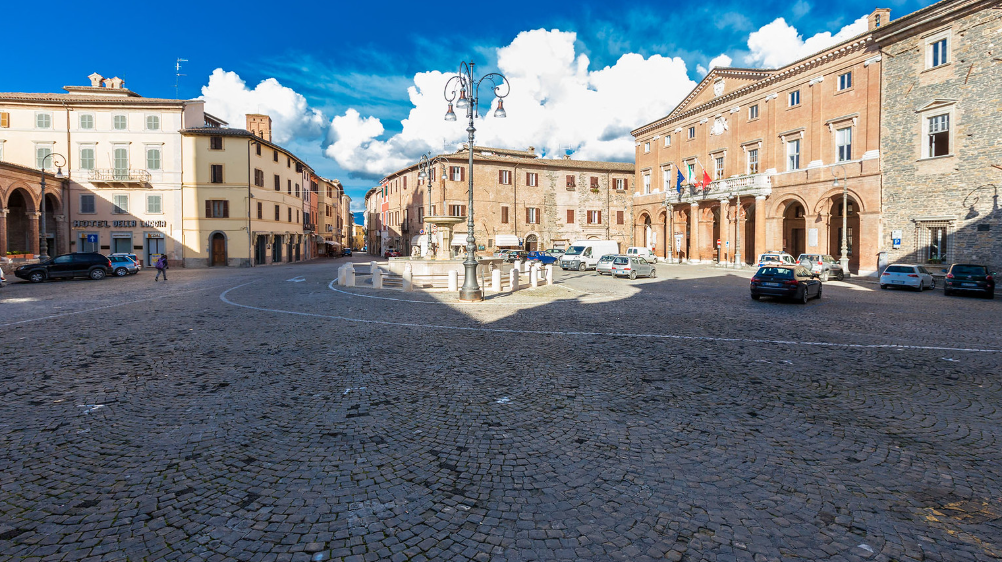
According to the government’s own reconstruction office, Camerino, the largest town in this valley, was still finishing the design phase of its historic-center reconstruction as of late 2025, with new construction sites expected to open through 2026 in some of the hardest-hit parts of the province. That is not a criticism. It is the actual pace of repairing a medieval hill town stone by stone, permit by permit, nine years after the ground moved. A cyclist rolling through in this window still finds shoring, fencing, and quiet streets in parts of the center. I see nine years of engineering, funding rounds, and permitting compressed into a steel frame.
Why Your Wheels Matter Here
There is a practical reason to choose this valley over a better-known one, and it has nothing to do with authenticity as a marketing word. The Marche region logged more than 20,000 requests for reconstruction funding since 2016, with roughly 8.7 billion euros approved and just over 5.7 billion actually paid out as of early 2026, according to the region’s own reconstruction report. Those numbers describe an economy still absorbing an enormous, slow-moving public investment, in towns whose ordinary commercial life, restaurants, wine shops, small hotels, took as hard a hit as their buildings did.
A cyclist who stops for lunch in Matelica, books a room in a restored farmhouse near Serrapetrona, and buys two bottles direct from a small producer is not doing charity. They are doing the single most useful thing an outside visitor can do for a place like this: spending money in the regular commercial economy of a town that needs customers as much as it needs contractors. Reconstruction money rebuilds buildings. Tourists who actually stop, eat, and buy something rebuild the businesses inside them. That distinction is easy to miss from outside and impossible to miss once you have watched a valley go through it.
Riding the Valleys: A Practical Guide
The most authentic way to link both wine roads on two wheels is to ride the opening stages of the Cammino nelle Terre Mutate (the Trail Through the Changed Lands), the long-distance route created after the 2016 earthquakes to connect the affected towns from Fabriano to L’Aquila. The first two stages, Fabriano to Matelica and Matelica to Camerino, cover a combined 49.6 kilometers and are rated for both hiking and mountain biking, following a mix of gravel tracks and secondary roads through the Verdicchio vineyards before climbing toward Camerino. Signage on the ground is inconsistent in places, so download the official GPS tracks from camminoterremutate.org before setting out, rather than relying on trailside markers alone.
For a shorter, road-focused loop connecting the two wine denominations directly, ride from Matelica south through Castelraimondo and Belforte del Chienti to Serrapetrona, then back. The roads are quiet provincial routes through vineyards and olive groves, with a handful of short, sharp climbs; because several of these towns still have active reconstruction sites, expect the occasional detour or temporary closure near a construction zone, and plan your exact distance and elevation with a current mapping app rather than a fixed itinerary, since road conditions here change more often than in an untouched region.
Reaching Matelica by train is straightforward: the regional line connecting Ancona, Civitanova Marche, Macerata, and Fabriano stops directly in town, and Trenitalia’s regional trains carry bicycles, typically in a dedicated car with vertical racks, free of charge for a folded or bagged bike and often for a standard bike as well, space permitting. This line has periodically run bus-replacement segments during infrastructure upgrades, so check Trenitalia’s website for planned works before booking your trip.
Time your visit deliberately. Late September and October bring the Matelica grape harvest and the most reliable cycling weather, warm days, cool nights, before the Apennine winter sets in; the higher stages toward the Sibillini turn genuinely alpine by December. If you want to see Serrapetrona’s Appassimenti Aperti, when producers open their drying lofts to the public on two Sundays each November, you will trade some of that cycling comfort for the single best window into how this wine is actually made; November is also one of the valley’s wettest months, so plan for that trade honestly rather than hoping around it.
Skip a chain hotel on the coast and a long commute inland. A handful of restored farmhouses and small agriturismi operate directly in the Matelica and Serrapetrona countryside, several of them in buildings that went through the same post-earthquake repair process described above; ask when you book, and most owners will tell you the story willingly. For meals, look for a trattoria serving vincisgrassi (the Marche’s layered pasta bake, older than lasagna) rather than a menu translated into English, and check current listings with the Pro Loco of Matelica or Serrapetrona rather than relying on an outdated guidebook.
Riders continuing south into the Sibillini foothills, or planning ahead for the walled town of San Ginesio or the wine village of Sarnano, both further into this same reconstruction cluster, will find full guides to each on this blog as they go live.
The People Who Stayed
The vineyards on both sides of Monte San Vicino do not know or care about earthquakes. Vines do not need scaffolding. They come back every spring on their own schedule, indifferent to the reconstruction office’s timeline, and that contrast, a living, productive landscape wrapped around villages still visibly healing, is the real character of this valley, not a story of ruin. The people who make Verdicchio di Matelica and Vernaccia di Serrapetrona did not leave after 2016. They kept pruning, kept harvesting, kept selling wine while their neighbors waited for repair contracts to clear, because a vineyard cannot be put on pause the way a building can. Ride through here slowly enough to notice both things at once, the vines and the scaffolding, and you will understand something about this stretch of Italy that no itinerary built around famous names will ever show you. If a house along the way catches your eye and you start doing the math on buying one, that is a separate conversation, and one I happen to know something about too.
FAQ — Cycling Matelica and Serrapetrona’s Wine Roads
What is Verdicchio di Matelica? Verdicchio di Matelica is a white wine, produced as a DOC with a DOCG Riserva tier, made in the Alta Valle dell’Esino, an inland valley in the Marche closed off from the Adriatic Sea by Monte San Vicino. Its continental climate gives the wine higher acidity, lower alcohol, and more mineral character than Verdicchio dei Castelli di Jesi, the same grape grown closer to the coast.
What makes Vernaccia di Serrapetrona unique? Vernaccia di Serrapetrona is Italy’s only DOCG red sparkling wine. It is made from Vernaccia Nera grapes through three separate fermentations, including one after a portion of the harvest is dried naturally to concentrate sugar and flavor, a process called appassimento. Production is limited to roughly seventy hectares around the town of Serrapetrona.
Can you actually cycle the Cammino nelle Terre Mutate? Yes. The Cammino nelle Terre Mutate, the long-distance route through the towns affected by the 2016 central Italy earthquakes, is designed for both hikers and mountain bikers, with downloadable GPS tracks available on the trail’s official website. Signage is inconsistent in places, so riding with GPS tracks rather than trailside markers is strongly recommended.
When is the best time to visit Matelica and Serrapetrona by bike? Late September through October offers the most reliable cycling weather, mild days and cool nights, and coincides with the Matelica grape harvest. Visitors who want to see Serrapetrona’s Appassimenti Aperti cellar-opening weekends should plan a November trip, keeping in mind that November is also one of the valley’s wettest months.
How do I get to Matelica without a car? Matelica has its own stop on the regional rail line connecting Ancona, Civitanova Marche, Macerata, and Fabriano, and Trenitalia’s regional trains carry bicycles, typically free of charge for a folded or bagged bike. Check Trenitalia’s website before traveling, since this line periodically runs bus-replacement service during track upgrades.
Is it disrespectful to visit an area still recovering from an earthquake? No, as long as visitors are thoughtful: avoid photographing the interiors of private homes, follow any posted restrictions near active construction sites, and remember that spending money at local restaurants, cellars, and lodging genuinely supports an economy still absorbing a slow-moving reconstruction process. Responsible, low-key tourism is one of the more useful things an outside visitor can offer these towns right now.
What do the scaffolding and metal braces on buildings actually mean? They are almost always temporary safety measures, known in Italian as provvedimenti di pronto intervento, installed to stabilize a damaged structure while it waits for a full repair project. Common examples include shoring frames (puntellature) and external tie-rods (tiranti) that bind walls together; their presence signals an active or pending repair process, not abandonment.