Viewing a House in Italy in Autumn: What the Rain Shows
Viewing a house in Italy in autumn starts with a smell. You open the door of a stone farmhouse after three days of rain, and the cold air carries wet lime, old wood, and something mineral that rises from the cellar. In July the same room smelled of warm dust and nothing else. The house has not changed at all. The weather has simply turned the lights on. I am an Italian engineer, and I have walked through houses like this one for thirty years. Rain shows me more in a single hour than a dry August afternoon shows me in a day.
The short answer: rain is the cheapest inspector you will ever hire
If you were viewing a house in Italy last summer, you saw it in its least informative state. Dry stone hides almost every water problem a building can have. Rain brings those problems to the surface within a day or two. A visit made 24 to 48 hours after prolonged rain will show you rising damp, roof leaks, overflowing gutters, a wet cellar, saturated drains and ground that pushes water toward the walls. All of this costs you nothing to observe. All of it costs a great deal to repair later. So the right moment for viewing a house in Italy is now, between October and January, because this is when central Italy receives much of its rain. You are not being pessimistic. You are simply looking at the building while it tells the truth, during the stretch the calendar hands you for free — see Italy in November for what that season actually feels like on the ground.
If you are still early in the process, our guide to buying a house in Italy and the breakdown of what these houses cost to buy are the right starting points before you focus on a single property.
What summer hides when you view a house in Italy
A masonry wall is a slow machine. It absorbs water, holds it, and releases it over weeks rather than hours. In August the machine runs empty. By late October it is loaded, and every defect in the system becomes visible to anyone who knows where to look.
Rising damp, condensation and leaks are three different problems
Americans tend to call all of it “damp,” and then they ask me for one number. But these are three separate failures, with three very different budgets attached.
Rising damp climbs from the ground through the capillary pores of stone and brick. Older rural houses here were built without a damp-proof course, because nobody used one before the 1960s. You recognize it by its height. The stain stops at a fairly level line, usually between 30 and 50 inches above the floor, and the plaster above that line stays sound. Look for salt. As the water evaporates it leaves behind a white, crystalline bloom called efflorescenza (efflorescence), which pushes the plaster off the wall in flakes. This is the failure I find most often in stone farmhouses in Le Marche, and it is manageable, though never cheap — our breakdown of renovation costs per square meter in Le Marche gives a realistic range.
Condensation behaves differently. It appears in corners, behind furniture, on north-facing walls and around window reveals. It arrives as grey or black mold rather than white salt, and it tends to spread in patches instead of a line. Often it is a heating and ventilation problem, not a structural one, which makes it the cheapest of the three to solve.
Lateral infiltration is the third case, and the most serious. Water enters sideways, usually where the ground outside sits higher than the floor inside. The stain has no level line and no logic. It moves with the weather, darkens after each storm, and fades slowly in between. If you see that pattern, the problem is outside the house, not inside it.
The roof tells the truth only while it rains
Italian roofs here are usually clay coppi, the curved tiles you have seen in every photograph of Tuscany. Traditionally they sat on wooden battens with nothing underneath. Modern practice adds a waterproof membrane below the tiles, and many houses were re-roofed in the last forty years. The question is whether the work was done properly.
You cannot answer that question while viewing a house in Italy in August. You answer it with a flashlight in the attic while water is falling on the roof above you. Go up and look at the underside of the tiles. Look at the timbers near the ridge, at the valleys where two roof planes meet, and at the point where the chimney passes through. Then look at the ceiling of the top floor from below. Old stains are brown with hard edges. Active leaks are darker, softer, and sometimes cold to the touch. Photograph everything, with the date visible.
Water outside the house decides what happens inside
Most of the damp I find in rural Italian houses is not caused by the walls at all. It is caused by water that nobody manages before it reaches them.
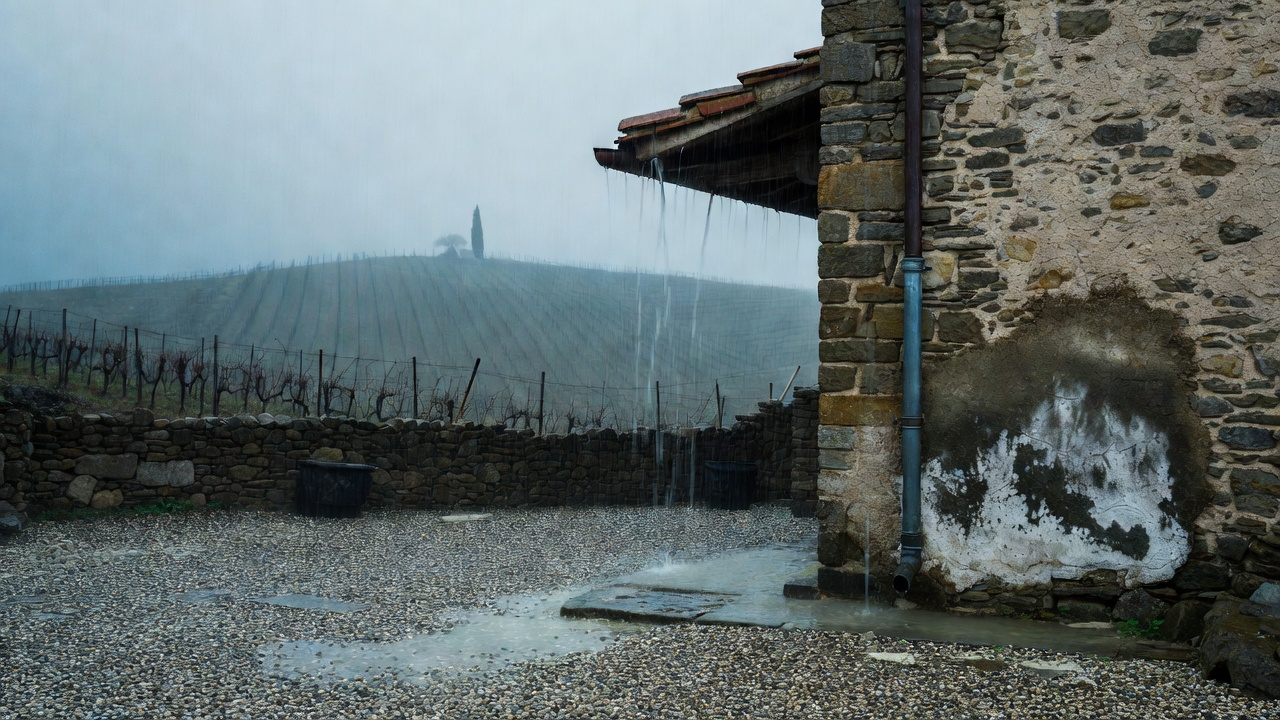
When you are viewing a house in Italy, walk the perimeter during the rain and watch where the water actually goes. Gutters should discharge into a sealed drain, not onto the ground beside the wall. Very often they do neither. Instead the downpipe stops a few inches above a stone slab, and sixty years of rainfall have soaked the base of the wall day after day. The repair is modest. The damage it prevents is not.
Then look at the ground itself. A courtyard should fall away from the building. In old farmhouses it frequently falls toward it, because the yard was regraded for a tractor and nobody thought about drainage. Check the uphill side as well. A house cut into a slope needs a drainage channel behind it, and if you cannot see one, assume the hillside is feeding water straight into the back wall. White gravel lanes matter too, since they collect rainwater efficiently and deliver it wherever gravity decides.
The cellar, and the week it fills up
Every stone house in central Italy has a cellar, and the cellar is the most honest room in the building. It was dug into the ground without any waterproofing, and it was used for wine, oil and cured meat precisely because it stayed cool and slightly humid.
So a little moisture is normal when you are viewing a house in Italy. Standing water is not. Look at the floor for a tide mark, at the lowest stones for green biological growth, and at any stored object for a horizontal line of rot. Ask the owner directly whether it floods, and ask in which month. In rural Italy you will usually get an honest answer, because flooding a cellar is considered ordinary rather than shameful. The answer still belongs in your decision.
Cracks look different when the wall is wet
Central Italy is seismic territory, and I write about that elsewhere. Here I want to make a narrower point about what autumn adds to a crack.
A dry crack gives you geometry: direction, width, position. A wet wall gives you behavior. Watch for cracks that darken while the rest of the wall dries, for water seeping through a joint during rain, and for cracks that cross a wall from outside to inside. Those are open paths through the masonry, which means the crack is not a surface blemish in the render.
Do not try to classify these yourself, and do not let an agent classify them either. Photograph them, note where they sit relative to windows and corners, and put them in front of an engineer. The difference between a settlement crack and a structural one is the difference between a weekend of work and a large reconstruction project.
Drains, septic systems and saturated ground
Many rural Italian houses are not connected to a public sewer. Instead they drain into an Imhoff tank, a two-chamber septic system, and then into a soakaway that disperses the treated water into the soil. The system works well when the ground can still absorb water. In November, after weeks of rain, the ground often cannot.
Anyone viewing a house in Italy outside a town should ask three questions, and ask them in writing. Where is the tank, when was it last emptied, and where does the final discharge go? If nobody can show you the drainage layout, treat that as a real cost rather than a detail. Autumn also reveals the symptoms directly: slow drains, smell near the discharge point, bright green grass in one patch of an otherwise brown field. Those are not cosmetic problems, and in a sale they are usually the buyer’s problem to inherit.
Check the public maps before you make an offer
Here is something most foreigners viewing a house in Italy never learn, because nobody in the transaction is paid to tell them. Italy publishes detailed hazard maps for landslides and flooding, free of charge, and you can consult them yourself from your kitchen table in Colorado.
The national platform is IdroGEO, run by ISPRA, the Italian national institute for environmental protection and research. It is available in English, it works on a phone, and it lets you search an address and generate a report. It carries the Italian Landslide Inventory (IFFI), which according to ISPRA had mapped more than 680,000 landslides by January 2026. Alongside it sit the PAI maps, the hydrogeological plans issued by the district basin authorities. For most of Le Marche, Umbria and Abruzzo the relevant body is the Autorità di Bacino Distrettuale dell’Appennino Centrale, which publishes its landslide and flood layers on a public web map.
What you are looking for is simple. Does the parcel sit inside a mapped landslide area or a flood hazard zone, and at what level? The answer matters for two reasons. First, it tells you how the hillside behaves. Second, it may restrict what you are allowed to build, extend or even change the use of, which can quietly remove the renovation you had in mind. Print the result and take it to your technician. Nobody will hand you these maps spontaneously, because the seller is not obliged to, and the agent has no reason to.
The road, the hill and the winter you have not seen
A house at 2,000 feet above a town like Sarnano is a dream in August. In January it is a commute. So drive the access road in bad weather, and drive it at night.
Three things are worth measuring honestly. How steep is the final stretch, and is it paved? How far is the nearest village with a pharmacy, a grocery and a doctor, measured in minutes rather than miles? Who maintains the road, and who clears the snow, which on a private lane may well be you. None of these facts make a hill house a bad purchase. They simply belong in the decision before the offer, not after the deed.
What rain cannot show you
Rain is an excellent diagnostic tool, and it has clear limits. It will not tell you how much water is inside a wall, only that water is there. It will not reveal a leak that has already been painted over. It will not show you what sits above a suspended ceiling, inside a chimney flue, or under a floor slab.
For that you need instruments and access: a moisture meter to compare readings at different heights, thermal imaging to find cold bridges and wet zones behind finishes, a safe inspection of the roof itself, and a check of the building’s paperwork against what physically exists. That last point surprises Americans most. In Italy there is no legal equivalent of a home inspection, and no obligation on the seller to commission one. So viewing a house in Italy puts the whole technical judgment on the buyer. The notary verifies title and legality of the transfer. The agent brokers the deal. The geometra who draws the plans works, in most cases, for the person selling. Nobody in that chain is paid to tell you what the building is actually worth repairing.
That gap is why I run a property survey service for foreign buyers. I should say plainly what I say on the phone: I take no commission from any sale, I do not sell houses, and I have no relationship with any agency. You are paying me to be the only person in the transaction with no interest in the deal closing.
Why October through January is the right window to decide
Italy in October covers the broader seasonal shift; here the focus is only on what that shift means for a buyer. The seasons of the Italian property market are not the seasons of the tourist calendar, and anyone buying a house in Le Marche can use that gap twice over this season.
Summer is when foreign buyers visit, when agents are busiest and when sellers are least flexible. By late October the visitors have gone home. Houses that did not sell over the summer have been sitting for four or five months, and the owner has started thinking about another winter of maintenance on an empty building. You are negotiating with far less competition in the room.
The calendar also works backward from your renovation. A deal agreed in late autumn moves to a compromesso, the preliminary contract, over the following weeks, and then to the rogito, the final deed, in early spring. A deal that closes by spring also lines you up for the fiscal year if you plan to apply for the 7% flat tax for foreign retirees, which has its own residency timing to respect. Permits and technical drawings take the rest of the spring. Work then starts in summer, which is the right season for roofs and external walls in central Italy, and the building has a dry stretch ahead of it to settle. Push the same sequence back by six months and your first site works land in November, which nobody here wants.
So treat this autumn as a working trip rather than a holiday. Viewing a house in Italy in bad weather is not a wasted day: it is the day that counts. Watch the forecast, book your viewings for the day after the rain, bring a flashlight and a moisture meter, and go back to the one or two houses you still think about. The rain will do most of the talking.
FAQ — Viewing a house in Italy in autumn
What is the best time of year to view a house in Italy? Late autumn and winter, between October and February, is the best time for viewing a house in Italy. Rain exposes damp, roof leaks and drainage faults that stay invisible in summer. Agents are also less busy, and sellers are more flexible than they are in August.
Can I ask the seller to let me visit while it is raining? Yes, and it is a normal request here. Agents usually arrange viewings a day or two ahead, so watch the forecast and ask for the day after sustained rain. A seller who refuses that specific timing has told you something useful.
Is a home inspection required by law when buying a house in Italy? No. Italy has no legal equivalent of the American home inspection, and the seller has no duty to provide one. The notary checks title and legality, not condition. Any technical assessment of the building is something the buyer commissions independently.
How much does a building survey cost in Italy? It depends on size, age and distance, so any quote given without seeing the property is a guess. For my own work the range runs from a short orientation call to a full survey and report, and I set the fee before the visit. The relevant comparison is not the fee, but the cost of the roof or drainage you discover afterward.
How long should viewing a house in Italy take? Allow two hours for the building and another hour for the land and the road. You need time to walk the perimeter during rain, climb into the attic, stand in the cellar and drive the access route. A 30-minute tour in good weather tells you almost nothing.
Is damp in an old Italian stone house a reason to walk away? Usually not. Rising damp is common in buildings constructed without a damp-proof course, and it can be managed. Lateral infiltration from badly drained ground is more serious, and persistent water in a cellar that also affects the ground floor deserves a professional opinion before you sign anything.
What does an Italian engineer check first that a buyer never thinks of? The ground outside, not the walls inside. Where gutters discharge, which way the courtyard falls, whether the uphill side is drained. I also check the hazard maps before the visit, because a parcel inside a mapped landslide zone can carry building restrictions that quietly cancel the renovation the buyer came for.
The takeaway
The house you saw in July was a photograph. The house you see in November is a building. Everything that matters financially when you are viewing a house in Italy over the next ten years — the roof, the walls, the ground, the drains — becomes legible in the days after sustained rain, and it costs you nothing but patience and a flashlight.
If you are close to an offer on a specific property, you can book a 30-minute orientation call with me at tidycal.com/mircovitellozzi/property-survey-orientation-call. We go through your photographs, the maps and the paperwork, and I tell you what I would want to see on site. Again, I take no commission and I do not sell property: I only tell you what the building is.
And if your purchase is still two or three years away, join The Engineer’s Italy, my newsletter. I write about these houses, the regions where they sit, and the quiet mechanics of buying one, roughly once a month.