What Is a Sagra? Italy’s Village Food Festivals, Explained by an Italian Who Grew Up Going to Them
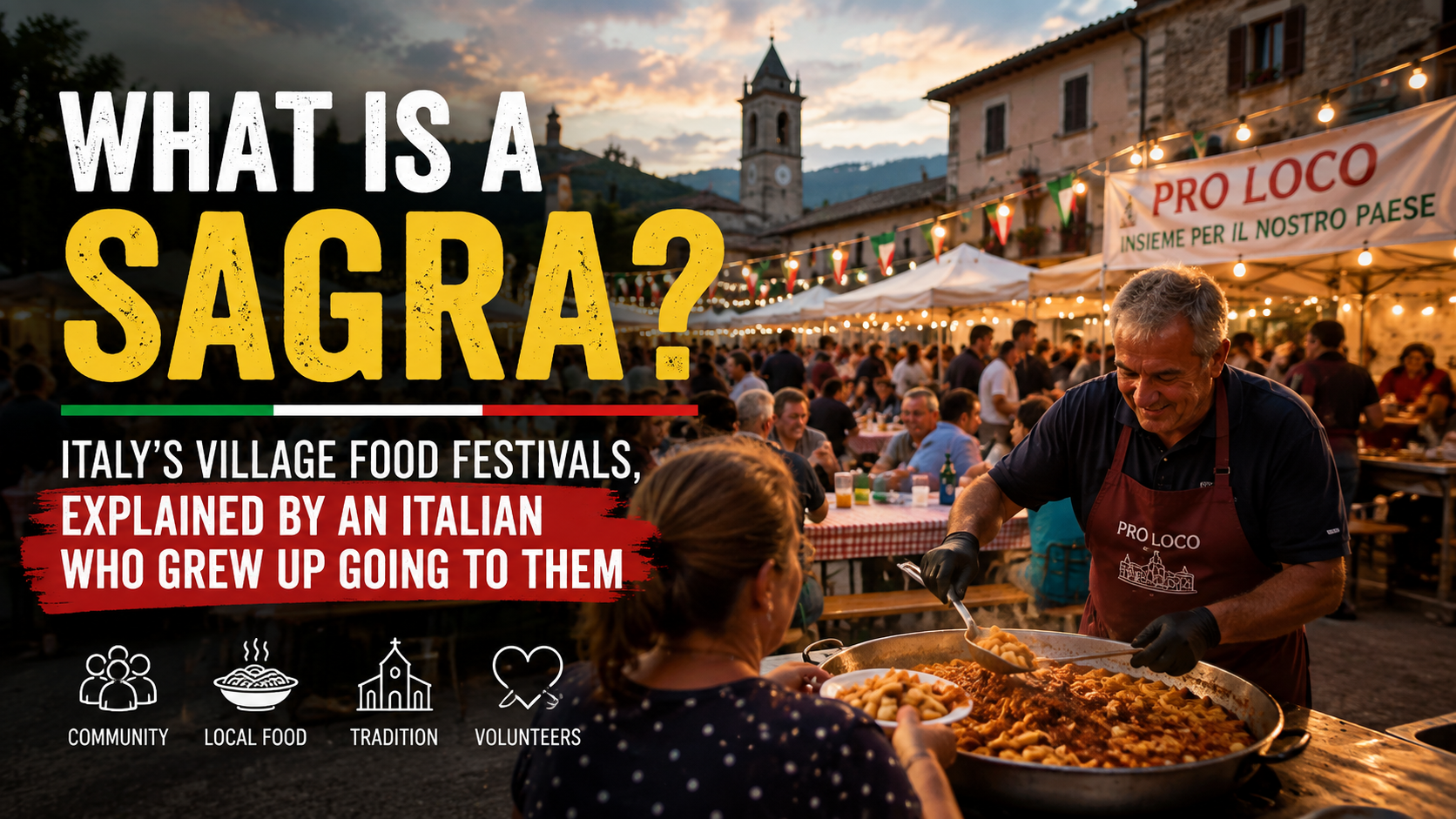
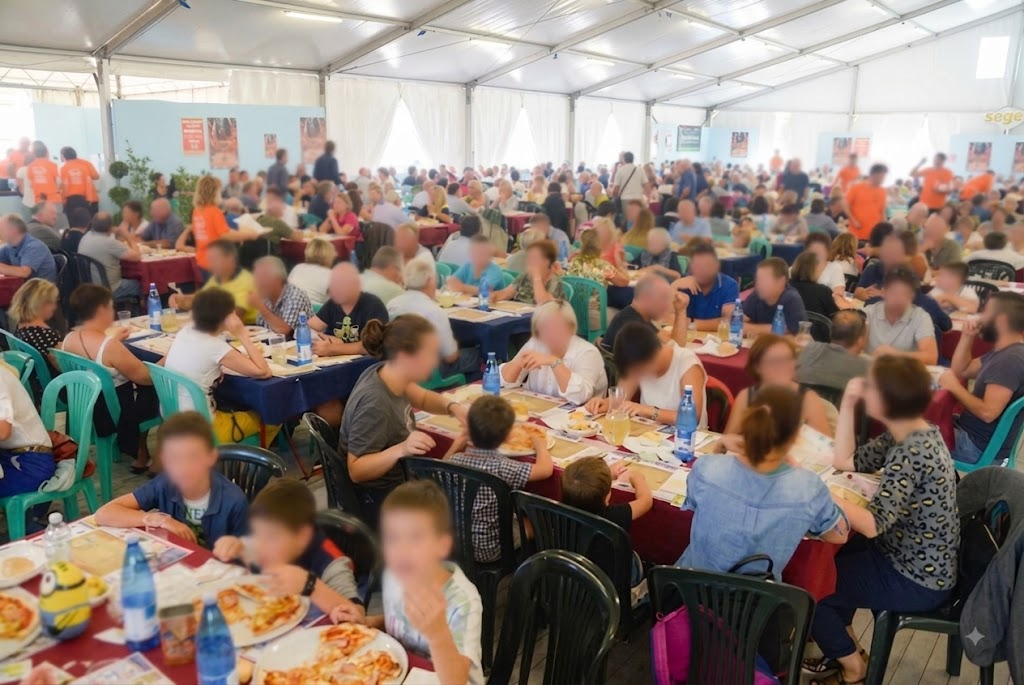
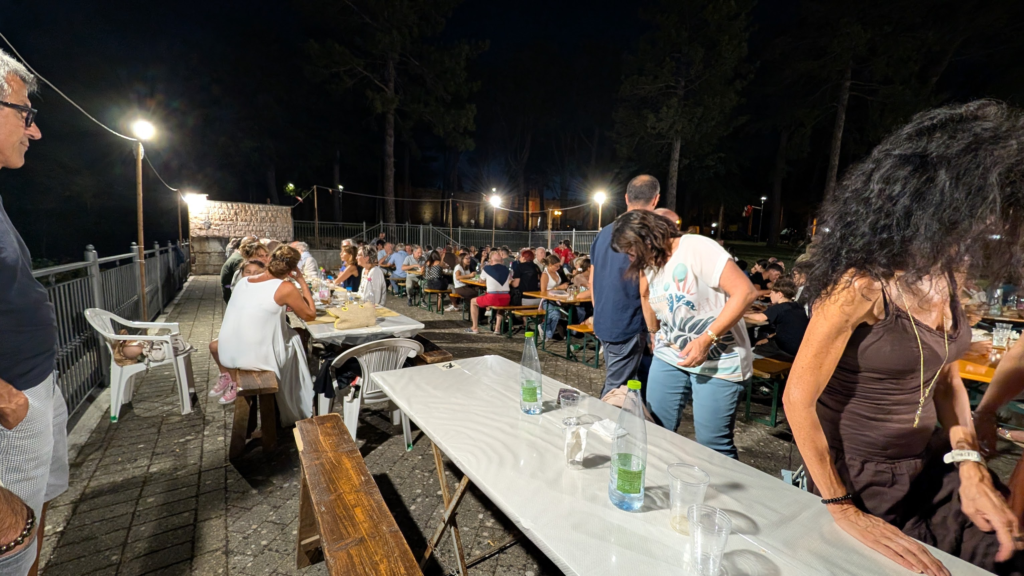
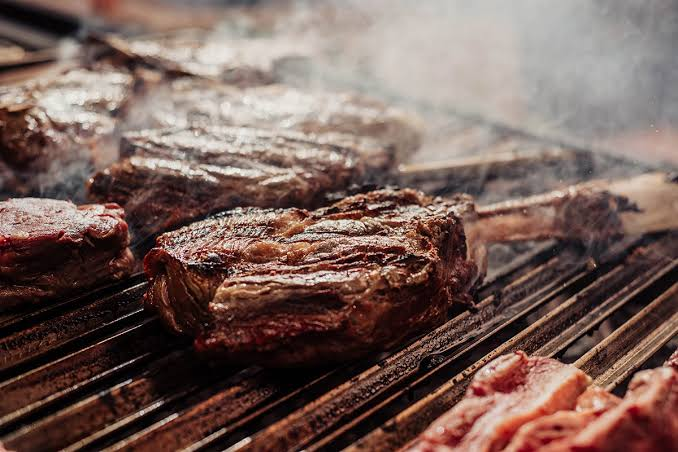
Two men in rubber boots are wrestling a folding table off the back of a flatbed truck at six in the evening, a full hour before anyone will eat. Behind them, a row of white canvas tents is going up over an asphalt parking lot that will, by nine o’clock, hold four hundred people shoulder to shoulder on wooden benches. Nobody is filming this part. This is what a sagra (a local food festival built around a single dish or product, run entirely by volunteers) looks like before it becomes the postcard: extension cords taped down, a grill still cold, a priest walking past without a second glance, because for him this is just Tuesday.
What Is a Sagra, Exactly?
A sagra is a community food festival held in an Italian town or village, organized by a local volunteer association — usually a Pro Loco — rather than a private business, and built around one specific local dish or product rather than a curated menu. It takes place in a public square, a parish courtyard, or a festival ground, never in a restaurant, and it exists to raise money for something the town needs, not to generate profit. Most sagre run for a fixed handful of days, typically one or two weekends, and then vanish until the same week next year.
That last detail is the one visitors from outside Italy tend to miss. A sagra is not a curated food festival with a jury and a program committee; nobody is auditioning the porchetta. It is closer to a fundraising dinner that a whole town happens to be running at once, which is exactly why it looks improvised and why, most years, it is.
Where the Word Comes From — And What It Meant Before Food Was the Point
The word traces back to sagro, an archaic Italian variant of sacro (sacred), itself rooted in the Latin sacrum. According to Treccani’s dictionary, the earliest sense of “sagra” was not a festival at all — it was the religious ceremony consecrating a church, an altar, or a sacred image: a dedication, full stop. Only over centuries did the word broaden to mean the annual celebration commemorating that dedication, or a town’s patron saint, held alongside the fair and the market that naturally gathered wherever a crowd already was.
That’s the part worth sitting with: the food was never the original point. A dedication anniversary or a saint’s feast day already pulled the whole parish into the square. Someone set up a stall. Someone else brought a pot. Over a couple of generations, the pot outgrew the procession, and by the twentieth century the religious ceremony had faded into the background of an event now defined by what’s cooking. The dictionary entry still carries both senses side by side — the archaic “consecration” meaning and the modern “town festival built around a food product” meaning — because Italian never fully let go of the older one.
Why Just One Dish, and Why That One
American food festivals tend to run on variety: a dozen vendors, a dozen cuisines, a ticket book you spend across the whole lot. A sagra runs on the opposite logic. It exists because a specific place produces a specific thing, and the festival is the town’s way of saying so out loud. Snail sagre happen where snails were historically gathered after the first autumn rain; chestnut sagre happen in the mountains where chestnut flour once got a family through winter when wheat didn’t grow; wine and grape sagre happen at harvest, in wine country, for obvious reasons.
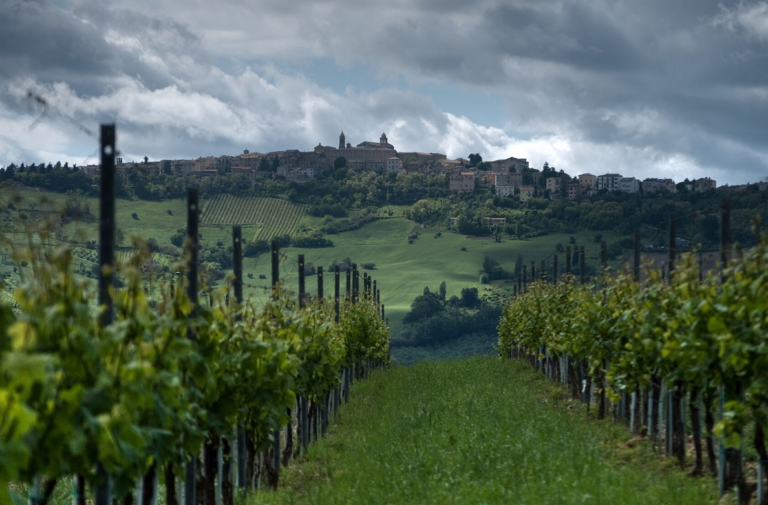
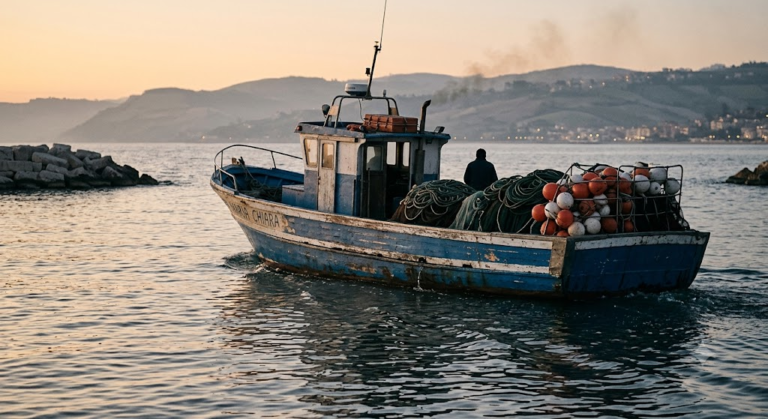
This is also why the “same” sagra dish can taste genuinely different two towns over — the festival is commemorating a raw ingredient and a local habit of cooking it, not a fixed recipe handed down with measurements attached. Marche alone has two good examples of this logic: vincisgrassi, the region’s layered pasta bake built on local ragù rather than the tomato-forward lasagna Americans know, and brodetto, the Adriatic fish stew that five different fishing towns along the same coast still argue about, each convinced its version is the only correct one. Both grew out of exactly the same pattern a sagra formalizes — a place, a product, a shared table — and neither started as a restaurant dish.
Not every sagra passes this test, which is worth knowing before you plan a trip around one. There’s a real difference between a sagra built on what a place actually produces and the generic version of the format — more on that below.
Who Actually Runs a Sagra, and Where the Money Goes
Sagre are organized almost entirely by Pro Loco — local, volunteer-run associations that exist in something like six thousand Italian towns, loosely federated under a national body, UNPLI. Since Italy’s 2017 overhaul of nonprofit law — the Codice del Terzo Settore, Legislative Decree 117/2017 — most Pro Loco have registered as an Associazione di Promozione Sociale (an Association for Social Promotion, or APS), the nonprofit category defined in Articles 35 and 36 of that code; UNPLI itself is registered nationally as an APS. This isn’t a technicality. It means a sagra’s kitchen tent is, legally, the fundraising arm of a registered nonprofit, subject to the bookkeeping and reporting obligations that come with that status, not an unregulated pop-up restaurant.
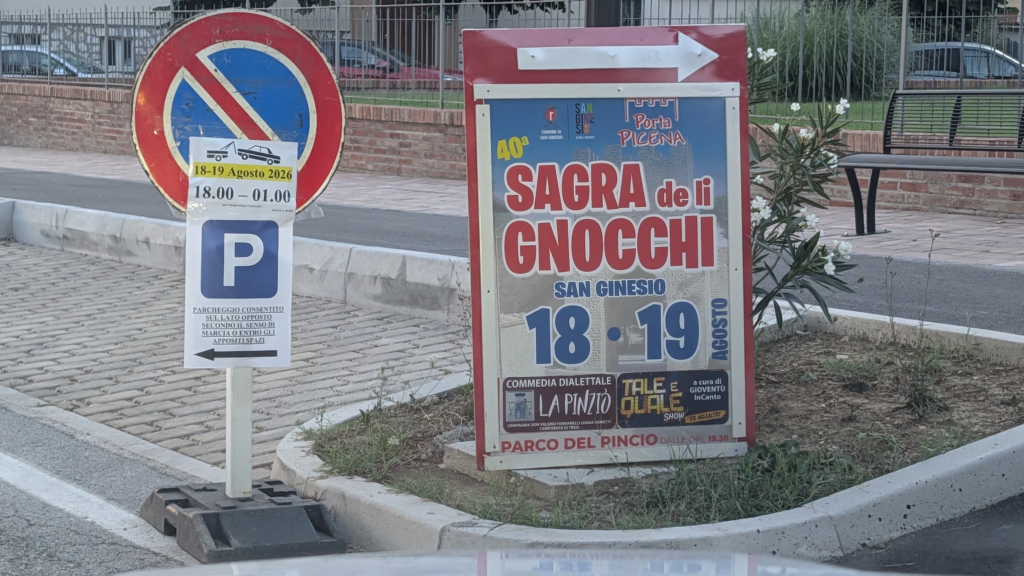
Where the money actually goes is usually visible if you ask, because in a town of two thousand people there’s no hiding it: a new roof on the parish church, uniforms for the youth soccer team, a defibrillator for the volunteer ambulance service, next year’s Christmas lights on the main street. As a registered APS, a Pro Loco also carries real obligations in exchange for that nonprofit status — an annual financial statement filed to the national Terzo Settore registry, and public disclosure of any single public contribution over ten thousand euros. A handful of large sagre — the ones that draw regional press and tens of thousands of visitors — have grown into genuine local economies with real turnover. Most have not, and were never meant to.
In some of the small Apennine hill towns still rebuilding after the 2016–2017 central Italy earthquakes, that civic function stops being symbolic and becomes closer to load-bearing: a town that empties out for most of the year needs the one weekend when its own residents, scattered relatives, and former neighbors all come back at once, and the sagra is often what still makes that happen. That’s a subject that deserves its own piece rather than a paragraph here. So does the day-to-day roster of who actually staffs a sagra — the retired teacher running the cash box, the teenager on dish duty, the person who’s manned the grill every summer for as long as anyone in town can remember.
Why Summer, Why Saints, Why After the Harvest
Three calendars overlap to decide when a sagra happens, and they usually reinforce rather than compete with each other. The religious calendar sets the date around a patron saint’s feast day, since that’s the anniversary the whole tradition descends from. The agricultural calendar sets the dish, timed to whatever the harvest or catch actually is that month — grapes in September, chestnuts in October, seafood whenever the boats are landing it. And the practical calendar does the rest: summer means outdoor seating works, means Italians who emigrated for work are home for their August vacation and Ferragosto, and means the volunteers who staff the whole operation aren’t also working a day job that week.
That third factor explains a statistic worth knowing before you plan a trip: figures from FIPE, Italy’s federation of licensed restaurants and bars — a trade group with its own competing interest in the matter, worth keeping in mind — put roughly eighty percent of the country’s sagre between June and September, with August alone accounting for a third of all sagra-days on the calendar. If your trip to Italy in August is already built around the idea that the country empties out and slows down, a sagra is one of the few things running at full volume during exactly that lull, precisely because it depends on the same emptying-out that shuts everything else.
The Engineering Side Nobody Talks About
Here’s the angle a food writer usually skips and an engineer can’t: a sagra is, structurally, a temporary occupation of public space, and Italy’s rules for that changed sharply after 2017. Following a crowd crush during a Champions League final broadcast in Turin’s Piazza San Carlo, Italy’s Chief of Police issued a nationwide circular on June 7, 2017 (no. 555/OP/0001991/2017/1, known informally as the Circolare Gabrielli) requiring organizers of any public gathering to formally calculate maximum crowd capacity, mark and keep clear dedicated evacuation routes, and coordinate fire-prevention measures for cooking and lighting equipment before an event could legally take place. A year later, after towns and Pro Loco reported that the 2017 rules were too rigid for a modest food stall in a small piazza, the Interior Ministry’s Chief of Staff, Prefect Matteo Piantedosi, issued a follow-up circular on July 18, 2018 (no. 11001/1/110/(10)) that explicitly named sagre, fairs, and historical reenactments among the events covered, and introduced a more proportional, risk-based approach for lower-criticality gatherings.
In practice, this is why a sagra you visit today has a posted maximum capacity, a marked path between rows of benches that’s kept clear even when the square is packed, and a fire extinguisher standing within reach of every frying station. I read these squares for a living, not out of curiosity but because capacity, egress, and fire load are the same variables I calculate for buildings that don’t fold up and disappear by Monday morning. A sagra is a building’s worth of risk assembled and disassembled in a weekend, and the two circulars above are the reason that risk gets managed rather than ignored.
What a Sagra Is Not
It helps to be specific about the gap between the American mental model of “festival” and what you’ll actually find.
- It is not a restaurant. There’s no host stand, no assigned server, and often no menu translation. You order at a window, take a numbered ticket, and carry your own tray to a shared bench with strangers.
- It is not a curated food festival. Nobody juried the recipe. Some sagre serve genuinely excellent food; some serve food that’s merely fine, cooked by volunteers rather than chefs, and that’s not a failure of the format — it’s the format.
- It is not staged for tourists. Signage is in Italian, payment is often cash-only, and the crowd is overwhelmingly local. You’re a welcome guest, not the intended audience.
- It is not guaranteed to be authentic. Trade groups representing licensed restaurants have publicly criticized a real subset of modern sagre for straying from any actual local product — a seafood sagra staged in a mountain town two hundred kilometers from the coast, a beer tent that could be dropped into any piazza in the country. That criticism comes from an interested party competing for the same customers, so it’s worth reading with that context, but the underlying pattern it points to is real and worth watching for.
Frequently Asked Questions
What is a sagra? A community-run food festival in an Italian town, organized by a volunteer association (usually a Pro Loco) and built around one local dish or product rather than a full menu, staged in a public square rather than a restaurant.
When is sagra season in Italy? Nearly year-round somewhere in the country, but roughly eighty percent cluster between June and September, when outdoor seating works and the featured ingredient is actually in season.
Do I need to book ahead or buy tickets? Almost never. Entry to the square is free; you pay per dish in cash once inside. Advance online tickets exist only for a handful of the largest, best-known sagre.
How much does a meal cost? Plan on roughly fifteen to twenty euros per person for a full plate and a drink, though this varies by region and by dish. Prices are set to cover costs and fund the organizing association, not to turn a restaurant-style profit.
How long should I plan to stay? Two to three hours covers ordering, eating at a shared table, and walking the stalls or catching whatever live music the Pro Loco has booked for the evening.
What should I pair a sagra visit with? Because most sagre run only a handful of evenings a year in one small town, build the day around the destination itself — its historic center, a nearby vineyard, a stretch of coast — rather than treating the festival as the only reason to go.
How do you tell a genuine sagra from a generic one? Check that the dish matches what the area actually produces. A seafood sagra far from any coast, or the same beer-tent setup appearing at every event regardless of region, is a booked commercial act rather than a local tradition. The real version is volunteer-run and usually listed on the town’s own municipal site or the regional Pro Loco federation, not on a generic events aggregator.
How to Actually Go to One
Bring cash, expect to wait in line, and expect plastic chairs rather than tablecloths — none of that is a sign you picked the wrong one. Look specifically for a sagra tied to a product the area is actually known for, check the listing against the comune’s own site rather than a tourist-events app, and go in treating it as a community fundraiser you’ve been let into, not a show staged for your benefit. That shift in expectation is most of what separates a good sagra evening from a disappointing one.
Order at the window like everyone else, take whichever bench has room, and don’t be surprised if the family next to you strikes up a conversation about where you’re from. That’s not performance for the visitor — it’s just how the evening is supposed to work, the same way it worked before anyone thought to write a guide about it.
For the mechanics of ordering, paying, and eating once you’re inside, see how to eat at an Italian sagra without looking lost. And for a working list of which sagre in Le Marche are actually worth building an evening around — grouped by what each one is defending rather than by a date that will be wrong within a season — see Le Marche food festivals: where the region actually eats.
If you want more stories like this from an Italian insider’s perspective, explore more on Tastes & Wonders of Italy or subscribe to our YouTube channel for video dispatches from around the country.
Written by Mirco Vitellozzi, a structural engineer from Le Marche who writes about Italy from the inside. More essays at Tastes & Wonders of Italy, and short films on YouTube.