Arnolfo Tower: Why Florence’s 95-Meter Tower Sits Off-Center
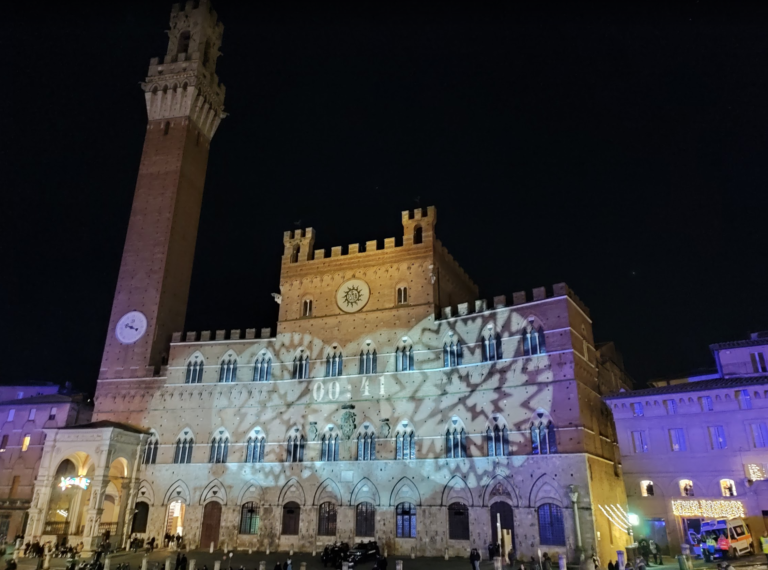
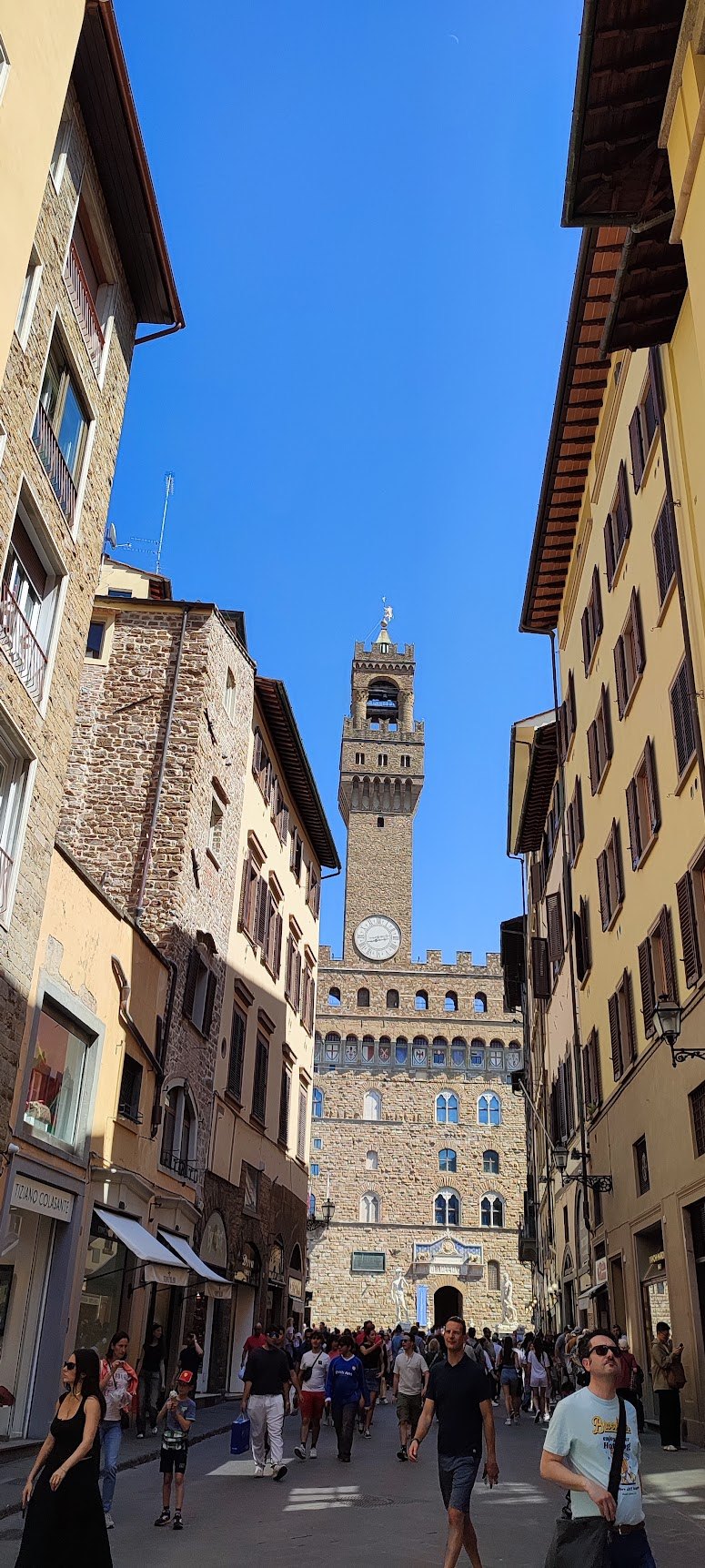
Stand in Piazza della Signoria and look up at the Arnolfo Tower. Something is off, and most visitors never notice it. The tower does not rise from the middle of the facade. It sits toward the right, pushed several meters out of line. Guides rarely stop to explain why. The answer is not a failure of taste. It is the visible record of two constraints, one structural and one political. Florence’s builders had to work around a tower that already stood on that spot. They also had to respect a strip of ground the city had declared unbuildable. Ninety-five meters of masonry, shaped by problems no architect would have chosen.
A note on links: some of the booking links in this article are affiliate links, and if you book through one I earn a small commission at no additional cost to you. It changes nothing about what I recommend. The ticket for the tower itself is cheapest from the city of Florence, which earns me nothing, and I say so plainly further down.
What the Arnolfo Tower Is, and Why It Sits Off-Center
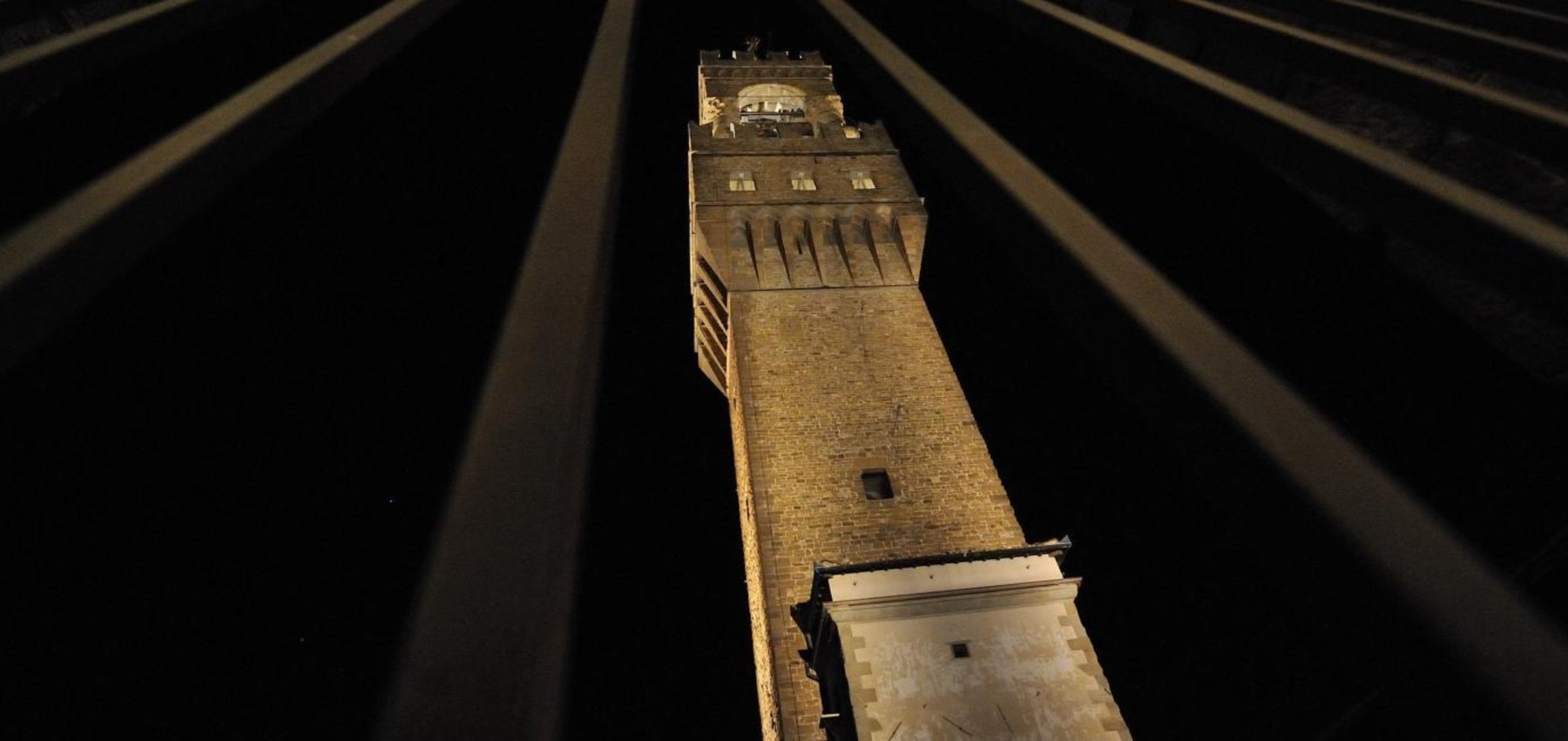
The Arnolfo Tower is the bell tower of Palazzo Vecchio, the seat of Florence’s government for more than seven centuries. According to the Musei Civici Fiorentini, it stands 95 meters high and belongs to the first nucleus of the palace, built between 1299 and the early fourteenth century. The city’s own museum service attributes the design only cautiously, saying it was perhaps by Arnolfo di Cambio. The tower is off-center because it was raised on the foundations of an existing private tower, the Foraboschi family’s Torre della Vacca. Its position is therefore inherited, not designed.
That single sentence explains more about medieval Florence than any panoramic photograph. The city did not build on empty ground. It built on top of what it had already taken from its enemies.
The Tower Inside the Tower
The Foraboschi were an old Florentine family with a tower house on this corner. Their tower carried a large bell that Florentines nicknamed la Vacca, the cow, for its low and heavy tone. The nickname stuck to the tower itself, and to the nearby street, Via Vacchereccia.
In 1250 the government known as the Primo Popolo changed the city’s skyline by decree. Private towers were the weapons of aristocratic families in street warfare. The new regime ordered them cut down to a maximum of about 50 braccia, roughly 30 meters. Dozens of towers across Florence were decapitated. The Foraboschi tower was one of them.
Half a century later, the commune bought the property and used the stump.
What the sources actually disagree about
Here the record is genuinely divided, and it is worth saying so plainly. The chronicler Giovanni Villani, writing close to the events, describes the tower of the Priors as founded upon the Foraboschi tower. His wording suggests the builders kept the foundations and started fresh above. Vasari, writing two centuries later, says something different: that the old tower was joined and accommodated into the new palace. Scholars have argued for a long time over whether Florence reused only the foundations or also part of the standing shaft.
You can still test the question with your own eyes. Look at the facade directly beneath the tower. A set of walled-up windows is visible in the masonry, out of alignment with the rest. That is the ghost of the older building.
What I look for when I read a masonry tower
Thirty years of assessing buildings in central Italy has trained me to distrust smooth surfaces. When I look at a masonry tower, I read the joints first, not the profile. Different mortar, different stone size, a change in coursing: these are the seams where two construction phases meet, and they are where damage concentrates.
Inheriting someone else’s foundations is not a shortcut. It is a commitment. You accept a footprint you did not size, on soil you did not test, and you agree to carry your loads down through it. The Arnolfo Tower rests on ground that also holds the remains of the Roman theater of Florentia, visible today in the basement of the palace. The medieval builders knew the subsoil was uneven. They compensated the only way available to them: enormous wall thickness, pietraforte sandstone laid in rusticated courses, and a mass that spreads the load slowly.
The overhang, and why it is the boldest thing here
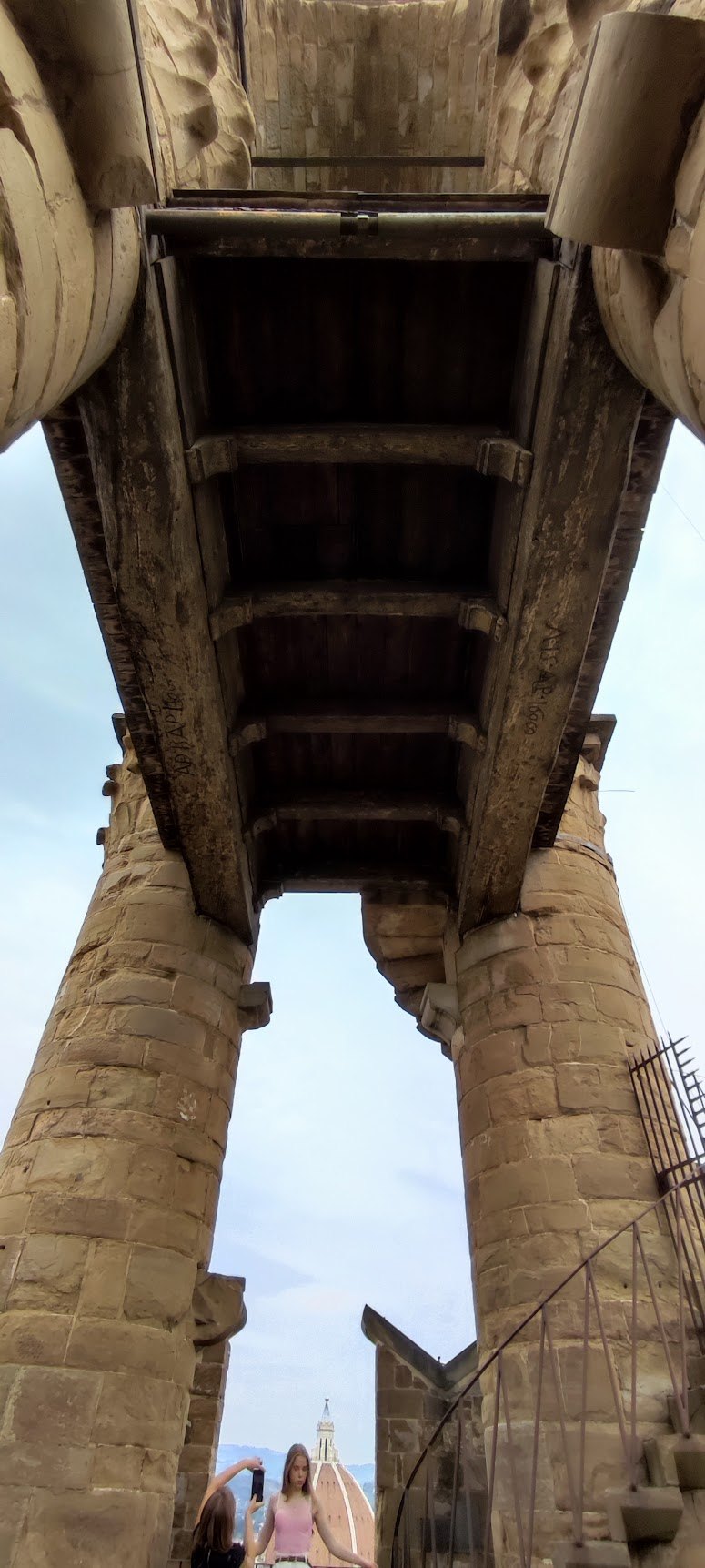
The tower was built in two campaigns. The first part, finished by 1302, is embedded in the palace walls and set on the older foundations. The second part rises in a different way. As the Musei Civici Fiorentini describe it, the upper shaft projects outward on the corbels of the crenellated walkway, in a daring architectural solution driven by the wish to give the facade visual continuity.
Read that again as an engineer would. Florence deliberately moved the upper mass of a 95-meter tower outward, over a bracketed overhang, for aesthetic reasons. This is not a decorative flourish. It is a structural decision taken to correct an optical problem. The beccatelli, the stone corbels supporting the projecting walkway, carry a cantilever loaded by everything above.
Medieval builders did not have the mathematics to calculate this. They had proportion, precedent, and nerve. Seven centuries later, the thing still stands.
The Cursed Ground That Bent the Plan
The second constraint was political, and Florentines have never stopped talking about it.
The Uberti were the leading Ghibelline family of the city. They were driven out in 1266, and their houses were razed. The ground where those houses had stood was treated as tainted, and the new palace of the Priors could not extend onto it. On the other side, the ancient church of San Pietro Scheraggio blocked expansion.
Squeezed between a demolished enemy and a church, the building took the shape it could. Later enlargements toward Via della Ninna gave the palace its trapezoidal plan, with the shortest side facing the piazza.
This is the detail I would give any American visitor who wants to understand Italy rather than photograph it. In Florence, urban form is a court record. The building is irregular because the city punished a family, and the punishment outlived everyone involved.
The Tower as an Instrument of Government
A civic tower in a medieval Italian city is not decoration. It is infrastructure for power, and it works in three ways: it sees, it speaks, and it holds.
The bell that called the city
The bell in the Arnolfo Tower summoned citizens to assemble and warned them of danger. In a city where most people could not read, the bell was the government’s broadcast system. Its pattern told Florentines whether to gather, to arm, or to run.
Florentine tradition records a final chapter worth knowing. After the fall of the republic in 1530, the bell that had rallied the city’s defenders was deliberately broken by Alessandro de’ Medici. Silencing a bell was a political act, and everyone understood it.
The Alberghettino: two prisoners, one cell
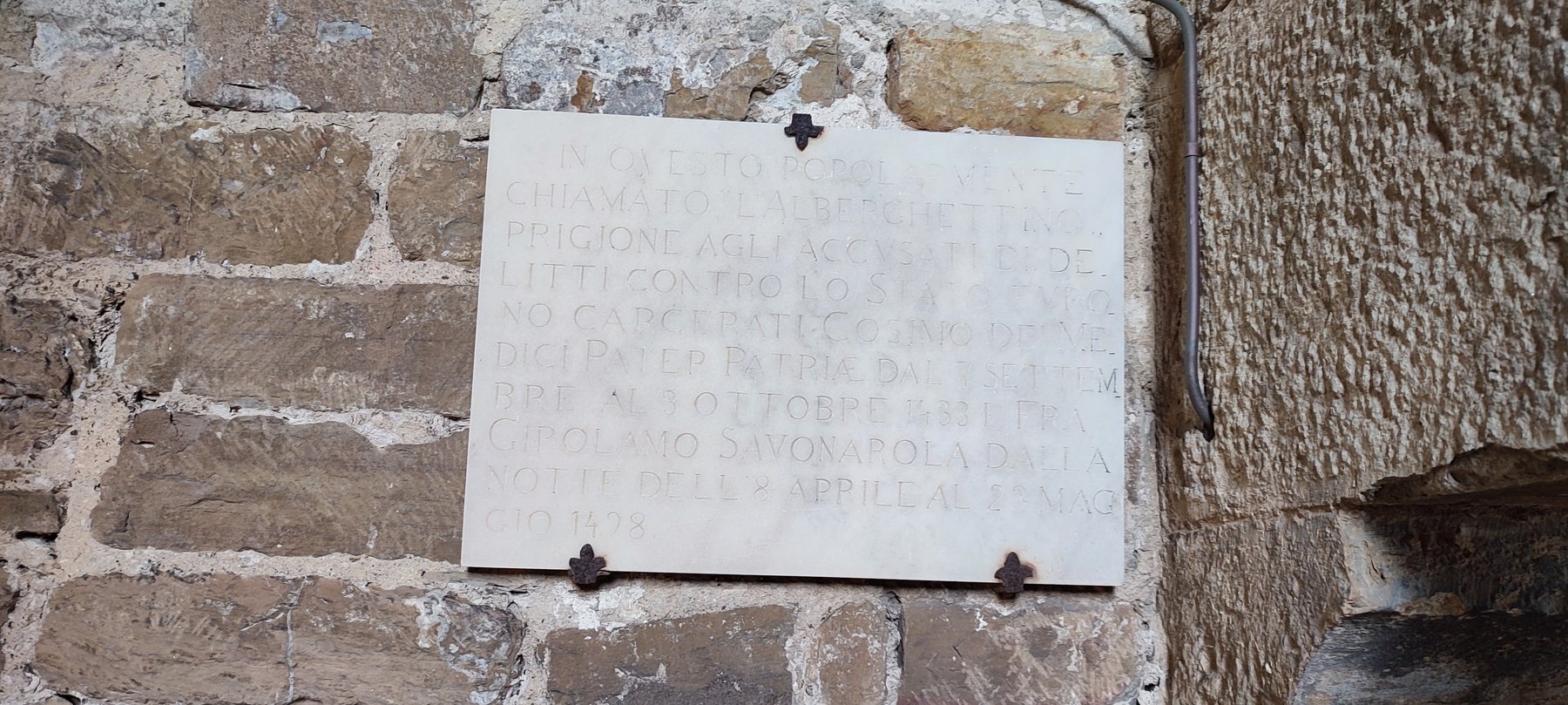
Partway up the stairs, behind a door, opens a small barrel-vaulted cell known as the Alberghettino, the little inn. The name is Florentine sarcasm at its driest.
A marble plaque on the wall records the dates, and I photographed it on the stairs. Cosimo de’ Medici, Pater Patriae, was held from September 7 to October 3, 1433, accused of crimes against the state. He was exiled for a year. He came back, and his family went on to rule Florence for generations. Girolamo Savonarola was locked in the same cell from the night of April 8 to May 23, 1498, and left it to be executed in the piazza below.
Sixty-five years apart. The same room, the same window, two opposite endings. That is the Arnolfo Tower’s real subject.
Reading Florence from the Walkway
The view matters less for what it shows than for what it explains.
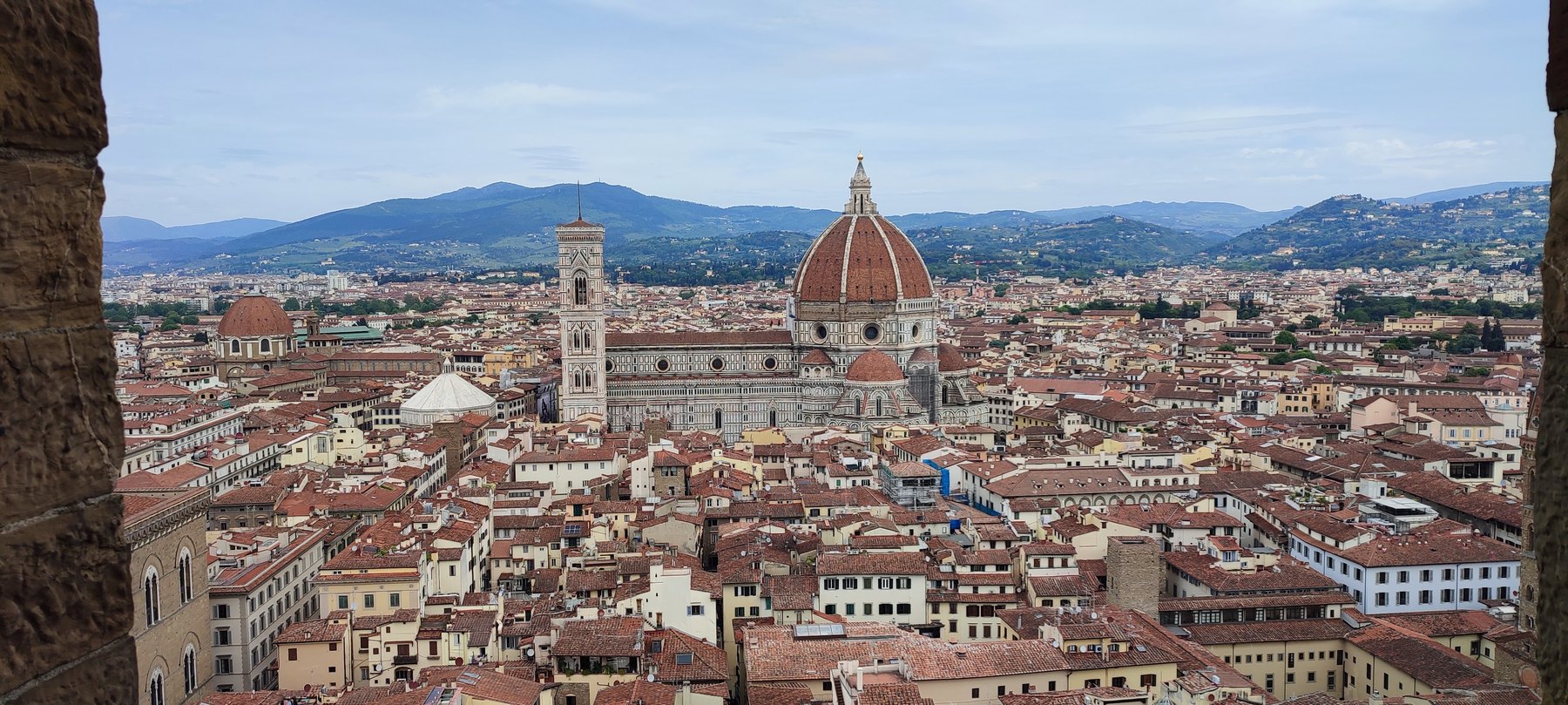
From the crenellated walkway you can finally read the medieval city as a system. The dome of Santa Maria del Fiore reveals proportions that flatten out at street level. The line of the old walls becomes legible in the street pattern. Above all, you see the surviving private tower houses, cut down and absorbed into later buildings, standing lower than the civic tower that overrules them.
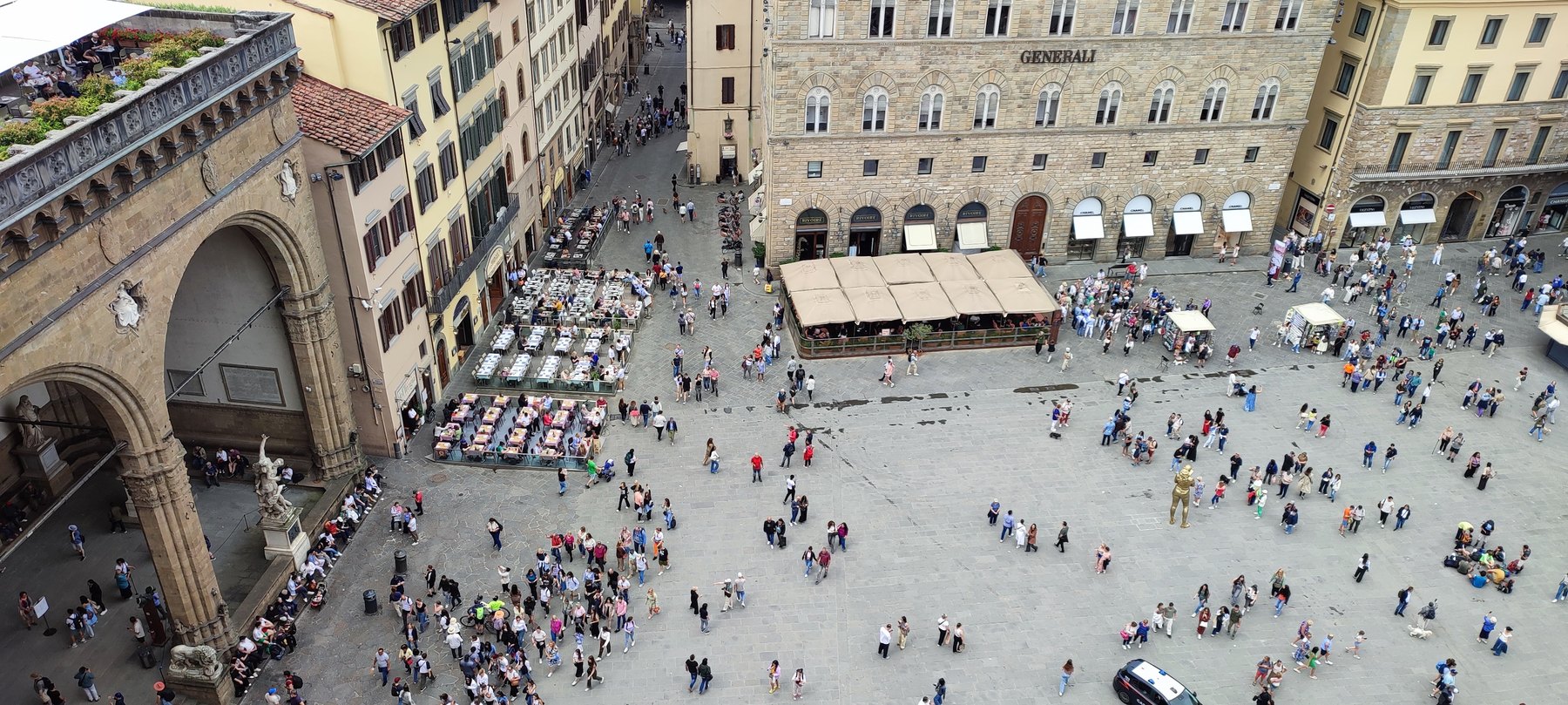
That hierarchy is the whole argument of the fourteenth-century commune, written in stone. Public power above private power. The Arnolfo Tower is the sentence that ends the paragraph.
Why This Tower Became Italy’s Template
The formula spread. A tall civic tower attached to a fortified town hall, facing an open square, became the standard image of self-government across central Italy.
I see the local version of that idea every day. In Macerata, my regional capital in Le Marche, the Torre Civica rises 64 meters over Piazza della Libertà. Work began around 1492 and finished only in 1653. On its base sits a reconstruction of the astronomical clock built by the Ranieri brothers of Reggio Emilia in the sixteenth century, returned to the tower in 2015 with the scientific direction of the Museo Galileo.
Florence set the grammar. Towns like Macerata and Ascoli Piceno wrote their own sentences with it, later and more quietly. If you want to understand what Tuscany exported, look at what the smaller regions did with it. I make that comparison at length in Tuscany versus Le Marche.
Practical Notes for Climbing the Arnolfo Tower
Details verified on the official Musei Civici Fiorentini pages on August 22, 2026. Always confirm before you go, since institutional ceremonies can close the palace at short notice.
- Hours: the tower opens Monday, Tuesday, Wednesday, Friday, Saturday and Sunday from 9 a.m. to 5 p.m., and Thursday from 9 a.m. to 2 p.m. Last tickets are sold one hour before closing.
- Tickets: the Arnolfo Tower ticket costs 20 euros full price and 13 euros reduced. The museum alone costs 18 and 12 euros. Reduced rates apply to visitors aged 18 to 25 and university students.
- The climb: a stone staircase of 223 steps runs inside the tower. The full route to the top totals 418 steps.
- Restrictions: children under six are not admitted. Visitors under 18 must be accompanied by an adult. The route is not accessible to wheelchair or stroller users.
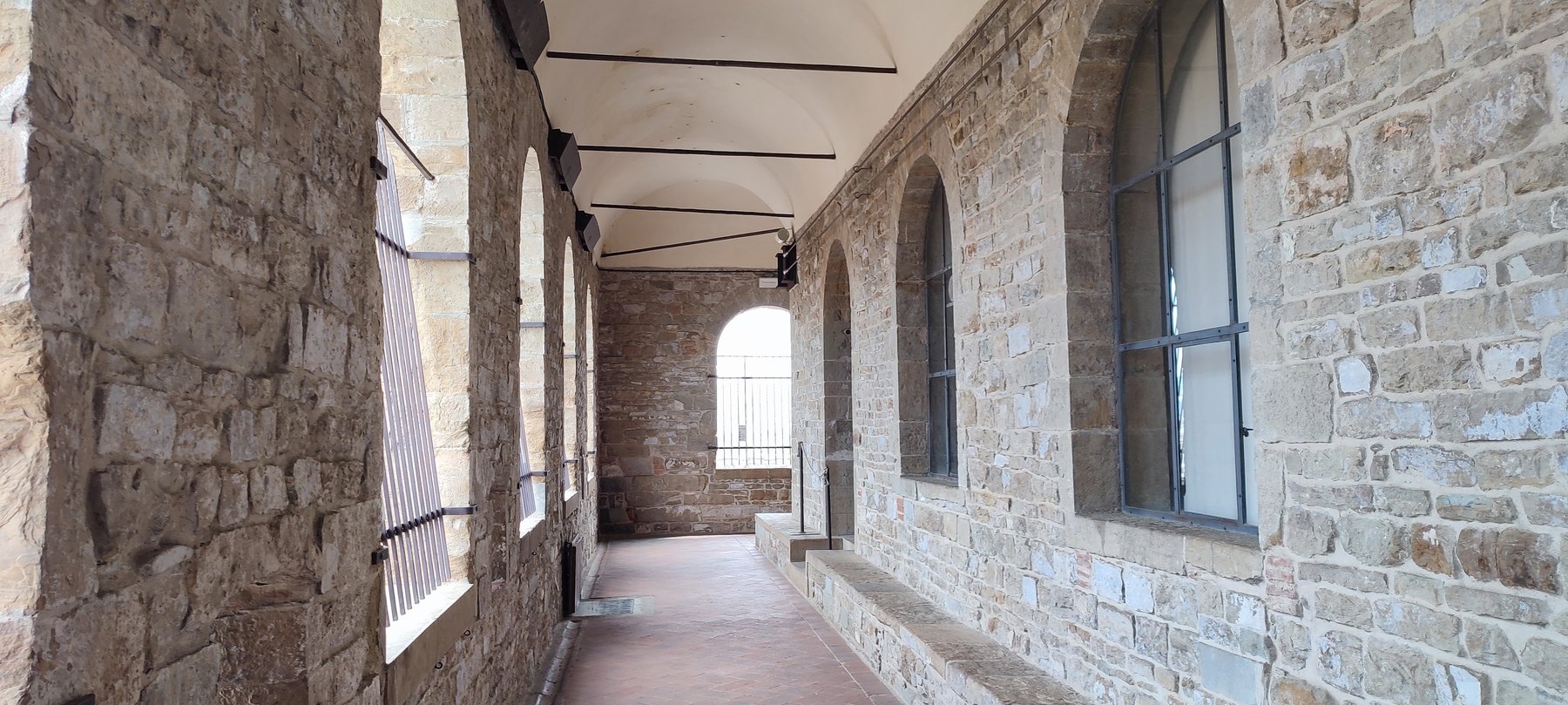
- Rain: the tower closes in rain, and during heat alerts. The medieval walkway stays open.
- Arrive early: the official guidance is to be there 15 minutes before your slot.
Two practical points the ticket page does not spell out. The tower and the museum are separate admissions, and the combined option that pairs the museum audioguide with the tower sends you up the tower first and into the museum an hour later. That is the order I would choose in any case. The tower closes during heat alerts, so the climb belongs to the morning, while the museum is indoors and absorbs the afternoon. The Palazzo Vecchio ticket with audioguide and tower upgrade is built around that sequence. The second point follows from the bullet above: rain cancels the climb outright, so do not put it on your last morning in Florence.
One honest recommendation. If you have time for only one climb in Florence, and you want architecture, choose Giotto’s Bell Tower instead. If you want the political history of the city, climb this one. They are not the same experience, and nobody tells you that at the ticket desk.
Booking Notes: What I Would Actually Reserve
For the tower alone, buy direct. The 20-euro ticket from the city ticket office is the cheapest way up, and nothing sold elsewhere buys you a better slot. I earn nothing on that sentence, which is precisely why I am comfortable writing it. Reserve a time, arrive fifteen minutes early, and spend the difference on lunch.
The one guided visit worth a supplement. The Secret Passages tour run by MUS.E, the association that runs the museum itself, costs 37 dollars against the museum’s own 18-euro admission. It lasts seventy-five minutes, is capped at four people, and takes you through the stairway buried in the thick walls, the studiolo of Francesco I and the Tesoretto. It closes on the timber truss Vasari built to carry the coffered ceiling of the Salone dei Cinquecento, and that truss is the reason it belongs in this article. It is the same argument as the corbels outside: a structural solution adopted for a visual result. The tour rates 4.7 across more than twelve hundred reviews, with free cancellation up to twenty-four hours before. The passages are narrow, and the operator states plainly that the route does not suit visitors with limited mobility.
If you want the palace explained at your own pace. The private guided tour of the museum with the Arnolfo Tower ticket included starts at 204 dollars, runs an hour and a half, and gives you a guide who answers your questions rather than a script; the tower admission comes bundled and is climbed on your own afterward. It rates 4.7, though on a thin base of reviews, so read it as the option for a couple or a family who want a conversation, not as a crowd-tested standard. If your interest is the political history rather than the paintings, this is where the money goes furthest.
What I would skip. The reseller bundles that pair the tower climb with museum entry at around 70 dollars. Run the arithmetic against the figures earlier in this article. Florence charges 20 euros for the tower and 18 for the museum, so a bundle at that price sits close to double the cost of the same two admissions at the source, and it buys no extra access, no guide and no explanation. A 4.2 rating on sixty-odd reviews does not close that gap. If you are going to spend more than the official price, spend it on a guide, not on a markup.
Arnolfo Tower FAQ
What is the Arnolfo Tower?
It is the 95-meter bell tower of Palazzo Vecchio in Florence, part of the palace’s original nucleus built from 1299. It is named after Arnolfo di Cambio, though the attribution is traditional rather than documented.
Why is the tower not centered on the facade?
Because it was raised on the site and foundations of an earlier private tower belonging to the Foraboschi family, known as the Torre della Vacca. The position was inherited from that older structure.
Do I need to book tickets in advance?
Booking is strongly recommended through the official ticket office, bigliettimusei.comune.fi.it. The tower has limited capacity and a separate, more expensive ticket than the museum.
How much does it cost to climb?
As of August 22, 2026, the Arnolfo Tower ticket is 20 euros full price and 13 euros reduced. The Firenzecard, at 85 euros for 72 hours, includes priority access to civic museums.
How long does the climb take?
Plan on 45 to 60 minutes for the tower and the walkway together. Add at least two hours if you also want the museum, which deserves more.
What should I do if it rains?
The tower closes and your climb is cancelled, but the medieval walkway remains open. Book a flexible day rather than your last morning in Florence.
What do most visitors miss?
The walled-up windows on the facade directly under the tower. They mark the older Foraboschi structure absorbed into the palace, and they are the clearest physical evidence that this tower was built around another one.
The Final Word
Florence is usually explained through beauty. The Arnolfo Tower is better explained through constraint. It is off-center because a family lost a war, and tall because a republic wanted to be seen. Every awkward angle in that facade is a decision someone made under pressure.
Look for the seams. They are the most honest thing a building can show you.
If you want more Italian buildings read this way, from the inside and with an engineer’s eye, keep following Tastes & Wonders of Italy.