Pontormo: The Painter Who Bent the Renaissance
Pontormo: The Painter Who Bent the Renaissance
By Mirco Vitellozzi
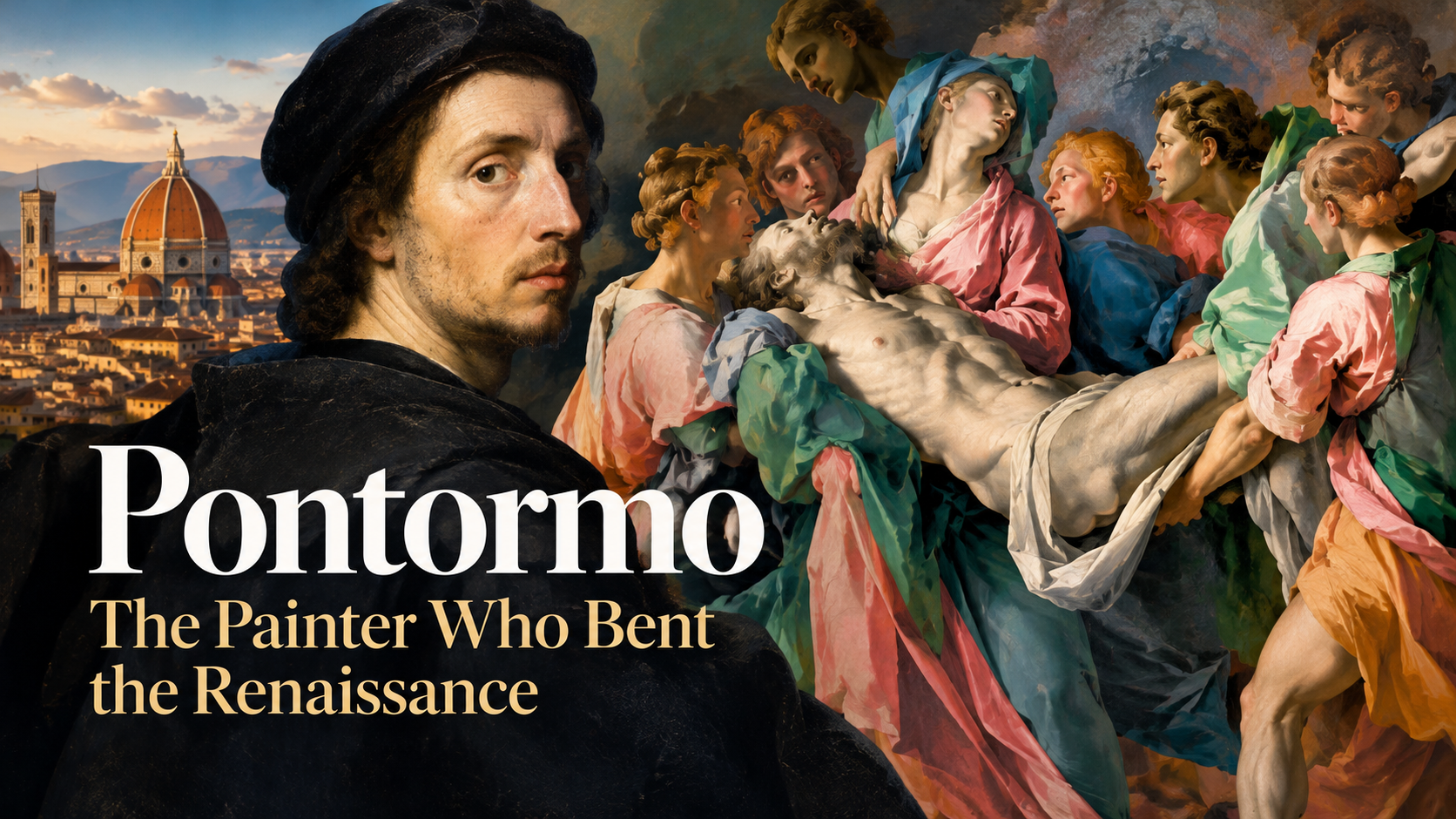
In the Capponi Chapel of the church of Santa Felicità in Florence hangs a painting with no cross, no ladder, no hammer, no tomb. Eleven figures carry a dead Christ between them, and not one of their feet seems to touch the floor. The colors are not the colors a fifteenth-century altarpiece would have used: a rose-pink tunic set against a sea-green mantle, a sky the color of a bruise rather than the blue of a Tuscan midday. This is Jacopo Carucci’s Deposition, painted between 1525 and 1528, and it is the clearest evidence in Italian art of a Renaissance that had stopped agreeing with itself.
Jacopo Carucci, known as Pontormo (1494–1557), was a Florentine painter who broke with the balance of the High Renaissance to create one of the first fully developed styles of Mannerism — elongated bodies, acid color, and compressed, often illogical space. Trained in Andrea del Sarto’s workshop and praised while still young by Michelangelo, Pontormo worked mostly for Florentine churches and the Medici family. His major surviving works remain in and around Florence: the Deposition in Santa Felicità, the Visitation in Carmignano, and the Passion frescoes at the Certosa del Galluzzo.
Two of those paintings are not where they usually hang. Through February 7, 2027, the Deposition and the Visitation are on loan to the Pontormo exhibition at Rome’s Scuderie del Quirinale, the largest solo show built around this painter in seventy years. That exhibition is about the show itself — tickets, rooms, loans. This article is about the man and the paintings, and it will still be useful after the Scuderie packs up the crates and sends everything back to its own wall.
Who Was Pontormo
He was born Jacopo Carucci on May 24, 1494, in the village of Pontorme, just outside Empoli, in the countryside west of Florence. Italian painters of the period were routinely renamed after their hometowns rather than their surnames — it is why nobody remembers Leonardo’s father’s family name either — and Jacopo became il Pontormo, the man from Pontorme, for the rest of his career and every art history textbook since.
His father, Bartolomeo di Jacopo di Martino, was himself a minor painter, reportedly trained in Domenico Ghirlandaio’s workshop, though no securely attributed work of his survives to confirm it. Jacopo lost his parents as a boy and arrived in Florence an orphan, where his early training reads less like an apprenticeship and more like a tour. According to Giorgio Vasari, the painter and biographer who knew him personally, Jacopo studied in quick succession with Leonardo da Vinci, then with Mariotto Albertinelli, then with Piero di Cosimo, before entering Andrea del Sarto’s workshop around 1512, at about eighteen. Four masters in a handful of years is an unusual education, and it shows: Pontormo absorbed Leonardo’s handling of soft light, Piero di Cosimo’s taste for the strange, and del Sarto’s color and monumental calm, then spent the rest of his career departing from all three.
He was precocious enough to be praised by Michelangelo while still a young man, and the relationship deepened later in both their careers. After Michelangelo moved permanently to Rome, he sent Pontormo his own drawings — full-scale preparatory cartoons — with instructions to turn them into finished paintings, including a Noli me tangere around 1531 and a Venus and Cupid not long after. Handing a cartoon to another painter to execute was a mark of real trust in Florentine practice, and Michelangelo extended it to very few people.
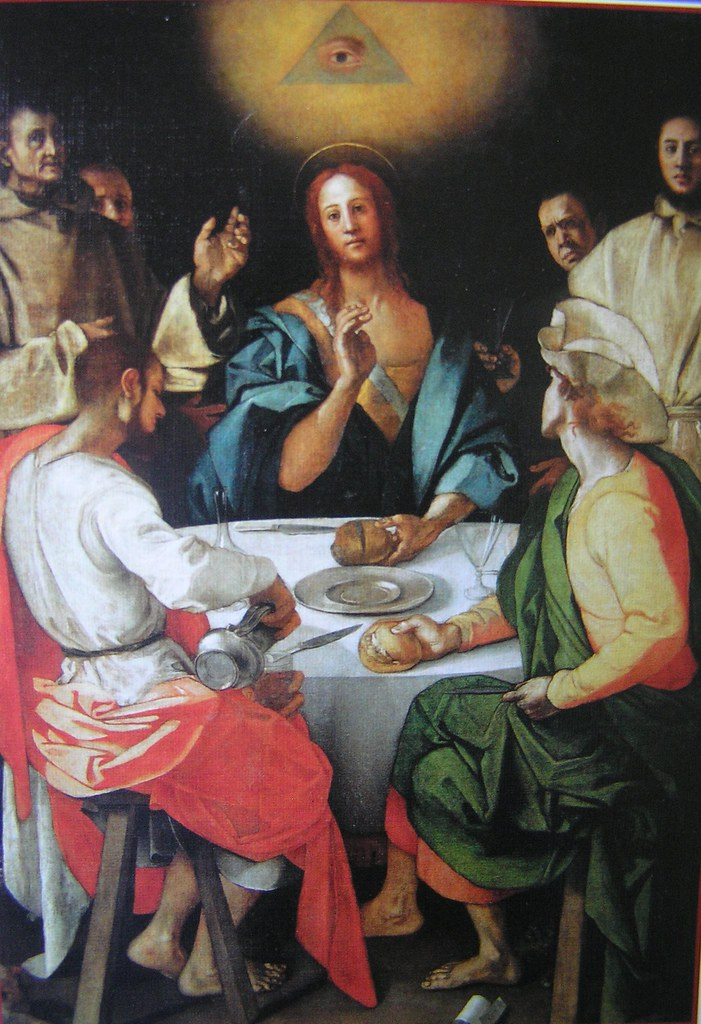
What survives of Pontormo’s own voice is stranger and more intimate: a diary, known as the Libro mio, that he kept during the final two years of his life while working on the choir of San Lorenzo. It records, in roughly equal measure, which figures he painted that day and what he ate, how his joints ached, and how little he wanted to see anyone. The manuscript disappeared after his death and resurfaced only in the early twentieth century, and it is largely responsible for the portrait Vasari had already sketched in words: a man, in Vasari’s phrase, “temperate and polite” but “solitary beyond belief.” That account, written by a younger rival who had no great love for Pontormo’s late style, shaped how the painter was read for four centuries. The research behind the current Rome exhibition argues for a different man underneath the diary’s obsessions: a professional constantly in demand from Florence’s most important patrons, who simply preferred working alone and trusted very few people with his process — which, given what Michelangelo trusted him with, seems to have been the right instinct.
Mannerism, Explained Without the Jargon
Italian art historians use the word maniera — style, or manner — for what Pontormo and his generation did next, and the English term Mannerism comes directly from it. It describes painters who trained inside the High Renaissance and then chose to push past its central achievement: a figure that stands convincingly in real, legible space, lit by a single logical source, weighted by actual gravity.
Raphael, born in Urbino, in the Marche, is the clearest measure of what Mannerism reacted against — figures arranged like a stable pyramid, light that falls the way light actually falls, space you could walk into. Pontormo’s figures do something close to the opposite. In the Deposition, bodies lean and twist against each other with no ground to push off from; color does the work that architecture and perspective used to do. Michelangelo’s own late work pointed the same direction, and his direct collaboration with Pontormo — handing him cartoons to paint — makes the link between the two painters literal rather than merely stylistic.
This style did not emerge from a settled city. The Medici were expelled from Florence in 1527, the same year mutinous imperial troops sacked Rome itself; a restored Florentine republic held out through a siege in 1529–30 before the Medici returned for good, first under Alessandro and then under Cosimo I. A painter working through that decade had reason to distrust balance.
Pontormo was not alone in the break. Rosso Fiorentino, a near-exact contemporary who trained in the same Florentine circle, pushed an even more extreme version of the same ideas before leaving Italy for France, where he helped found the School of Fontainebleau. Agnolo Bronzino, Pontormo’s pupil and something close to an adopted son, inherited his position as Florence’s leading portraitist and went on to become court painter to Cosimo I — a title Pontormo, despite decades of Medici commissions, never held. The style eventually traveled well beyond Florence: the ceiling Pellegrino Tibaldi painted for Palazzo Ferretti, now Ancona’s archaeological museum, is Mannerism arriving on the Adriatic coast within a generation of Pontormo’s death.
The Paintings That Define Him
The Deposition, Santa Felicità (1525–1528)
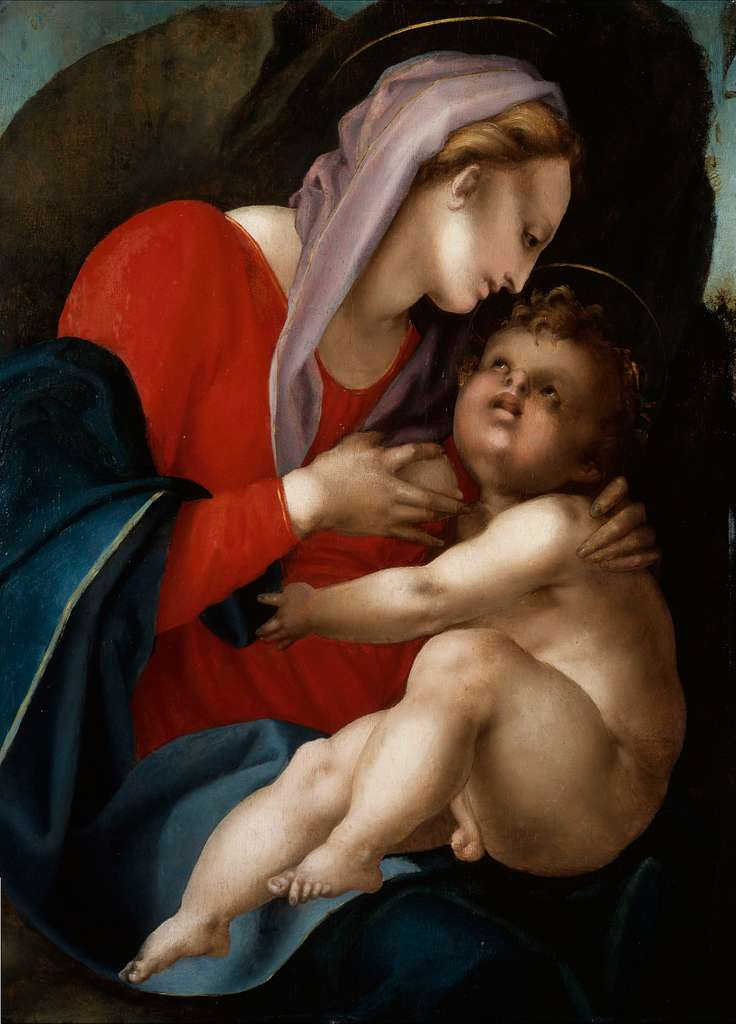
The Capponi Chapel sits just inside the church’s door nearest the Ponte Vecchio, in a space designed decades earlier by Brunelleschi. Pontormo filled it with a composition built almost entirely from color and the collision of bodies — no cross, no instruments of the Passion, no landscape to place the scene in any particular city or hour.
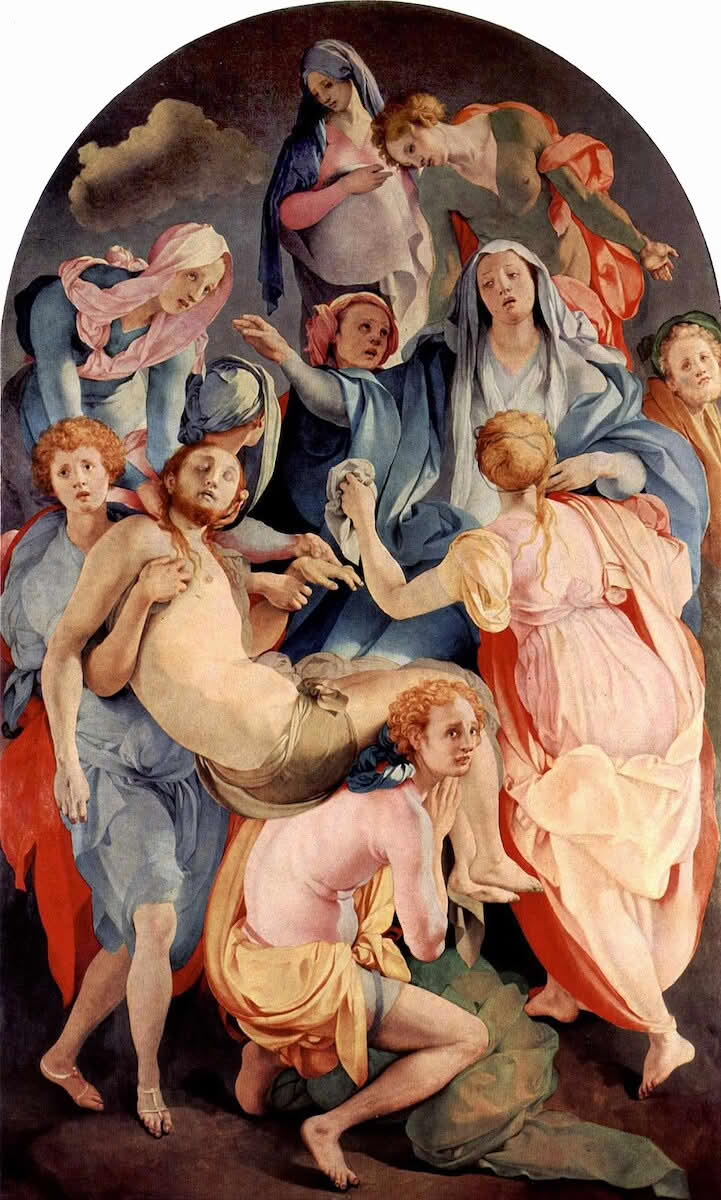
A technical note, since I spend my working life assessing how buildings and materials respond to their environment: this is a painting on a wood panel, and wood panels are sensitive to the swings in humidity and temperature that any centuries-old masonry building produces. That sensitivity is one real reason a piece this size and this age travels only rarely — the current loan to Rome is a genuine event, not a routine one. In the chapel itself, the light is dim by design, and the coin-operated light box familiar to anyone who has visited an Italian parish church buys you roughly a minute of illumination at a time. Keep coins ready, and expect to feed it more than once.
The Visitation, Carmignano (c. 1528–1529)
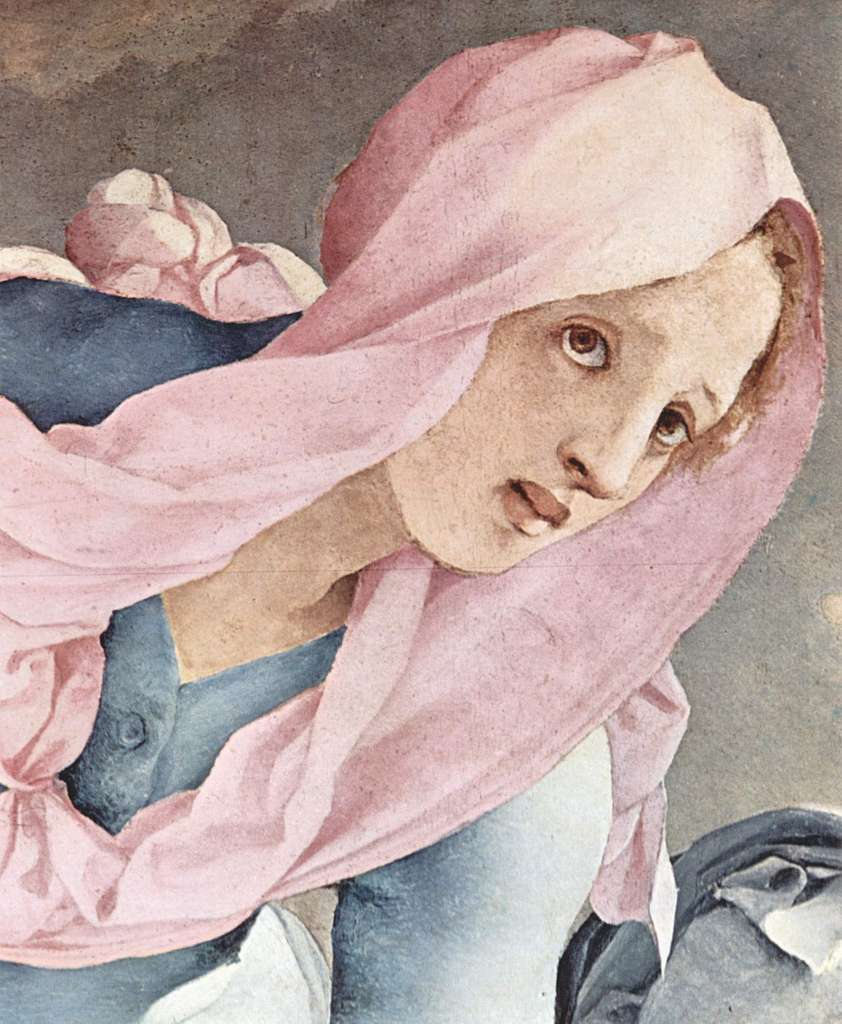
This panel hangs in the Pieve di San Michele — pieve is the old Italian term for a mother-church serving a rural district, predating the parish system that eventually replaced it — in Carmignano, a hill town between Florence and Pistoia. Four women meet in a street that belongs to no identifiable city: two embrace in the foreground, two more look on from behind, their robes shifting through rose, orange, and sea-green as though lit from within the cloth itself.
The picture was unknown to Vasari, absent from his otherwise thorough catalog of Pontormo’s output, and was identified as his work only within the past century. It is on loan to Rome alongside the Deposition through February 7, 2027\.
Vertumnus and Pomona, Poggio a Caiano (1520–1521)
This lunette fresco fills one end of the grand salone in the Medici villa at Poggio a Caiano, part of a decorative program begun jointly with Andrea del Sarto and Franciabigio that was never fully completed. Vasari identifies the subject as the Roman myth of the orchard god Vertumnus courting the nymph Pomona, though some modern scholars dispute that reading. Whatever the subject, the villa is now part of the UNESCO-listed Medici Villas and Gardens, and the room still functions as a working demonstration of how the Medici used mythology as interior decoration.
The Passion Cycle, Certosa del Galluzzo (1523–1525)
Pontormo retreated to this working Carthusian monastery south of Florence during the plague outbreak of 1522 and spent roughly three years frescoing scenes from Christ’s Passion in the monastery’s great cloister. The German influence is visible at a glance: Albrecht Dürer’s engravings were circulating through Florentine workshops at the time, and Pontormo grafted their angularity onto a Tuscan hand.
The frescoes were later detached from the cloister walls to protect them from weather and now hang, in reduced condition, in the monastery’s guest quarters. Detaching a fresco means physically cutting the painted plaster layer away from the wall behind it — standard conservation practice for centuries, and one that inevitably strips away some of a mural’s original surface. What survives at the Certosa is a fainter record of a stronger original, which is worth knowing before you go.
The Lost Choir of San Lorenzo (1545/46–1556)
Duke Cosimo I de’ Medici gave Pontormo his last major commission: frescoing the choir of San Lorenzo, the Medici family’s own parish church, with scenes running from Genesis to the Last Judgment. Pontormo spent the final eleven years of his life on it, working largely alone, and died with the project unfinished; Bronzino completed it.
The frescoes stood for under two centuries before they were torn down during an eighteenth-century remodeling of the choir, ordered in the late 1730s. Nothing of the paintings survives except roughly four hundred of Pontormo’s preparatory drawings, most now held by the Uffizi’s print and drawing collection — the single largest body of evidence for how he actually thought, even though the finished paintings are gone entirely.
The Portraits: Cosimo il Vecchio and the Halberdier
Pontormo’s posthumous Portrait of Cosimo the Elder (c. 1519, Uffizi) commemorates the founder of Medici power in profile — a political statement as much as a likeness, painted decades after its subject’s death. His Portrait of a Halberdier (c. 1529–1530), a soldier in half-armor painted during the siege of Florence, is the one major Pontormo panel most Americans can see without crossing the Atlantic to Italy at all.
Pontormo in America
That Halberdier is in the J. Paul Getty Museum in Los Angeles — the single confirmed major Pontormo panel in a United States public collection, and one of the Getty’s signature Renaissance portraits. The sitter’s identity has long been debated, with one proposed candidate a young defender of the besieged Florentine republic, though the attribution is treated as unsettled. Beyond this one painting, no other autograph Pontormo panel is currently confirmed in a US public collection; readers planning a museum visit around him should check directly with institutions like the Metropolitan Museum of Art or the National Gallery of Art in Washington before assuming a drawing or workshop piece amounts to the real thing.
That may change. Reporting from Artribune around the opening of the Rome exhibition quotes the Uffizi’s director, Simone Verde, announcing two further Pontormo projects in preparation — one with the National Gallery in London, one with the National Gallery of Art in Washington. No dates were public when the Rome show opened in October 2026, but it means American audiences may not need a transatlantic flight to see more of him within the next few years.
Where to See Pontormo in Italy
A reasonable day, or day and a half, runs Florence outward. Inside the city: the Uffizi for the Cosimo il Vecchio portrait and early panel work; Santa Felicità for the Deposition, loan permitting; Casa Buonarroti and the nearby Bargello for the Michelangelo connection that runs straight through Pontormo’s career; the Galleria dell’Accademia for the Venus and Cupid painted from Michelangelo’s cartoon.
Then three short trips outside the walls, in order: the Certosa del Galluzzo, about fifteen minutes south of the city center, for the Passion frescoes; Poggio a Caiano, roughly twenty-five minutes further, for Vertumnus and Pomona; and Carmignano, another ten minutes on from there, for the Visitation. None of these three keeps museum hours. The Certosa is a working monastery and the Pieve di San Michele a functioning parish church, both with the reduced, sometimes seasonal opening windows typical of buildings that exist to serve a congregation first and visitors second — confirm hours before you drive out, not after.
One firm date to build around: through February 7, 2027, the Deposition and the Visitation are both away from their usual homes, on loan to the Pontormo exhibition in Rome. See them there, or wait until after the show closes and plan the Florence-area route above once both paintings are back on their own walls.
Frequently Asked Questions
Was Pontormo a Renaissance painter or a Mannerist? Both, depending on when you look. He trained inside the High Renaissance, in Andrea del Sarto’s workshop, and his earliest surviving work follows its balance closely. By his mid-twenties he had broken from it, and art historians now count him among the first generation of Mannerist painters.
Where is the Pontormo Deposition? In the Capponi Chapel of the church of Santa Felicità in Florence, a short walk from the Ponte Vecchio. Through February 7, 2027, it is on loan to the Pontormo exhibition at Rome’s Scuderie del Quirinale.
Why is he called Pontormo instead of Carucci? He was born Jacopo Carucci and took his more familiar name from Pontorme, the village near Empoli where he was born — a common naming practice among Italian Renaissance artists, Leonardo da Vinci among them.
Can I see a Pontormo painting in the United States? Yes. The Portrait of a Halberdier, one of his finest portraits, is in the J. Paul Getty Museum in Los Angeles. No other confirmed autograph panel by him is currently held in a US public collection.
Who was Bronzino to Pontormo? Agnolo Bronzino trained under Pontormo and lived for years in his household as something close to an adopted son. He completed Pontormo’s unfinished San Lorenzo frescoes after his master’s death and went on to become court painter to Cosimo I de’ Medici — the title Pontormo never held.
What does Mannerism actually mean? The word comes from the Italian maniera, meaning style or manner. Art historians use it for the generation of painters, Pontormo chief among them, who followed the High Renaissance and chose elegance, tension, and invention over its balance and naturalism.
Is the Rome exhibition worth combining with a Florence trip built around this guide? If your travel dates fall before February 7, 2027, yes. It is the largest Pontormo show in seventy years, and it brings together loans — including the Deposition and the Visitation — that are unlikely to travel together again soon. Full planning details are in our guide to the exhibition.
The Takeaway
Pontormo’s paintings don’t explain the Italian Renaissance so much as argue with it from the inside — trained in its workshops, fluent in its technique, and unwilling to leave its balance unchallenged. That argument is still legible four centuries later, in a chapel off the Ponte Vecchio and in a parish church outside Carmignano, for anyone willing to feed the light box a few coins and go looking.
If you are building a trip around central Italian art and want an itinerary that goes past the standard Florence circuit — Pontormo’s Florence paired with Raphael’s Urbino, or the Renaissance read through an engineer’s eye on seismic reconstruction and seven centuries of building technique — I offer online consultations for exactly this kind of planning.