What Extra Virgin Olive Oil Means: The Lab Report Behind the Label
What extra virgin olive oil means comes down to a lab report, not a label. Still, the label is where you meet it. Eleven bottles sit in a US grocery aisle. Nine say extra virgin. Prices run from six dollars to forty. The fronts show stone mills, old trees, low gold light. Turning those eleven bottles into one purchase is a separate problem, and it has its own rules: how to buy real Italian olive oil when you are not in Italy.
I spend my working days reading test certificates. Concrete, steel, insulation, flue gas. A certificate is a dull page: a column of values, a column of limits, a stamp. Olive oil has one of those pages too. Almost nobody ever sees it.
In the European Union, “extra virgin olive oil” is a legal grade, not a sales word. A bottle may carry it only if lab results and a trained taste panel meet eight limits in Annex I of Commission Delegated Regulation (EU) 2022/2104. Free acidity must stay at or below 0.80%. The peroxide value must stay at or below 20.0 mEq O2/kg. The panel must find zero defect and some fruitiness. One failed limit, and the oil drops a grade. That is what extra virgin olive oil means in law.
What Extra Virgin Olive Oil Means in European Law
The grade sits inside a chain of three rules. Regulation (EU) No 1308/2013, Annex VII, Part VIII, sets the sales names. Delegated Regulation (EU) 2022/2104 sets the numbers behind each name. Implementing Regulation (EU) 2022/2105 sets how you measure them. The 2022 pair replaced a rulebook that had run since 1991.
Two points matter most for an American reader. First, the grade is a floor, not a ranking. Second, it is binary. There is no “almost extra virgin.” A single value outside its limit pushes the oil down a category, and the law says so right under the table.
For the human side of this product rather than the legal side, I have written about how olive oil works inside an Italian household. This piece stays with the paperwork.
The Eight Numbers on the Certificate
Eight numbers decide what extra virgin olive oil means on paper. Here they are, as they stand in the consolidated text of Regulation (EU) 2022/2104. The plain-language column is mine; the official table has none.
| Parameter | Limit | What it tells you |
|---|---|---|
| Free acidity (as oleic acid) | ≤ 0.80% | How far the fat has broken apart. Bruised, late or sick fruit pushes it up |
| Peroxide value | ≤ 20.0 mEq O2/kg | First-stage oxidation. How much oxygen has reached the oil |
| K232 | ≤ 2.50 | Early oxidation products, read under UV light |
| K268 or K270 | ≤ 0.22 | Later oxidation products, and traces of refined oil |
| ΔK | ≤ 0.01 | The shape of the UV curve. A classic flag for blending |
| Fatty acid ethyl esters | ≤ 35 mg/kg | Fermented or badly stored fruit, and soft deodorizing |
| Median of defect (Md) | = 0.0 | What a taste panel found as a fault |
| Median of fruitiness (Mf) | > 0.0 | Whether the panel found any fruit at all |
Six come from a bench. Two come from a room with trained noses in it. That split carries the rest of this piece.
Free Acidity: The Number Everyone Reads Wrong
Free acidity is the figure that escaped into marketing. Bottles brag about 0.2%. Shoppers read it as a flavor score.
It is not one. Free acidity has no taste. The method behind it, set by the International Olive Council, titrates free fatty acids in the cold.
So what does the number tell you? It tells you how far the fat came apart before anyone made the oil. Bruised olives, fruit left in sacks, fly damage, a slow mill in a warm November: all of this drives it up. So free acidity is a record of handling, not of pleasure. It is one eighth of what extra virgin olive oil means, and the least sensory eighth. A low figure means healthy fruit, milled fast. It says nothing about tonight’s flavor. What happens in the grove is a separate story, and I have told it from inside a working frantoio.
Peroxides and UV: How an Oil Grows Old
The next three numbers track oxidation. They are the clock.
The peroxide value catches the first stage. Oxygen reaches the fat and forms peroxides, which have no smell yet. Then those peroxides break down into the compounds you do smell: the stale, waxy note of old oil.
The UV readings catch that second stage. K232 rises early. K268 or K270 rises later. ΔK is subtler: it reads the shape of the curve, and an odd shape points to refined oil in the blend.
So the law forces every bottle to carry storage instructions, away from light and heat. The clock runs, and it runs faster in clear glass on a bright shelf.
Ethyl Esters: The Parameter Built Against Fraud
Fatty acid ethyl esters are the newest number in the set, and the most political.
They form when olives ferment. Fruit sits too long, yeasts get to work, alcohol appears, and it binds to free fatty acids. The result is an ester that no cleaning step removes.
That matters, because fraud here is rarely a bucket of soybean oil. It is subtler. You take a dull, faulty oil and deodorize it gently, below the temperature that leaves the classic refining signature. The nose is clean. A panel may miss it. But the ethyl esters stay in the bottle and testify.
So the 35 mg/kg limit works as a lie detector. Somebody built it for one purpose: to catch the oil that passed a taste test it should have failed. Without it, what extra virgin olive oil means would rest on human noses alone.
The Panel Test, and Why Md = 0.0 Does Not Mean “Good”
Now the part that surprises almost every American reader. Taste is not an opinion here. It is a measured parameter.
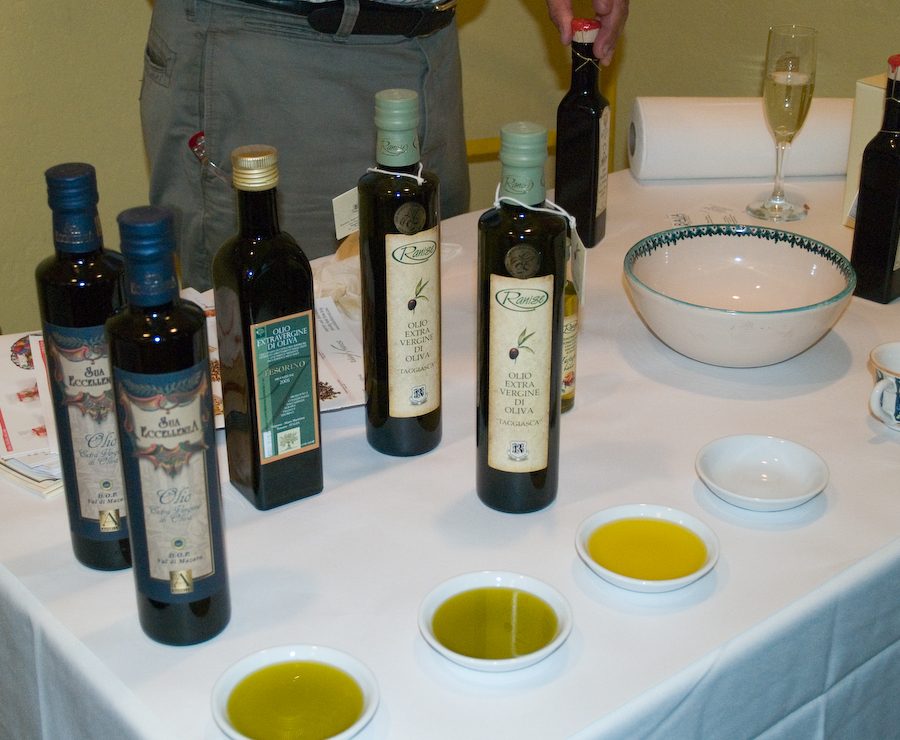
Regulation (EU) 2022/2105 requires member states to approve tasting panels. The panel leader must hold recognized training, and approval comes up for review every year. Two medians go in the report: Md, the median of the defect perceived most strongly, and Mf, the median of fruitiness.
Here is the sentence I would print on every bottle:
Md = 0.0 means that an approved panel of tasters found no defect. It does not mean the oil is good.
Read it twice. Zero marks the absence of a fault, not the presence of a virtue. The law then asks one further thing: fruitiness above zero. Above zero. A thin, barely-there fruitiness clears that bar exactly as a dense green one does. Everything you care about sits higher up: bitterness, pungency, the pepper that catches your throat, the smell of cut grass. None of it shows in the grade.
So the system defends you against bad oil. It does not find you good oil. That is what extra virgin olive oil means at the level of taste, and nobody ever promised more.
There is a formal appeal too. A rejected operator can demand two counter-assessments by other approved panels, and pays for them if both confirm.
The Purity Check Between 0.5 and 0.8
Beyond quality, the same Annex I holds a second table: purity. This is the chemical fingerprint that says the liquid really is olive oil. Sterols, waxes, fatty acids, stigmastadienes. One of those sterols is Δ-7-stigmastenol, normally at or below 0.5% of total sterols. Here nature complicates the paperwork. Some real olive varieties, grown honestly and milled properly, fall just outside that box.
So the law added a side door. Regulation (EU) 2024/1401 replaced the purity table in June 2024 and brought the European Union in line with the International Olive Council. Under the current text, an extra virgin or virgin olive oil showing 0.5 < Δ-7-stigmastenol % ≤ 0.8 still counts as authentic, provided the apparent β-sitosterol/campesterol ratio is ≥ 28, ΔECN42 is ≤ |0.10|, and every other parameter stays inside its limit.
This is the least glamorous paragraph here, and the one I find most honest. One number alone cannot catch fraud without also catching some real oil. So the rule asks for two more before it convicts.
The Only Health Claim Europe Allows
Olive oil carries a mountain of health talk. European law authorizes exactly one claim, and it is narrow.
Commission Regulation (EU) No 432/2012 permits this statement: olive oil polyphenols contribute to the protection of blood lipids from oxidative stress. The conditions are strict. The oil must hold at least 5 mg of hydroxytyrosol and its derivatives, meaning the oleuropein complex and tyrosol, per 20 g of olive oil. That works out to roughly 250 mg/kg. And the label must tell the consumer that the effect comes from a daily intake of 20 g.
So why do you almost never see this claim on a bottle?
Because the regulation named a threshold but never named an official method to measure it. Worse, olive oil holds more than thirty phenolic compounds, and specialists still disagree on which ones belong in the sum. Peer-reviewed work has flagged that gap for a decade. So most producers stay quiet rather than defend a claim in a dispute.
A rule without a method is not really a rule. It is an intention.
Treat all of this as a regulatory fact, not as medical advice. For the dietary frame, start with what the Mediterranean diet actually is, then look at the longevity data from Le Marche and at Montegiorgio, an original Seven Countries Study site. Those pieces hold the evidence. This one holds the paperwork.
Why the American Shelf Works Differently
Now the comparison that matters at the register, because what extra virgin olive oil means on a US shelf is not quite what it means in Europe. The American benchmark is the United States Standards for Grades of Olive Oil and Olive-Pomace Oil, issued by USDA’s Agricultural Marketing Service in 2010 and aligned with International Olive Council criteria. Its thresholds look familiar: free fatty acids at or below 0.8%, zero defects, fruitiness above zero.
The legal status differs, though. Use of the USDA grade standards is voluntary. The Federal Register notice that issued them says exactly that. A producer may seek USDA grading and use the designation “U.S. Extra Virgin Olive Oil.” A producer may also skip the program and still print “extra virgin” on the front, where general rules against misbranding catch the claim only afterwards.
Europe runs the other way around. The grade lives in law, the methods are prescribed, member states approve the panels, and each one must run at least one conformity check per year per thousand tonnes of olive oil marketed on its territory.
Neither system is magic, and enforcement everywhere depends on budgets. Still, the difference is real. In Europe the words point at a defined test. In the United States they may point at a program the bottler chose to skip.
What the Label Cannot Tell You
A compliant European label gives you the legal name, the category sentence, the place of origin, the storage conditions and the best-before date. For extra virgin olive oil the origin is mandatory, and it must sit next to the legal name in the main field of vision.
Plenty is missing, though.
The label will not give you the harvest month. That line is optional, and allowed only when 100% of the contents come from a single harvest. So treat it as a strong signal when it appears.
It will not give you the polyphenol count, the cultivar, or the real blending history.
Above all, it will not tell you what the oil is like now. The certificate describes a lot at the moment of testing. Then come a truck, a warehouse, a shelf, a window, your kitchen counter. Most of the decline in a good bottle happens after the paperwork ends.
So what extra virgin olive oil means is a guarantee about a past moment and a legal minimum. It is not a promise about tonight’s dinner. For the part nobody certifies, see my guide to buying oil in Italy.
FAQ
What does extra virgin olive oil mean in the European Union? It is a legal grade. The oil must come from olives by mechanical means only, meet eight limits in Annex I of Regulation (EU) 2022/2104, and pass a taste panel with zero defect and fruitiness above zero. One failed limit removes the grade.
Does low acidity mean better-tasting oil? No. Free acidity has no taste at all. It records how well somebody handled the fruit before milling, so a low figure points to healthy, fast-milled olives. A panel judges flavor separately, and the law only asks for fruitiness above zero.
What does Md = 0.0 mean on a lab report? It means an approved panel found no sensory defect in the sample. That is all. It marks the absence of a fault, not a mark of quality. Two oils can both score Md = 0.0 while one is thin and the other peppery.
Does extra virgin olive oil mean the same thing in the United States? Not quite. The USDA grade standards from 2010 mirror the international criteria, but their use stays voluntary. A bottler can print “extra virgin” without entering the program. In Europe the grade lives in law, with mandatory checks behind it.
Why do almost no bottles advertise polyphenols? Because Regulation (EU) No 432/2012 set a threshold of 5 mg of hydroxytyrosol and derivatives per 20 g of oil, yet named no official method to measure it. Experts still disagree on which phenols to count, so most producers stay silent.
Can a bottle legally labeled extra virgin still disappoint me? Yes, easily. The grade is a floor. It filters out defective oil, not mediocre oil. It also describes the lot at test time, and oil keeps aging in the bottle, faster in light and heat.
What should I look for on the label instead? Look for a harvest date, a stated place of origin, and dark glass or tin. The harvest line is optional, so its presence tells you the bottler had nothing to hide about age. Then trust your own throat.
What to Do With This
You now know more about this label than most of the people selling it.
Three habits follow. Check for a harvest date, the most useful voluntary line on the bottle. Ignore the acidity figure as a flavor guide, since it is a handling record. Then trust your own senses once the bottle is open.
That is what extra virgin olive oil means in the end: a floor, written in numbers, that keeps the worst oil in the room away from you. Finding the best one is still your job, and it always was.