Kandinsky in Rome: Seventy Works, and the Italian Winter That Changed Him
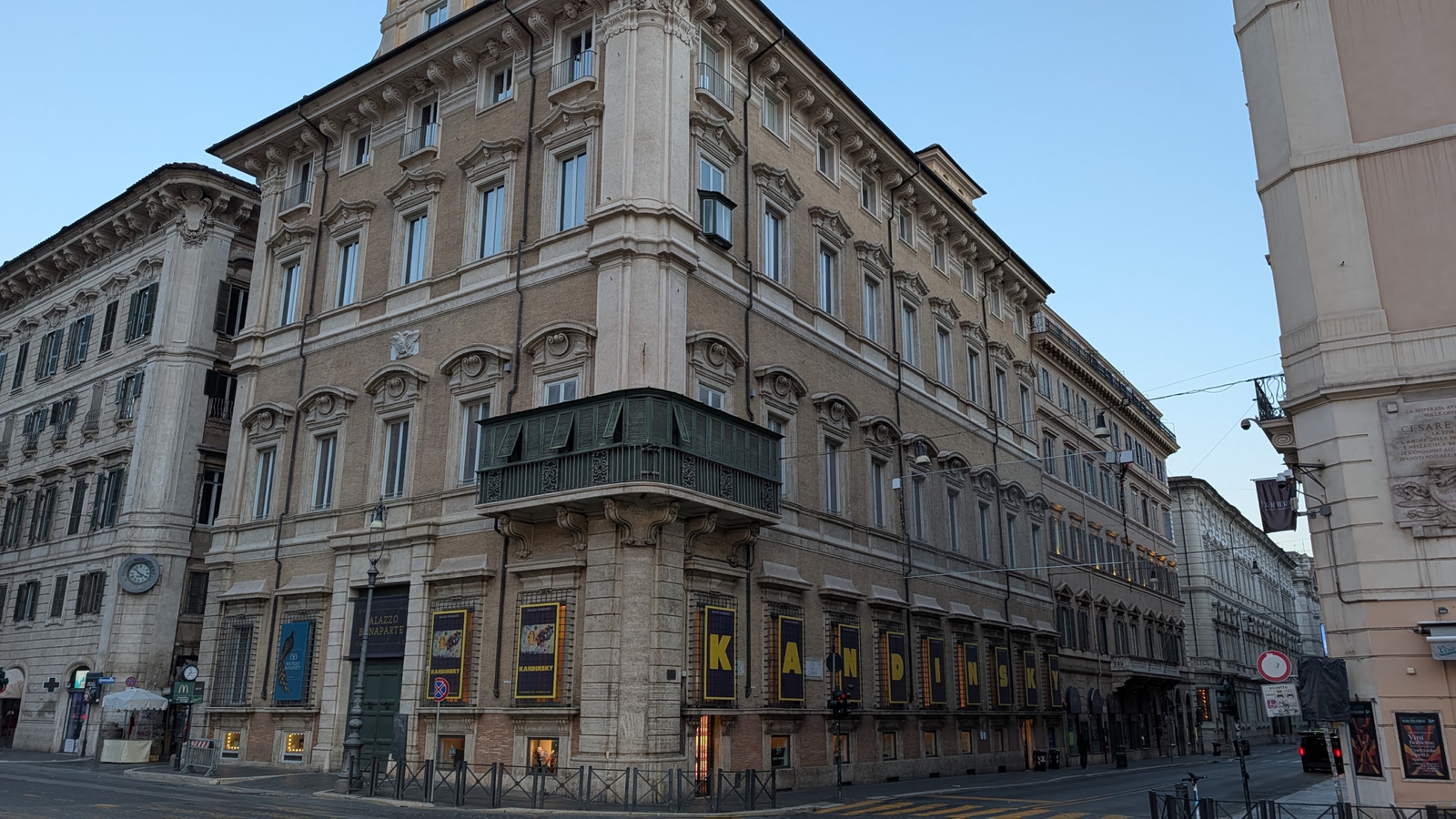
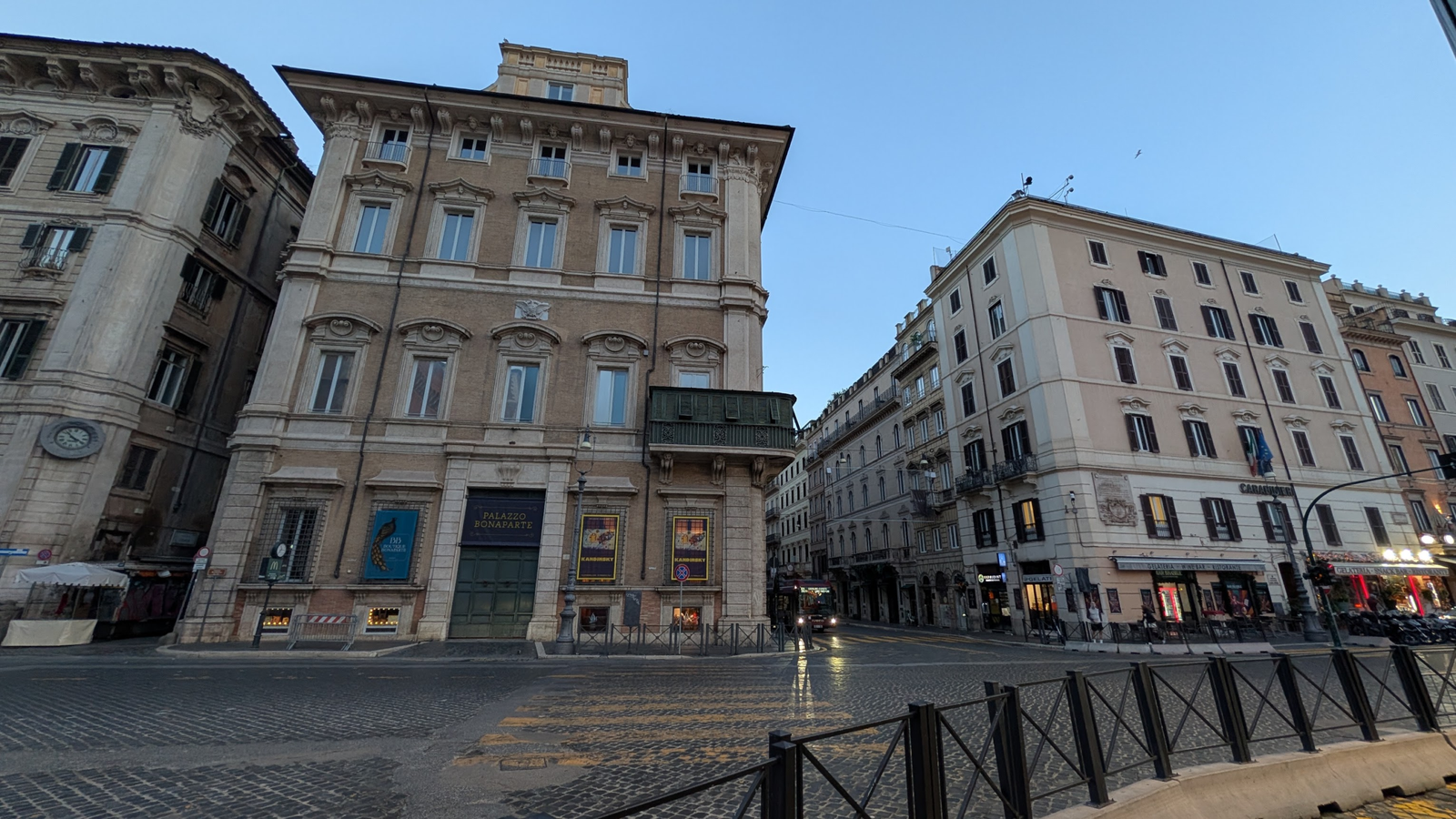
The Kandinsky exhibition in Rome opens two floors above a small green balcony. It is sealed like a lantern on the corner of Piazza Venezia. Maria Letizia Ramolino, Napoleon’s mother, had it built so she could watch the carriages pass without being watched herself. When she went blind in old age, a companion sat beside her and described the square: what moved, what stood still, which way the light fell. Up in the galleries of Palazzo Bonaparte, seventy works by a Russian lawyer turned painter make the opposite argument. Color needs no object to carry it. No carriage, no crowd, nothing to be color about. Letizia never saw it that way. Kandinsky spent four decades proving it could be true.
A note on links: some of the booking links in this article are affiliate links, and if you book through them I earn a small commission at no extra cost to you. Tickets to the Kandinsky exhibition itself are not among them. Palazzo Bonaparte sells those directly, and I have no commercial relationship with the organizers.
What’s On at Palazzo Bonaparte, and How Long You Have
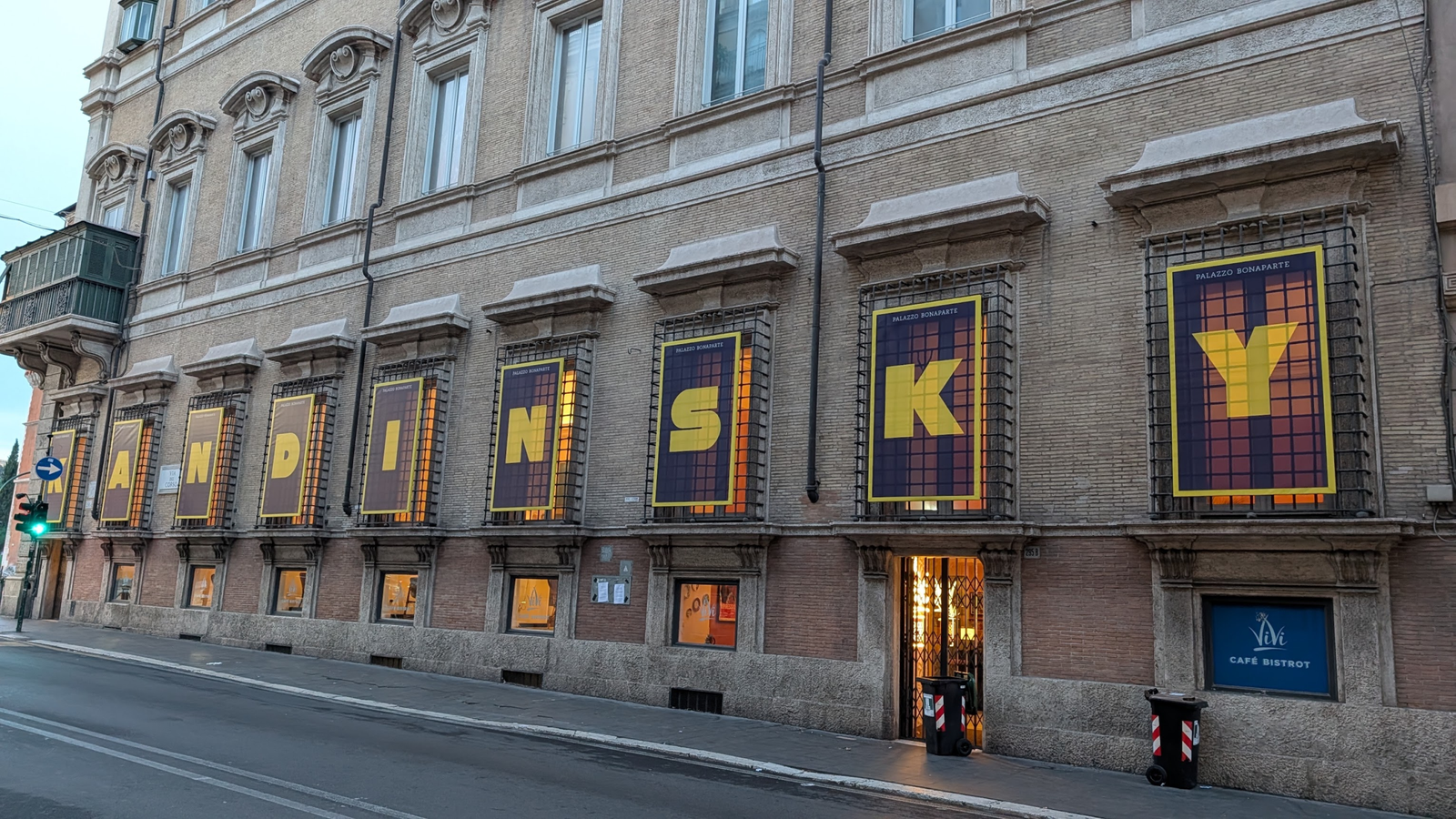
Kandinsky runs at Palazzo Bonaparte, in the heart of Rome, from September 15, 2026, through February 14, 2027. Curated by Angela Lampe of the Centre Pompidou, the retrospective gathers more than seventy works. Most come from the Pompidou’s own holdings, the largest Kandinsky collection anywhere, built almost entirely on the bequest of the artist’s widow, Nina Kandinsky. It is the first major Kandinsky retrospective in Rome in over twenty-five years.
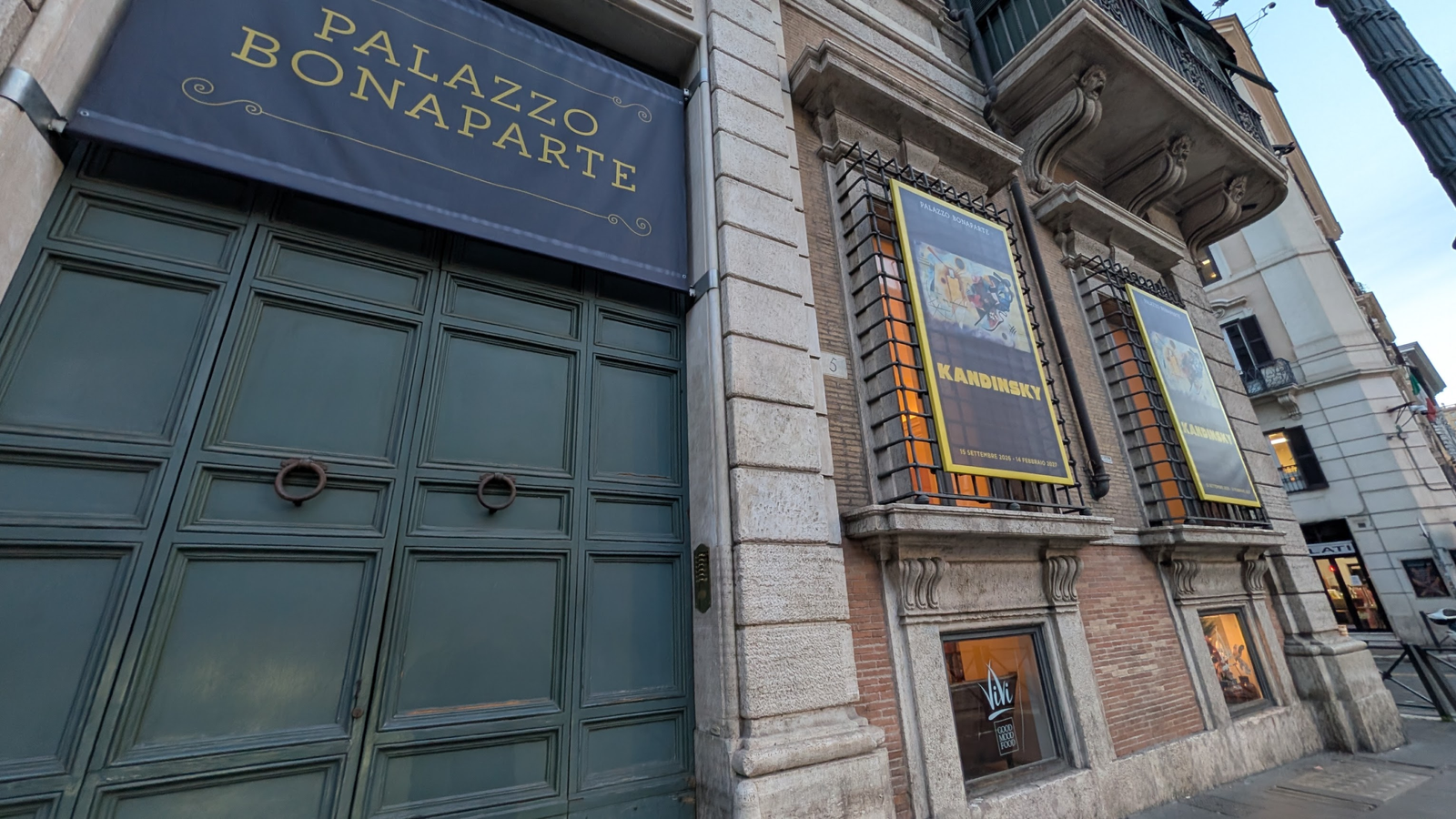
The show moves through five rooms in chronological order and stays open daily. Hours extend around the New Year and in the final days. Treat February 14 as a hard deadline. Arthemisia exhibitions in Rome rarely run longer, and this one shares its last weekend with Valentine’s crowds at Palazzo Bonaparte. A ticket includes a free audio guide and starts at 18 euros. A short walk also gets you to a second major exhibition that can turn the trip into a full day of art. More on that below.
The Winter Kandinsky Spent on the Italian Riviera
None of the wall text at Palazzo Bonaparte will tell you this, so an Italian will. Kandinsky spent a winter here before he was Kandinsky, before the lawyer from Moscow became the man credited with inventing abstract painting. From December 1905 to April 1906, he lived in Rapallo, on the Ligurian coast. He stayed with Gabriele Münter, his student at Munich’s Phalanx school and, by then, his companion. In five months he painted eighteen small oil studies of the bay: the castello that still guards its harbor, boats pulled up on gray winter sand, a sea the color of hammered tin.
Wintering on the Riviera in 1905 meant something specific, and it is easy to miss from an American armchair. Liguria in December is not Capri in July. The light comes in low and sideways. The palm trees look stranded rather than tropical, and the towns empty out until they belong mostly to residents and a few foreigners who came for the mild air and stayed for the quiet. For a Russian painter in his late thirties, restless after a decade of training and travel, Rapallo was cheap and private, and it was nothing like Munich. The eighteen paintings mark a hinge. The brushwork loosens, color pulls away from the thing it describes, and the figurative leash slackens, visibly, for the first time. Within a few years he would let it go entirely. Most of those canvases hang today in Munich, at the Lenbachhaus, which holds the world’s largest Blue Rider collection. Münter drew him there too. Her small pencil sketch Kandinsky in Rapallo survives in the same museum.
One letter a month from inside central Italy.
The places, seasons and stories I don't put on the blog. No itineraries, no spam.
The eighteen Rapallo canvases themselves are not in Rome. What is in Rome suits the point better anyway: the exhibition puts the joint travel sketchbooks on display, the ones Kandinsky and Münter filled side by side in Holland, Tunisia and Rapallo. Stand in front of a page from that Ligurian winter and you are looking at two painters working from the same bay and already disagreeing about what paint is for. The show goes further still. For the first time anywhere in Italy, it gives real wall space to Gabriele Münter herself: not as a footnote, but with her own paintings on display, including Dragon Fight (1913), adapted from a small Russian folk carving the couple kept in their Munich apartment. Münter spent a decade at Kandinsky’s side. For most of the twentieth century, she was written up as his companion rather than his equal. Seeing her work here, in the country where that decade began its most important turn, is the closest the exhibition comes to Rapallo. It may also be the more honest tribute.
Five Rooms, One Argument
Palazzo Bonaparte has built its reputation on shows like the three rival geniuses of the Renaissance. This one organizes itself by date, but walk it as an argument instead of a timeline. Five rooms trace how thoroughly Kandinsky stopped painting things.
Munich and the Blue Rider
In 1911, Kandinsky founded Der Blaue Reiter, the Blue Rider, together with Franz Marc and, again, Gabriele Münter. Americans tend to know the name without knowing it names a group. It was a loose circle of Munich-based painters who believed color and form could carry spiritual and emotional weight on their own, with no need to borrow it from a recognizable subject. The Black Arch (1912) belongs to this room. Curators pair the canvas with a short piece of music, so visitors can hear, not only see, how Kandinsky pulled his elements apart.
Revolutionary Russia and the Bauhaus
Kandinsky returned to Moscow in 1914. He spent nearly eight years inside the machinery of a country remaking itself, before Germany called him back, this time to teach. At the Bauhaus, first in Weimar and then in Dessau, he traded the easel for the lectern. There he wrote Point and Line to Plane, the 1926 treatise that turns up in the show’s next room.
Neuilly: The Last Season
The Nazi regime closed the Bauhaus in 1933. Kandinsky left Germany for good and settled outside Paris, in Neuilly-sur-Seine, where he painted until his death in 1944. The show’s final room holds Gelb-Rot-Blau, or Yellow-Red-Blue (1925), the canvas most people picture when they hear his name. Stand in front of it and measure the distance. It is a long way from a gray Rapallo winter the wall text leaves out.
What an Engineer Sees in Point and Line to Plane
Point and Line to Plane, the treatise Kandinsky wrote at the Bauhaus in 1926, reads less like an artist’s manifesto than a textbook. That makes sense: its author trained as one before he trained as the other. Before Munich, Kandinsky earned a law degree in Moscow and taught himself the language of economics. He came to painting at thirty, already fluent in the habit of building a system from first principles.
That habit shows. The treatise does not throw out rules in the name of freedom. It rewrites them, point by point, the way an engineer rewrites a load calculation when the materials change but the physics does not. A dot is not decoration; it is a unit of tension. A line is not a boundary; it is a record of force. Reading it feels less like reading art history and more like reading a spec sheet for a field that did not yet have standard units.
I will not push this comparison further than it deserves. Art does not need an engineering credential to earn respect, and claiming otherwise would do Kandinsky a disservice. But if you have ever rebuilt a system of reference from scratch, and kept the rigor while you did it, this room will feel strangely familiar.
The Kandinskys You Already Know
If you have spent any time at the Guggenheim in New York, you have already met this painter, even if the introduction did not register. Solomon Guggenheim began buying his work in the 1930s, the same decade Kandinsky was teaching at the Bauhaus and painting the canvases now on loan to Rome. That early enthusiasm is the reason the name feels familiar to Americans who could not name a second abstract painter from the period.
What the Rome retrospective adds is not a different artist. It is the missing chapters. The Guggenheim’s holdings lean toward the mature, fully abstract Kandinsky of the American imagination. Palazzo Bonaparte opens with the young lawyer who had not picked up a brush yet. It closes with an old man still rewriting his own rules in a borrowed country. See where the paintings started, and the familiar ones make more sense.
Tickets, Hours, and the Part Nobody Tells You
A full-price ticket runs 18 euros, a reduced ticket 17, and admission includes a free audio guide. Skip any guided tour that charges extra just to repeat what is already in your ear. One thing worth knowing before you shop around: Palazzo Bonaparte and its official ticketing partner sell these tickets directly, and the exhibition is not distributed through the large international booking platforms. If you find Kandinsky bundled into a third-party package, you are paying a markup on a ticket you can buy at the door. Students pay 15 euros on Tuesdays. Children ages four to ten pay 8. Travelers arriving by Frecciarossa, Frecciargento, or Frecciabianca get 25 percent off with a same-week ticket to Rome, shown at the box office. Hours run 9 a.m. to 7:30 p.m. Monday through Thursday, and 9 a.m. to 9 p.m. Friday through Sunday. The schedule extends around the New Year, and again from February 12 through 14.
Here is what the brochure will not say. Palazzo Bonaparte is a seventeenth-century palace, not a modern museum built for crowds, and its rooms are genuinely small. A Saturday afternoon in January brings real crowding, not a figure of speech. Piazza Venezia has been a Metro C construction site since 2023, and the walk to the entrance looks nothing like the postcard version of the square. If you have exactly one day in Rome and have not yet stood inside the Colosseum or the Forum, spend it there instead. This show rewards a second or third visit to the city more than a first one.
If that is you, and you want the version of ancient Rome that earns a whole morning, the small-group tour that goes onto the arena floor caps the group at ten and includes the Roman Forum and Palatine Hill with a guide. That last part matters more than the listings suggest. The Forum without someone to explain it is a beautiful field of rubble with no story attached, and most visitors walk out of it having understood nothing.
None of that is a reason to skip it. It is a reason to go on a weekday morning, book ahead, and know what you are walking into before you stand in a line that wraps around a construction site.
Make It Two Exhibitions in One Day
Twelve minutes on foot separate Palazzo Bonaparte from the Scuderie del Quirinale. A parallel retrospective on Jacopo da Pontormo runs there through February 7, 2027: five centuries and one short walk apart. Pontormo spent his career twisting the human figure until it looked lit from within by something like anxiety. Kandinsky spent his dismissing the figure altogether. See both shows in the same week, or the same day, and two separate museum visits become one argument about what four hundred years did to the idea of a body in paint.
The logistics cooperate. The Scuderie open at 10 a.m. and close at 8 p.m., with last entry at 7. Palazzo Bonaparte opens earlier and stays open later on weekends. Start with Pontormo in the morning, while the Scuderie’s smaller rooms still feel empty. Then walk twenty minutes to the Pantheon neighborhood for lunch. Our guide to Rome’s best olive oil tasting lands you eight minutes from Piazza Venezia, with time to walk off a meal before the Kandinsky galleries open their afternoon doors.
Plan the day in that order. You will close the evening at Palazzo Bonaparte’s balcony, looking at a square neither Pontormo nor Kandinsky ever painted, but that both, in their own centuries, would have found something to say about.
Walk out of the exhibition and look up at the green balcony from the street. It is smaller than it looks in photographs, closed like a shutter. The piazza it frames is the same one Letizia Ramolino could no longer see but refused to stop watching, secondhand, through someone else’s eyes. Kandinsky spent a career arguing that you do not need the object in front of you to feel what it holds. Standing under that balcony, ticket still in your pocket, it is hard to say he was wrong.
Want more dispatches like this one, written from inside the places most guidebooks only pass through? Subscribe to the Taste & Wonders of Italy newsletter.
Booking Notes: What I Would Actually Reserve
The food, on a different day from the two exhibitions. The museum day described above is already full, and a proper Roman food walk runs two and a half hours and crosses the river. The Trastevere and Campo de’ Fiori street food tour is the one I would book, on an evening with nothing else scheduled: it starts near Piazza Navona and ends in Trastevere, and it spends its time in the two neighborhoods where Romans buy lunch rather than the ones where lunch is sold to visitors. Do not try to wedge it between the Scuderie and Palazzo Bonaparte. You will spend the Kandinsky rooms thinking about your feet.
The honest cheaper option at the Colosseum. If you do not want a guide, the standard entry covering the Colosseum, Roman Forum and Palatine Hill costs 24 euros from the official ticketing site, and nothing about the guided version is compulsory. The small-group tour earns its price for the arena floor and for having the Forum explained out loud; it does not earn it if you were going to read every panel on your own anyway. Work out which of those two people you are before you book.
What I would skip. The arena-floor-only tickets. They read like the upgrade and they are closer to the opposite. The access they sell lasts twenty minutes and excludes the rest of the monument, so you stand on the reconstructed sand, take the photograph, and never climb to the upper tiers where the structure of the building becomes legible. Buy full access or buy the basic ticket. The option in the middle is the one designed to be misread.
Frequently Asked Questions
How long does the Kandinsky exhibition in Rome run? The Kandinsky exhibition in Rome runs at Palazzo Bonaparte from September 15, 2026, through February 14, 2027. The museum keeps its normal hours for most of that window, with extended hours around the New Year and in the show’s final three days.
How much are tickets, and do I need to book? Full-price tickets cost 18 euros and reduced tickets cost 17, with discounts for students, children, and Frecciarossa travelers. Booking is not required, but it is strongly recommended for weekend afternoons, when the palace’s small seventeenth-century rooms fill up fast.
How long should I allow for the visit? Plan on an hour and a half. The five rooms take about an hour at a steady walking pace; the audio guide, the listening stations and the Münter room are what push it past that. Arthemisia does not publish an official visit duration, so treat this as an estimate rather than a timetable.
Is it worth it if I don’t like abstract art? Yes, because the show does not start with abstraction. It opens with a young, fully figurative Kandinsky and lets you watch, room by room, how and why he dropped recognizable subjects. By the time you reach the abstract canvases, the leap feels earned, not arbitrary.
Did Kandinsky ever live in Italy? Yes. Kandinsky spent the winter of 1905 to 1906 in Rapallo, on the Ligurian coast, with fellow painter Gabriele Münter. He produced eighteen oil studies there, and they mark an early turn toward looser, more expressive color. Those canvases are not in the Rome exhibition, but the travel sketchbooks he and Münter filled in Rapallo are on display.
Who was Gabriele Münter? Gabriele Münter was a German Expressionist painter, Kandinsky’s student and then his companion for over a decade, and a founding figure of the Blue Rider group in her own right. The Rome exhibition shows her work in Italy for the first time, including her 1913 painting Dragon Fight.
Is Palazzo Bonaparte easy to reach by public transport? Palazzo Bonaparte sits directly on Piazza Venezia, a short walk from the Colosseum and the Pantheon, but the square has been a Metro C construction site since 2023. Budget extra time for the walk-up, and expect scaffolding rather than an open piazza.