Cavalcata dell’Assunta, Fermo: Italy’s Oldest Reenactment
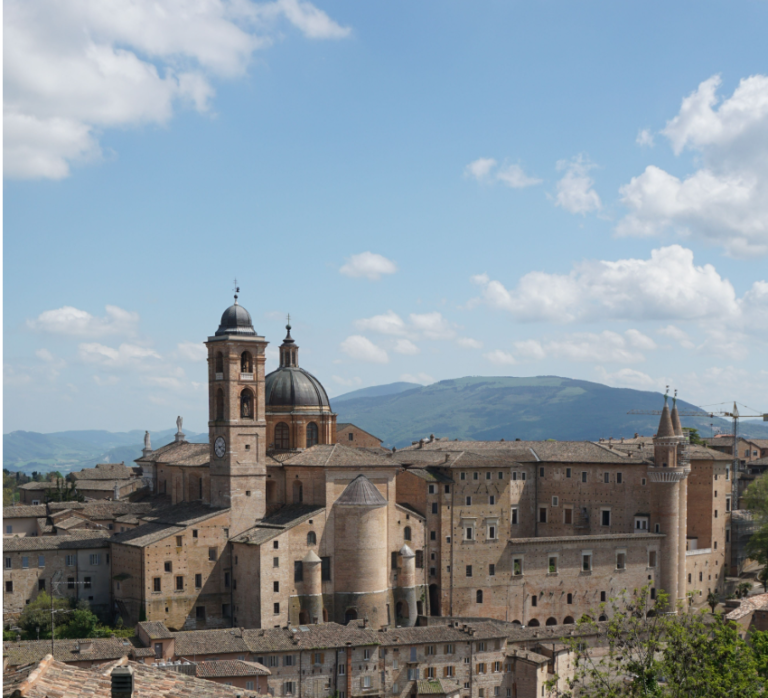
The Cavalcata dell’Assunta announces itself before you see it: drums bouncing off the travertine facades of Piazza del Popolo, contrada colors catching the last light on the Girfalco, the hill where Fermo’s cathedral has stood since the fifth century. This is the oldest historical reenactment in Italy, run in some form since a documented 1182 agreement bound the neighboring castles to bring tribute to Fermo’s patroness, Santa Maria Assunta. In 2026 it reaches its 45th modern edition. The horse race still falls on August 15, as it always has, but a genuine structural change — decided by the contrade themselves, not for tourists — is reshaping how the final two processions unfold.
The Cavalcata dell’Assunta takes place in Fermo, a hill city in Italy’s Marche region a few miles from the Adriatic coast, across the first two weeks of August, with the corteo storico — the historical procession — held on the evening of August 14 and the horse race, the Palio itself, run on the afternoon of August 15. Ten contrade, meaning city wards rather than costume clubs, compete over weeks of drumming, flag-throwing, archery, and a bareback race for a hand-painted silk drappo (the banner awarded to the winner). Unlike Siena’s Palio, run twice a year for an international audience, Fermo’s version draws a mostly Italian crowd, and nearly everything worth seeing costs nothing to watch from the street.
What the Cavalcata dell’Assunta Actually Is
“Oldest in Italy” is not marketing language here; it is a claim historians can trace on paper. The earliest surviving reference to the tribute-and-palio arrangement dates to 1182, when the towns of Monterubbiano, Cuccure, and Montotto committed to delivering a palio to Fermo every year for the feast of the Assumption. An even older document, from 998, records a bishop of Fermo granting land in exchange for an annual payment tied to that same August feast — evidence that the devotion itself predates the horse race by centuries. The clearest picture of how the medieval city actually organized the day comes from an illuminated page in the Messale de Firmonibus, a missal from 1436 held in Fermo’s Museo Diocesano, which depicts the procession climbing toward the cathedral in the order that, broadly, survives today. What most visitors call “the Cavalcata,” meanwhile, is the modern race format: it resumed in its current shape in 1982, which makes 2026 the 45th consecutive modern edition, layered on top of nine centuries of documented devotion.
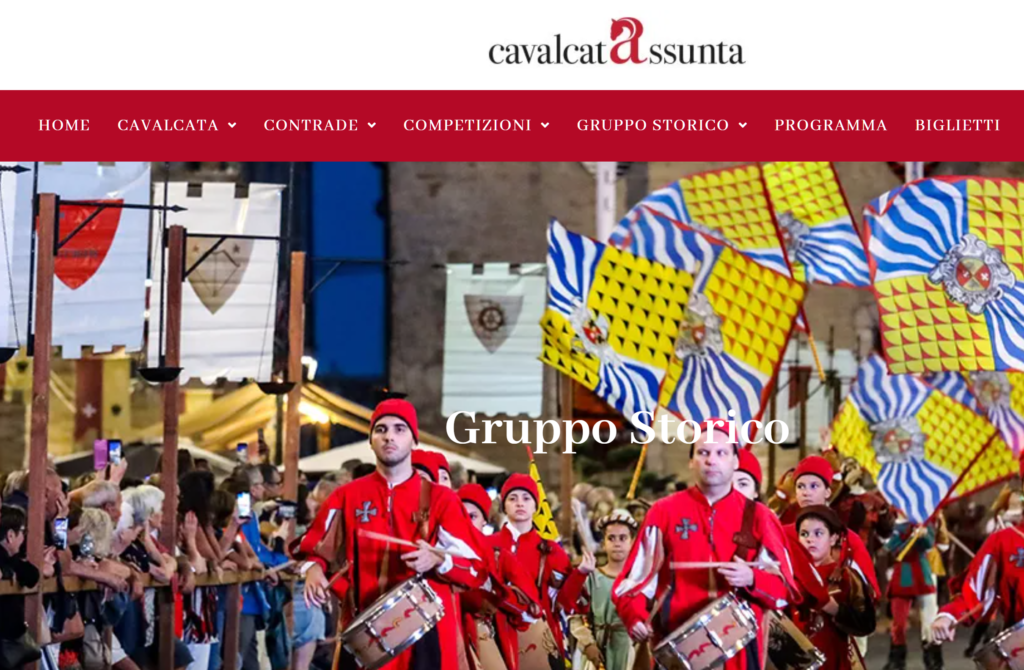
Ten Contrade, Not Ten Costumes
Fermo’s ten contrade — Campolege, Castello, Fiorenza, Pila, San Bartolomeo, San Martino, Campiglione, Capodarco, Molini Girola, and Torre di Palme — are neighborhoods with their own headquarters, their own colors, and their own calendar of internal events that runs well beyond August. Rivalry plays out first at the table, in the Hostarie delle Contrade (open-air taverns serving period-inspired food in Piazza del Popolo), then in games that have nothing to do with horses: a drumming competition, a flag-throwing tournament, a tug-of-war, an archery contest fired from the Girfalco. Only after that accumulated tension does the actual bareback race decide the drappo. A visitor who shows up only for August 15 sees the finale; a visitor who arrives by late July sees why the finale matters to the people standing next to them.
Medieval Life Continued, Not Staged
The distinction is worth being precise about, because it changes how you should watch. A staged reenactment recreates a period for an audience that has come to observe it. The Cavalcata is closer to the opposite: it is the mechanism by which ten real neighborhoods still settle a centuries-old civic argument, and the fact that it happens to look medieval is a byproduct of continuity, not costume design. Decisions about the event — including, as you’ll see below, the 2026 change to the August 15 procession — are made through the Cernita, the historic deliberative body of the contrade, by vote. Tourists are welcome, but nothing about the calendar bends toward them.
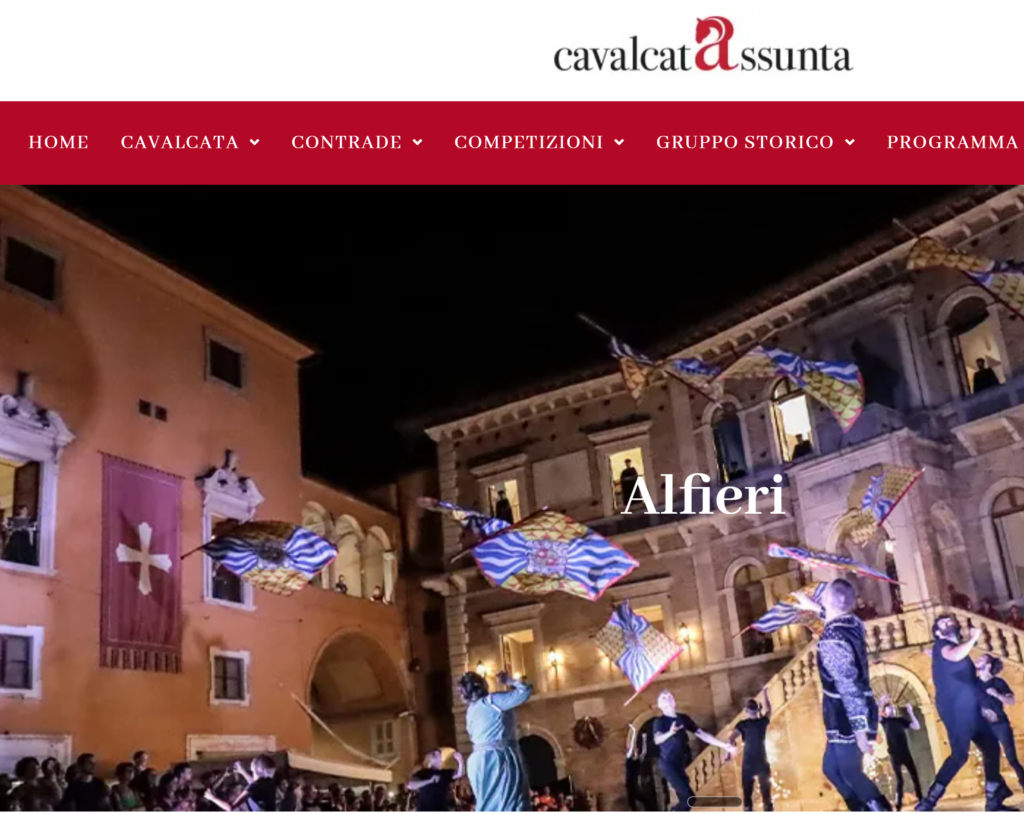
Bianca Maria Visconti and the Cathedral of the Assumption
The opening ceremonies in late July recreate a specific, documented moment: the arrival in Fermo of Bianca Maria Visconti, escorted by the Morlacchi, mercenary troops in Venetian and Dalmatian service who moved through the Adriatic in the same period. The scene is staged with sbandieratori and drummers ahead of it, and it sets up the devotional logic that governs everything that follows — a city preparing, over three weeks, to bring its collective offering to Santa Maria Assunta, honored in the cathedral that gives Fermo’s skyline its silhouette from the coast road below.
The Fermano Is My Family’s Ground
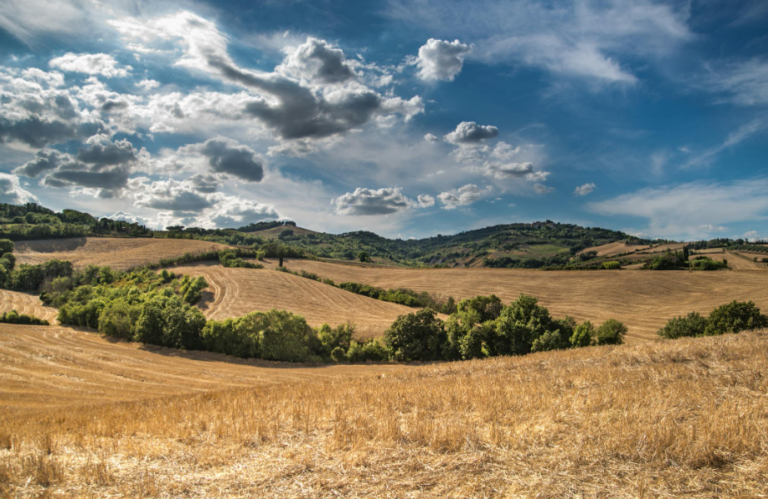
I grew up in these hills, and the Fermano — the countryside around Fermo — is where my own family’s history sits, in the same territory but in a different chapter. Near Moregnano, not far from the city, my grandfather Mario Vitellozzi sheltered Allied prisoners of war during the Second World War, a story I have been documenting under the working title The English Cave. I did not grow up going to the Cavalcata every August the way a Fermano native from inside the walls would have; what I know of it is the knowledge anyone from this stretch of Le Marche absorbs by proximity — which contrada a friend’s family belonged to, why the drums in late July mean summer is turning toward its final, most serious stretch. That is a different kind of authority than a lifelong contradaiolo’s, and I want to be honest about which one this is.
From Pentecost to Ferragosto: The Long Run-Up
The Cavalcata’s calendar opens far earlier than most visitors expect. The Pentecost season brings the Investitura dei Priori, the formal investiture of each contrada’s leadership in the cathedral, and by early July a smaller children’s palio has already run in Piazza del Popolo — a reminder that the event trains its own future participants years in advance. The visible season begins on July 26 with the Arrivo del Palio, staged this year at Porta San Francesco, near the old Porta Marina gate: the 2026 drappo, painted by that year’s selected artist, arrives escorted by the Armata di Pentecoste of the neighboring town of Monterubbiano, one of the three medieval communities named in the original 1182 tribute agreement. Two evenings of competition follow in short order — the Trofeo Gallo d’Oro on July 28, pitting the contrade’s drummers against each other, and the Trofeo Bandiere al Vento on July 29, the flag-throwers’ equivalent. From August 1 through 4, the Hostarie delle Contrade take over Piazza del Popolo each evening, serving traditional dishes alongside costumed street theater, while the Girfalco hosts its own athletic contests: the Tiro al Canapo, a tug-of-war between contrade, and the Tiro per l’Astore, an archery competition. The tension resolves on the night of August 12 with the Tratta dei Barberi, the costumed ceremony in which each contrada’s horse is drawn by lot — the moment the abstract rivalry of the preceding weeks becomes a specific horse, a specific rider, a specific chance.
What Changes in 2026, and Why It Matters
Local press coverage from this year’s presentation, held in Fermo’s Palazzo dei Priori on July 11, described 2026 as “the edition of change” — a new mayor, a new director, and a genuine adjustment to how the final two days are structured. It is worth getting this right, because the loose version circulating online (that the main procession simply moved from the 15th to the 14th) overstates what actually happened.
August 14: The Corteo Storico in Notturna
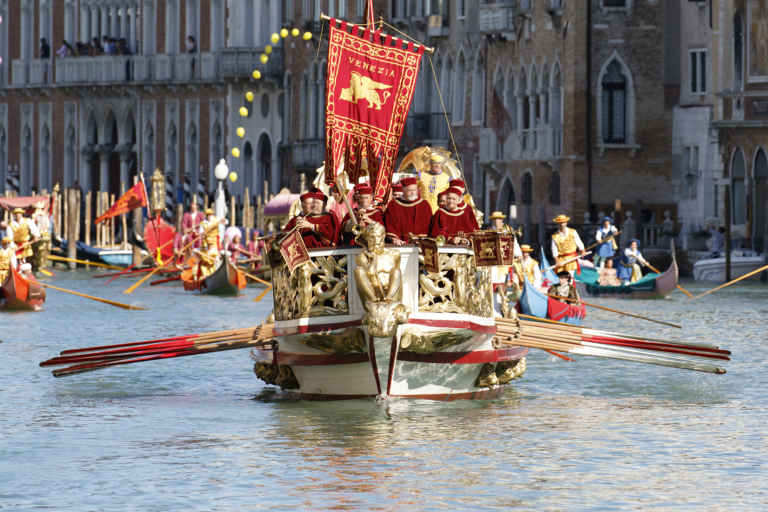
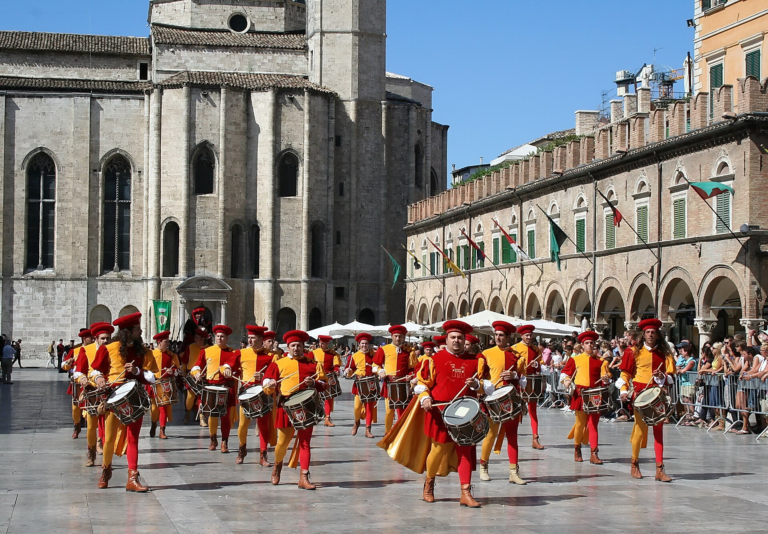
The evening of August 14 has long carried the corteo storico in notturna: a torchlit procession in fifteenth-century costume that departs from the Chiesa di Santa Lucia, climbs through the Campolege district, and arrives at the cathedral for a liturgy of the word and the archbishop’s blessing of the Palio. Regional press regularly puts the number of costumed participants at over 1,400. According to Fermo’s vice president Stefano Lignite, speaking at the July presentation, this was — historically, per the researcher Tomei’s account — always the principal devotional procession honoring the Assumption of Mary, even though it draws less attention from outsiders than the race itself.
August 15: A Smaller Transfer, By the Contrade’s Own Vote
The actual change concerns a second, shorter procession: the transfer, in costume, from Piazza del Popolo to the racetrack on the afternoon of August 15, ahead of the run itself. For 2026, that transfer procession has been scaled back to the Cernita’s core figures plus three representatives per contrada — the gonfaloniere (standard-bearer), the capitano d’armi (arms captain), and the Priore (the contrada’s elected head). The decision followed a request from contradaioli themselves, carried to the Cernita by the contrade and approved by majority vote, with the stated goal of letting participants actually experience their own feast day — the blessing of the jockeys’ colors, the Pontifical Mass, the race — rather than spend part of it marching. For a visitor, the practical effect is straightforward: August 14 remains the larger, more visually dense procession to watch on foot; August 15’s pre-race procession will be shorter and more compact than in past editions.
Planning Your Visit
Getting to Fermo
Fermo sits on a regional rail line with connections from Ancona and Pescara to the coastal station at Porto San Giorgio, from which local buses and taxis climb the roughly five miles up to the historic center; driving from Ancona’s airport takes under an hour on the A14 and SS210. August traffic into the walled center is heavy on procession evenings, and parking closer to the perimeter with a short walk in is the more reliable plan.
Tickets: What’s Free and What Isn’t
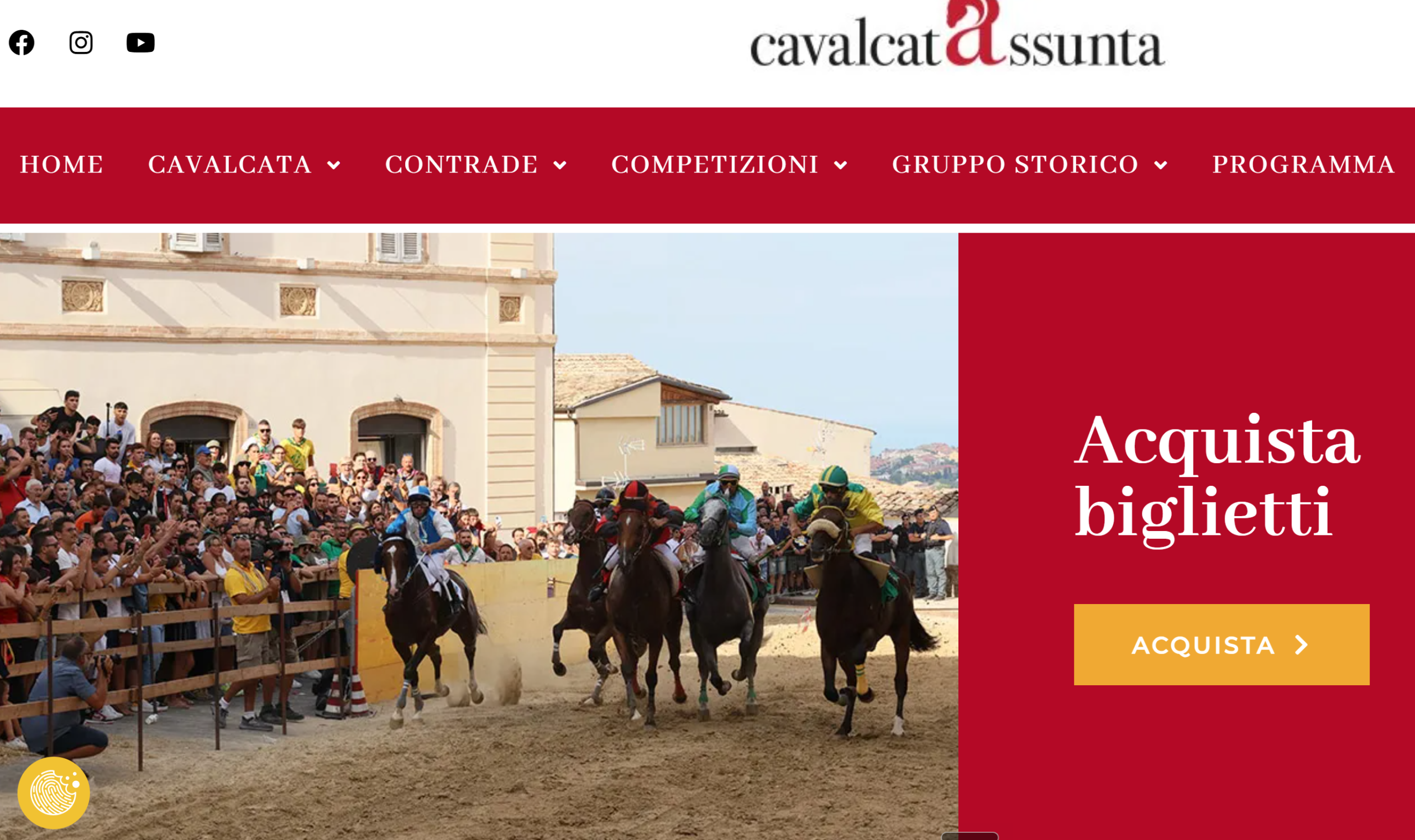
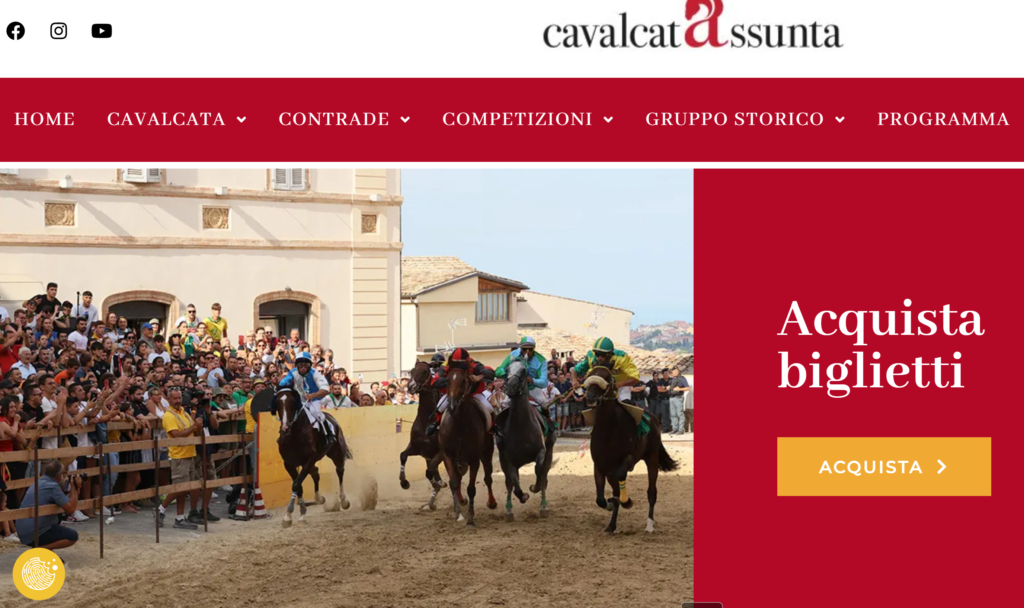
Most of the Cavalcata costs nothing. The Hostarie, the Arrivo del Palio, the drumming and flag-throwing tournaments, the Tratta dei Barberi, and the August 14 corteo can all be watched for free by claiming a spot along the route or in the piazza. The one paid element is reserved tribune seating for the August 15 race itself, along Viale XX Settembre and Viale Vittorio Veneto: Settore A runs a single price of 20 euros, with no reduced fare but free admission for visitors with disabilities and one companion; Settore B costs 12 euros full price or 6 euros reduced (for ages six to eleven, visitors over 65, and a disabled companion), with children under six admitted free. Tickets are sold in person at the Musei di Fermo, at the Tabaccheria Cruciani on Piazza del Popolo, at the box office of the Teatro all’Aperto di Villa Vitali, and online through Live Ticket, which lets you print your seat at home. Confirm current prices and sales windows on the official site before you commit a date, since organizers do adjust hours as the season firms up.
Where to Watch
For the August 14 corteo, the stretch between the Chiesa di Santa Lucia and the cathedral offers a free, standing view of the full procession as it climbs; arriving thirty to forty minutes early secures a spot without blocking a local family’s usual corner. For the race on August 15, standing room along the fenced track is free on a first-come basis, while the numbered tribune seats guarantee a sight line to the finish for the price of a ticket.
Where to Stay
Fermo itself has a limited number of rooms inside the walls, which sell out well before August for a city its size; nearby Porto San Giorgio on the coast, or agriturismi scattered through the Fermano countryside, both put you within a twenty-minute drive of the center with considerably more availability. [Booking link and specific property recommendations to be added once verified for the current season.]
The 2026 Program, Day by Day
This section reflects the schedule confirmed by the Cavalcata dell’Assunta association as of July 2026. Times and locations are subject to change; verify against cavalcatadellassunta.it before finalizing plans, and expect this section to be updated for 2027.
- Sunday, May 10 — 100 Giorni al Palio, a children’s historical procession, Piazza del Popolo, 5:30 p.m.
- Sunday, June 14 — Investitura dei Priori, Cathedral, 9:00 p.m.
- Sunday, July 5 — 13th Palio dei Bambini, Piazza del Popolo, 8:30 p.m.
- Sunday, July 26 — Arrivo del Palio and presentation of the 2026 drappo, Porta San Francesco, from 7:30 p.m.
- Tuesday, July 28 — 16th Trofeo Gallo d’Oro (drummers), Piazza del Popolo, 9:00 p.m.
- Wednesday, July 29 — 5th Trofeo Bandiere al Vento (flag-throwers), Piazza del Popolo, 9:00 p.m.
- Saturday, August 1 – Tuesday, August 4 — Hostarie delle Contrade, Piazza del Popolo, from 7:00 p.m.
- Saturday, August 1 — 39th Tiro al Canapo, Girfalco, 9:00 p.m.
- Monday, August 3 — 31st Tiro per l’Astore, Girfalco, 9:00 p.m.
- Monday, August 10 — Il Tempo delle Dame, presentation of the contrade’s ladies, Castello di Torre di Palme, 9:30 p.m.
- Wednesday, August 12 — Tratta dei Barberi, horse-to-contrada draw, Piazza del Popolo, 9:30 p.m.
- Friday, August 14 — Corteo storico in notturna and liturgy of the word, from Chiesa di Santa Lucia to the Cathedral, 8:45 p.m.
- Saturday, August 15 — Blessing and presentation of the jockeys’ colors, Cathedral steps, 10:30 a.m.; Pontifical Mass presided by Archbishop Rocco Pennacchio, 11:30 a.m.; procession to the racetrack, 3:00 p.m.; 45th Palio dell’Assunta horse race, two heats plus final, 5:00 p.m.; Festa della Vittoria, Piazza del Popolo, 9:30 p.m.
FAQ — Common Questions About the Cavalcata dell’Assunta
What is the Cavalcata dell’Assunta? It is Italy’s oldest documented historical reenactment, held annually in Fermo, in Italy’s Marche region, culminating in a bareback horse race among ten city contrade on August 15, the feast of the Assumption.
When is the Cavalcata dell’Assunta held in 2026? The main events run from late July through August 15, 2026, with the torchlit corteo storico on August 14 and the 45th Palio dell’Assunta horse race on the afternoon of August 15.
Do I need a ticket, or is it free? Nearly everything is free to watch from the street, including both processions. Only reserved tribune seating for the August 15 race requires a paid ticket, priced at 12 to 20 euros depending on the sector.
What’s the best day for a first-time visitor? August 14 offers the fuller spectacle — a torchlit procession of some 1,400 costumed participants — with lighter crowds than race day; August 15 delivers the race itself but draws the largest audience of the season.
What are the contrade? The ten contrade are Campolege, Castello, Fiorenza, Pila, San Bartolomeo, San Martino, Campiglione, Capodarco, Molini Girola, and Torre di Palme — city wards with year-round identities, not costumes assembled for August.
Where should I stand to watch the corteo and the race? For the corteo, claim a spot along Chiesa di Santa Lucia’s route toward the cathedral thirty minutes early. For the race, free standing room lines the fenced track on Viale XX Settembre and Viale Vittorio Veneto, alongside paid tribune seating.
How does the Cavalcata connect to Ferragosto? The race falls on August 15, Ferragosto, Italy’s Assumption Day holiday; in Fermo, the civic and religious weight of that date is expressed through the Palio rather than a beach day, which is part of what distinguishes the city’s Ferragosto from the coastal norm.
The Takeaway
What makes the Cavalcata dell’Assunta worth the detour from the Chianti-and-Florence circuit is not that it is old, though it is, verifiably, older than any other reenactment in the country. It is that the age hasn’t calcified into performance. Ten neighborhoods still argue, still vote through their Cernita, still adjust their own centuries-old ceremony when their own members ask for it, as they did for 2026. A visitor who arrives expecting a costume pageant staged for cameras will find something more demanding and more rewarding: a city still doing, every August, the thing it has apparently never quite stopped doing since 1182.
Planning a trip to Le Marche or the Fermano and want an Italian insider’s read on timing, logistics, or which towns are worth the detour? You can book a 30-minute consultation with me at tidycal.com/mircovitellozzi/tuoingegnere-linkedin.
Written by Mirco Vitellozzi, a structural engineer from Le Marche who writes about Italy from the inside. More essays at Tastes & Wonders of Italy, and short films on YouTube.