The Real Cost of Buying a House in Italy: An Engineer’s View
The real cost of buying a house in Italy rarely shows up in the photos that go viral. Somewhere on a Marche hillside outside Macerata, a stone farmhouse is having its best month in years — an American buyer, phone raised, stands in a kitchen with a walk-in hearth and shutters thrown open onto vineyard rows that fold into the blue Sibillini foothills. Everything in the room says exactly what the listing promised: three bedrooms, half a hectare, a cash-only price under fifteen thousand euros. It is close to a story the buyer has probably already read: a family that traded a coastal American city for a stone farmhouse in central Italy, spent less on the whole property than a year of rent back home, and posted the after photos online. That story is largely true. It is also not the complete one.

A few weeks later I stand in the same kitchen with a plumb line, a moisture meter, and thirty years of habit that makes me look up before I look around. I am not seeing the same house anymore. This article lives in the gap between those two visits: the version of buying a house in Italy that reaches American headlines, and the version a structural engineer who has spent three decades inside buildings exactly like this one actually finds. Both versions are real. Only one of them protects your money. If you haven’t yet worked through the national purchase process itself — contracts, notary, taxes — my guide to buying a house in Italy covers that ground; this piece goes deeper into the one step that decides whether the story ends well.
The story making the rounds
The headline version usually starts with a number that sounds like a typo. In a story CNBC published in June 2026, Cassandra Tresl and her husband, Alex Ninman, described closing on a two-bedroom house in Abruzzo for eleven thousand five hundred euros, paid entirely in cash, with the deal finalized in February 2022. They report having spent roughly eighteen thousand dollars on renovations and moving in within months, ending up with a finished home for a fraction of what a down payment costs in most American cities.
Stories like this travel because they are, for one specific and fairly narrow category of property, accurate. There is also a second, related story that Americans frequently fold into the same narrative without realizing it is a different program entirely: Italy’s one-euro house schemes, in which specific municipalities — Sambuca di Sicilia, Mussomeli, and dozens of others — sell designated abandoned properties for a symbolic price in exchange for a binding commitment to renovate within a set timeframe, typically backed by a security deposit. Forbes’ April 2026 explainer on how Americans can take part walks through the mechanics: an application process, a required renovation plan, and deposits that in practice run into the thousands of euros before any structural work begins. Coverage of these towns often centers on mayors framing the trade in civic rather than commercial terms — Mussomeli’s mayor, widely quoted in international press including the Guardian, has described the goal less as selling houses than as rebuilding communities.
These are two distinct paths into Italian real estate — an ordinary market purchase of an inexpensive rural property, and a municipal revitalization program with its own legal architecture — and American coverage routinely blurs them into a single, seductive idea: Italy is giving houses away. Neither story is fabricated. Both leave out the part that determines whether the outcome looks like Tresl and Ninman’s kitchen, or like something considerably more expensive and considerably slower.
What the documented cases actually show
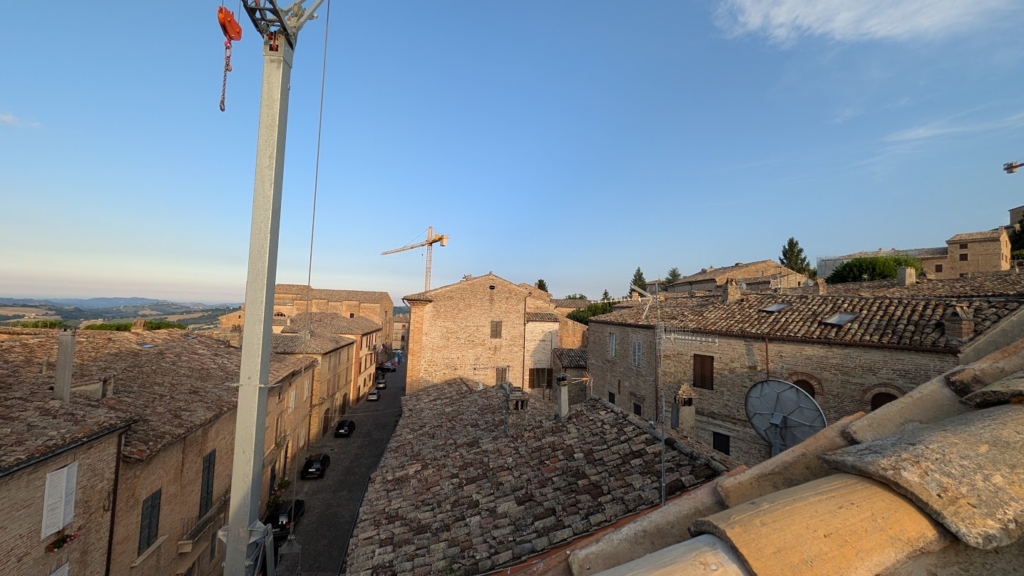
Independent accounts tell a more variable story. One American who bought a Tuscan farmhouse, or casale, at auction and moved in during the strict lockdown of November 2020 later wrote on Substack that she and her husband expected the renovation to take eight months. It took three years. Their initial renovation budget, she wrote, more than doubled despite careful project management on her part — and she flagged something else worth knowing before you negotiate: what expats in Italy sometimes call, informally, the stranieri tax — a pattern of two different prices for the same work, one for locals, one for foreigners.
The one-euro scheme produces its own range of outcomes, and it is wide. CNBC’s 2024 reporting on foreign buyers in Sicily’s symbolic-price towns found one Chicago buyer who secured a Sambuca di Sicilia property with a winning bid of 5,555 euros, which came to roughly 5,900 euros once fees and taxes were added — before a single wall was touched. A Mussomeli buyer profiled in the same reporting paid 3,301 euros in fees and deed costs to secure each one-euro property before renovation began. Total project costs for buyers profiled in coverage like this have ranged from the tens of thousands of dollars into the hundreds of thousands, depending almost entirely on the structural condition behind the façade — a variable that stays invisible until someone qualified actually inspects it.
Notice what these two sets of numbers have in common. The gap between the fast, affordable story and the slow, expensive one is not luck, and it is not regional. Tresl and Ninman closed and largely finished their renovation inside a single year; the Substack buyer needed three. Both bought old buildings in central Italy. The difference sits in what each buyer discovered — and when they discovered it — about the condition of the structure they were signing for.
Why the Italian system works this way
Once you understand what a proposta d’acquisto and a compromesso actually commit you to, the rest of this article makes more sense.
The proposta d’acquisto (purchase proposal) is a written, signed offer: it names a price and terms, and it is typically accompanied by an initial deposit. Until the seller accepts it, either side can generally walk away. Once accepted, the offer becomes binding on the buyer, immediately. What follows is the contratto preliminare, known colloquially as the compromesso: a more detailed contract that fixes the final price, the closing date, and the size of the caparra confirmatoria, the security deposit that Italian real estate practice treats as considerably more consequential than an American earnest money deposit.
The caparra confirmatoria is governed by Article 1385 of the Italian Civil Code, and market practice typically sets it somewhere between ten and thirty percent of the purchase price, most commonly landing around ten to twenty. Its function is symmetrical and unforgiving: if you, the buyer, back out of a signed compromesso without a legally recognized justification, you forfeit the entire deposit to the seller. If the seller backs out, they owe you double what you paid. Neither side has an easy exit once this contract is signed.
Here is the detail that surprises most Americans, and the one this article is really about: nothing in the standard compromesso automatically protects you if a structural problem surfaces after signing. A mortgage financing contingency exists, but only if you, your lawyer, or your agent explicitly write a condizione sospensiva — a suspensive condition — into the preliminary contract, naming the bank, the loan amount, and a deadline. Without that clause spelled out, “the loan fell through” is not grounds for recovering your deposit. And there is no equivalent, standard clause for “the inspection revealed a compromised roof structure.” A structural or compliance problem that surfaces after the compromesso is signed is, in nearly every ordinary case, the buyer’s problem, not an exit ramp.
The notaio, who presides over the final rogito (the closing deed), is a public official and a genuinely important safeguard — but for legal title, not physical condition. A notary verifies that the seller actually owns the property free of liens, confirms the chain of ownership, and ensures the deed is properly registered. A notary does not climb into the roof void or read a crack pattern on a load-bearing wall. Many foreign buyers assume the notary’s involvement means someone with technical authority has looked at the building. No one with that authority is required to, by law, at any point in an ordinary Italian residential purchase — unless the buyer arranges it independently.
One honest caveat before moving on: Italy’s Sismabonus tax deduction can offset part of the seismic-retrofit cost described in this article, but only against Italian tax liability, and the rate depends on how you use the property. As of the 2026 budget law, Sismabonus gives a 50 percent deduction on seismic work for a prima casa (a primary residence), but only 36 percent for a second home — which is what a Le Marche farmhouse is for most American buyers — on a spending cap of €96,000 per property unit, spread across ten annual installments. I go into the full cost breakdown, including this exact distinction, in my companion guide to renovation costs in Le Marche. I am a structural engineer, not a commercialista (a licensed Italian tax accountant), and anything involving Italian tax law deserves a final check with one before you rely on it.
What an existing building can hide
An existing building carries three separate identities that do not always agree with each other: what is physically there, what the cadastral records (the catasto) say is there, and what a formal building permit once authorized. In rural central Italy, where farmhouses have been divided among heirs, extended informally over generations, and occasionally patched up after earlier earthquakes without always following the paperwork, these three versions frequently diverge — a converted attic that was never declared, a bathroom added where the cadastral plan still shows a hayloft, a staircase that moved. None of this is unusual, and none of it is necessarily disqualifying. But it needs to be identified and, in most cases, formally regularized before or immediately after purchase, and the cost of that regularization needs to enter your budget before you make an offer, not after the rogito.
Agibilità, the habitability certificate, is a separate document confirming that a building meets basic safety, hygiene, and energy requirements for occupation. Many older rural properties either never obtained it or hold it for only part of the structure. Buying a house without agibilità is not automatically a problem — but living in one, or renting it out, generally requires resolving the gap first.
Then there is the variable I spend the most time on: seismic vulnerability. Le Marche sits inside a defined seismic zone, and a stone or masonry structure’s actual resistance to ground movement depends on things a buyer cannot see on a walkthrough — whether perimeter walls are properly tied to the floor and roof structure above them, whether an earlier “improvement” replaced a light, flexible timber roof with a heavier, more rigid one that the walls below were never designed to carry, whether a previous owner cut a new doorway through a load-bearing wall without reinforcing the opening. In thirty years of assessing existing buildings in this region, the failure I find most often is not the dramatic crack that shows up in every renovation-horror-story headline. It is the quiet one: a heavy roof replacement from decades ago, resting on walls that were never engineered to hold the additional weight, invisible until someone traces the load path room by room.
A proper technical survey, a rilievo, checks all three of these — cadastral and permit conformity, agibilità status, and structural condition — together, before you are financially committed. That sequencing, more than any single fact in this article, is the difference between the fast story and the slow one.
The sequence that actually protects you
Here is the order that keeps Italian buyers — and increasingly, well-advised foreign ones — from becoming a cautionary story instead of a magazine feature.
- Get the technical survey first, before any written offer. A qualified Italian engineer or architect should inspect the property, check the cadastral records against the physical building, and flag open building-permit issues, before you sign anything with a deposit attached.
- Verify agibilità status separately from the general condition report. Ask specifically whether the certificate exists and covers the entire building.
- In a seismic-classified zone, ask for a seismic vulnerability assessment, not just a general structural opinion. These are two different scopes of work, and only one of them tells you how the building will actually perform in an earthquake.
- Only after the survey comes back clean — or with a clear, costed list of what needs fixing — sign the proposta d’acquisto, and negotiate price or scope based on what the survey found, not the listing photos.
- Write any financing condition explicitly into the compromesso, naming the bank, amount, and deadline, if a mortgage is part of your plan.
- Use the compromesso to require that outstanding non-conformities be resolved, or their cost credited, before the rogito.
- Bring your own notary if you prefer to. You are not required to use the seller’s, and Italian law lets either party choose.
Every documented story in this article that ended badly skipped the first step. Every one that ended well, even when it also ended up costing more than planned, had already answered the structural question before any money became non-refundable.
Le Marche as a case in point
Le Marche sits inside Italy’s post-2016 earthquake-affected zone, sometimes called il cratere, the crater — the technical shorthand for the area that received central-government reconstruction funding after the 2016 Centro Italia earthquakes. For an American house-hunter, that label can read as a warning to look elsewhere. I would argue it should read almost the opposite way, provided you do the technical homework this article has been describing.
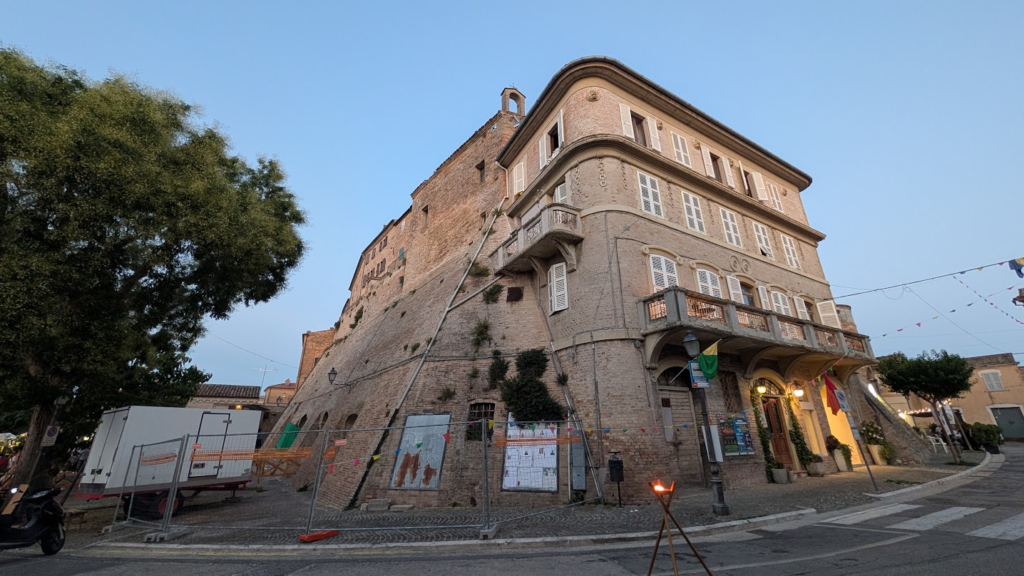
By mid-2026, close to ten years after the earthquakes, the Marche region alone counted 5,526 active reconstruction projects and 8,644 completed ones — more than 14,000 total interventions — spread across 180 municipalities for private reconstruction, backed by more than 11.2 billion euros in allocated and programmed resources, according to the anniversary report presented in Rome in June 2026. That is not a statistic about damage. It is a statistic about capacity. A decade of sustained, funded, technically supervised reconstruction work has built a density of engineers, geometri, and specialized contractors trained specifically in assessing and reinforcing historic masonry buildings for seismic performance that simply does not exist at the same scale anywhere else in the country. Towns like Camerino, whose historic center spent years as one of the most visibly damaged sites in the crater, are today active construction sites rather than silent ones — a shift the reconstruction authority has been documenting step by step. I am one of the licensed engineers who has spent this decade doing that work, and I can tell you plainly: a building in this region that has already been assessed, or reinforced, under this program often carries better-documented structural history than a comparable farmhouse in an unclassified zone that has never had to prove anything to anyone. The crater zone also carries a real fiscal upside for foreign retirees who relocate here, which I cover separately in my guide to the 7 percent flat tax in Le Marche.
The seismic classification is a variable to price into your decision, not a reason to walk away from it. A property with an unresolved seismic vulnerability and no plan to address it is a real liability. A property with a documented, professionally assessed structural condition — seismic zone or not — is simply a known quantity, which is exactly what the easy version of the buying-a-house-in-Italy story never gives you.
The takeaway
None of this is meant to talk you out of buying a farmhouse in central Italy. I have spent thirty years walking through buildings like the one in that Marche kitchen, and I understand exactly why an American standing there, light coming in low through the shutters, starts doing the math on rent versus ownership before finishing the tour. The dream is not the problem. The problem is signing the compromesso before anyone qualified has told you what the walls are actually carrying.
Get the survey before the offer. Read the compromesso like the binding contract it is, not like the offer letter it resembles. Treat the seismic zone as information, not as a reason to skip due diligence you would need anywhere else in Italy too. Do that, and the story you tell afterward can be both the eleven-thousand-euro headline and the honest one — because the two were never actually in conflict. Only the order of operations was.
If you are considering a purchase in Le Marche or elsewhere in central Italy, I offer an independent pre-purchase technical survey for foreign buyers, separate from any real estate agency and reporting only to you. You can book an orientation call to talk through your specific property at tidycal.com/mircovitellozzi/property-survey-orientation-call.
FAQ — Buying a house in Italy: what Americans actually need to know
What does it actually cost to buy and renovate a house in Italy?
Costs vary enormously by property condition, not by the sale price alone. Documented cases range from roughly $30,000 all-in for a straightforward two-bedroom renovation to well over $400,000 for a full structural rebuild of a one-euro property, according to CNBC’s reporting on foreign buyers. The purchase price is often the smallest line item.
Is a technical survey required before buying a house in Italy?
No Italian law requires one, and that is precisely the risk. Neither the real estate agent nor the notary is obligated to assess structural or seismic condition, so a technical survey has to be arranged independently by the buyer, ideally before signing any binding offer.
How long does it typically take to close on a house in Italy?
Timelines vary widely. Some foreign buyers report finishing a purchase and basic renovation within about a year; others, especially with older or structurally compromised buildings, report a process stretching to three years or more, with renovation budgets doubling along the way, according to independently published buyer accounts.
What is a caparra confirmatoria and how much do I need to pay?
It is a binding security deposit paid when signing the preliminary contract, the compromesso, typically between ten and thirty percent of the purchase price, most often around ten to twenty. Under Article 1385 of the Italian Civil Code, a buyer who backs out without legal justification forfeits it entirely.
Do I need a lawyer as well as a notary?
The notary is a neutral public official who verifies legal title and registers the deed, not an advocate for either party. Foreign buyers, particularly those unfamiliar with Italian contract language, often engage an independent lawyer or technical consultant to review the compromesso before signing, alongside the notary’s role at closing.
What documents reveal a building’s condition before I make an offer?
A proper technical survey checks three things together: conformity between the cadastral records and the physical building, the status of the agibilità (habitability) certificate, and, in seismic-classified zones like Le Marche, a specific seismic vulnerability assessment rather than a general structural opinion.
Is Le Marche’s seismic zone a reason to avoid buying there?
Not on its own. A decade of funded post-2016 reconstruction work has built an unusually deep concentration of structural engineers and specialized contractors in the region, and many properties already carry documented, professionally assessed structural histories. The zone is a variable to factor into due diligence, not a disqualifier.