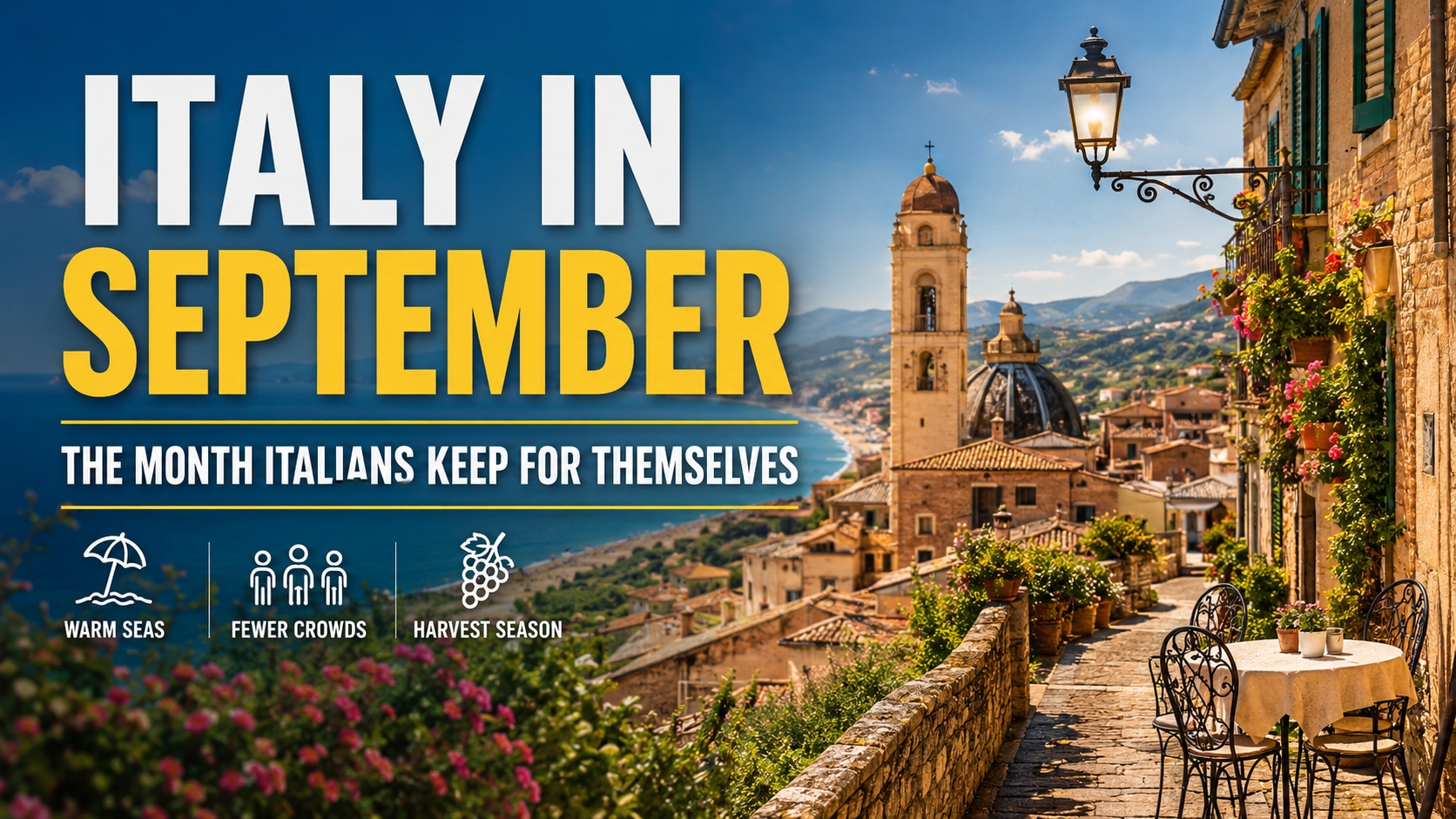
Italy in September: The Month Italians Keep for Themselves
Italy in September belongs to a country that has already gone back to work. By the second week of the month, the lifeguard towers along the Adriatic between Civitanova Marche and Porto San Giorgio start coming down, even though the afternoon sun still pushes past 80°F (27°C). I have watched this handover every September of my working life: beach clubs that spent June through August packed elbow to elbow start folding their umbrellas while the sea is still warm enough for a swim, because September 1 in Italy is not primarily a weather event. It is a social one. School bells prepare to ring, offices refill, and an entire country quietly turns its back on summer while summer, meteorologically, is still very much in progress. This guide covers what actually changes, what the numbers show, and where the month works best — including the parts nobody selling you a plane ticket wants to explain.
Is September a Good Time to Visit Italy? The Short Answer
Yes — September is one of the strongest months to visit Italy, pairing summer-level warmth with thinner crowds and a meaningful drop in domestic tourist traffic after the mid-August holiday of Ferragosto. Average highs stay in the mid-70s to mid-80s Fahrenheit across most of the country through the first half of the month, the sea remains swimmable on both coasts, and Italian vacationers largely disappear from beaches and hill towns once schools and offices reopen.
The qualification matters more than the headline. Early September, roughly through the 15th, still behaves like a quieter version of August. Late September shifts toward genuine autumn — cooler nights, a rising chance of rain, and shortening days, especially inland and in the north. Treat the month as two different trips, not one.
What Actually Changes on September 1
Nothing changes meteorologically on September 1. Everything changes socially. Italians organize their year around Ferragosto, the August 15 holiday, and the weeks that follow it function as a kind of collective exhale. Offices that ran on skeleton staff through August fill back up. Restaurants that posted chiuso per ferie (closed for holidays) signs for two or three weeks in August reopen with fresh menus. In Le Marche, where I do most of my structural survey work, the shift is visible on the ground within a single week: second homes along the coast get shuttered and winterized, beach concessions start dismantling their seasonal structures, and farm calendars pivot hard toward the grape harvest, which I will get to shortly.
School is the one piece of this that does not happen on September 1 itself. In the Marche, the 2026/2027 school year officially opens on Monday, September 14, under the regional school calendar approved in May 2026 — a date roughly in line with most of Italy, where the return to class clusters in the second week of the month. That two-week gap between “offices reopen” and “kids are back in school” is exactly when a lot of Italian families take their last trip of the summer, which is worth knowing if you are hoping September means an empty Italy. It does not, fully, until closer to the 20th. Anyone timing a visit around Italy in September for the sake of quiet piazzas should treat the first two weeks as a transition period rather than the finish line.
The scale of the shift shows up clearly in the national tourism data. According to Italy’s national statistics institute, ISTAT, the third quarter of 2025 split unevenly across its three months: July accounted for 36.5% of the quarter’s overnight stays, August for 39.3%, and September for just 24.2% — roughly a third less traffic than August in absolute terms. That drop is what makes the month feel different even though the weather barely has. It is also the reason Italy in September reads, on the ground, as a completely different country from the one you would have found there three weeks earlier.
Italy in September: Weather Region by Region
September weather in Italy runs on a north-south gradient that is sharper than most visitors expect. Milan and the Po Valley are already shedding summer humidity by mid-month, while Palermo and the deep south hold onto genuine summer heat through the first two or three weeks. The table below draws on long-term climate averages (Weather Atlas historical dataset, accessed August 2026) for each location, cross-checked against a second climate archive where the two diverged by more than a degree or two.
| Location | Avg. high | Avg. low | Avg. rainy days |
|---|---|---|---|
| Milan | 76°F / 24.4°C | 57°F / 14.0°C | ~6 |
| Venice | 74°F / 23.5°C | 58°F / 14.3°C | ~6 |
| Florence | 80°F / 26.7°C | 58°F / 14.4°C | ~6 |
| Rome | 80°F / 26.5°C | 59°F / 15.2°C | ~6 |
| Naples | 78°F / 25.8°C | 67°F / 19.5°C | ~11 |
| Le Marche coast (Ancona) | 76°F / 24.3°C | 65°F / 18.5°C | ~10 |
| Le Marche interior / Sibillini foothills (Amandola) | 73°F / 22.7°C | 56°F / 13.6°C | ~10 |
| Palermo | 78°F / 25.5°C | 68°F / 19.8°C | ~5 |
Two things stand out. First, the north-south temperature gap that feels enormous in January nearly disappears in September: Milan and Palermo are nine degrees Fahrenheit apart on average highs, versus a much wider spread in deep winter. Second, rainy-day counts do not track temperature the way you would expect. Naples and the Marche coast both show more rain days than Rome or Florence, because September is when the first proper Mediterranean low-pressure systems start organizing off the Tyrrhenian and Adriatic coasts, and the south catches more of them early in the season than the numbers for August would suggest.
Inland and at altitude, the gap widens further. In the foothills of the Sibillini Mountains, where towns like Amandola and Sarnano sit above 1,500 feet, the day-to-night temperature swing in September regularly exceeds 20°F, something that never happens on the coast twenty miles away. By the final third of the month, the Apennine ridge line starts pulling in the season’s first real cold fronts, and afternoon thunderstorms in the mountains become a near-daily possibility rather than an occasional one — a pattern any hiker planning a Sibillini trip in late September needs to build into the itinerary, not treat as bad luck.
The Sea Is Warmer in September Than in June
This surprises most first-time visitors: Adriatic and Tyrrhenian sea temperatures in September average higher than in June, despite September having noticeably shorter, cooler days. Adriatic water along the Italian coast averages roughly 73–77°F (23–25°C) in September, compared to about 72–74°F (22–23.5°C) in June, based on multi-year seawater temperature records. Off Ancona specifically, average September sea temperature runs around 75°F (23.9°C).
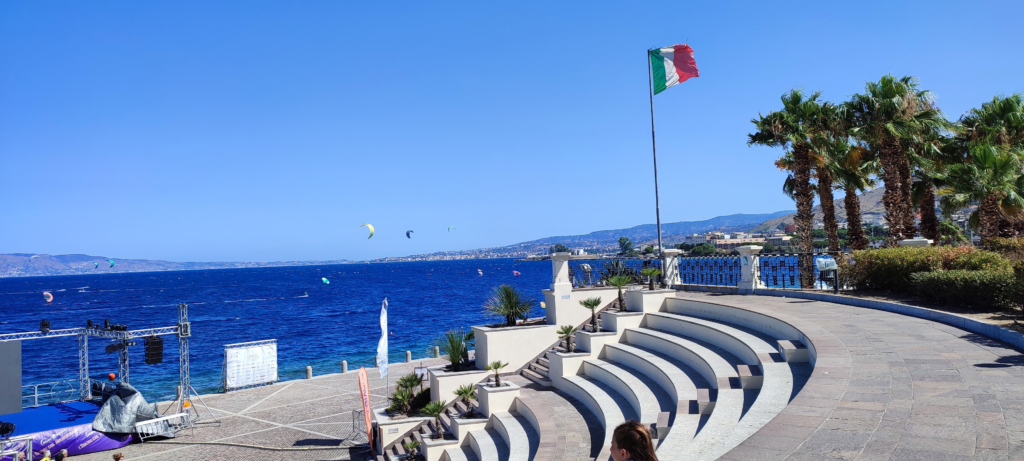
The explanation is thermal inertia, and it is the kind of thing that comes up naturally when you spend a career thinking about how mass absorbs and releases heat. Water has a far higher heat capacity than air or rock, so the Adriatic and Tyrrhenian keep warming through the peak sun months and release that stored heat slowly, with a lag of roughly six to eight weeks behind the air temperature curve. June sits right after the sea’s coldest stretch of the year; September sits right after its warmest. The sea, in other words, is still catching up to August’s heat while the beaches have already emptied out around it — which is precisely why late-September swimming, on a calm day, can feel better than anything in early summer. It is one of the clearest arguments for treating Italy in September as a beach month, not just a culture-and-cities month.
Crowds and Prices: What the Numbers Actually Show
The crowd story is straightforward. ISTAT’s provisional third-quarter 2025 data recorded 19.1 million arrivals and 85.2 million overnight stays across Italy in August, against 14.8 million arrivals and 52.4 million overnight stays in September — a drop of roughly 22% in arrivals and 39% in overnight stays month over month. September was also the only month of the quarter, alongside July, where foreign visitors outnumbered Italians by a wide margin: non-resident guests accounted for 63.4% of September’s overnight stays, compared with just 53.3% in August, when Italians themselves dominate the beaches.
The price story is less tidy, and worth stating plainly rather than picking a number that sounds good. One 2026 hospitality industry report (SiteMinder’s Hotel Booking Trends, covering hotels on its own booking platform) projected September 2026 average daily hotel rates in Italy at roughly €332, up 5.7% year over year and actually higher than both July (€282) and August (€289) — a reversal driven by a surge in international shoulder-season demand and longer booking windows for September specifically. A separate hospitality dataset covering 2025, drawn from a broader sample of Italian accommodations, found the opposite seasonal pattern: average nightly rates around €220 in July and €210 in August, with prices trending downward from September onward. The two sources disagree because they are measuring different things — one tracks a subset of internationally-oriented hotels riding a documented 2026 surge in premium shoulder-season bookings, the other reflects a wider, more budget-inclusive slice of the market. The honest takeaway: September pricing in Italy is no longer the automatic bargain it was a decade ago, particularly in destination cities and for well-reviewed properties, even if plenty of value still exists once you move off the most-booked addresses.
September versus October, the comparison most people actually want to make, splits cleanly along one line: September still gives you swimmable seas and a functioning beach infrastructure in most places, October generally does not. If water time matters to your trip, that single fact should settle the month for you before price or crowd data even enters the conversation. Weigh the two datasets above against your own priorities rather than looking for a single verdict: a visitor chasing the lowest possible price should still lean toward the back half of the month or October proper, while a visitor who values functioning infrastructure and predictable service will find Italy in September, particularly its first three weeks, the more reliable choice of the two.
Vendemmia: The Harvest That Reorganizes the Countryside
September in the Italian countryside is vendemmia season — grape harvest — and in wine country it reorders daily life more than any calendar date does. The sequence runs roughly from grape variety to grape variety rather than from date to date: base wines destined for spumante come in first, typically in the final days of August; aromatic and early-ripening white varieties follow through the first half of September; and late-ripening reds close out the season from late September into October, sometimes later at altitude.
| Grape / wine | Typical harvest window |
|---|---|
| Base wines for spumante | Late August |
| Early white varieties (Pecorino, Moscato) | Early September |
| Verdicchio dei Castelli di Jesi (Marche) | Mid-to-late September into early October |
| Rosso Conero / Montepulciano (Marche) | Late September through late October, later inland |
Verdicchio, the white grape that built the Castelli di Jesi’s reputation, is generally picked from the second half of September into the first days of October, according to the production framework set by the DOC consortium. Rosso Conero, made from the late-ripening Montepulciano grape, comes off the vine even later — from the end of September in warm years to the end of October in cooler ones, with inland vineyards typically finishing after the coastal ones. That gap between Verdicchio and Rosso Conero, two wines grown within a short drive of each other around Ancona, is exactly the kind of detail nobody explains to visitors: the same September week can mean full-scale harvest chaos in one valley and quiet, unpicked vines in the next.
2026 is a useful case study in why nobody, including the professional bodies that normally forecast this, should pretend to know the harvest calendar with precision months in advance. Italy’s main oenological and wine-trade associations — Assoenologi, Ismea, and Unione Italiana Vini — canceled their traditional pre-harvest press conference for 2026 altogether, citing weather too unstable to produce reliable early estimates, and pushed final production data to after the harvest concludes in November. On the ground in the Marche, Coldiretti reported in early August 2026 that the regional harvest was starting about a week earlier than in 2025, driven by an unusually hot summer. The takeaway for a visitor: harvest timing shifts by a week or two most years, and a specific winery’s picking date is not something you can plan around from another continent. Contact the producer directly if witnessing an active harvest matters to your itinerary — the reward, when the timing lines up, is watching a working farm rather than a staged one.
September Festivals and Sagre Worth Planning Around
A handful of the country’s most significant annual events land in Italy in September, several with 2026 dates already confirmed by their organizers as of this writing (verified early August 2026).
Regata Storica, Venice — Sunday, September 6, 2026. Venice’s grandest rowing event and costumed water pageant fills the Grand Canal with historic vessels on the first Sunday of September, as it has for centuries.
Venice International Film Festival (Mostra del Cinema) — September 2–12, 2026, at the Lido di Venezia. The world’s oldest film festival, and one of the year’s biggest draws on hotel availability in Venice specifically, regardless of the wider region’s quieter numbers.
Palio di Asti — Sunday, September 6, 2026, in Piedmont’s Piazza Alfieri. A bareback horse race dating to 1275, preceded by a medieval parade with over a thousand costumed participants.
Giostra della Quintana — La Rivincita, Foligno — September 12–13, 2026, in Umbria. The autumn rematch of Foligno’s baroque jousting tournament, in which knights from the city’s ten districts compete for a painted banner — a sister event to the better-known June edition, and a cousin, in spirit if not in season, to the summer Quintana held in Ascoli Piceno.
Giovedì al Castello, Gradara — weekly through September 10, 2026, in the Marche. Thursday-evening medieval reenactments inside one of the best-preserved fortified castles in the region — a smaller, local counterpart to the grander palios elsewhere.
Worth noting for anyone building an Italian-insider itinerary: the Marche’s own calendar of medieval pageants and historic horse races — the Cavalcata dell’Assunta in Fermo, the Torneo Cavalleresco in Servigliano, the Quintana in Ascoli Piceno — clusters almost entirely around Ferragosto in mid-August, not September. By the time the month most visitors associate with festivals arrives, the region’s public attention has already shifted from costumed pageantry to the vineyards. The clearest expression of that shift, the Sagra dell’Uva in Cupramontana — the oldest grape festival in the Marche, running since 1928 — technically falls just outside our window in 2026, scheduled for October 1–4.
Early September vs. Late September: Two Different Months
Early and late September are different trips wearing the same name, and the dividing line sits almost exactly at the 15th. Before mid-month, expect summer prices in beach towns, a still-full calendar of seasonal restaurants and beach clubs, warm swimming water, and crowds that are lighter than August but still present at major sites. After mid-month, expect a sharper drop in both temperature and tourist density, along with the first closures of seasonal coastal businesses.
The practical discriminants line up cleanly. Prices: early September still commands close to peak-season rates in resort towns; late September starts to soften, especially inland. Crowds: early September is meaningfully quieter than August but not empty; late September is when Italy’s most-photographed piazzas start to feel like they belong to residents again. Weather: early September is reliably warm across the whole country; late September introduces real variability, particularly north of Rome and at altitude. Sea and beach infrastructure: early September beaches operate at close to full service; by late September, a rising share of beach concessions along the Adriatic have already dismantled for the season, even where the water itself is still swimmable.
Where September Works Best (and Where It Doesn’t)
Five places where Italy in September earns its reputation, and one honest exception.
Le Marche’s Adriatic coast works well in September because the region never had August’s volume of foreign tourism to begin with, so the post-Ferragosto emptying is dramatic without leaving the coast dead — restaurants and hotels stay open, just noticeably less crowded, while the sea holds its late-summer warmth.
Venice works in September on a purely practical level — the worst of the summer humidity breaks — but this is the exception where the calendar works against you: the Regata Storica and the tail end of the Film Festival both land in the first half of the month, so “quieter” is relative to August, not to the rest of the year.
The Sibillini Mountains and Apennine interior reward September hiking with clear early-month conditions and the added spectacle of the vendemmia in the valleys below, though the window narrows fast — by late September, afternoon storms at altitude become a real planning consideration rather than a remote possibility.
Piedmont’s wine country around Asti combines the Palio’s costumed spectacle with the start of its own harvest season, and the region’s inland climate keeps daytime temperatures comfortable for walking vineyards without August’s heat.
Tuscany’s hill towns thin out noticeably once Italian domestic tourism recedes after Ferragosto, restoring some of the quiet that makes towns like San Gimignano or Montepulciano worth visiting in the first place.
The exception: high-altitude Dolomite hiking after mid-September is a genuinely poor fit. Many mountain refuges (rifugi) close for the season between mid-September and early October, cable cars reduce their schedules, and snow becomes a real possibility above 6,500 feet by the month’s final week — this is a trip to plan for July or August instead, not September, regardless of how appealing the lighter crowds sound on paper.
What to Pack for Italy in September
The single detail that catches Americans off guard is the day-to-night temperature swing, which is sharper in September than at any other point in the Italian calendar — nowhere more so than in hill towns and inland valleys, where a 25°F drop between 3 p.m. and 11 p.m. is routine.
A practical layering approach handles this without overpacking:
- Lightweight, breathable clothing for daytime — the same things you would wear in July
- One genuine layer for evenings: a light jacket or sweater, not just a cardigan, especially inland or at altitude
- A compact umbrella or packable rain shell, given the rising rain probability toward month’s end
- Comfortable, broken-in walking shoes — September’s cobblestones do not care what month it is
- A swimsuit, even for a city-focused trip — an unplanned coastal detour in early September is one of the better impulse decisions available to a visitor
Five Mistakes Americans Make in September
The pattern I notice most often, reviewing the trips friends and clients plan for this month, comes down to five recurring miscalculations.
Booking the coast after September 15 and expecting August service. A meaningful share of beach clubs, restaurants, and seasonal hotels along the Adriatic close for the year once the local school calendar returns and the weekend crowd disappears — sometimes with only a few days’ notice on their website.
Assuming museums keep their summer hours. Many state museums and archaeological sites shift to shorter autumn opening hours partway through September; a schedule checked in July is not reliable by the third week of the month.
Not accounting for early-month restaurant closures in small towns. Family-run restaurants in villages often take their own late-summer break in the first days of September, right after the owners’ own Ferragosto-adjacent holiday — the inverse of the assumption that everything reopens on schedule the moment August ends.
Underestimating Apennine rain and temperature swings. Visitors planning inland or mountain days based on coastal weather forecasts consistently pack too light and get caught by afternoon storms that build over the ridge lines with little warning.
Trying to plan a vendemmia visit without contacting the winery directly. Harvest dates move by a week or two most years and depend on grape variety, altitude, and that season’s weather — a producer’s own calendar, confirmed close to your travel dates, is the only reliable source. The same caution applies to truffle season, which visitors often conflate with the grape harvest: the real white-truffle calendar in the Marche and Piedmont doesn’t open in earnest until October.
The Takeaway
Italy in September rewards visitors who understand it is two different months stitched together under one name, governed less by temperature than by the rhythm of a country going back to work. Book the first half if you want warm water and a full calendar of open businesses with meaningfully lighter crowds than August. Book the second half if quiet matters more to you than convenience, and bring a real jacket. Either way, you are visiting during the exact stretch that Italians themselves, myself included, consider the best-kept secret on the calendar — not because nothing is happening, but because what is happening, the harvest most of all, was never designed with visitors in mind.
If you’re planning a September trip to the Marche and want an Italian insider’s read on timing, routes, or where the region’s harvest season is worth building a visit around, you can explore more from Tastes & Wonders of Italy or get in touch directly.
FAQ: Italy in September
Is September better than October to visit Italy?
September generally beats October for beach time, since the sea stays swimmable and coastal towns still operate at near-full service. October offers thinner crowds, lower prices, and the start of white-truffle season, but cooler weather, shorter days, and closed seasonal beach infrastructure. Choose September for warmth and water, October for quiet and value.
Can you still swim in Italy in September?
Yes. Adriatic and Tyrrhenian sea temperatures in September average around 73–77°F (23–25°C), often warmer than June, thanks to the sea’s slow seasonal heat lag. Swimming stays comfortable through most of the month, though beach club infrastructure — umbrellas, changing rooms, lifeguards — starts closing along stretches of the Adriatic coast after mid-month.
How crowded is Italy in September?
Noticeably quieter than August. ISTAT recorded 52.4 million overnight stays nationwide in September 2025, against 85.2 million in August — a drop of roughly 39%. Crowds thin further after mid-month, once Italian schools reopen, though major sites in cities like Venice and Rome still draw significant international visitor traffic throughout the month.
Is Italy rainy in September?
Rainfall increases gradually through the month but stays moderate overall. Most major cities average around six rainy days, with wetter patterns in Naples and along the Adriatic coast, where roughly ten rainy days is typical. Inland and mountain areas, including the Apennines, see rising thunderstorm risk in the final third of the month.
Are prices lower in Italy in September than in August?
It depends on the source and the type of property. Some 2026 hotel industry data shows September rates running higher than August, driven by strong international shoulder-season demand; other broader hospitality datasets show September prices trending downward from August. Expect meaningful variation by destination and property type rather than a single reliable discount.
What should I pack for Italy in September?
Pack for a wide day-to-night temperature swing: lightweight daytime clothing plus a genuine jacket or sweater for evenings, especially inland or in hill towns. Add a compact umbrella, comfortable walking shoes, and a swimsuit. Layering matters more in September than in any other month of the Italian travel calendar.
Is late September too late for the beach in Italy?
Not for swimming — sea temperatures generally stay comfortable into early October. It is often too late for full beach-club service, though, since many seasonal concessions along the Adriatic close once the local school calendar returns and weekend crowds fade. Confirm directly with a specific beach club before counting on facilities being open.
Are museums and restaurants open normally in Italy in September?
Mostly, but not entirely. Many state museums and archaeological sites shift from summer to shorter autumn hours partway through the month, so hours checked in July may be outdated by late September. Small-town, family-run restaurants sometimes take their own late-summer break in the first days of the month, right after Ferragosto.