Italian Sparkling Wine for the Holidays: Prosecco, Franciacorta, Trentodoc and Lambrusco
Italian sparkling wine is not one wine, and it is not only Prosecco. Four or five styles sit behind that word, and each one has its own night in an Italian house between December 24 and January 1. Prosecco is light, fruity, and cheap, made quickly in a steel tank. Franciacorta and Trentodoc are made the way Champagne is made, and they cost less than Champagne. Lambrusco is red, frothy, and built for fatty food. Moscato d’Asti is sweet, and it exists for the cake. This guide tells you which one to buy, and for which evening.
This article contains affiliate links. If you buy through them, I may earn a small commission at no extra cost to you.
Italian Sparkling Wine at a Glance
Here are the five styles of Italian sparkling wine, side by side. The column that matters most is the last one, because in Italy the occasion chooses the bottle rather than the other way around. The price bands are what these wines generally cost in American stores; they move with the state you live in, so treat them as a range and not a quote.
| Style | Region | Method | Main grapes | Minimum time on the lees | Taste, in four words | US price band | When Italians open it |
|---|---|---|---|---|---|---|---|
| Prosecco | Veneto and Friuli Venezia Giulia | Steel tank | Glera, at least 85% | None set by the rules | Light, pear, floral, easy | Under $20 | Before dinner, any night |
| Franciacorta | Lombardy | Bottle | Chardonnay, Pinot Nero, Pinot Bianco | 18 months | Toasty, fine, dry, serious | $20 to $45 | Christmas lunch and midnight |
| Trentodoc | Trentino | Bottle | Chardonnay, Pinot Nero, Pinot Bianco, Meunier | 15 months | Sharp, clean, bracing, taut | $20 to $45 | Christmas Eve, with fish |
| Lambrusco | Emilia | Tank or bottle | Lambrusco grape varieties | None set by the rules | Red, tart, frothy, savory | Under $20 | New Year’s Eve, with pork |
| Moscato d’Asti | Piedmont | Single tank fermentation | Moscato bianco, at least 97% | None set by the rules | Sweet, grapey, gentle, low | Under $20 | With the Christmas cake |
Two Ways to Put Bubbles in a Bottle
Every Italian sparkling wine starts as a still wine. The bubbles come from a second fermentation, and there are only two places to run it. The first place is a sealed steel tank, big enough to hold a small car. Italians call this the Martinotti method, after Federico Martinotti; Americans usually call it Charmat. The wine ferments for weeks, then gets bottled under pressure. It is fast, and it keeps the fruit.
The second place is the bottle itself. Wine, yeast, and a little sugar go in, and the fermentation happens inside the glass you will eventually open. Afterward the wine rests on the spent yeast for months or years. That contact changes it. The fruit retreats, and bread, almond, and pastry notes come forward. At the end the dead yeast has to be frozen into the neck and fired out.
So the price gap is not marketing. Tank wine is ready in a season; bottle wine occupies cellar space for years and needs an extra set of hands at the end. That is why a good Prosecco costs fifteen dollars and a good Franciacorta costs forty. Neither method is better. They simply make different wine, and they suit different moments.
One letter a month from inside central Italy.
The places, seasons and stories I don't put on the blog. No itineraries, no spam.
Prosecco: The Everyday Bottle, and How to Read It
Prosecco is the Italian sparkling wine Americans already know. It became a protected name in 2009, and the law behind it is worth two minutes of your time. The grape is Glera, which must make up at least 85% of the wine. The flat, generous vineyards of Veneto and Friuli Venezia Giulia produce Prosecco DOC, which is most of what reaches America. In 2025 the growers made 667 million bottles, and the United States took the largest share of the exports.
Above the DOC sit two smaller zones with stricter rules: Conegliano Valdobbiadene Prosecco Superiore and Asolo Prosecco. Both are DOCG, the higher Italian tier, and both come from steep hills where the harvest is done by hand. Inside Conegliano Valdobbiadene you will also find Rive, single-village bottlings, and Cartizze, a small, famous hillside. These bottles cost more. They also taste more specific.
There is one more version, rarely exported and worth hunting: col fondo (bottle-fermented and cloudy, resting on its own yeast). The official name in Conegliano Valdobbiadene is Sui Lieviti, on the lees. It is bone dry, hazy, and often closed with a beer cap. Italians drink it the way you might drink a farmhouse cider, and it belongs on a table with cured meat rather than in a flute.
The Extra Dry Trap
Now the part that costs Americans money every December. On a sparkling label, Extra Dry is sweeter than Brut. That is not a translation quirk; it is written into European law. Commission Delegated Regulation (EU) 2019/33 sets the ladder, in Annex III, Part A. The unit is grams of sugar per liter. Brut nature sits under 3, and extra brut runs from 0 to 6. Brut stays under 12. Extra dry runs 12 to 17, and dry runs 17 to 32. Demi-sec is 32 to 50, and dolce is anything above 50.
Read that ladder again. “Dry” is the fourth-sweetest term on it, and “extra dry” is the third. If you want a crisp bottle for shrimp or for an Italian aperitivo, the word you want is Brut, or Extra Brut if you like it severe. Much of the Prosecco sold in America is Extra Dry, because the extra sugar flatters the fruit. Browse the Prosecco selection at Wine.com and you can filter by that single word.
Franciacorta: Italy’s Answer to Champagne
Franciacorta is the Italian sparkling wine that takes on Champagne directly. It comes from Lombardy, east of Milan, near Lake Iseo. It earned its DOC in 1967 and was promoted to DOCG in 1995. The grapes are Chardonnay and Pinot Nero, with Pinot Bianco permitted up to half the vineyard and a local grape called Erbamat allowed up to a tenth since 2017. Every bottle ferments a second time in the bottle and is then disgorged. There is no tank version.
The production rules set the aging, and the numbers are the point. A basic Franciacorta rests 18 months on the spent yeast, a year and a half before anyone tastes it. The Rosé and the Satèn rest 24 months. A vintage bottle rests 30 months. A Riserva rests 60 months, five full years in a dark cellar. Those months are what you are paying for, and you can taste them as pastry and toasted almond.
Satèn deserves its own sentence, because it exists nowhere else. It is made only from white grapes, it is always Brut, and it is bottled at a lower pressure than a normal sparkling wine. The bubbles arrive softer and rounder rather than sharp. Satèn is the bottle I open when the table includes people who say they do not like sparkling wine. It usually converts them.
Is it better than Champagne? Honestly, not always. The very best Champagne has a depth and a saline length that few Franciacorta reach. But at thirty to forty-five dollars, where most Champagne is still thin and industrial, Franciacorta is frequently the better glass. One more detail that amuses me: the rules forbid the words “metodo classico” on a Franciacorta label. The name alone is supposed to tell you the method.
Trentodoc: Mountain Bubbles
Trento became a protected name in 1993, and it was the first Italian denomination reserved entirely for bottle-fermented sparkling wine. The vineyards climb the Alpine slopes of Trentino, reaching up to 800 meters, roughly 2,600 feet. Cold nights at that height slow the grapes down and keep the acidity high, and acidity is the backbone of a sparkling wine. You taste it as a line of tension running the length of the glass.
The grapes are Chardonnay, Pinot Bianco, Pinot Nero, and Meunier, in any combination the producer wants. A basic bottle rests 15 months on the spent yeast. Add a vintage on the label and the minimum rises to 24 months; a Riserva rests at least 36 months. The producers market the wines together under the collective name Trentodoc, which is why you will see that word written as one piece.
Trentodoc remains the least known Italian sparkling wine in American stores, and the reason is arithmetic. Trentino makes fewer bottles than Franciacorta, and Italy drinks most of them. When you do find one, it tends to be the sharpest and leanest of the lot. Pour it when the food is delicate and you want the wine to cut rather than cushion.
Lambrusco: Forget What You Drank in 1985
Lambrusco is the Italian sparkling wine with the worst reputation in America, and the reputation has a cause. An American over fifty usually has one memory of it: sweet, red, and sold in a screw-cap bottle. That memory is accurate. Riunite built an empire on it. By 1983 it was the number one imported wine in America, according to Wine Spectator. TIME later reported a peak of roughly 11.5 million cases a year. Then tastes moved on, and the category collapsed in the United States.
Meanwhile, in Emilia, nobody stopped drinking the dry version. Real Lambrusco is a red sparkling wine with a foam-like head, sharp acidity, and a savory, almost bitter finish. There are several denominations, and three matter most. Lambrusco di Sorbara is the palest, closest to a dark rosé, and the most mineral. Grasparossa di Castelvetro is the darkest and most tannic. Salamino di Santa Croce sits between them.
Reading the label is simple once you know the words. The rules allow everything from bone dry to sweet. Look for “secco” or “brut” if you want the dry style. Avoid amabile (off-dry) and “dolce” unless sweetness is what you came for. Emilia is the land of prosciutto, mortadella, and pork fat. That explains the wine. The acid and the bubbles scrub the palate between bites. Italians generally match a wine to the local food rather than to a score.
Which Bottle for Which Night
This is how the week actually runs in an Italian household. I am not describing a sommelier’s pairing chart. I am describing what sits on the table, and why.
December 24: The Fish Dinner
Christmas Eve is a fish meal across most of Italy, and in the south it is a long one. The food is salty, often fried, and rarely rich. You want a wine with acidity and no sugar at all. Trentodoc is the natural choice, and a Franciacorta Satèn works beautifully too. Look for the word Brut or Extra Brut on the label, and ignore anything that says Extra Dry.
December 25: Christmas Lunch
Lunch is the heavyweight meal: filled pasta in broth, roast meat, several courses, three hours at the table. A basic Prosecco gets lost here. This is where a vintage Franciacorta earns its price, because 30 months on the lees give it enough body to stand beside roast meat. If your budget is tighter, a Franciacorta without a vintage still carries 18 months and handles the job.
December 31: Cotechino and Lentils
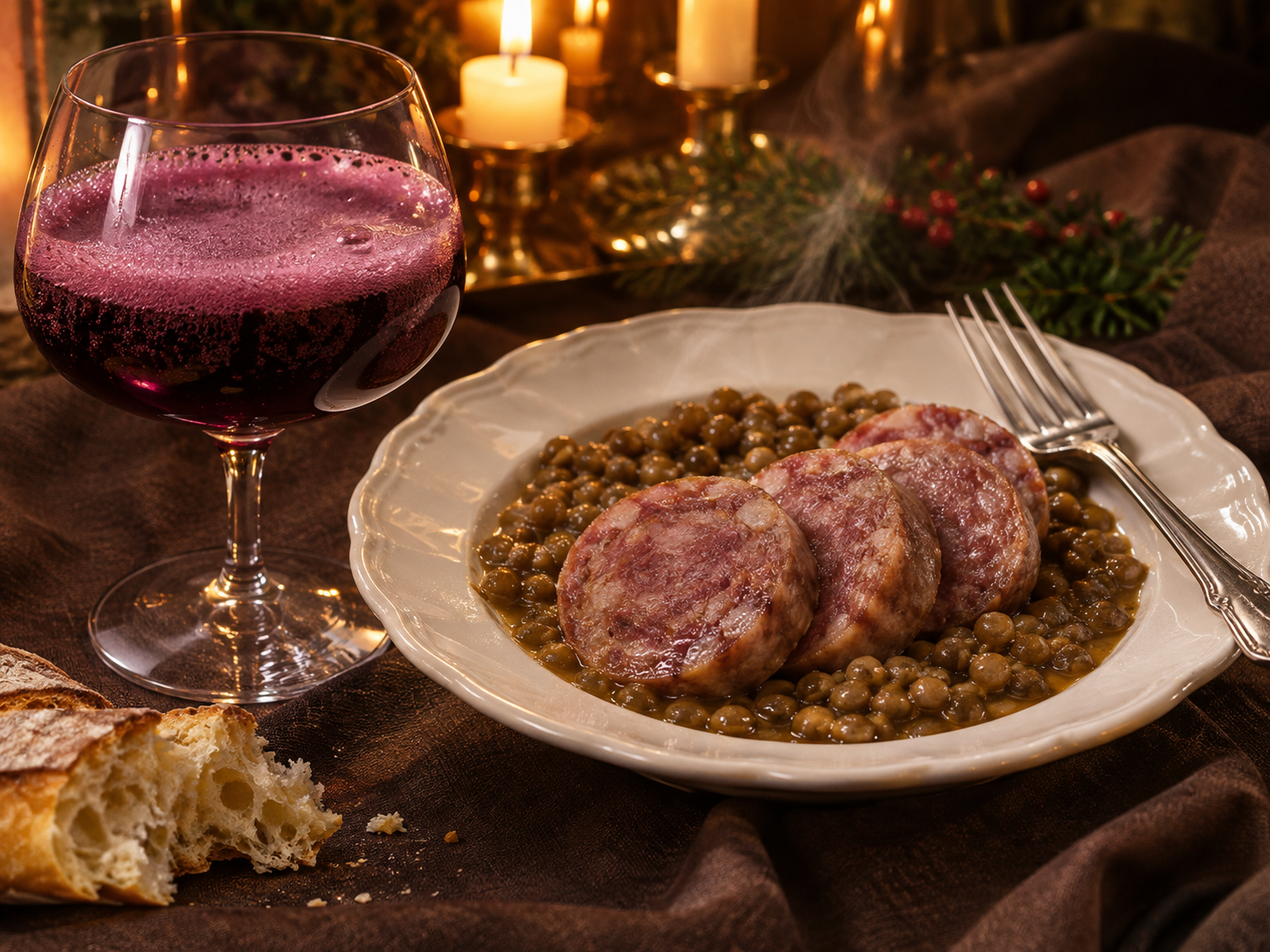
New Year’s Eve in Italy means cotechino (a large, soft pork sausage, boiled and sliced thick). It arrives on a bed of lentils, which are supposed to bring money in the coming year. This dish is fatty and deeply savory. A delicate white sparkling wine disappears against it. Dry Lambrusco is the answer, and it is the single best argument for the style. At midnight, pour whatever metodo classico you saved.
And Then the Cake
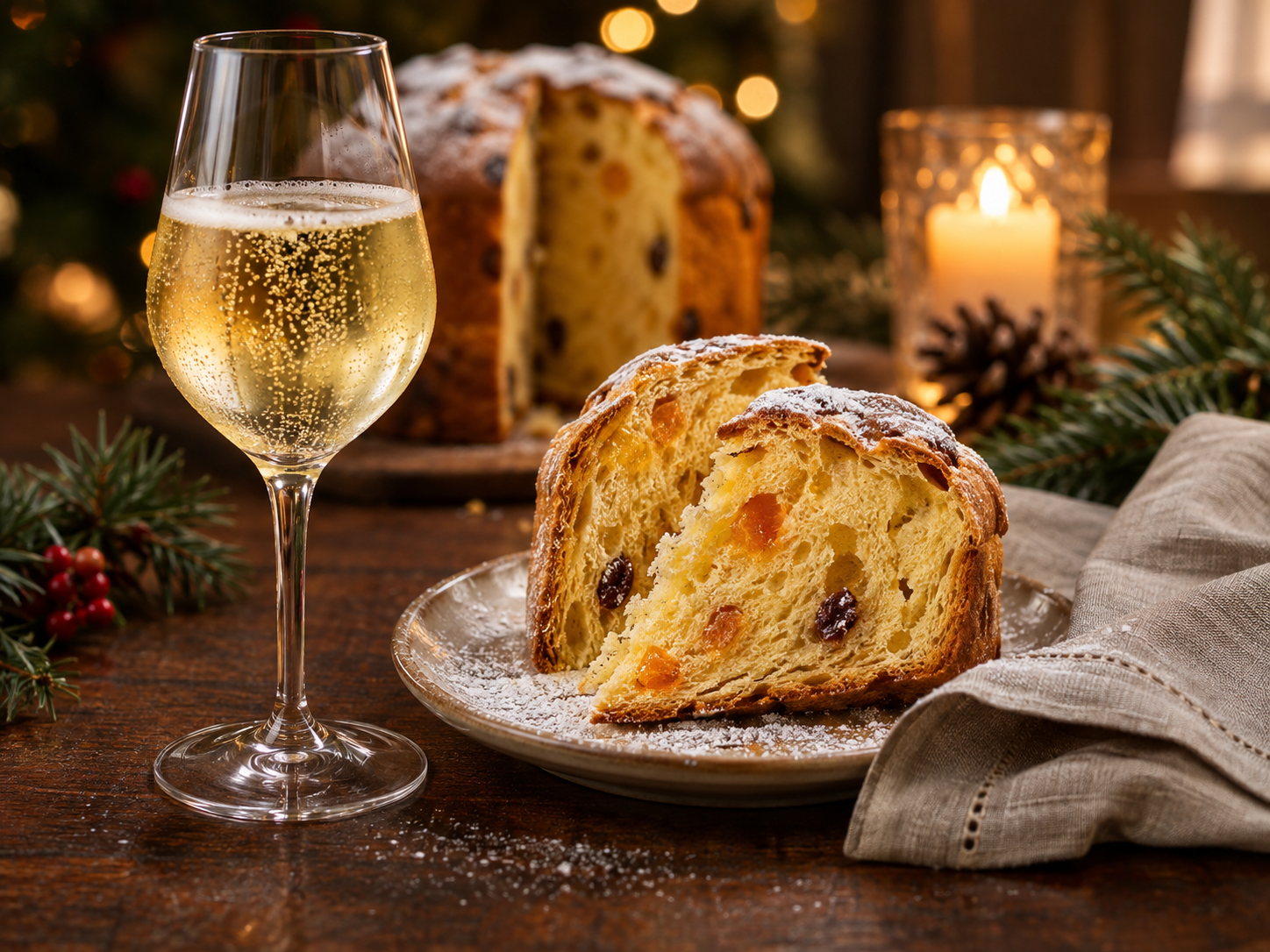
Dessert is panettone or pandoro, and the last Italian sparkling wine of the evening is Moscato d’Asti. It belongs to the Asti DOCG in Piedmont, it is made from Moscato bianco, and its fermentation is stopped early. The result has gentle fizz, obvious sweetness, and only four to six and a half percent alcohol, which is why it can follow a four-hour lunch. If you are still choosing between the two cakes, I wrote a guide to panettone versus pandoro.
The Bottle Nobody Exports: Verdicchio Spumante
I live in Le Marche, and we make an Italian sparkling wine that almost nobody outside the region knows. The Verdicchio dei Castelli di Jesi rules were rewritten in September 2025, and they now include a Spumante and a Spumante Riserva. The sparkling version can use either the tank or the bottle. The Riserva has to ferment in the bottle and age at least 36 months, the same minimum as a Trentodoc Riserva.
It tastes like the still wine it comes from: almond, green herb, and a faintly bitter finish that Verdicchio always leaves. Production is tiny and exports are thinner still, so you are unlikely to find it in an American store this December. If you come to the Marche, buy it at the winery. Meanwhile, the still version is easy to find and remains, in my view, the most underpriced white wine in Italy.
Buying Italian Sparkling Wine in the US
Three price bands cover almost everything. Under $20 buys you Prosecco, dry Lambrusco, and Moscato d’Asti, all of which are genuinely good at that price. Between $20 and $45 you reach Franciacorta and Trentodoc, and this band is where Italian sparkling wine beats Champagne most clearly on value. Above $45 you are buying vintage bottles and Riserve, with 30 to 60 months of aging behind them.
One reason the shelf price surprises people: the United States currently applies a tariff of 10% on European wine, in force since late July 2026 under a Section 301 determination. Wine was not exempted, though both the European Commission and France have asked for it. That tariff lands on the importer and works its way down to you, on top of federal duty, state excise, and three-tier distribution.
Shipping is the other obstacle, and state law decides it rather than retailer policy. Some states accept direct wine shipments, some restrict them, and a few forbid them. Any online retailer checks your address at checkout, so enter your ZIP code before you build a cart. You can browse Italian sparkling wine at Wine.com, or the wider Italian selection if you are filling a case.
What Not to Buy
Three honest warnings before you spend money on Italian sparkling wine, because a guide that recommends everything is useless.
First, do not buy Extra Dry for someone who told you they like dry wine. You now know the ladder, and the gap between Brut and Extra Dry is wide enough to taste. Second, do not serve sweet supermarket Lambrusco with the fish course. Sugar and seafood fight, and the pairing that works in Emilia works because the Lambrusco there is dry and the food is pork.
Third, be careful with holiday gift boxes. Many wrap one bottle in a rigid case and charge twenty dollars for cardboard. Compare the boxed price against the same wine sold bare, usually two aisles over. If the gap is more than a few dollars, buy the bare bottle and a ribbon.
If You Would Rather Give a Year of Wine
Sometimes the better gift is not a bottle but a subscription, especially for someone who already drinks well and owns everything. A wine club ships a selection every month or quarter, and it keeps arriving long after the holidays are over. Gold Medal Wine Club gift subscriptions work this way. Be clear about what it is: a general wine club, not a curated selection of Italian sparkling wine. If your recipient specifically wants bubbles from Italy, buy the bottles yourself.
Frequently Asked Questions
What is the difference between Prosecco and Champagne?
The method and the grape. Prosecco is made from Glera and ferments a second time in a sealed steel tank, which keeps the fruit bright. Champagne ferments in the bottle and ages on the spent yeast, which adds bread and pastry flavors. Prosecco is lighter and cheaper. Champagne is deeper and more expensive. Both answers are correct, depending on the night.
Is Franciacorta better than Champagne?
Not across the board, but often at the same price. Franciacorta is made by the same bottle method, with minimum aging of 18 months and up to 60 months for a Riserva. Below about fifty dollars it frequently outperforms Champagne. At the very top, the best Champagne houses still have more complexity.
What does Extra Dry mean on a sparkling wine label?
It means off-dry, not dry. European rules put Extra Dry at 12 to 17 grams of sugar per liter, while Brut sits under 12 and Extra Brut between 0 and 6. If you want a dry bottle, look for Brut, Extra Brut, or Brut Nature. Extra Dry is sweeter than all three.
Is Lambrusco sweet?
It can be, but the traditional style is dry. The rules permit everything from bone dry to sweet. The sweet version is the one America imported in enormous volumes in the 1970s and 1980s. Look for “secco” or “brut” on the label to get the dry style that Italians actually drink with food.
What temperature should I serve Italian sparkling wine?
Colder for the light styles, warmer for the serious ones. Prosecco and Moscato d’Asti are best around 43 to 46°F. Franciacorta and Trentodoc show more when slightly warmer, around 46 to 50°F, because deep cold mutes the aged aromas. Dry Lambrusco is served cool rather than cold, around 54 to 57°F.
How long does an open bottle last?
Two or three days with a proper sparkling stopper, which clamps onto the lip and holds pressure. A teaspoon in the neck does nothing; that is folklore. The wine will lose some of its bubbles each day but stays pleasant. Bottle-fermented wines such as Franciacorta hold up noticeably better than Prosecco.
What would an Italian buy that an American never thinks of?
Col fondo Prosecco, labeled Sui Lieviti in Conegliano Valdobbiadene. It is cloudy, completely dry, refermented in the bottle, and usually sealed with a beer cap. It looks like a mistake and tastes like the opposite. It is also the closest thing to the way Prosecco was made before the tanks arrived.
One Last Thing
Buy two bottles rather than one, and make them different. A Prosecco for the hours before dinner and a Franciacorta or Trentodoc for the table will teach you more about Italian sparkling wine than any article can. Curious about the rest of the Italian calendar in these weeks? Read my guide to Italy in December, then decide where to spend next winter.