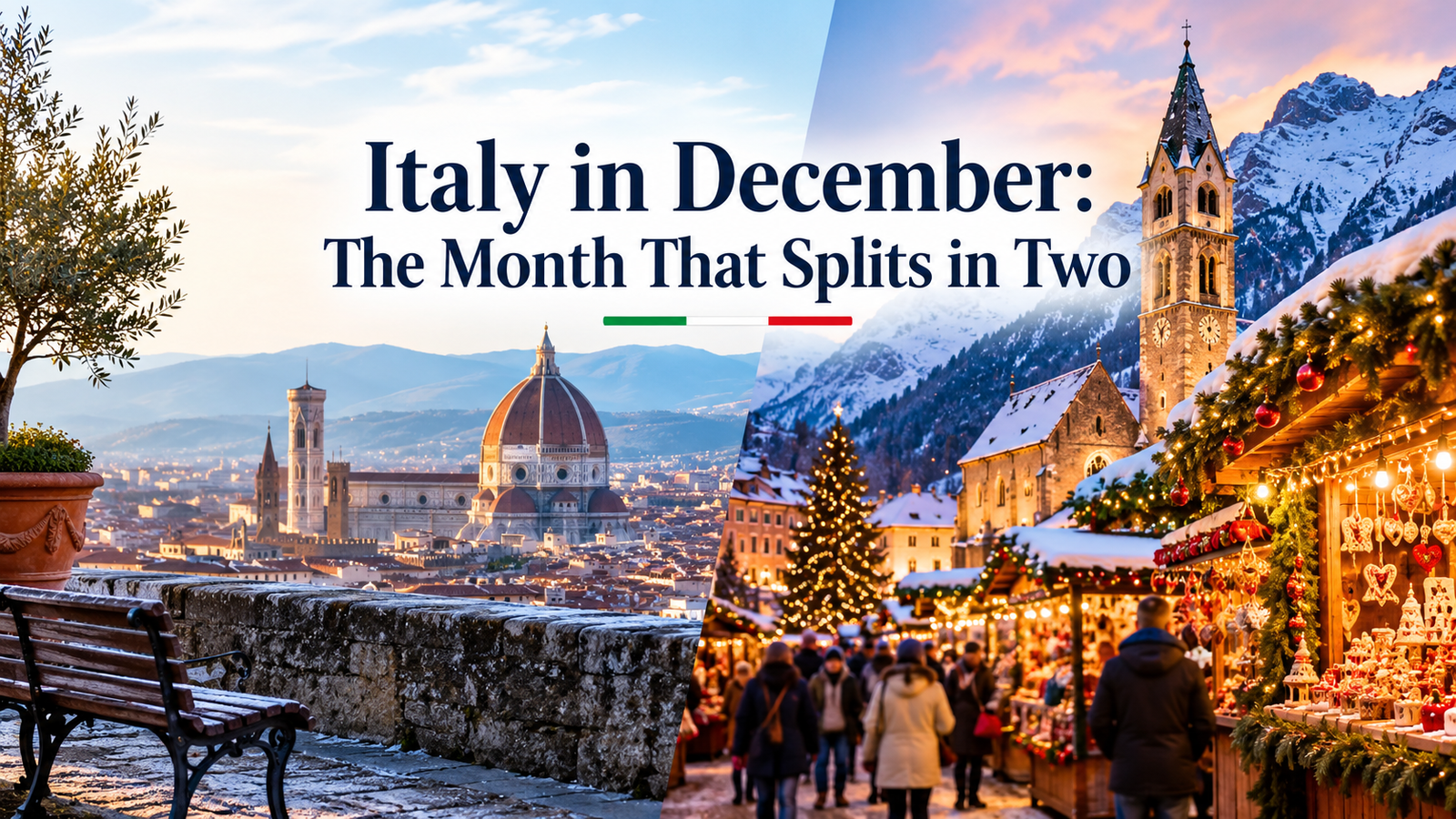
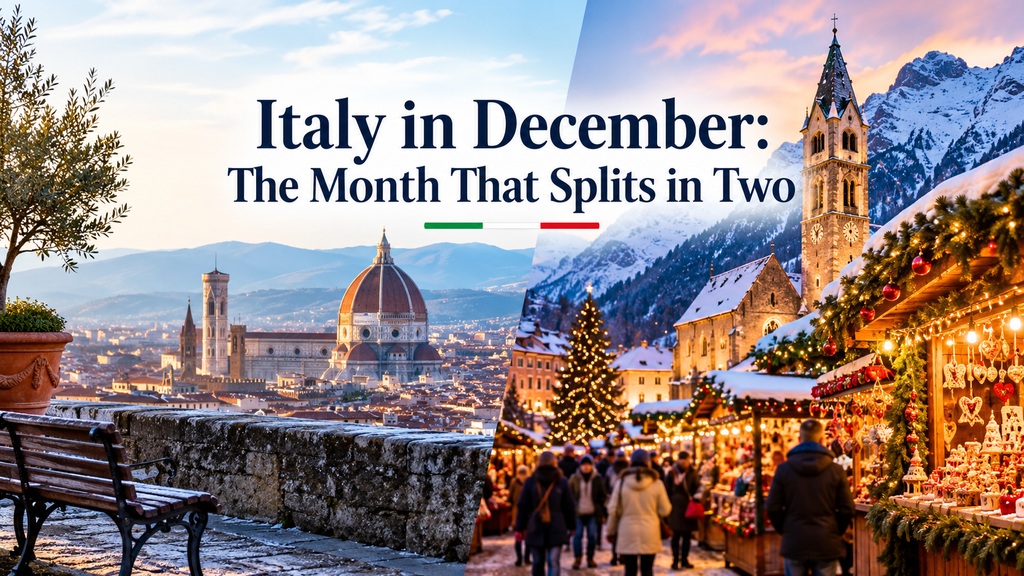
Italy in December: The Month That Splits in Two
Italy in December runs on two clocks, not one. Walk through Siena on December 3, and you will mostly have the loggias to yourself. The hotel room costs about what it did in November. Walk the same street on December 20, and you share it with coach tours from three countries, at a price that would embarrass August. The weather barely changes between those two dates. The calendar does.
This guide draws that line, then builds the rest of the month around it: the holidays, the weather, and the one subject no American guide covers honestly. Inside a historic Italian church in December, it is colder than the street outside it, and there is a real engineering reason why.
A note on links: a few booking links below are affiliate links. If you book through one, I earn a small commission at no extra cost to you. I checked current listings before including them, and I say plainly where the inventory is thin.
Italy in December: The Short Answer
Italy in December splits into two trips, not one. The line falls on the weekend of December 19 and 20. Book before that weekend, and you get the cheapest, emptiest stretch of the winter in the art cities: short lines, soft rates, churches in quiet Advent mode. Book from December 20 on, and you get something closer to a second August. Schools close, families travel, and the Alpine Christmas markets fill fast. Rome and Milan fill with domestic visitors on school break, and prices rise to match. Neither half is the wrong choice. Picking the wrong half for what you want is the real mistake. The weather hardly shifts all month. The price and the crowd shift hard, on one weekend.
The Line That Splits the Month
Italian schools close for the winter break around December 20. They do not reopen until after the Epiphany, on January 6. That one fact reshapes the country for ten days. Families who worked through the first three weeks suddenly travel at once, toward the same places: the Alps for snow, Rome and Florence for the family trip, and grandparents’ towns in the south.
American flights follow the same curve. Most Christmas travelers from the United States fly out the week before the 25th and back in early January, the exact window Italian domestic travel also claims. The two waves meet. From December 20 to January 2, airfare to Rome or Milan sits at one of its two annual peaks, right alongside August.
High-speed trains feel it first. A Rome-to-Florence train half empty on December 5 can show sold-out fares by December 22, at two or three times the price. Restaurants move on a slower version of the same curve, and dinner on the 24th, 25th, and 31st is the tightest of all: many kitchens close to the public and run one fixed holiday menu, booked by regulars months ahead.
None of this makes the second half a bad trip, only a different one, built for the Alpine markets and the theater of Christmas Eve. The first half suits people who want the art cities at their emptiest, right before Italy goes on vacation.
The December 2026 Calendar, Day by Day
December carries more fixed dates than any other month in Italy, and several of them change how a whole city behaves for days on either side.
The Immacolata Bridge, December 5 to 8
December 7 is Sant’Ambrogio, Milan’s patron saint day, a local holiday, falling on a Monday in 2026. December 8 is the Immacolata, a national holiday, falling on a Tuesday. For Milan, those dates line up into a free four-day stretch, Saturday through Tuesday. Elsewhere, a Tuesday holiday invites a ponte, a bridge day, so many Italians take Monday off too and build the same long weekend by choice. Our Italy in November guide explains why this bridge pushes up Alpine prices before November even ends.
Sant’Ambrogio is also opening night at La Scala, Milan’s opera house. The Prima della Scala is one of the most watched evenings on the Italian cultural calendar, and the 2026-2027 season opens on December 7 with Verdi’s Otello, conducted by Myung-Whun Chung in his debut as music director. Hall tickets sell out to subscribers long before December, but the show is broadcast live on a giant screen in Piazza del Duomo, so Milan is worth being in for the atmosphere alone.
December 13: Santa Lucia
Santa Lucia, on December 13, is not a national holiday, so offices and shops stay open. It still matters a great deal, in two different registers. In Verona, Bergamo, and Brescia, she plays a role close to the Befana’s, arriving by night with small gifts for children, and Bergamo builds a real market and light display around her feast. In Syracuse, Sicily, where Lucia was born, the day turns solemn instead: a silver statue is carried through the old city, and by old custom, Syracusans eat cuccìa, boiled wheat with ricotta or honey, instead of bread or pasta. An American expecting a market in Syracuse, and finding a procession, has arrived at the right place with the wrong idea.
December 24 to 26: The Christmas Block
In 2026, Christmas Eve falls on a Thursday, Christmas Day on a Friday, and Santo Stefano, a national holiday, on Saturday. That lineup hands most of Italy five days off in a row, not one day boxed in by work. Christmas Eve afternoon runs short hours everywhere, as families shop for the cenone, a large dinner built on fish rather than meat in most regions. Christmas Day is the most closed day on the calendar: museums and state sites shut nationwide, no exceptions, and streets outside the tourist core can feel empty by midmorning. Santo Stefano reopens the country slowly, on a holiday schedule.
December 31 to January 1: The Hinge to January
San Silvestro, December 31, falls on a Thursday in 2026. New Year’s Day, a national holiday, falls on a Friday, so this too becomes a long weekend, not one isolated day. Restaurants book the cenone di San Silvestro as heavily as Christmas Eve, often as a fixed menu sold in advance. Fireworks run informally in most towns, and formally in Rome, Naples, and Florence. State museums close completely on December 25, but in recent winters have opened as an extra on January 1, alongside the 26th and the 6th. The Ministry of Culture sets that policy fresh each year, so check the site you want to see. From January 1, Italy is still inside its holiday mood, and our Italy in January guide picks up right here.
What the Weather Actually Does
Averages flatten the picture, because Italy in December runs at least four climates at once, a few hours apart by train. The figures below are long-term averages, rounded, so check the forecast before you pack.
The North: Fog and Inversion
The Po Valley settles into its deepest winter pattern of the year. Nebbia, a ground fog, can sit for days around Milan, Turin, and Bologna. Daytime highs hover near 7°C, about 45°F, with colder, clearer nights when the fog briefly breaks. Expect slower traffic and poor visibility on the valley motorways.
The Center: Rain and the Tramontana
Rome and Florence stay wet more than bitterly cold, with highs around 12°C, or 54°F. The tramontana, a dry wind off the Apennines, can clear the sky for a day or two and drop the temperature faster than the forecast suggests. Waterproof shoes matter more than a heavy coat here.
The Apennines and the Alps: Snow and Opening Lifts
This is the month the ski season actually starts, not just gets announced. Resorts across the Dolomites and the western Alps typically open their first lifts in late November, with most terrain live by the first full week of December, snow allowing. The Sibillini Mountains and the Gran Sasso follow a smaller version of the same pattern. Treat any single opening date as provisional.
The South: Mild but Wet
Sicily and the far south stay the mildest part of the country, with Palermo’s highs near 16°C, 61°F. December is also one of the south’s wetter months, with short, heavy bursts rather than the Po Valley’s long gray stretches. A sunny lunch outside can give way to a squall an hour later.
Daylight: The Solstice
The solstice falls on or near December 21, the shortest day of the year. The sun sets in both Rome and Milan around 4:42 p.m. Sunrise comes near 7:34 a.m. in Rome, but a later 8:00 a.m. in Milan, since Milan sits further north and closer to the edge of Italy’s one time zone. Rome gets just over nine hours of daylight; Milan gets under eight hours forty-five. Plan outdoor sightseeing for the morning, and save the museums and the long lunch for the dark hours after.
Churches and Museums Are Not Heated, and Here Is Why
By December, every one of Italy’s six climate zones sits deep inside its legal heating season (Presidential Decree 412 of 1993 and Presidential Decree 74 of 2013, article 3, which caps indoor temperature at 20°C with a two-degree tolerance). Our Italy in November guide covers that system zone by zone, so this piece will not repeat it.
That decree does not touch the one building where a December visitor feels winter most: the historic church. Most parish churches, cathedrals, and small museums in protected buildings have no heating at all, and neglect is not the reason. A church under Italy’s heritage code (Legislative Decree 42 of 2004) cannot have a heating system installed or altered without approval from the Soprintendenza, the state heritage authority. Almost any system that would actually warm the space means cutting into the walls or floor, the very fabric being protected.
Even where heat is possible, conservation science argues against it. Fresco plaster and old wood panels stay stable only inside a narrow, steady band of temperature and humidity. Standards such as UNI 10829 call for avoiding fast heating and cooling cycles, because the humidity swing after a sudden rise in temperature damages plaster and pigment far more than still, cold air ever does. A warm, damp church is a bigger risk to its own art than a cold, dry one. So the building sits close to the outdoor temperature: 6 to 9°C, 43 to 48°F, on bare stone, with humidity that makes it feel colder still.
For the visitor, this has a simple, rarely mentioned result. Dress for ninety minutes in a Romanesque church as you would for a cold walk outside, not an indoor errand. A scarf for the neck matters more here than anywhere else on the trip, since this chill is damp, and it finds you through stillness, not wind.
The Christmas Markets, Honestly Ranked
Italy has one genuine Christmas market tradition and several newer additions built for tourism. Both are worth seeing. They are not the same thing, and few American guides say so plainly.
The real circuit runs through South Tyrol, the German-speaking province that was Austrian land until 1918 and still keeps its own Christmas calendar. Bolzano’s market, the largest and oldest of the group, opens the evening of Thursday, November 26, 2026, and runs through January 6, 2027. Merano and Bressanone open the same evening; Trento follows close behind, though its organizers had not confirmed an exact date at the time of writing. These markets sell vin brulé, mulled wine, alongside wooden ornaments and speck, from stalls that have supplied this region for generations, not booths built fresh each November for tourists. A guided evening walk through Rome’s Christmas lights, listed under fifty dollars with free cancellation, works well on a night when your itinerary does not reach the Alps.
Central Italy has built its own, newer answer. The most visible example sits in Arezzo, Tuscany, where a market branded as a Tyrolean village, a Santa’s house, and a Lego exhibit fills Piazza Grande from mid-November through the days after Christmas. It is popular, well run, and upfront about what it is: a manufactured attraction for families and coach groups, imported in style rather than inherited. There is nothing dishonest about enjoying it, and nothing especially Tuscan about it either. A visitor expecting Bolzano’s texture will be disappointed in both directions. Montepulciano and a few other Tuscan hill towns run smaller versions of the same formula.
Umbria answers with its own landmark in Gubbio, where the hillside above town is strung each winter into what organizers call the world’s largest Christmas tree, traced up the slope of Monte Ingino. It is switched on in the first days of December and usually stays lit into the second week of January. Candelara, a hamlet near Pesaro in the Marche, lights its whole center with thousands of candles instead of electric bulbs, on a handful of winter weekends. It is small and genuine, worth a detour if your dates line up, but its Pro Loco confirms dates late, so check its own channels before you travel.
The Nativity Scenes Nobody Tells Americans About
Americans know the nativity scene as a tabletop set, a few painted figures under a string of lights. Italy invented something much bigger, and the word for it, presepe, carries none of the small, decorative weight that “nativity scene” has in English. A presepe can be one family’s figurines on a sideboard, or an entire artisan’s lifework filling a room. Italians build and collect them across generations, the way some families collect anything else worth keeping.
Naples is the capital of the tradition. Via San Gregorio Armeno, named for a convent of Basilian nuns who settled there with relics from Constantinople, has been the city’s presepe workshop district since the eighteenth century, when the Bourbon court turned elaborate nativity scenes into an aristocratic hobby. The street still sells shepherds and Holy Families, alongside a very Neapolitan twist: hand-painted figures of the year’s most talked-about footballers and politicians, slotted into the manger scene as satire, not reverence. Naples has never treated the presepe as untouchably sacred, only as endlessly, affectionately alive.
Le Marche answers with something stranger, and to my eye, more moving: a living nativity staged inside the Frasassi Caves, in the town of Genga, where costumed locals populate a real cave on select winter evenings. There is no studio polish here, just town volunteers, and a Holy Family staged inside rock older than Christianity by millions of years.
Beyond the famous names, nearly every parish in Italy builds its own presepe each December, often entered into informal neighborhood contests. Walk into whichever church is open on an evening stroll, and you will almost always find one. For a gift instead, a bottle of this year’s novello olive oil, bought from a producer rather than an airport shop, travels far better than a figurine.
Where December Works, and Where It Does Not
Italy in December rewards the art cities of the center and north for the first three weeks, then rewards the Alps and the family-oriented cities for the last ten days. Rome, Florence, Bologna, and the hill towns of Le Marche and Umbria sit at their quietest and cheapest before the 20th. After it, the same cities fill with Italian families, and the Alpine valleys, dead in a summer traveler’s mind, come fully alive.
What does not work in either half is the coast. Adriatic and Tyrrhenian beach towns stay almost entirely closed, hotels and beach clubs shuttered until spring, and small islands run thinner ferries than even November. Rural hill villages can feel genuinely shut outside the towns running their own market, since many family restaurants take a winter break right around the holiday. Confirm any single countryside plan directly. Do not assume it is open.
Prices and Booking: The Two Windows
The split month leaves two separate booking rhythms, not one gradual slide. Hotel rates in Rome, Florence, and the other art cities stay close to their November lows through about December 18, then rise sharply for the final stretch, peaking around Christmas and New Year’s Eve. In the Alpine market towns, the pattern runs almost in reverse: rates are already up from the Immacolata bridge, and they climb again once school holidays begin. There is no real cheap window in Bolzano or Merano in December, only a less expensive first week and an expensive rest of the month.
A trip built around the Naples nativity tradition fits the first pattern better than the second. A guided walk through San Gregorio Armeno with a MuseoDiVino nativity ticket is worth booking a few days out, once you are inside the first three weeks and the workshops run at full production. I would not book a long, multi-stop Alpine market day tour sight unseen for the last week of December. Several of those bundled packages are new enough each winter that last year’s reviews tell you little, and a market reached on your own, by regional train, costs less and commits you to nothing.
What to Pack
Pack for Italy in December as damp and cold, not just cold. Humidity changes how a Roman or Florentine winter feels more than the thermometer does. A waterproof shell with a hood, a wool or fleece mid-layer, and shoes with real tread matter more than one heavy coat. A single coat is too much on a heated train and too little inside an unheated church.
Add a scarf you will keep on indoors, gloves thin enough to use a phone in, and warm socks, since church and museum floors stay colder than the air around your head. If the Alps are part of the trip, pack for real winter, not a postcard. Bring waterproof boots, not fashion boots, and a true winter coat, not the city layers that work fine in Rome.
Five Mistakes Americans Make in December
Five errors come up again and again when people plan Italy in December.
Treating the whole month as one price. A room booked for December 5 and the same room booked for December 23 can differ more than a summer high season does. Price the exact dates, never the month.
Assuming the Christmas markets are the whole trip. Bolzano and Arezzo wear the same marketing language and offer two different experiences. Decide whether you want South Tyrol’s inherited tradition or Tuscany’s built one, and do not expect either to deliver the other.
Skipping a dinner booking on the 24th, 25th, or 31st. Many kitchens close to walk-ins on these three nights and run one fixed menu, booked months out. Reserve early, or plan a quiet meal at your own table instead.
Dressing for the street and forgetting the church. Ninety minutes in a six-degree nave is a different trip from a walk between shops. Keep the scarf on once you step inside.
Treating December 25 like an ordinary holiday closure. It has no meaningful exception. Museums, state sites, and most restaurants shut outright, not on reduced hours. Plan that day around your own table, not a sightseeing list.
FAQ — Italy in December
Timing and Weather
Is December a good time to visit Italy? Yes, in two different ways. The first three weeks are among the cheapest and quietest of the year in the art cities. The last ten days bring the Alpine Christmas markets and a real family mood, at the year’s second-highest prices after August.
Is Italy very cold in December? It depends on the region and the building. Highs run from about 7°C in Milan to 16°C in Palermo, and unheated churches and small museums can feel colder than the street outside, since most have no heating at all.
What is closed in Italy in December? December 25 is the most closed day of the Italian year, with museums, state sites, and most restaurants shut nationwide. Coastal towns and small islands stay closed all month, and many rural restaurants take their own winter break right around the holiday.
Booking and Getting Around
When do the Christmas markets open in 2026? Bolzano, Merano, and Bressanone open the evening of Thursday, November 26, 2026, and run through January 6, 2027. Trento, Arezzo, and smaller markets set their own dates inside roughly the same window, so check the official calendar for your destination before you book.
Should I book before or after December 20? Before, if value and quiet matter most. After, if the Alpine markets and the family mood are the real goal. Straddling both halves without planning for the price jump is the most common mistake for this month.
Do I need to book restaurants in advance? Not in early December, but yes for dinner on the 24th, 25th, and 31st almost everywhere, since many kitchens run one reserved holiday menu those three nights instead of normal walk-in service.
Do I need a car in Italy in December? Not in cities, where trains connect everything well. Winter tires or chains may be required on signed mountain roads once the Apennine and Alpine passes see their first real snow, typically from late November on.
The Takeaway
Italy in December is not one season sliding slowly toward Christmas. It is two trips stitched together at a single weekend, the 19th and 20th, while the weather barely changes between them and the price changes completely.
Choose your half on purpose. Book the first three weeks for the art cities at their emptiest, with Advent quiet in the churches. Book the last ten days for Bolzano’s real Alpine market and Christmas dinner inside an Italian family’s idea of the holiday, at a price that reflects how many other families had the same idea. Either way, keep the scarf on once you step inside a church. The coldest ninety minutes of your trip will likely happen indoors.
If you want an Italian to check your December route against the two price windows, the market calendar, and the restaurant closures, you can book a consultation with me.
Explore more at Tastes & Wonders of Italy, or watch the video dispatches on YouTube.
Last reviewed for the 2026 season. The fixed rules in this guide — the heating zones, the heritage limits on church heating, the national holidays — do not change from year to year. What does change, checked each autumn: the market opening nights, the La Scala production, the exact weekday each date falls on, and the winter hours of major sites. In 2027, December 25 falls on a Saturday, not a Friday, which will reshape the Christmas block described above.