Spoleto, Italy: A City Built to Climb a Hill
Stand at the foot of the Ponte delle Torri in Spoleto, Italy, and look straight up. Nine stone piers, unequal in girth, carry a walkway eighty meters above the Tessino gorge — roughly the height of a twenty-six-story building, held up with no steel inside it. The bridge reopened in December 2024 after eight years closed for earthquake checks, and that repair, more than any single view, is the real story of this hill town in Umbria. Spoleto has spent twenty-two centuries solving one problem: how to move water, and eventually people, up and down a slope. Nearly everything worth seeing here is part of that same argument with gravity.
A note on links: some of the booking links in this article are affiliate links. If you book through them, I earn a small commission at no additional cost to you. I have not linked the guided day tours from Rome, for the reasons explained in “Getting there” below — I would not book one myself.
Why Spoleto rewards a slower visit
Most itineraries file Spoleto, Italy under “half-day stop between Assisi and Rome,” which undersells it. This is Umbria’s most vertical city, and its best material — a Roman arch, a Lombard basilica, a Renaissance fresco cycle, a twenty-first-century escalator system — sits at different elevations and different centuries. Rushing it flattens the whole point.
Quick orientation: a city built on a slope
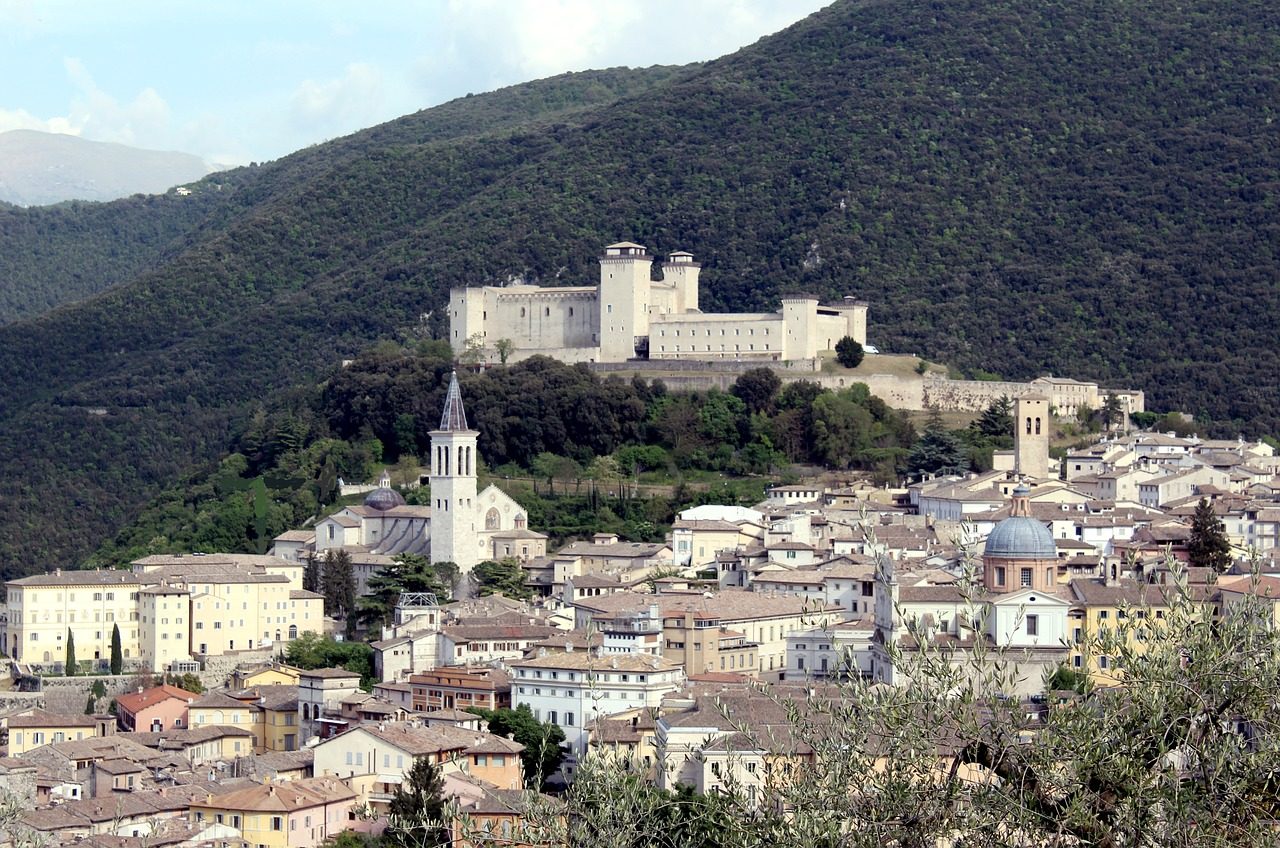
Spoleto sits in Umbria, roughly ninety-six kilometers north of Rome, where the Apennines fold down into the Valle Umbra. The historic center climbs Colle Sant’Elia, crowned by the Rocca Albornoziana, with the wooded slope of Monteluco — part of the same highland stretch running east toward the Sibillini Mountains — rising across the gorge behind it. There is no flat way to see this city; every itinerary is a decision about which elevation to tackle first, because the layout was designed for defense and water distribution long before it was designed for a stroll.
The engineer’s angle: 2,200 years of moving water uphill
I read buildings professionally, mostly seismic retrofits on farmhouses and churches one region over in Le Marche, and Spoleto is the kind of town that makes an engineer stop mid-sentence. The problem the Romans solved in 241 B.C. — getting water from the springs on Monteluco into a hilltop colony — is the same problem medieval builders solved with an aqueduct disguised as a bridge, and the same problem the city solved again in the 2000s with escalators bored into the rock. Three centuries, three technologies, one unbroken argument with a slope. Most guides treat the bridge as a photo opportunity and the escalators as a parking convenience; read together, they’re the same infrastructure project, twenty-two centuries apart.
Ponte delle Torri: the structure that explains the city
No single structure in Spoleto carries more narrative weight than the Ponte delle Torri — the postcard image, but also the clearest physical argument for how this city works. Understanding what it actually is, and what it took to reopen it after the region’s most recent earthquake, explains almost everything else on this list.
What it actually is (aqueduct first, bridge second)
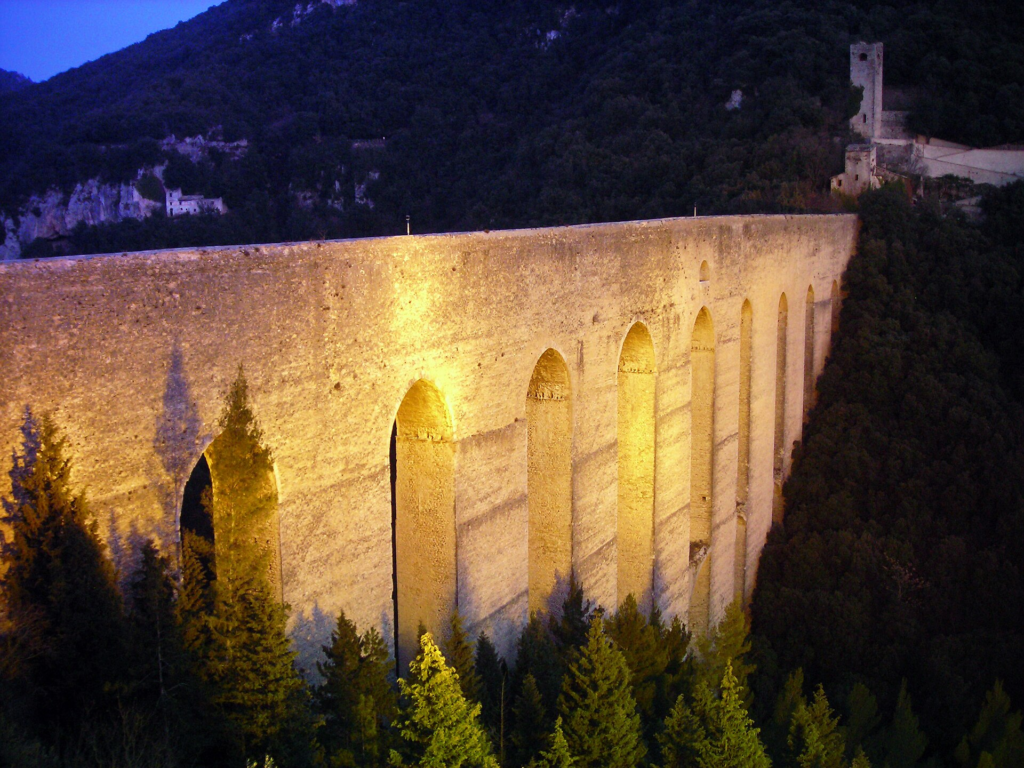
The Ponte delle Torri began as an aqueduct, not a crossing for pedestrians. A channel along its summit carried water from the springs of Cortaccione into the city center; the pedestrian walkway running its length was a secondary use layered onto a hydraulic structure. It connects Colle Sant’Elia, where the Rocca and the old town sit, to Monteluco, where the Fortilizio dei Mulini once ground grain using water diverted from the same channel.
The numbers shift slightly by source — the Comune di Spoleto lists it at 230 meters long and 80 meters high, while some local guides push those figures to 236 or 240. I use the municipal figures, but the discrepancy says something: nobody ever measured this bridge for a spec sheet. It was built to work, not to be catalogued. What’s certain on inspection is the asymmetry between the nine piers: those on the Monteluco side are noticeably heavier, reinforced partway up with secondary arches, while the two central piers are hollow, with internal chambers that once served as guard posts — a structure responding to different ground conditions on each side of the gorge, exactly the detail a modern seismic assessment flags first.
Dating is contested, and worth stating plainly rather than resolving by editorial choice. One theory holds the bridge rises on Roman foundations that left no direct trace; the more widely accepted account places its current form in the mid-1300s, ordered by Cardinal Egidio Albornoz after 1353 and designed by Matteo di Giovannello, known as Gattapone — the same architect behind the Rocca above it. Goethe crossed it during his Italian journey and used it to argue that structures built for a real purpose carry a permanence ornament alone never achieves. Standing under arches built to different specifications on each side of a gorge because the ground demanded it, it’s hard to disagree.
Eight years closed, and what it took to reopen
The 2016 closure is where this bridge’s story turns contemporary, and it’s worth telling accurately rather than dramatically. On August 24, 2016, hours after the earthquake that struck Amatrice and rippled through central Italy, Spoleto closed the bridge as a precaution. It stayed closed for eight years — not neglect, but a restoration campaign that ran from September 2021 through 2024, funded with 1.2 million euros from Italy’s Ministry of Culture and carried out by two Spoleto-based firms. The work covered the central tower, a twelve-meter retaining wall, the summit channel, and a discharge arch roughly forty meters up linking the two central piers.
The bridge reopened December 7, 2024, initially restricted to daylight hours. By April 18, 2025, the city removed that restriction entirely, allowing round-the-clock access after a trial period showed the structure holding up well under regular foot traffic. The Fortilizio dei Mulini at the far end still awaits its own repairs. This is the story worth leaving with: not a monument that survived a disaster, but one repaired, tested, and handed back to the public in stages — what a good seismic retrofit looks like from the outside, slow and unglamorous until it’s simply done.
Reading Spoleto’s layers
Spoleto’s history reads less like a timeline than a series of tenants who each left the walls slightly different than they found them — Umbrians, Romans, Lombards, and popes, often reusing what the last occupant left behind.
Roman Spoletum: the town that turned Hannibal around
An Umbrian settlement, defended by hilltop forts known as castellieri, occupied this hill before Rome arrived. Rome absorbed it formally in 241 B.C., founding a Latin colony with an estimated four to six thousand settlers. Three years later, the western branch of the Via Flaminia opened through the valley, running straight through the settlement — travelers entered through Porta Monterone and exited through Porta Fuga.
That second gate’s name tells the story in two words. In 217 B.C., fresh off his victory at Lake Trasimeno, Hannibal marched on the colony and was turned back; the resistance is credited with helping discourage a direct assault on Rome, and “Porta Fuga” — the gate of flight — has carried that memory ever since. The city’s wartime loyalty earned it municipium status in 90 B.C., though it backed the losing side eight years later, siding with Marius against Sulla and paying for it with a sacking in 82 B.C.
A small philological footnote deserves the right amount of hedging. Roman literary sources — Livy, Suetonius, the poet Martial, who praised the local wine as “Spoletina” — call the city Spoletium. But no surviving inscription carved by the Romans themselves uses that spelling; every one found so far reads Spoletum, the form that gives modern Italian its adjective, spoletino. Literature and stone didn’t always agree, even about a city’s own name.
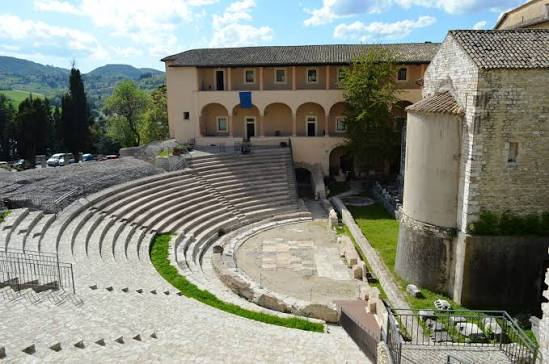
The Arco di Druso e Germanico, still standing near Piazza del Mercato — the old Roman forum — was raised in A.D. 23 by the local senate, honoring Tiberius’s son and adopted son. Medieval builders absorbed it into later structures; excavations in the 1950s freed one of its piers back down to the ancient street level. Nearby, the Roman theater and the well-preserved Casa Romana round out a Roman quarter most visitors to Umbria never associate with Spoleto at all.
The Lombard duchy and San Salvatore
Rome’s authority faded gradually. Theodoric drained the still-marshy valley around 507–511, Totila took the city by force in 545, and Narses restored its walls after 553. Then, in either 570 or 576 depending on the source, a Lombard duke named Faroaldo founded the Duchy of Spoleto. Paired with Benevento to the south, the duchy made up what historians call Langobardia Minor, projecting influence across Umbria, Lazio, and into the Marche, fused to the city’s fate until roughly 1230.
The clearest physical trace of that period, the Basilica di San Salvatore, sits inside the city’s Cimitero Monumentale, designed in 1836 by architect Ireneo Aleandri. San Salvatore was likely a funerary building first before an eighth-century Lombard reconstruction gave it its current form, rededicated by 815 to the Savior, and built with heavy reuse of Roman spolia — columns and carved fragments worked back into new walls, adaptive reuse centuries before the phrase existed. It has held UNESCO status since June 25, 2011, part of the seven-site “Longobards in Italy: Places of Power” inscription.
Aleandri’s other Spoleto commission is worth a detour: the Teatro Nuovo, built 1854–1864, has hosted the Festival’s main productions since 1958. The same architect designed the open-air Sferisterio in Macerata and the Teatro Ventidio Basso in Ascoli Piceno, one region over — part of a set of ten Italian theaters UNESCO added to its World Heritage list on July 26, 2026.
San Salvatore was also closed after 2016. A seismic improvement project — 1.2 million euros through a 2018 ordinance, plus 400,000 added later, using crack-stitching repair and lime-mortar injections — brought it back into public use during the summer of 2026, timed to the 69th Festival dei Due Mondi, which reopened it with a staging of Aeschylus’s Eumenides. Whether that access is now standing or tied to festival programming isn’t something I can confirm with confidence from here; check current hours with Spoleto’s tourist office before building a visit around it.
Albornoz, Gattapone, and the papal fortress
By the 1150s Spoleto was wealthy enough to attract a beating: Frederick Barbarossa burned the city in 1155, and it rebuilt with papal help. Papal authority solidified around 1230, and the factional violence typical of the fourteenth century followed — in 1324, Perugia intervened for the Guelph faction and imposed its own governor.
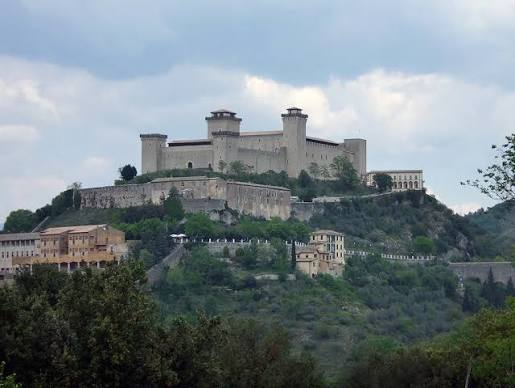
That instability eventually built the Rocca Albornoziana, the fortress dominating Colle Sant’Elia. Cardinal Egidio Albornoz commissioned it, and Gattapone — the same architect behind the Ponte delle Torri — designed it as serious military architecture, not a decorative castle. It now houses the Museo Nazionale del Ducato di Spoleto, and since 2024 visitors can walk the fortress’s old military ramparts and the restored garden of the Malborghetto, both previously off-limits.
The Duomo and what hangs inside it
Piazza del Duomo is the payoff at the bottom of the city’s best staircase, Via dell’Arringo, and the cathedral anchoring it, Santa Maria Assunta, rewards the climb down as much as any view rewards a climb up. Built between 1151 and 1227, it was consecrated by Pope Innocent III in 1198, though the facade wasn’t finished until 1207 — the year a mosaicist known as Solsterno signed and dated the image of Christ enthroned between the Virgin and Saint John that still dominates it. A Renaissance portico, added 1491–1504 by Ambrogio Barocci — who had also worked on the ducal palace at Urbino, one region over — softens what would otherwise be a stark medieval front. Even the bell tower is built largely from spolia, the same reuse technique that shaped San Salvatore across town.
The apse holds the reason art historians make the trip: a fresco cycle by Filippo Lippi depicting the life of the Virgin, worked on from 1467 until his sudden death in Spoleto in 1469 and finished by his son Filippino. What happened next says more about Renaissance politics than the painting: Lorenzo de’ Medici wanted the body brought back to Florence for burial, but Spoleto’s canons refused, arguing their own young cathedral deserved an illustrious tomb of its own. Lorenzo settled for commissioning a monument instead, having Filippino design it and the poet Angelo Poliziano write the epitaph — a marble tribute to an artist the city wouldn’t give back. Nearby, the Cappella Eroli holds frescoes by Pinturicchio from around 1497, and the right nave preserves a painted cross by Alberto Sotio dated 1187, one of the oldest works in the building.
Getting around a vertical city
Spoleto solved its slope problem again in the twenty-first century, and this part of the story connects directly back to the aqueduct. Three mechanized routes, known locally as Posterna, Rocca, and Spoletosfera, link parking areas on the valley floor to the historic center above, combining escalators, moving walkways, and elevators bored into the hillside. They’re free to use, and connected evening parking is often free too.
Ordinary hours run roughly morning into evening, extending later on weekends and considerably later during the Festival, when routes stay open past midnight to move crowds. Confirm current hours before relying on them, since they shift seasonally.
The practical upshot: park at Posterna or Spoletosfera, ride up, and save the walking for parts of the city that reward it. Structurally, it’s the same idea as the aqueduct on the bridge — moving something up a slope with the least possible effort — built in concrete instead of stone.
Eating in Spoleto
Umbrian food here leans rustic rather than refined, built around what the hills produce. Strangozzi, a thick hand-rolled pasta with no egg in the dough, shows up dressed simply with olive oil, garlic, and whatever black truffle is in season — this stretch of Umbria, running toward Norcia, produces some of Italy’s most prized truffle, at its peak in winter. Lentils from the high plains, cooked slow with little more than oil and herbs, are a genuine regional staple rather than a menu gesture. A handful of family-run mills in the hills nearby still press the oil that ends up on that strangozzi, and a few, like the century-old Del Sero oil mill, open their doors for a guided tasting of the process itself. Torta al testo, a flatbread cooked on a griddle and split for fillings, does the work a sandwich would do elsewhere.
The weekly market fills Piazza del Mercato — the old Roman forum, framed by the Arco di Druso — and is worth timing a visit around; it’s a better read on what the region eats than any restaurant menu. A guided version of the same idea exists too — a market walk followed by lunch at a local cook’s home, which turns the browsing into an actual meal. I’m leaving specific restaurant names out of this guide deliberately: kitchens change hands fast enough that a name printed here in 2026 is a poor promise by 2027.
When to go
Spoleto works on a different clock depending on what you want from it. Spring and early autumn bring mild weather and manageable crowds, ideal for climbing the bridge and the Rocca without competing for the view. Late June into mid-July is a different city entirely: the Festival dei Due Mondi, founded here by composer Gian Carlo Menotti in 1958, takes over the town for roughly two and a half weeks. The 2026 edition, the 69th, ran June 26–July 12, with roughly a hundred performances and artists from twenty-seven countries — and it’s what pushed San Salvatore back open after a decade closed. Menotti later founded an American counterpart, Spoleto Festival USA, in Charleston in 1977; the two split administratively in the early 1990s but share the same origin, and 2027 will mark both the 70th Italian edition and Charleston’s 50th. A few weeks earlier and an hour up the road, Umbria Jazz fills Perugia with a different kind of crowd entirely, if the trip allows for both.
Come for the Festival if live performance is the point; expect higher prices and fuller hotels. Come outside that window to read the city itself without competing for space to look at it. Autumn adds truffle season and thins the crowds again; see our guide to Italy in September for a broader sense of the season.
Getting there: why the train beats the day tour
Spoleto sits ninety-six kilometers from Rome, and the fastest way there is also the cheapest: a direct train from Roma Termini, no transfers, as little as 86 minutes, with roughly twenty departures a day. Fares start around eleven to fifteen euros — checked August 13, 2026, on a route well-served by Trenitalia’s Intercity and Frecce services.
That math is worth stating against the alternative: a guided day tour from Rome, the kind bundled with a stop in Cascia or Assisi, commonly runs past two hundred and fifty dollars a person for perhaps three hours actually in the city. For less than the price of lunch and under ninety minutes each way, the train delivers the same destination on your own schedule — a rare case where the cheaper option and the better option are the same one.
The train station sits below the historic center, connected to it by city bus and the same mechanized routes that move everyone else up the hill. Drivers should plan for the same logic: park low, at Posterna or Spoletosfera, and ride up rather than hunting for parking in the old town.
Booking Notes: What I Would Actually Reserve
The market lunch is the one booking I’d make first. The market tour and meal at a local’s home turns the browsing I describe above into an actual meal, cooked by a certified home cook rather than a restaurant kitchen — the closest a visitor can get to eating the way the market itself suggests.
If you have a car, the olive mill is worth the detour. Del Sero has pressed oil on the same land for more than a century, and at sixteen dollars with a 4.9 rating across more than a hundred reviews, it’s the best value on this list by a wide margin.
If you want a guide once you’re actually in Spoleto, a private walking tour of the historic center covers the Duomo and the Rocca in a couple of hours, priced per group rather than per person, which makes it inexpensive to split among a family or a few friends. It’s a newer listing without a long review history yet, but the ground it covers is exactly what this article does.
What I would skip: the guided day tours from Rome. The bundled Cascia-and-Spoleto tours run $286 to $437 a person for a few hours actually on the ground in Spoleto — the same math my “Getting there” section already argues against. That money buys a lot of train tickets.
FAQ — Planning your Spoleto visit
What is Spoleto, Italy known for?
The Ponte delle Torri, a medieval bridge over a Roman aqueduct route; the Festival dei Due Mondi, founded here in 1958; and a layered history running from a Roman colony through a Lombard duchy to a papal stronghold, all within a few hundred meters of hillside.
When is the best time to visit Spoleto?
Late spring and early autumn offer mild weather with manageable crowds. Late June through mid-July brings the Festival dei Due Mondi, with higher prices and fuller streets. Autumn adds black truffle season once festival crowds thin out.
Is the Ponte delle Torri open to visitors?
Yes. It reopened in December 2024 after an eight-year closure for post-earthquake structural work, initially with daytime hours only. Since April 2025 it has been accessible around the clock, though checking for recent updates is sensible on a structure still being monitored.
How much does it cost to visit Spoleto’s main sights?
Many landmark churches, including the Duomo, have free entry. The Rocca Albornoziana and its museum charge admission. The mechanized routes connecting parking areas to the historic center are free. Confirm current ticket prices locally, since they update periodically.
How long do you need in Spoleto?
A full day covers the essentials — bridge, Duomo, Rocca, historic center — comfortably. An overnight allows time for San Salvatore and a slower pace through streets a rushed day trip skips.
Can you visit Spoleto as a day trip from Rome?
Yes, easily: direct service from Roma Termini takes as little as 86 minutes, fares from around eleven euros, no transfers — cheaper and more flexible than a bundled bus tour.
Why was the Ponte delle Torri closed for eight years?
As a precaution after the August 2016 earthquake that struck Amatrice and was felt across this part of central Italy. Engineers spent the following years on structural checks and a 1.2-million-euro restoration — repairing the central tower, a retaining wall, and a discharge arch — before reopening it in stages between December 2024 and April 2025.
The final word
Spoleto rarely tops an American itinerary next to Florence or the Amalfi Coast, and that’s an advantage for anyone willing to give it a full day. What holds the city together isn’t a single monument but a continuous argument with its own hillside, fought with Roman stone, medieval masonry, and twenty-first-century steel and glass. Visit for the bridge if that’s what brought you here. Stay long enough to notice the escalators are answering the same question the aqueduct did, twenty-two centuries apart, and you’ll leave with the version of Spoleto worth having.
If you want more stories like this from an Italian insider’s perspective, explore more on Tastes & Wonders of Italy or subscribe to our YouTube channel for video dispatches from around the country.
Explore more at Tastes & Wonders of Italy, or watch the video dispatches on YouTube.