Le Marche in Autumn: Where to Walk When the Beech Turns
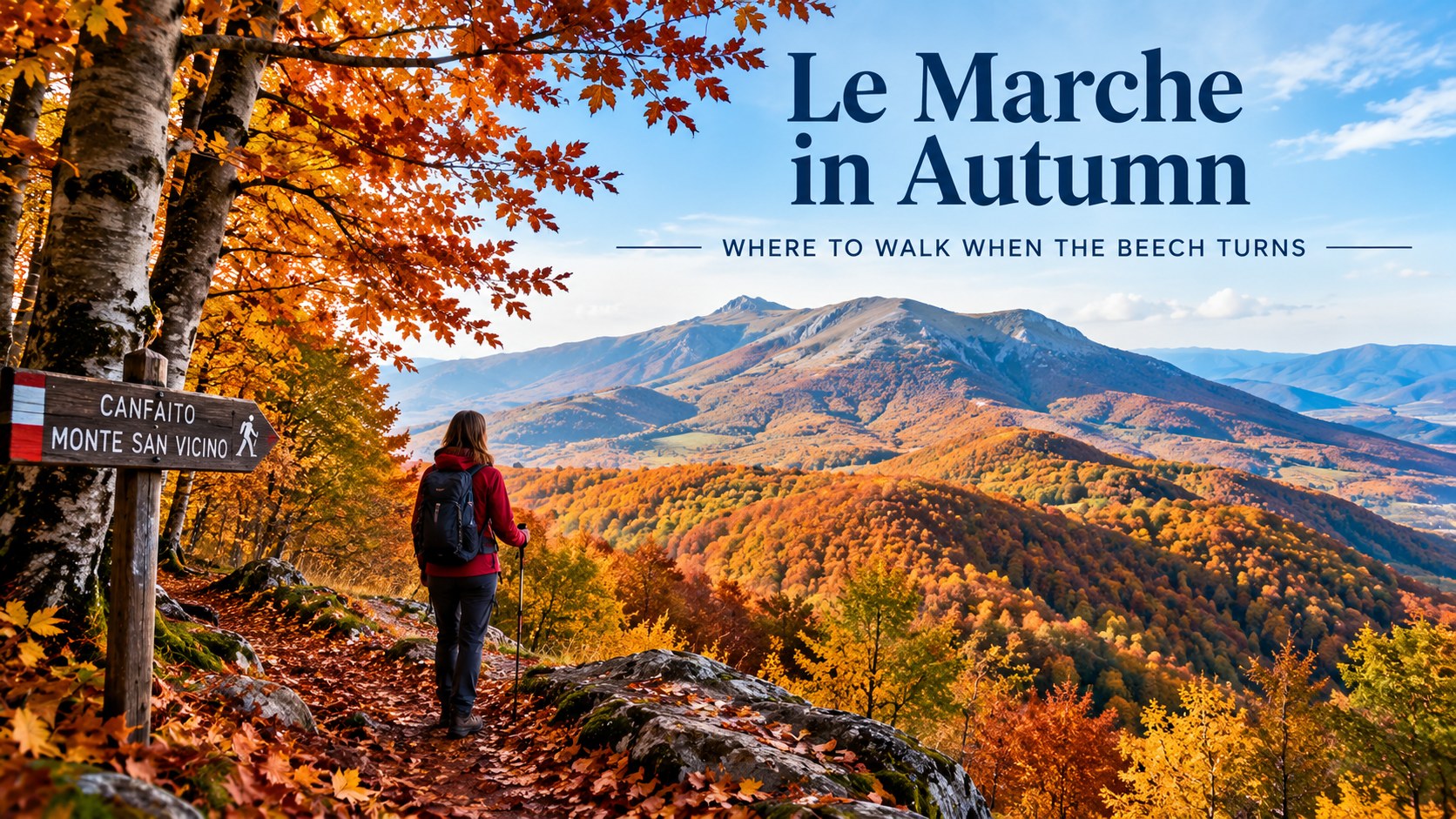
Le Marche in autumn begins about 1,000 meters above the sea. There the beech leaves turn copper before anything in the valley changes. The trunks are smooth and gray, and the low light slips sideways between them.
Soon the forest floor fills with leaves, and every step makes a dry sound. At Canfaito, above the town of San Severino Marche, one beech is said to be more than 500 years old, according to a local cycling guide. Italians call this season of color foliage, borrowing the English word. This guide explains where to see it, when to go, and how to walk it safely.
The Short Answer: Le Marche in Autumn
Le Marche in autumn peaks in the high beech woods from mid-October to early November. Local sources for Canfaito, the best-known site, give that window. However, they disagree by about two weeks on the start, and the weather shifts the dates every year. Because of this, plan around elevation rather than the calendar.
The best color of Le Marche in autumn grows in three places. The first is the Monte San Vicino and Canfaito reserve near San Severino Marche. Next comes the Monte Catria massif in the north, and finally the Sibillini mountains in the south.
Walks range from an easy two-hour stroll to a full day on a summit. In short, almost any fitness level can find a route. Hunting season also runs through January 31, 2027, so read that section before you go. For the wider region, start with our Le Marche guide.
Where the Color Actually Is
Beech trees like cool, moist slopes, which in the Marche means the Apennine ridge, mostly above 900 meters. Lower down, oaks, hornbeams and chestnuts turn later and in duller browns. As a result, elevation predicts the color of Le Marche in autumn better than any calendar.
Canfaito and Monte San Vicino
Canfaito is a high plateau at about 1,000 meters. It lies inside the Regional Nature Reserve of Monte San Vicino and Monte Canfaito. A mountain union, the Unione Montana Potenza Esino Musone, manages the reserve. The town of San Severino Marche controls the road and the parking.
Drivers arrive from San Severino via Apiro, or from Matelica. Set your GPS to “Canfaito parcheggio.” Then follow the signs to the lot beside the first beech wood.
Paid parking is the rule that surprises visitors. For 2026, the town charges five euros per car, camper or van, from 8 a.m. to 8 p.m. on set days. The autumn dates are Sunday, October 18, Sunday, October 25, and Saturday, October 31. They continue with November 1, 2, 7, 8, 14, 15 and 22.
Motorcycles and vehicles with a disability permit enter free. Staff close the road when the lot is full. For that reason, arrive before 8:30 a.m. on a busy day. Older visitor reports also describe rows of fined cars along the road, so use the lot.
Two older rules still appear in town notices. Parking is banned from 8 p.m. to 8 a.m., and camping and bivouacking are always banned. Buses and trucks may not enter either, so check the current notice before you go, because the 2025 wording is the latest I found on those points.
Monte Catria
Monte Catria rises to 1,701 meters in the northern Marche. Its slopes hold beech, but guides also report maple, manna ash and hornbeam, which add yellow, orange and red. The usual base is Bocca della Valle, near the Casetta Mochi hut.
Note that the CAI (Club Alpino Italiano, the Italian Alpine Club) has renumbered many trails. For example, path 56 now appears as 252 on updated signs, according to Pesaro Trekking, a local trail-mapping group. Old and new numbers can coexist, so carry both.
The Sibillini Mountains
The travel magazine The Wom reports that color in the Sibillini National Park changes with elevation. Woods at middle elevations turn gradually through October. The large beech woods above them follow later, and on the Marche side it points to the valleys near Montefortino and Montemonaco.
For the mountains themselves, see our guide to the Sibillini Mountains. It explains the geography and the villages beneath the peaks.
Reading the Season Before You Book
Le Marche in autumn is a weather event, not a date. Warm Septembers delay the color, and early cold snaps speed it up. Still, you can read the season with three simple tools.
First, use elevation. Air cools by roughly six degrees Celsius for every 1,000 meters of climb, so a wood at 1,400 meters turns before one at 900 meters. If Canfaito is still green, drive higher, and if it is bare, drive lower.
Second, watch the parking calendar. San Severino Marche picked its 2026 paid dates in June, based on past crowds. Those dates show which weekends will be busy but not when the color peaks, so treat them as a crowd forecast.
Third, look ten days out. Search for live webcams of mountain villages and ski areas near your chosen walk, and check the reserve and park websites for notices. In 2025, for example, the town republished its parking dates on October 13.
Then ask your host what the leaves are doing this week. Book refundable lodging in a valley town, and finally choose the exact walk when the forecast firms up.
Four Walks, Not a List of Trails
An engineer reads a trail like a drawing, so length, vertical gain and time matter more than adjectives. The figures below come from guide companies, local operators and recorded tracks. They differ from source to source, so I give ranges.
Confirm them on a CAI map before you leave. That said, the four walks for Le Marche in autumn climb steadily in difficulty, and each one gives a different view of the beech.
Walk 1: The Beech Path to Elcito
Path 209 runs from the Canfaito parking area to the village of Elcito. Expect about seven kilometers round trip, 300 meters of climbing and roughly three hours, according to the local guide site A Marche. It is graded E, for escursionisti, the ordinary hiking grade.
The path passes through a green tunnel of moss-covered trees. Elcito is a stone village on a spur at 821 meters, and it is a good place to turn around.
Walk 2: Canfaito, Prati di Roti and Sasso Forato
This loop leaves the plateau for open meadows and a natural rock arch. The arch is the Sasso Forato, or pierced rock. A guide company lists 13 kilometers, 550 meters of climbing and four and a half hours.
However, a shorter recorded track of the Sasso Forato loop shows 10.9 kilometers and 483 meters. The difference comes from route variants, so choose one before you start. Both are graded E and marked with red and white CAI paint.
Walk 3: Monte San Vicino from Pian dell’Elmo
The summit stands at about 1,480 meters, although sources put it anywhere between 1,476 and 1,484. The AllTrails route from Pian dell’Elmo is 9.5 kilometers with 547 meters of climbing. Plan on three and a half to four hours.
The walk is rated moderate. Start early, because the descent through the beech wood is best in soft afternoon light.
Walk 4: The Monte Catria Circuit
The circuit from Bocca della Valle climbs to the 1,701-meter summit and returns around Monte Acuto. Guided listings give 12 to 13 kilometers and 650 to 730 meters of climbing. Those groups schedule about seven hours, including stops. From the top, guides report views toward Umbria, Tuscany and the Adriatic.
A direct route through the beech wood on path 260 is shorter but steeper. AllTrails lists it at nine kilometers with 968 meters of climbing, and rates it difficult. Choose the circuit if you prefer a gentler grade.
The Long Walks: Cammini in Autumn
A cammino (plural cammini) is a long-distance walking route of several days. Walkers carry a credential, a small passport stamped along the way. They sleep in hostels, parish shelters and small guesthouses.
Three of these routes cross the mountains of Le Marche in autumn, and each balances altitude and ease differently. Above all, none of them suits a walker who has not trained.
Grande Anello dei Sibillini
The Grande Anello, or Great Ring, circles the Sibillini in nine stages. The park lists about 124 kilometers, starting and ending in Visso. It is fully marked and ranges from 560 to 1,794 meters. Stage 1, Visso to Cupi, is 12.1 kilometers with 800 meters of climbing.
Stage 8, Colle Le Cese to Campi Vecchio, is 19.5 kilometers and takes six to six and a half hours. Lodging is the real problem, because the park restored refuges along the route but the 2016 earthquakes closed several.
Sources I found confirm only Garulla and Tribbio as open, and they are not dated. One guide recommends early May through October, so treat November as out of season and ask the park before you book. The park’s own page is at parks.it.
Cammino nelle Terre Mutate
The Cammino nelle Terre Mutate, or Walk Through the Changed Lands, runs from Fabriano to L’Aquila in 14 stages, and publishers quote 245 to 257 kilometers. Its Marche section starts with Fabriano to Matelica at 26.4 kilometers. Then come Matelica to Camerino at 23.2, Camerino to Fiastra at 21.4, and Fiastra to Ussita at 17.7.
The high point is about 1,600 meters, and one route guide recommends May and June, or September and October. The path crosses areas hit by earthquakes, and a credential gives access to hospitality along the way. Details are at camminoterremutate.org.
Cammino Francescano della Marca
This route links Assisi to Ascoli Piceno in eight stages and 167 kilometers. It follows the tradition of Saint Francis’s journeys and opened in 2016. The stage from Montalto di Cessapalombo to Sarnano is 17.8 kilometers with about 700 meters of climbing, mostly on unpaved track.
The next stage, Sarnano to Comunanza, is 22.3 kilometers. Its high point is about 960 meters, according to the publisher Terre di Mezzo. That makes it the lowest of the three routes, and my reading is that it stays gentler into November. Tradition also holds that the Fioretti, the stories of Saint Francis, were written near Sarnano.
Which One to Choose
A single stage is a fair introduction to any of them. Sarnano to Comunanza is a full day of 22 kilometers. Camerino to Fiastra is similar at 21 kilometers. Whichever route you pick, ask each hostel directly about November, because I found no reliable list of shelters that close after October.
Hunting Season: The Thing Nobody Tells Foreign Walkers
Le Marche in autumn is also hunting country, which surprises visitors from countries where hunting is rare near public trails. Nothing here is illegal or unusual, but it means you should plan around it.
The regional calendar for 2026 to 2027 opens the season on September 5 and closes it on January 31, 2027. From October 1, each hunter chooses three days a week, excluding Tuesday and Friday. Italians call those two days silenzio venatorio, or hunting silence. Most tourist guides ignore them, yet they are the best days to walk.
Hare, pheasant and wild boar may be hunted only on Wednesday, Saturday and Sunday. Wild boar drives start on October 3 and use teams with dogs, called braccata. In addition, migratory birds may be hunted from fixed hides two more days a week until November 30, although Tuesday and Friday stay free even then.
Hunting is banned in protected areas, and Federparchi, the federation of Italian parks, restated this in July 2026. However, boundaries are not always visible, so assume hunters may be near any wood outside a reserve. Courts have also changed the Marche calendar in the past, so check for late changes.
Follow four habits. First, walk on Tuesday or Friday when you can. Second, stay on marked paths, and third, wear an orange, red or yellow layer, the colors that individual boar hunters must wear.
Finally, avoid dawn and dusk, and speak up if you hear dogs or shots nearby. Your host will know which days the local teams go out, so ask before you choose a route.
What the Mountain Villages Are Like Now
The earthquakes of 2016 struck the central Apennines in August and October. Camerino, Visso and Arquata del Tronto are among the places on or near these routes. Reconstruction continues in parts of the crater, and as a result some streets are fenced and some shops are closed.
Do not treat the villages as scenery. Le Marche in autumn also means small towns that are still rebuilding, so buy your coffee and lunch locally and ask before photographing a closed house. For more on the area, read our guide to the mountain chestnut festivals.
Add a Table to the Walk
Each of these has its own guide, so this is only a signpost. A walk in Le Marche in autumn pairs well with a long lunch, and then the day feels complete.
For truffles, read how to visit the Acqualagna truffle fair in 2026. For new olive oil, see what Americans can legally do at the olive harvest.
A sagra is a local food festival, and our guide to Le Marche food festivals shows where the region eats. For the wider picture of the month, see Italy in October.
Practical Autumn
Le Marche in autumn gets dark early once the clocks go back on Sunday, October 25, 2026, and after that the sun sets before 5 p.m. in the mountains. Start walks by 9 a.m. and turn back by 2:30 p.m.
Mountain roads to the trailheads are narrow provincial roads. Drive slowly, and expect parked cars along the verges on peak weekends. Fill your tank and visit an ATM in a valley town, because small mountain businesses may prefer cash.
Temperatures fall about six degrees per 1,000 meters. A mild valley day can feel cold at 1,400 meters. Wear layers, a hat and boots with good grip. Download offline maps because the phone signal can drop in the hills, and remember that the European emergency number is 112.
What I Would Skip
Three things earn a skip. First, skip Canfaito on the paid-parking Sundays if your dates are flexible. A weekday walk under the same beeches costs nothing and has more room.
Second, skip the Piani di Ragnolo for autumn color. The Marche Region’s floristic survey describes vast grazing meadows made by clearing the forest. FAI, Italy’s national heritage trust, says trees are absent there. Its season is spring, when the flowers arrive between May and June.
Third, skip the full Grande Anello in November. Refuges are limited and the weather at 1,700 meters is unforgiving, so take a single stage instead.
FAQ — Le Marche in Autumn
When is peak foliage in Le Marche?
Local sources place the peak of Le Marche in autumn in the high beech woods between mid-October and early November, though the exact week moves with the weather. Lower woods turn later.
Do I need a car?
Yes, in practice. For Le Marche in autumn the trailheads sit on narrow mountain roads, and I found no reliable public transport to them. Base yourself in a valley town and drive up for the day.
Are the trails marked?
Yes. Local trails use red and white CAI paint and numbered signs, and the park calls the Grande Anello fully marked. The Cammino Francescano uses red and white marks with the letters CFM, while the Terre Mutate route uses yellow and blue arrows. Numbers have changed on some CAI paths, so carry a map.
Is it safe to hike during hunting season?
Yes, with precautions. Walk on Tuesday or Friday when possible, wear bright colors and stay on marked paths. Avoid dawn and dusk, and listen for dogs and shots.
Where do I stay?
Stay in valley towns such as San Severino Marche, Matelica, Camerino or Sarnano. They offer more lodging and services than the trailheads. Book refundable rooms until the color forecast firms up.
Is November too late?
For the high beech woods, often yes. Sources describe Canfaito’s peak as ending in early November. However, lower oak and chestnut woods still work, and so does a low route like the Cammino Francescano. Crowds persist too, because San Severino keeps paid parking through November 22.
Which walk suits a non-hiker?
The main path through the Canfaito beech wood. According to The Wom, it is easy for everyone. Go on a weekday and arrive before 8:30 a.m., then stay under the old beeches.
The Takeaway
Le Marche in autumn rewards planning by elevation, not by date. Pick one walk, one backup and one hunting-free weekday, and spend your money in the mountain villages. If you would like help fitting these walks into a trip, start from the About page.