Le Marche Food Festivals: Where the Region Actually Eats
Le Marche food festivals crowd the summer calendar more than any single listing admits. Drive the provincial roads that lace the hills between Fermo and Ascoli Piceno on a Friday night in late August, and you will pass the same scene four or five times before reaching wherever you were actually going: a hand-lettered sign wired to a utility pole, an arrow pointing up a side road, and beyond the crest of a hill you cannot yet see, a paler patch of sky lit by string lights and a single spotlight trained on a canvas tent. I have made this drive often enough on August evenings to know the pattern by now. Follow any one of those arrows and you find a version of the same setup — folding tables, a cashier’s line, a kitchen staffed by volunteers who have been on their feet since four in the afternoon — and roughly the same reason for it: in a thirty-kilometer radius on any weekend between mid-July and late September, four or five small towns across the Marche are doing this at once, each for a different dish, and almost none of them advertising past its own province.
That density, more than any single festival, is what defines eating in the Marche once summer turns toward its second half. This piece assumes you already know what a sagra (a volunteer-run village food festival) is and how one actually works — both are covered in full in what a sagra actually is and in how to order, pay, and eat at one without looking lost — and instead maps the ones worth building an evening around, organized by the reason each one exists rather than by a calendar that would be wrong within a season of being written.
What Makes Le Marche’s Food Festivals Different
A Marche sagra is almost always tied to a single comune and a single product the surrounding land genuinely produces, run by that town’s own Pro Loco (a local volunteer association) rather than a regional festival circuit, which is why the calendar reads less like a curated list of headline events and more like a scattered directory of two hundred small associations, each defending one dish. According to a Marche Regional Council publication on the Pro Loco network, more than two hundred Pro Loco associations operate across the region with over sixteen thousand volunteer members, a density that explains why a single weekend in July or August can offer four or five genuinely different sagre within an hour’s drive rather than one large event drawing from the whole region. The season runs from early June through late September, but the real crowding falls in the six or seven weeks between mid-July and mid-September, when the harvest calendar, the summer heat, and the return of emigrated family members for the August holidays line up at once.
Why the Marche Produces So Many of These, and Packs Them So Close Together
The concentration traces back to the same fact that shapes the region’s whole food identity: the Marche has no single dominant city, only a chain of small comuni, each historically self-sufficient, each with its own agricultural specialty tied to a particular valley or hillside. That fragmentation is the same force behind a Mediterranean diet built on small-plot, mixed-crop farming rather than industrial monoculture, and behind a region that exists almost entirely without a single dominant capital to organize its identity around. A sagra is the natural civic expression of that pattern: rather than one city hosting one prestige food festival, two hundred small towns each defend the one thing that grows, is raised, or is made on their own hillside, and late summer — after the wheat harvest, well before the olive harvest and the grape harvest that follow in autumn, with the returning diaspora still in town for Ferragosto — is when nearly all of them choose to do it.
The Sagre Anchored to a Certified Product
Some of the region’s sagre exist specifically to defend a product that already carries formal European protection, which changes the stakes of the event from a nice evening to something closer to a trade fair with a folk-festival wrapper. Moresco, a walled hill town in the province of Fermo with fewer than seven hundred residents, has run its Sagra del Ciauscolo since 2011, typically the first weekend of September, in the small Piazza Castello at the heart of the borgo. The dish in question, ciauscolo — a soft, spreadable pork salume eaten smeared on bread rather than sliced — earned IGP (Protected Geographical Indication) status in 2009, and Moresco’s version of the sagra leans into that certification, pairing the classic spread with fried stuffed olives, burgers, and rolled cuts all built around the same product, alongside a sparkling passerina, the local white grape that few visitors outside the region have tasted. I have watched American guests taste ciauscolo for the first time and reach, almost always, for the wrong comparison — “like a pâté” — when the texture and the pork-forward flavor are closer to nothing they already know.
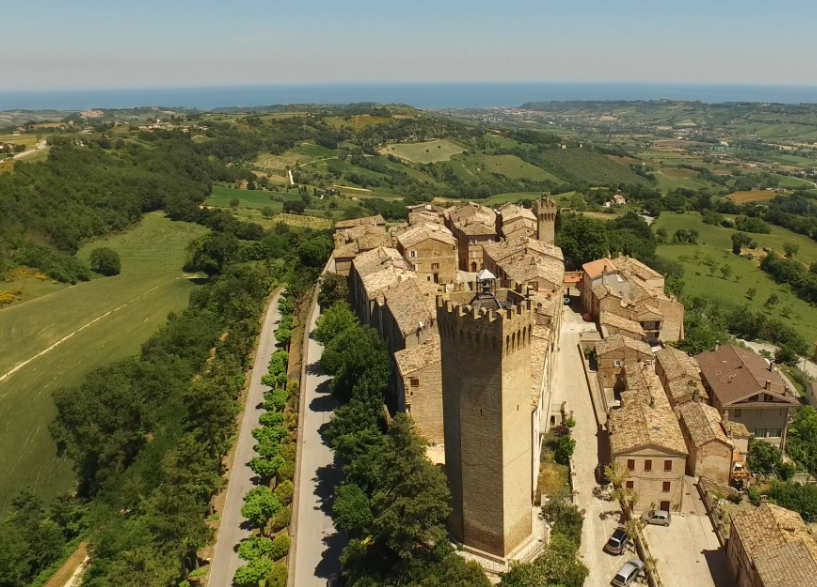
What a menu can’t quite convey is that this is a six-hundred-person town running a food event almost entirely on volunteer labor for a salume most Americans have never encountered even in an Italian delicatessen; the sagra is, functionally, the closest thing Moresco has to a marketing department.
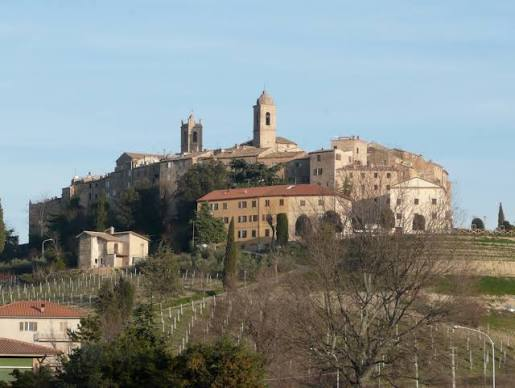
Cossignano, a hill town of just over a thousand people in the province of Ascoli Piceno, runs a different kind of certified-product sagra: its Sagra del Fritto Misto all’Ascolana, organized by the Pro Loco Cossinea, centers on the oliva all’ascolana — the large, meat-stuffed, breaded and fried green olive that carries DOP (Protected Designation of Origin) status and functions as the closest thing the Piceno area has to a signature dish. The event runs for a handful of evenings in August in Piazzale Europa at the edge of the historic center, cooking starting around 7:30 in the evening and running well past midnight — Cossignano sits in the same Piceno hill country covered in the region’s cycling routes — the olives fried alongside other regional fritti — battered vegetables, small cubes of cremini (fried béchamel), turkey — and local autoctonous wines. It is worth distinguishing this from Ascoli Piceno‘s own much larger Fritto Misto all’Italiana festival, held in the city itself over ten spring days in late April, which despite its overlapping name is a curated, ticketed regional food festival rather than a volunteer-run village sagra — a useful early example of how loosely the word gets applied, which a later section returns to.
The Sagre Built Around a Dish That Exists Nowhere Else
A second category of sagra exists not because the product carries a certification mark, but because the preparation itself belongs to that one town and nowhere else. San Costanzo, in the province of Pesaro e Urbino, hosts what is officially recognized by the region’s own UNPLI Pro Loco committee as the oldest sagra in the Marche: the Sagra Polentara, or Sagra della Polenta, whose origins are traced to the 1700s, when the nobility of nearby Pesaro and Fano would gather at San Costanzo to eat plain polenta at long communal tables as an act of penance following Carnival excess. What survives of that origin story is a two-day event, typically the third weekend of July, that reached its 220th edition in 2026, with the town’s polenta prepared according to a recipe carried by generations of Polentari and topped with the ragù of the historic mastri carrettieri (master cart drivers). Two hundred and twenty editions is not a marketing number; it is closer to a civic institution than a food event, and the town’s own Pro Loco president has described it publicly not as a tourist draw but as the clearest expression of the community’s volunteer spirit.
Castelplanio, an inland comune in the province of Ancona, runs a comparable but distinct tradition with its Sagra della Crescia sul Panaro, dating to 1974 and reaching its 51st edition in July 2026, typically held over four days in the third week of the month. The crescia here is not the flatbread most visitors to central Italy already know from Umbria; it is a polenta-based version, cooked entirely by hand on a panaro (a flat metal griddle), served both savory — with vegetables, sausage, or pecorino — and sweet, fried and filled with Nutella, and it sits in the same Castelli di Jesi hills that produce the region’s best-known Verdicchio. This is a different dish from Moresco’s ciauscolo and from the vincisgrassi tradition covered separately on this site, but it belongs to the same family of hyper-local preparations that never traveled beyond their own comune. The town’s own Pro Loco is candid, in its published history of the event, that Castelplanio’s population has thinned considerably since the sagra’s early decades and that fewer young residents now step in to run it — a detail worth noting for anyone assuming these events run on autopilot. Several of the Marche’s longest-running sagre survive today specifically because a shrinking core of volunteers and their comune choose, year after year, to keep them going.
The Coast Answers Back
Everything so far sits in the hills, but the coast runs its own parallel version built around the Adriatic catch rather than pork, olives, or grain. Montemarciano, on the coast between Senigallia and Falconara Marittima, hosts its Sagra del Pesce in the frazione of Gabella, typically over four or five evenings in the first full week of August, organized by the local sports association U.S. Montemarcianese with the backing of the comune and reaching its 61st edition in 2026. The menu runs to grilled and fried small Adriatic fish, mixed seafood fry, mussels, clams, and brodetto — a dish with its own full treatment on this site, since brodetto’s town-by-town variation is a story in itself. What distinguishes the coastal sagre from their hill counterparts is less the food than the logistics: Montemarciano’s draws a beach-holiday audience rather than a strictly local one, table service is more common than the stand-and-carry model typical inland, and the same stretch of coast is where the region’s small ittiturismo operators fish the very Adriatic catch a sagra like this one fries, and — a small but telling detail — careful event listings for the 2026 edition could not even agree on whether it ran August 1–4 or August 5–9, a gap worth remembering the next time a website states a sagra’s date with total confidence.
When the Word on the Banner Says Something Else
Not everything called a sagra is one, and not everything worth attending for the food is called a sagra at all. Macerata’s Fiera di San Giuliano, the city’s civic and religious patronal fair, dates its modern late-summer scheduling to 1513, when the celebration honoring San Giuliano l’Ospitaliere was moved from January to the end of August for a fuller, more participatory event. It runs across the final week of the month, closing on August 31 with a solemn Mass and procession, and centers on a genuine market fair — some two to three hundred stalls filling the historic center — rather than a single-product food stand. According to the comune’s own published programs, the city’s Pro Loco does run a gastronomic stand within the fair serving tagliatelle con la papera and roast duck, two dishes tied to the San Giuliano tradition, alongside the decades-old custom of selling a terracotta whistle as a keepsake of the feast. It is worth attending for that stand specifically, not for the fair as a whole, which is closer in spirit to a street market than to any of the sagre above.
The truffle fairs of Acqualagna and Sant’Angelo in Vado follow the same logic in the opposite direction: both are genuinely major events, both draw dealers and buyers as much as diners, and neither is a sagra in the volunteer, single-product-defense sense described here — they belong instead to the region’s truffle cluster, covered in a separate piece comparing Acqualagna’s white truffle culture to Alba’s and in the legal season calendar that governs when either of them can open. A future piece in this series works out the fuller taxonomy — where sagra, fiera, and festival actually diverge in Italian usage — since the word gets applied loosely enough, even by the towns themselves, that a visitor going purely on event names will end up in the wrong kind of crowd more than once.
Finding This Year’s Actual Dates
None of the dates above should be treated as fixed, and that is by design rather than an oversight: Pro Loco associations set their own calendars around volunteer availability, harvest timing, and even weather, and UNPLI’s own national committee states plainly, in its guidance on nationally recognized sagre, that dates can shift by weeks or, in some cases, months from one year to the next, and that visitors should confirm against the organizing Pro Loco’s own channels rather than a static list. In practice, three sources are worth checking, in order. Start with the comune’s own municipal website, which usually posts the current year’s civic and patronal calendar directly, often under a “turismo” or “eventi” section; comune.macerata.it, for instance, publishes San Giuliano’s full program every August. Next, check the UNPLI Marche regional committee’s site, which aggregates confirmed dates from its member Pro Loco associations and tends to run more current than third-party aggregators. Finally, the region’s own tourism portal maintains a searchable events calendar covering sagre, fiere, and festivals across all five provinces, updated by the organizers themselves. A sagra listed on a generic aggregator site with last year’s dates copied forward is common enough that it should not be trusted alone; cross-checking against one of these three sources before building an evening around a specific date is the only way to avoid driving to a closed piazza.
One caveat applies specifically to the towns inside the 2016 earthquake’s reconstruction zone — Sarnano, Amandola, Montefortino, and the smaller comuni around them — where several long-running sagre have continued through a decade of scaffolding and rebuilding, often relocated to whatever open ground the town currently has available rather than the historic piazza the event has occupied for generations. That story, and what it says about how these communities have kept their traditions alive through reconstruction, deserves its own treatment rather than a passing mention here.
Building One Evening, Not a Grand Tour
The instinct, looking at a map with Moresco, Cossignano, Castelplanio, and San Costanzo all marked on it, is to treat the sagra season as a single road trip that hits several towns in a night. It does not work that way, and the reason is entirely about roads rather than distance. Moresco and Cossignano, both in the Valdaso hill country south of Fermo, sit under twelve kilometers apart as the crow flies, but the road connecting them follows the Aso river valley and climbs in and out of side ravines the whole way, with no highway lighting and a speed limit that the two-lane provincial road, not a map’s straight line, actually determines. I have driven that stretch after dark more times than I can count, and twelve kilometers on the map has never once felt like twelve kilometers in the car; that distance can comfortably eat thirty minutes, more behind a tractor. Castelplanio and San Costanzo sit in entirely different halves of the region — one inland from Ancona, one up near Pesaro — and treating them as a single itinerary means giving up on eating properly at either one. The workable version of a Marche sagra evening picks one sub-area — the Valdaso hills, the Ancona coast, the country around Fabriano — commits to one sagra as the destination, and treats anything else nearby as an optional pre-dinner walk rather than a second meal. One sagra a night is the actual local pattern; trying to do more is the most common way visitors end up disappointed by an event that, done properly, was never the problem.
FAQ: Planning a Sagra Season Trip Through Le Marche
How many sagre actually happen in the Marche in a single summer? Given more than two hundred active Pro Loco associations across the region, several hundred sagre and related events run between June and September, though only a fraction are large or well-documented enough for a visitor from outside the region to plan around confidently.
How far in advance are a given year’s dates usually confirmed? Most Pro Loco associations lock in dates two to four months ahead, though smaller ones sometimes confirm only a few weeks out; checking in the spring for a late-summer trip is too early, and early-to-mid summer is the realistic window.
Can I build a sagra trip around the coast alone, without a car? Coastal sagre like Montemarciano’s are reachable by the regional train line that runs the length of the Adriatic coast, but the hill-town sagre that make up most of this list sit well inland with limited or no public transit, so a car is effectively required for anything beyond the coast itself.
Is it realistic to see more than one sagra in a single evening? Rarely, and not recommended: the provincial roads connecting hill towns are slower than distance suggests, and most sagre run their kitchens on a fixed evening window, so arriving late at a second stop usually means a closed kitchen rather than a shorter visit.
Does the sagra season really run into September, or does it taper off after Ferragosto? It tapers but does not stop: September in the Marche sees fewer events than the July–August peak, but several, including Moresco’s Ciauscolo sagra, are specifically scheduled for early September rather than earlier in the summer.
Are these events listed on national sagra-finder apps, or do I need local sources? National aggregators cover the larger, longer-running sagre reasonably well but frequently carry stale or approximate dates for smaller ones; the comune, Pro Loco, and UNPLI Marche sources described above are more reliable for anything happening within the current season.
What’s the single most common routing mistake Americans make planning a Marche sagra evening? Treating the map the way it would work in a flatter region — picking two or three towns that look close together and assuming a normal driving pace between them — when the actual road is a two-lane provincial route through hill country that takes roughly twice as long after dark as daylight driving would suggest.
The Takeaway
None of these towns are competing for a visitor’s attention the way a curated food festival does; each one is defending something specific — a certification, a recipe, a catch, a saint’s day — for an audience that, until fairly recently, was almost entirely its own. That is exactly what makes them worth the drive: pick one sub-region, confirm the date through the comune or UNPLI Marche rather than a stale listing, and go in treating the evening as an invitation into a small town’s own calendar rather than a stop on a tourist circuit built for you. That is most of what separates a good sagra evening in the Marche from a disappointing one, and it has very little to do with which dish ends up on the plate.
If you want more stories like this from an Italian insider’s perspective, explore more on Tastes & Wonders of Italy or subscribe to our YouTube channel for video dispatches from around the country.
Explore more at Tastes & Wonders of Italy, or watch the video dispatches on YouTube.