The Engineer’s Italy No. 1 — The Ticket You Can’t Buy Online
The Engineer’s Italy is my monthly letter from the Marche region, sent on the last Thursday of every month. This is the first issue, published here in full. Subscribers get each issue four weeks before it appears here.
The piazza comes apart first
On the first Monday of September, the piazza in my town is taken apart. The men who put up the stage in July come back with the same flatbed truck and take it down in a morning. The strings of lights that cross the street between the pharmacy and the tobacconist come down next, coiled into crates that go back into somebody’s garage until June. The bar that stayed open until one in the morning through August closes at nine again. Nobody announces any of this. It happens the way a tide goes out.
And then, in the middle of that emptying, three towns put on armor.
Arezzo, Marostica, and Foligno all hold their historical tournaments in the eight days between September 4 and September 13, 2026. Every guidebook will tell you they’re spectacular. What no guidebook will tell you is that none of them is organized for you — and one of them proves it in writing.
If you’re still deciding whether September is your month at all, I’ve made the case at length in Italy in September: The Month Italians Wish You Knew About.
The proof is a ticket office
Arezzo runs its 150th Giostra del Saracino on Sunday, September 6 at 5:00 p.m. in Piazza Grande. Four quarters of the city ride against the Buratto, a rotating armored automaton that hits back if you’re slow. It is one of the great sights in Tuscany, and here is how you buy a seat for it.
Ticket sales opened on Saturday, August 29, at 7:30 in the morning — not online. In person, at the box office on the ground floor of the Palazzo Comunale. On that first day only the grandstand seats were sold, maximum four per person. Standing places and dress rehearsal tickets went on sale the following afternoon, after the drawing of the lots. Only on Monday, August 31 at 3:00 p.m. did anything reach the internet, and even then it was just the standing places and the rehearsal, through the city’s own ticketing site. The grandstand never goes online at all. For the June edition, those grandstand seats ran 60 to 100 euros depending on the sector; current terms are posted on the official ticket page.
Read that again as a system rather than an inconvenience. A city that wanted your money would sell you the best seats from your kitchen in Ohio. Arezzo sells them to whoever is standing in Piazza Libertà at half past seven on a Saturday morning, eight days out. That is a town allocating its own festival to its own people, and tolerating the rest of us in the spaces left over.
Siena does something structurally similar with its horses, and I’ve written about how the tratta actually works if you want the longer version of this argument.
What each one actually is
Foligno: the ring that shrinks
Foligno, in Umbria, runs the Giostra della Quintana — La Rivincita on the weekend of September 12 and 13. This is the one I’d cross the country for. Ten neighborhoods compete; a rider gallops a figure-eight course and has to spear a ring held out on the arm of a statue of Mars. The ring shrinks each round: eight centimeters, then six, then five. Five centimeters is smaller than the mouth of an espresso cup, taken at a gallop, three times, with the whole town watching. The first documented Giostra dell’Anello in Foligno dates to 1613. In the weeks before, the ten neighborhood taverns open and serve seventeenth-century recipes rebuilt from period sources. Check the exact dates and the hour-by-hour schedule on the official program page before you book — I’ve seen two different weekends given by different sources this year, and I’d rather tell you that than pretend the question is settled.
One clarification, because it trips up almost everyone: Ascoli Piceno, over in Le Marche, has a Quintana of its own, and it is not this one. Different region, different century, different rules. I’ve written that one up separately in The Quintana of Ascoli Piceno. If you search the word alone, you’ll end up with two festivals stacked on top of each other and no idea which town you’re booking a hotel in.
Venice: free from the banks
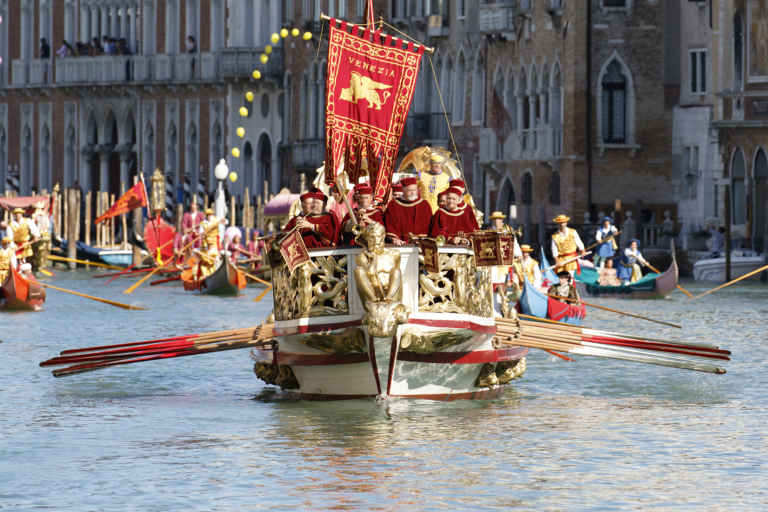
Venice holds its Regata Storica the same afternoon as Arezzo, Sunday, September 6. The costumed procession starts around 3:30 p.m. from the Bacino di San Marco, and the racing runs until the gondolini final at 6:10. Watching from the banks is free. It commemorates the welcome Venice gave Caterina Cornaro in 1489, after she gave up the throne of Cyprus and handed the island to the Republic. If you’re already going to be in Venice in early September, it overlaps with the film festival — what that week is actually like on the Lido is a separate piece.
Marostica: beautiful, and not a contest
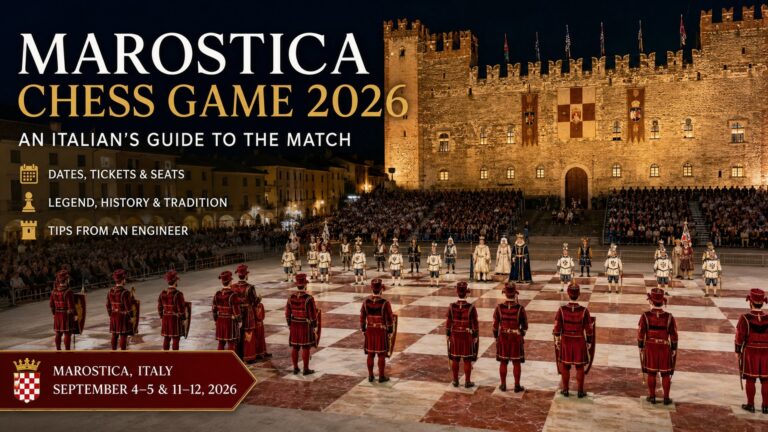
And Marostica, in the Veneto, stages its human chess game on September 4, 5, 11 and 12 at 9:00 p.m. — 600 costumed players, fireworks, an entire piazza turned into a board, performed in archaic Venetian. It happens only in even-numbered years, which makes it feel urgent. Seats are numbered and go through the official box office.
Here’s where I’ll be less enthusiastic than the tourism office, and it matters because it changes what you should buy. Marostica is not a contest. The match was decided in 1454 and it ends the same way every night; the town says so itself, and its own history page credits a local theater enthusiast with staging the first costumed game in 1923 after reading about the idea in a magazine. Buy that seat expecting the finest night of open-air theater in Italy and you will not be disappointed. Buy it expecting a race, the way you would at Arezzo or Foligno, and you will spend two hours waiting for something that isn’t coming. I’ve written the full guide to the dates, the seating tiers and which one is actually worth the money in Marostica Chess Game 2026: An Italian’s Guide to the Match.
Still open this autumn
If you’re arriving later in the fall, the Biennale Arte in Venice runs through Sunday, November 22 — and it changes underneath you on September 29, when the summer hours end. From that date the Giardini and the Arsenale open 10 to 6, last admission 5:45, instead of 11 to 7. The shift is buried in the Prepare Your Visit page. If you booked an afternoon in October assuming the summer schedule, you have less day than you think.
There’s also a reason to go late this year. After the international jury resigned, the awards ceremony moved from opening week to closing day, and in place of the usual Golden Lions the exhibition will hand out two Visitors’ Lions, decided by the people who actually walked through it. Go in October or November and you’re not a spectator. You’re the jury.
My full guide — which pavilions are worth the walk, how the two venues connect, what to do about the queue — is here: Venice Biennale 2026: Tickets and Hours, by an Italian Who’s Been There.
And if none of this is your idea of a good evening: on that same first weekend, Piobbico in Le Marche holds its polentone festival, which has no tickets, no grandstand, and no English-language website, because it was never built for anyone who isn’t from Piobbico. That’s the other kind of September. I’ve explained how to eat at an Italian sagra without embarrassing yourself if you’d rather go that way.
Next month
The next issue goes out on Thursday, September 24, and it covers October: the truffle fairs, the olive harvest, and the month when central Italy is at its best and at its emptiest. Subscribers will have it four weeks before it appears on the blog.
— Mirco Vitellozzi, engineer, Le Marche