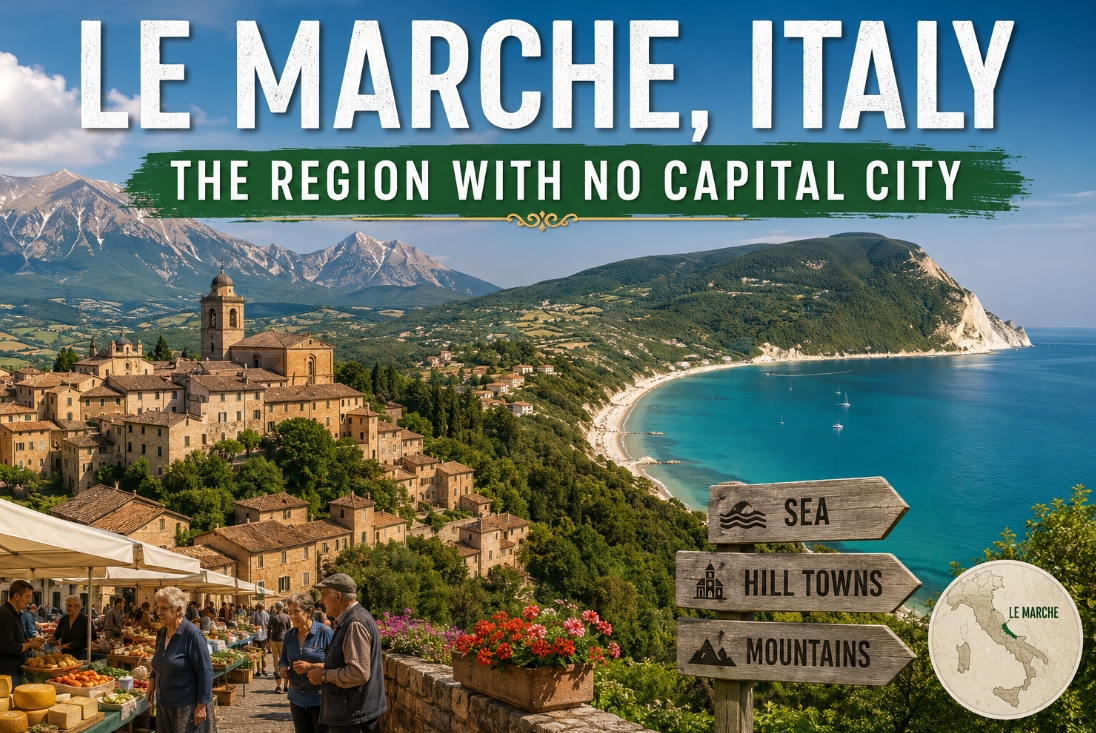
Le Marche, Italy: The Region With No Capital City
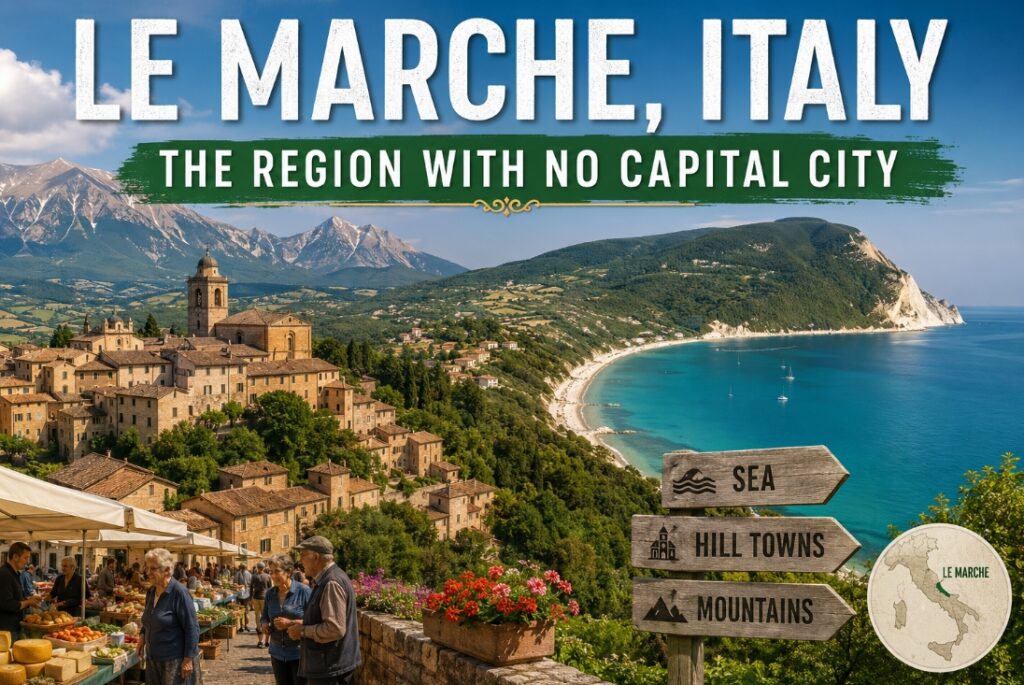
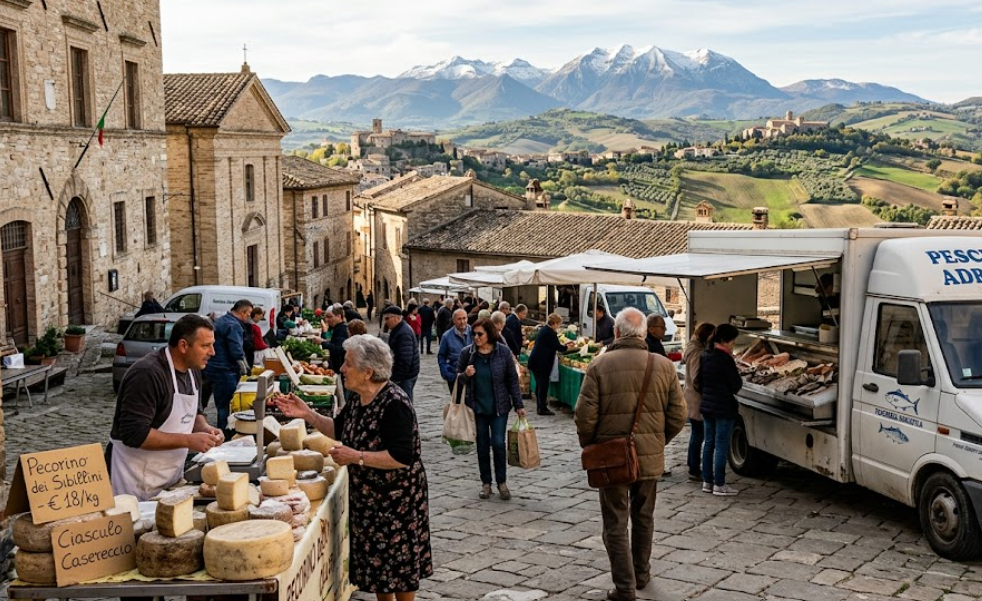
On a Tuesday morning in Sarnano, tucked into the hills of Le Marche, Italy, the weekly market fills a piazza that was already old when Columbus sailed. Cheese vendors trade gossip with grandmothers, a fishmonger’s van idles two hours in from the Adriatic, and nobody lifts a phone to photograph the scene. I have been coming to markets like this one for thirty years, first as a boy trailing behind my own grandmother, later as an engineer called out to inspect the very town halls that ring these same squares. Le Marche is the only Italian region that has never agreed on a single city to represent it, and once you understand why, you understand almost everything else worth knowing about this place: why the food changes every twenty kilometers, why the coastline empties out while the hill towns fill, and why an American traveler can spend a week here and meet almost no other Americans at all.
What Is Le Marche, Exactly?
Le Marche is a region of central Italy on the Adriatic coast, bordered by Emilia-Romagna to the north, Tuscany and Umbria to the west, and Abruzzo to the south. Unlike Tuscany, which is culturally organized around Florence, or Umbria, organized around Perugia and Assisi, Le Marche has no dominant city; Ancona holds the administrative title of regional capital, but the region is really a federation of five provinces and roughly two hundred hill towns, none of which ever grew large enough to define the whole. That absence of a single center is the reason Le Marche is worth visiting: it never developed the tourist infrastructure, the multilingual menus, or the crowd-control barriers that flatten so much of central Italy into a single postcard experience. What you find instead is a region still organized much as it has been for centuries, with roughly 180 kilometers of Adriatic coastline within an hour’s drive of mountains that rise above 2,400 meters, Renaissance art in towns most Americans cannot place on a map, and a food and wine culture that changes from one province to the next. It rewards travelers who have already done Tuscany and Umbria and want to see what those regions looked like before they became famous.
Three Landscapes, One Hour Apart
Most of central Italy asks you to choose between coast and countryside, beach and mountain. Le Marche refuses the choice, because its geography compresses three distinct landscapes into a strip of land rarely more than eighty kilometers wide.
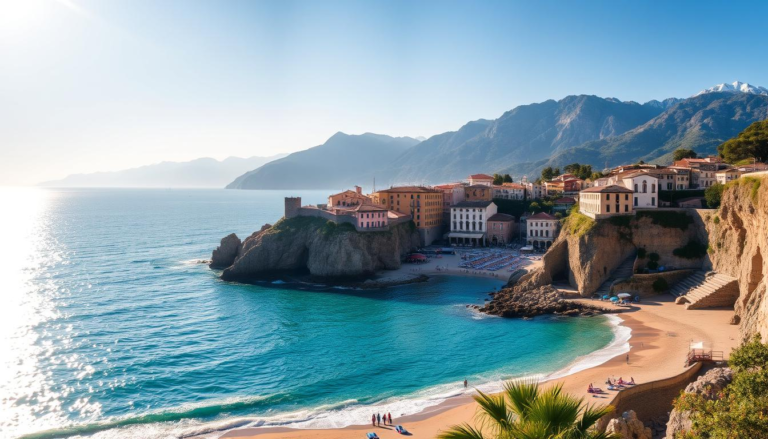
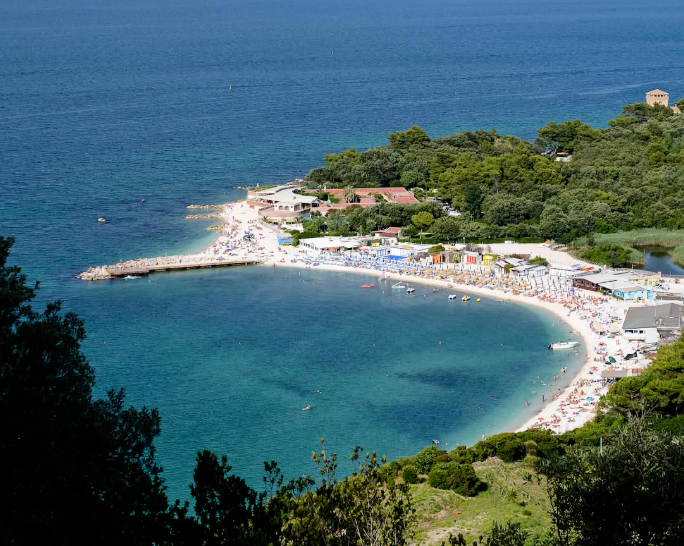
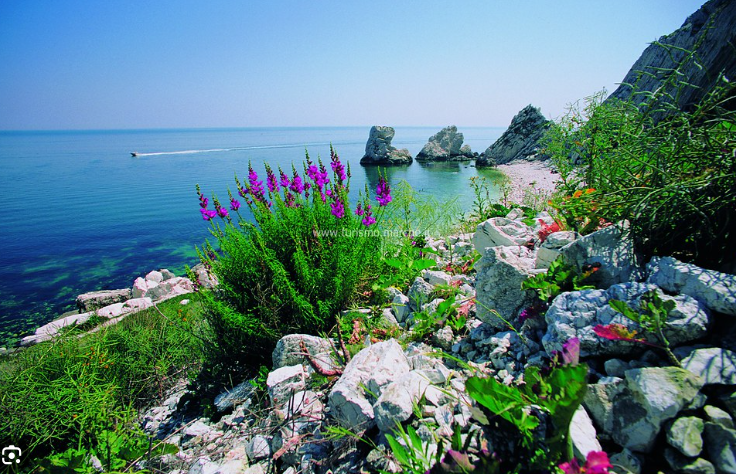
The coast is the flattest and most legible part of the region: a nearly unbroken run of beach towns from Gabicce Mare in the north to San Benedetto del Tronto in the south, interrupted by exactly one dramatic outcrop, Monte Conero, a limestone promontory south of Ancona where the shoreline suddenly turns to cliff and the water shifts to the deep green-blue that gives the Riviera del Conero its name. This is where Marchigiani themselves spend their summer weekends, and where most American visitors never think to look, since nobody has marketed it the way the Amalfi Coast has been marketed for six decades.
Climb inland fifteen or twenty minutes from almost any coastal town and the hills begin, terraced with vineyards and wheat, punctuated by walled towns built on high ground for reasons that had everything to do with defense and nothing to do with the view. This is the Le Marche of the postcard, the rolling hill country that shows up in a thousand photographs mislabeled as Tuscany, taken just across the regional border.
Keep going and, within roughly an hour of leaving the beach, the hills give way to the Apennines proper: the Monti Sibillini, a national park shared with neighboring Umbria, where the highest peak, Monte Vettore, rises above 2,400 meters and holds snow into May. I have driven this same road, coast to summit, in every season, and the one-hour scale is not a marketing line; it is the single geographic fact that explains the region’s entire personality. Few places in Italy pack beach, Renaissance hill town, and high mountain wilderness into a stretch of land a single rental car can cover before dinner.
Why You’ve Never Heard of It
The honest answer is structural, not accidental. Every other famous Italian region built its international reputation around one city: Tuscany has Florence, Umbria has Perugia and Assisi close together, Campania has Naples and the Amalfi Coast feeding each other’s fame. Le Marche never had that engine, because it never had that city. Ancona is the regional capital administratively, but it has spent most of its history as a working port rather than a court city, and it never produced the kind of concentrated art patronage that turned Florence, or Urbino itself, into a destination for the entire Western world.
That absence traces back to how the land was actually worked. For centuries, Le Marche’s agricultural economy ran on mezzadria, a sharecropping arrangement in which a landowning family and a farming family split both the labor and the harvest, which kept extended families living on scattered farmhouses across the hills rather than clustering into large towns. Where other regions consolidated population and wealth into a single capital, Le Marche stayed diffuse almost by design: dozens of small centers, each with its own church, its own piazza, its own dialect inflection, none large enough to eclipse the others.
That same diffusion carried straight into the twentieth century as small-scale industry replaced small-scale farming, family by family rather than factory by factory. The pattern shows up in the region’s distretti industriali, industrial districts built on exactly this same logic of dispersed, family-run production: Fermo’s shoe and leather workshops, the furniture makers of the Pesaro hinterland, and Castelfidardo, a small town near Ancona that has manufactured the majority of Italy’s accordions since the mid-1800s, an industry built by farming families who took up instrument-making as winter work between harvests. One historical cause, the family farm under mezzadria, explains both the landscape of scattered hill towns and the economy of scattered workshops. It is the same story told twice, once in stone and once in commerce.
The consequence for a visitor is direct: mass tourism never found a single door to walk through. There was no Florence to put on a poster, so tour operators built their Italian itineraries around the regions that did have one, and Le Marche stayed off the standard route for reasons of marketing logic rather than any lack of substance. What has been commercially inconvenient about this region is exactly what has kept it real.
Five Provinces, No Single Center
Pesaro e Urbino, in the north, pairs a Renaissance capital with a beach city: Urbino carries the region’s only UNESCO World Heritage listing, while Pesaro, birthplace of composer Gioachino Rossini, holds a separate UNESCO title as a Creative City of Music, a distinction worth keeping straight since the two are frequently conflated.
Ancona, the administrative capital and the most populous of the five provinces at roughly 460,000 residents, centers on the port city of the same name, which will serve as Italy’s Capital of Culture in 2028, a title the Ministry of Culture confirmed in March 2026.
Macerata, inland and the province hit hardest by the 2016 earthquake, holds the Sibillini high country and the open-air Sferisterio arena, where opera has been staged since 1921.
Fermo, the youngest of the five provinces, formally established in 2004, pairs a short stretch of coastline with an interior built on leather and footwear manufacturing.
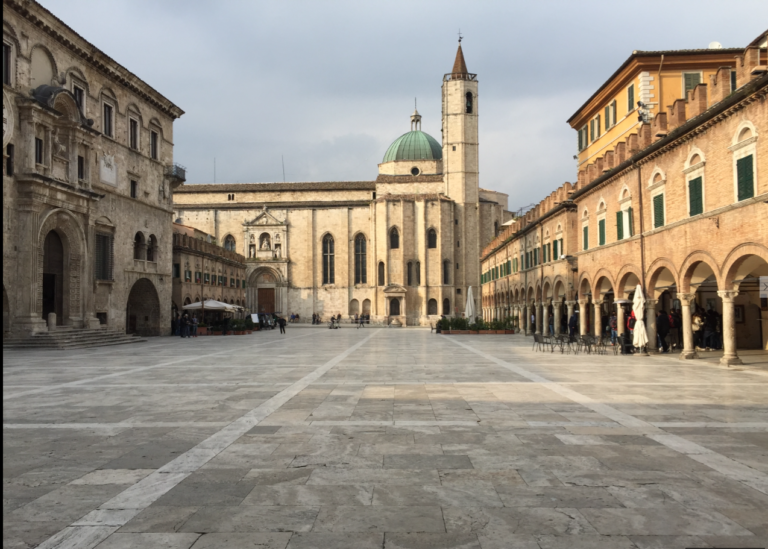
Ascoli Piceno, the southernmost province, centers on a city built almost entirely from travertine stone, its Piazza del Popolo widely considered among Italy’s most beautiful, still hosting the medieval jousting tournament known as the Quintana.
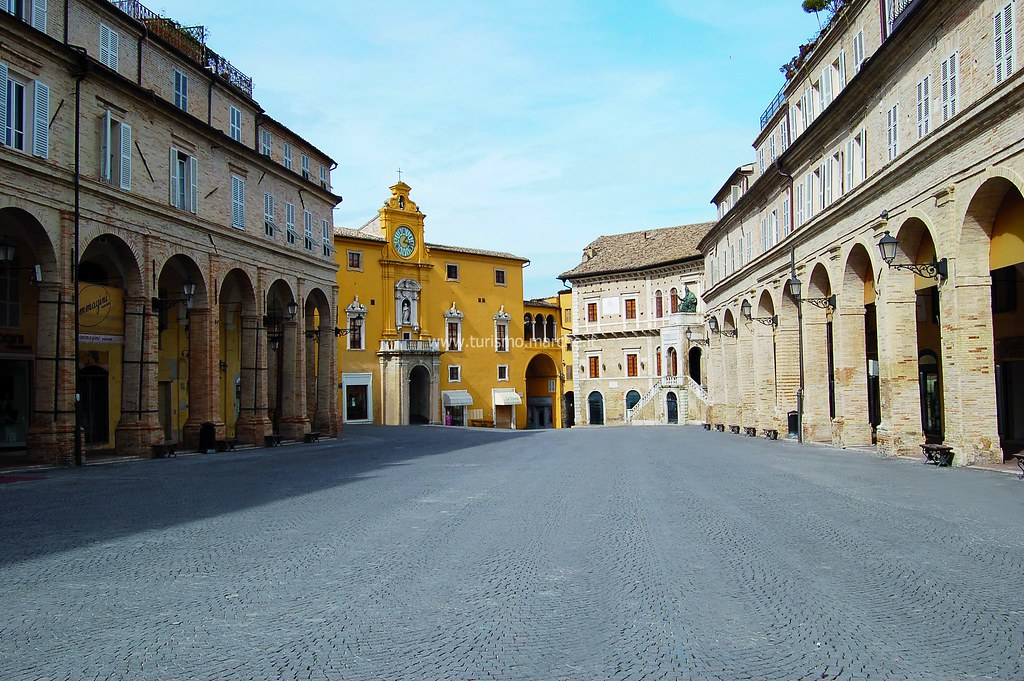
Together the five hold just under 1.5 million people, according to the latest ISTAT regional estimate, spread across 225 municipalities with no single city holding more than about 100,000 residents. That distribution is the whole argument of this guide, restated as a number.
What’s Actually Here — And Why It’s Barely a Paragraph Long
A Renaissance city most Americans have never named
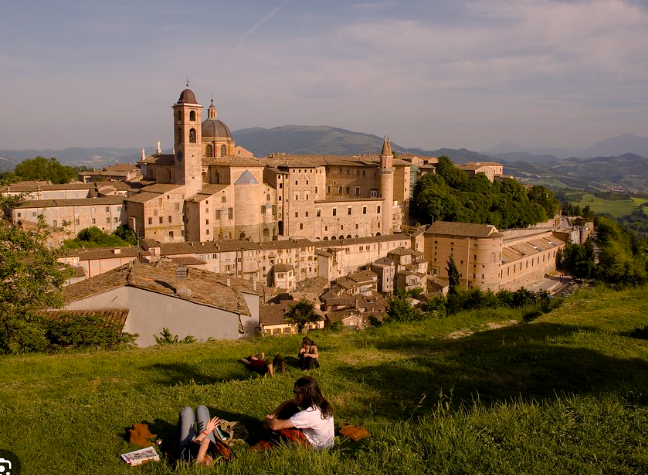
Urbino is where the compression of Le Marche shows most clearly: a hill town of roughly 15,000 people that produced Raphael, holds Piero della Francesca’s most enigmatic painting inside its Ducal Palace, and built a court that the writer Baldassarre Castiglione once called a city shaped like a palace. Its historic center earned Le Marche’s only UNESCO World Heritage listing in 1998, a fact worth stating precisely, because Pesaro and the paper-making town of Fabriano hold a different UNESCO title, Creative Cities for music and craft respectively, that American researchers frequently mistake for World Heritage status. Only Urbino carries that specific designation. The full case for a day here lives in the dedicated Urbino guide.
Underground, then up in the air
Two natural sites anchor the interior. The Frasassi Caves, near Genga in Ancona province, form one of Europe’s largest cave systems, mapped by speleologists only in 1971 after staying essentially unknown for centuries. An hour further inland, the Monti Sibillini National Park delivers genuine high-mountain hiking and wildflower meadows in June, inside a park most American hikers have never had reason to research. Along the coast, Monte Conero adds a third register entirely: cliffs, pine forest, and beach coves reachable only on foot or by boat.
What’s on the table
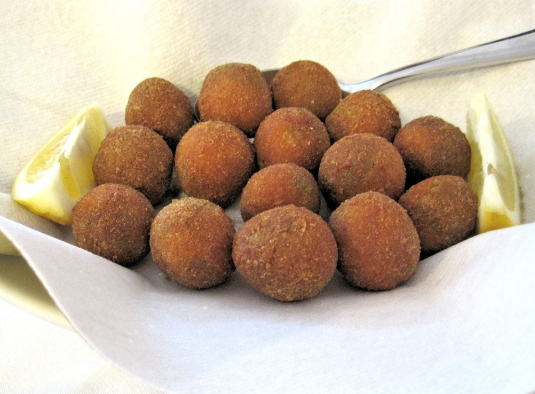
Marchigiano food resists a single signature dish precisely because the region resists a single identity. Vincisgrassi, a baked pasta dish that, according to some regional food historians, predates lasagna by centuries, anchors inland Sunday tables; I’m still finishing the dedicated piece on it. Along the coast, brodetto, a fish stew, changes recipe by province and sometimes by town. Inland from Urbino, the hill town of Acqualagna competes directly with Alba, Piedmont for the title of Italy’s serious truffle country. Near Ascoli Piceno, a stuffed and fried olive called oliva all’ascolana has quietly become one of Italy’s most exported bar snacks without most Americans ever learning where it came from; that story, too, is still on my list.
Wine that beats its French rivals on paper
Verdicchio, the region’s signature white grape, produces wines from the Castelli di Jesi and Matelica zones that regularly outperform far more expensive Sancerre in blind tastings. Sagrantino belongs to neighboring Umbria, not here, a distinction worth making since the two get confused; Le Marche’s reds lean instead on Lacrima di Morro d’Alba and Rosso Piceno, both still rare on American wine lists.
Opera under an open sky
Two opera traditions run in parallel and rarely get confused by anyone who has attended both. The Rossini Opera Festival in Pesaro, dedicated to the region’s most famous composer, draws a specialist international audience each summer. Inland, Macerata’s Sferisterio, an open-air arena built between 1820 and 1829 for a now-forgotten ball game, staged its first opera in 1921 and has run a continuous summer festival since 1967, making it one of Italy’s most atmospheric venues for outdoor performance. I haven’t written its full story yet, but I intend to.
The Earthquake, Honestly
Any accurate account of Le Marche has to include August and October 2016, when a sequence of earthquakes centered in the central Apennines killed close to 300 people across four regions and damaged or destroyed tens of thousands of buildings, concentrated most heavily in Macerata, Le Marche’s own hardest-hit province. I have spent thirty years assessing structural damage in exactly this part of Italy, and I will not pretend the reconstruction is finished, because it is not.
According to the government’s own 2026 reconstruction report, Le Marche alone has approved more than 8.7 billion euros in private reconstruction funding, with over 5.7 billion euros already disbursed, and roughly 5,500 construction sites still active alongside another 8,600 already closed. Macerata province still has the largest number of families in temporary housing of anywhere in the earthquake zone, though that number has been falling year over year. Some hill towns near the epicenter remain visibly under scaffolding a decade on; others have finished and reopened to the point that a visitor with no prior knowledge would notice nothing at all.
The honest advice for a visitor is simple: the great majority of Le Marche, including every town named in this guide, sits outside the areas still under active reconstruction, and normal tourism has continued throughout, in most towns without interruption. A smaller number of interior villages closer to the epicenter are still mid-repair, and a traveler drawn specifically to one of those should check current access before planning a visit rather than assume either total closure or total normalcy. Saying this plainly is more credible than pretending it never happened, and it is also, frankly, the point where an engineer’s perspective on this region earns its place in a travel guide rather than just decorating one.
Planning Your Visit
Getting there. Ancona’s Falconara airport (AOI) handles roughly half a million passengers a year and, as of mid-2026, offers direct flights to hubs including London Stansted, Madrid, Brussels, Munich, Paris, and Barcelona, alongside daily domestic service to Rome and Milan; seasonal routes shift year to year, so check current listings rather than relying on any fixed list. By rail, fast trains connect Ancona to Bologna in under two hours, and to Rome in roughly three and a half to four hours depending on the specific service; the difference between the fastest connection and a slower one with a change can run over an hour, so it pays to compare specific departure times rather than assume a single travel time.
Driving in. Most visitors coming from Rome arrive by car rather than rail, and the numbers explain why: the drive to Ancona along the A24 and A14 autostrada runs a little over three hours door to door, comparable to the train once you count getting to and from the stations at either end, with the added advantage of a rental car already in hand for the hill towns once you arrive. The stretch through the Apennines between Rome and the coast is genuinely scenic, though winter snow occasionally slows the mountain sections, so it is worth checking conditions before a cold-weather trip.
When to go. May, June, and September deliver the best balance: warm enough for the coast, cool enough for hiking the Sibillini, and clear of the heaviest domestic crowds that fill the beach towns from mid-July through August. Winter access to the high mountains requires real alpine experience and equipment; this is not casual off-season hiking territory.
Where to base yourself. There is no single obvious base, which is itself consistent with everything above. Travelers prioritizing art and architecture should anchor in or near Urbino; those wanting beach access with easy day trips inland should look at the Conero coast south of Ancona; hikers should base closer to Sarnano or the Sibillini foothills. Most visitors end up splitting a week between two bases rather than committing to one.
How long you need. A minimum of four full days covers one coastal stop, Urbino, and one interior hill town without rushing; a week allows the Sibillini and a second hill town cluster such as San Ginesio or Sarnano; ten days to two weeks lets you add Frasassi, Ascoli Piceno, and a slower pace throughout.
Do you need a car? Yes, without qualification. Regional trains connect the coastal towns adequately, but the hill towns and mountains that make Le Marche worth visiting sit almost entirely outside useful public transit. Renting a car at Ancona’s airport or at the Ancona or Bologna train station is the only realistic way to see the region described in this guide.
If you’re considering property, not just a visit. A growing number of foreign buyers are looking at Le Marche precisely because of everything above: real towns, real prices, and none of the premium that Tuscany now commands. If that’s part of why you’re reading this, I run an independent property survey service for exactly this situation, separate from any real estate agency, alongside a broader guide to buying a house in Italy, a region-specific look at the 7% flat tax available in the earthquake crater zone, a breakdown of what a farmhouse renovation actually costs here, and a closer look at Sarnano, one of the hill towns where this quiet buying trend is most visible.
FAQ — Planning Your Le Marche Visit
What is Le Marche, and why does it matter for an Italy trip?
Le Marche is a central Italian region on the Adriatic coast, distinct from Tuscany and Umbria, organized around five provinces rather than one dominant city. It matters for travelers because it offers Renaissance art, mountain hiking, and beach coastline within the same short drive, largely without the crowds that now define its more famous neighbors.
When is the best time to visit Le Marche?
May, June, and September offer the best combination of warm coastal weather and comfortable hiking conditions in the Sibillini mountains, while avoiding the peak domestic crowds of July and August.
Do you need to book accommodation far in advance?
Coastal accommodation in July and August should be booked months ahead, since Italian domestic tourists fill the region during those weeks. Outside high summer, hill town accommodation can often be booked with just a few weeks’ notice.
How does the cost of a Le Marche trip compare to Tuscany?
Costs run noticeably lower than Tuscany or the Amalfi Coast for comparable quality, since the region has not been priced for international tourism the way its neighbors have. A detailed breakdown for property and long stays specifically is covered in the region’s dedicated cost guides linked above.
How many days do you need to see Le Marche properly?
A minimum of four days covers one coastal stop, Urbino, and one hill town; a full week to ten days allows the Sibillini mountains and a second hill town cluster without rushing.
What should first-time visitors pair Le Marche with?
Many travelers combine Le Marche with Umbria or the Tuscan border towns, since both share a land border with the region; a direct comparison between the two for travelers deciding where to go is covered in the Tuscany versus Le Marche guide.
What’s the one thing about Le Marche that surprises visitors most?
That there is no single place to point a first-time visitor toward. Every other central Italian region has an obvious first stop; Le Marche’s defining feature, the absence of one dominant city, means the region rewards travelers willing to build their own itinerary rather than follow someone else’s.
The Final Word
I have spent thirty years driving these roads for work rather than for a travel blog, inspecting town halls and churches in towns most of my own countrymen from other regions could not locate on a map. What I can tell you, after that much time, is that Le Marche’s lack of a capital is not a gap waiting to be filled. It is the reason the market in Sarnano still runs the way it did when I was a boy, the reason a fifteenth-century piazza in Ascoli Piceno still functions as a piazza rather than a stage set, and the reason this region rewards exactly the kind of curious, patient traveler this blog is written for. Start with one province. You will be back for the other four.
—